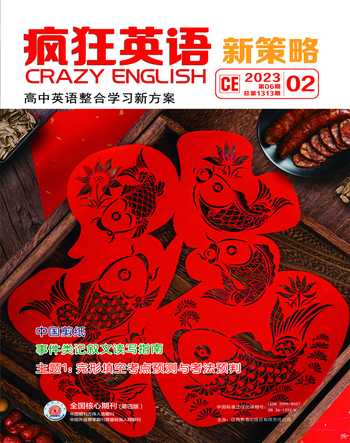
Chinese paper?cutting 中國剪紙
2023-07-14 06:32:35莫炎芬
瘋狂英語·新策略
2023年2期
莫炎芬


Chinese paper?cutting is one of the oldest handicrafts in China, and its a hollow?outart. The content varies from animals and plants to vivid daily life scenes. Some of themeven are created into a series to tell you an interesting Chinese legend. Some are cut intomany creatures in the world on one sheet with great imagination.
According to the unearthed relics, paper?cutting appeared during the NorthernDynasties (386 AD to 581 AD). Hence, it has ahistory of more than 1,500 years.
Today, the art has developed into art formsthat can partly represent traditional Chinese folkculture. Combining many folk art forms such aspainting and cutting, Chinese paper?cutting canserve as a window to understand traditional Chi?nese folk art.
The theme of paper?cutting always relates tonature worship and reflects peoples life and work. The biggest similarity is that people willenlarge the topic they cut, so everything is bigger than the real size—the bigger fish, thebigger pepper, the bigger grain and so on. Chinese people put their hope to the paper?cutting to praise peoples creation of nature and encourage people to keep going. Most ofthe paper?cutting is in red, which is the lucky color in China.
Paper?cutting falls into many categories according to their sticking places and func?tions. There are different kinds of paper?cutting for windows, doors, walls, and those forroofs and lights as well as for marriages and different festivals. Many of them are usedduring the New Year and marriages to add up the happy and auspicious atmosphere.
Chinese people, especially people in northern China, like to use paper?cutting as adecoration when the Spring Festival is coming. To some extent, not only is Chinese paper?cutting a decoration, but also an emotion.
Activity A Reading for understanding
Ⅰ. Text?centered chunks
vary from...to 從……到……各不相同
a series(of)一系列……
traditional Chinese folk culture 中國傳統民俗文化
serve as 擔任……;充當……
relate to 涉及;有關
and so on 等等;諸如此類
fall into many categories 分成許多種類
add up the happy and auspicious atmosphere 增添了喜慶、吉祥的氣氛
to some extent 在某種程度上
Ⅱ. Text?centered sentences
1.現在分詞作狀語
Combining many folk art forms such as painting and cutting, Chinese paper?cuttingcan serve as a window to understand traditional Chinese folk art.中國剪紙融合了繪畫和剪裁等多種民間藝術形式,充當著了解中國傳統民間藝術的窗口。
【點石成金】本句中的Combining many folk art forms such as painting and cutting在句中充當原因狀語,解釋了剪紙能充當了解中國傳統民間藝術的窗口的原因。現在分詞作狀語可以表達時間、原因、伴隨、結果、讓步等邏輯關系。
【運用遷移】和這個女孩一起生活了五年,我們都很了解她。
2. not only引導的倒裝句
To some extent, not only is Chinese paper?cutting a decoration, but also an emotion.在某種程度上,中國剪紙不僅是一種裝飾品,還代表了某種情感。
【點石成金】本句是一個not only引導的倒裝句,起強調作用。在這種情況里只有第一個分句要部分倒裝,第二個分句不需要倒裝。但是,當not only...but also...連接兩個并列的主語時,則不倒裝,如“Not only the teachers but also the students love theirschool very much.”。
【運用遷移】對這件事不僅教授們有自己的看法,學生們也有自己的想法。
Activity B Reading for writing
假定你是學生會主席李華,你想邀請學校新來的外國交換生Henry一起參觀中國剪紙藝術展。請你給他寫一封郵件,內容包括:
1. 介紹中國剪紙;
2. 展覽的相關信息。
注意:
1. 詞數80左右;
2. 可以適當增加細節(jié),以使行文連貫;
3. 至少需要使用一個本文中解析過的句式;
4. 注意段落內的邏輯關系。
寫作導引
本次的寫作任務是寫一封邀請信,要求學生以學生會主席的名義,邀請學校新來的交換生參觀中國剪紙藝術展,并且需要使用現在分詞作狀語或not only引導的倒裝句。這些寫作要求和所給語篇的主題語境、語言內容是緊密相關的。
登錄APP查看全文