人工智能技術驅動的紡紗質量預測研究進展
2023-07-04 11:31:38趙薇玲章軍輝陳明亮李慶陳大鵬
絲綢 2023年4期
趙薇玲 章軍輝 陳明亮 李慶 陳大鵬
摘要: 本文探討了人工智能技術在紡紗質量預測領域的應用、創新與不足,介紹了Hadoop技術為紡紗質量預測建模提供可靠高效的數據處理與運算平臺,重點闡述了智能建模方法在紡紗質量預測領域的研究進展。通過分析得出基于數據與知識融合驅動的人工智能技術,構建出多工序關聯的混合智能模型,用以準確描述紗線質量與纖維特性、工藝參數、環境參數等之間的非線性映射關系,可為試紡、過程參數設計、態勢預測等環節提供指導,具有重要的理論研究意義。
關鍵詞: 紡紗質量預測;人工智能;Hadoop技術;混合智能模型;目標優化;發展趨勢
中圖分類號: TS104.7
文獻標志碼: A
文章編號: 1001-7003(2023)04-0061-10
引用頁碼:
041109
DOI: 10.3969/j.issn.1001-7003.2023.04.009(篇序)
紡紗是紡織產業鏈中的首道工序,根據紡織技術的不同,可以分為環錠紡、轉杯紡、噴氣紡及其他新型紡紗,不管什么類型的紗線都會受原料質量、工藝參數等因素的影響,進而影響到織造、印染等后道工序的品質。科學合理的紡紗質量預測不僅能夠減少原料浪費、提升紗線質量,還可以協調成本與質量的相互關系。高效準確的底層數據支撐、合理的特征因素及有效的預測模型都決定了紡紗質量預測的有效性,甚至關系到試紡、工藝優化等任務的進一步開展[1]。毛羽、強度、條干不勻率、斷裂伸長率等紗線質量指標是紡紗工序中的重要預測目標。決定成紗質量的兩個關鍵因素是原料性能和紡紗工藝相關參數,因此預測模型的輸入特征通常是纖維長度、纖維強度、馬克隆值、斷裂伸長率、長度不勻率等棉纖維屬性,纖維長度、纖維線密度、短毛率、離散系數等毛纖維屬性及其他纖維屬性,捻度、混紡比等紡紗參數,錠子、羅拉等環錠紡設備參數,轉杯類型、轉杯直徑等轉杯紡設備參數,以及其他機器部件的速度、某些設備之間的距離等[2]。人工智能方法和統計方法是建立紡紗質量預測模型的兩種主要方法,人工智能方法的預測比統計方法更加準確,因此研究人員在人工智能方法應用于紡紗制造過程建模研究中取得了許多研究成果[3]。
人工智能技術在紡紗行業有多種應用,尤其是檢測和預測紗線的質量參數方面。通過適當模擬不同紗線類型的生產過程,智能建模可以改善紗線性能評估和整體質量控制[4]。探討人工智能技術在紡紗質量預測領域中的應用,在理論上可以深化對紗線工藝制造的認識,在實際應用中對于發展新的預測模型及優化方向也具有重要指導意義[5]。
本文介紹了Hadoop技術在整個紡紗質量預測建模流程中,作為數據處理與運算平臺的優勢,重點闡述了人工智能技術在紡紗質量預測領域的研究現狀,最后對紡紗質量預測研究的共性問題及發展趨勢進行了總結與展望。
1 紡紗工業大數據處理
1.1 數據獲取
針對紡紗車間設備互聯困難、不同系統間“信息孤島”等問題,一直以來沒有廣泛認可的一體化解決方案,隨著網絡技術和新興技術的發展,多種網絡連接技術和通信技術為設備間的互聯及數據交互的低時延、高可靠性提供了基礎設施保障和技術支撐。現有的典型技術有現場總線、工業以太網、工業無線、5G等;新興技術有邊緣計算、軟件定義網絡(SDN)、時間敏感網絡(TSN)等[6]。現場總線結合
工業以太網完成紡紗設備物理層和鏈路層的數據傳輸,利用PLC、RFID、智能化設備接口和人工輔助等多種數據采集方式,通過PLC擴展模塊、網關、總線橋、工業交換機和以太網模塊等設備完成現場總線組網,總線網絡向上集成工業以太網,以TCP/IP作為公共協議,采用“多對一”方式實現多協議的集成,是未來紡紗工業互聯互通的主要實施路徑[7]。
1.2 數據預處理
1.2.1 數據集成
由于紡紗生產制造工序較長,生產數據種類繁多,分布分散,數據量大,超越了傳統的存儲方式和數據庫管理工具的功能范圍,從而導致企業面臨數據存儲能力不足、數據處理繁瑣復雜等困境。隨著大數據技術的成熟和發展,依托大數據存儲與處理技術可以實現海量紡織數據的可靠存儲和高效運算。Hadoop已經成為大數據技術領域中成熟的代表,它具有分布式存儲和計算的優勢,是一個彈性可擴展式的開源軟件框架,用戶根據應用需求在其基礎上構建模塊,共同組成Hadoop生態系統。Hadoop包含Hadoop分布式文件系統和MapReduce計算引擎兩個主要組件,其他常用組件有Hbase分布式數據庫、Hive數據倉庫工具等[8]。
先進的紡紗企業或相關研究機構已經開始應用Hadoop技術構建自己的紡紗大數據平臺,依托大數據架構實現紡織制造執行系統的改造升級[9]。邵景峰等[10]基于Hadoop技術構建集成管理平臺,融合集成全流程紡紗生產數據,利用智能建模技術挖掘影響紡紗質量的關鍵因素,分析車間運行的潛在規律,為在線質量檢測提供技術支撐。
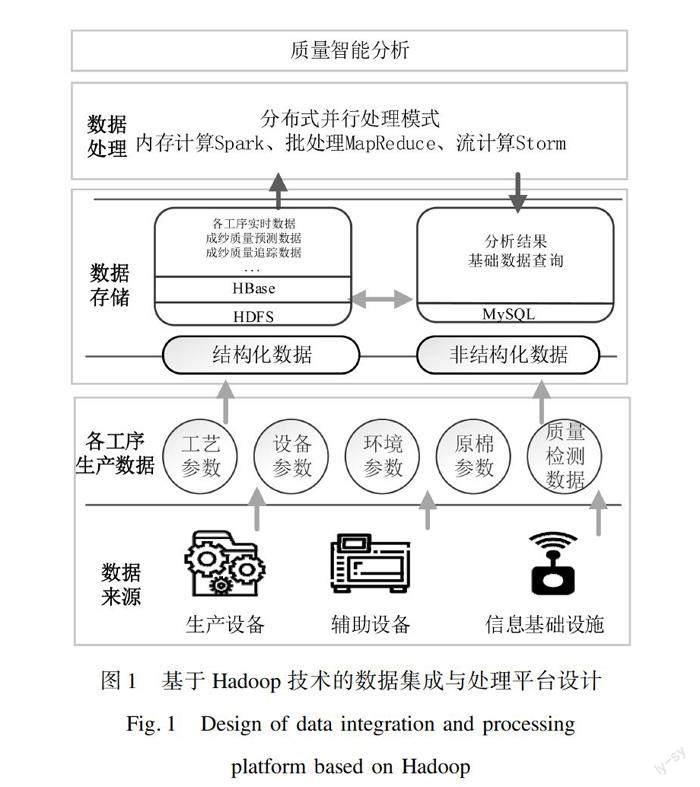
傳統數據庫對于大規模數據存儲有限、處理緩慢,在一些開展數字化轉型的紡紗企業所構建的制造執行架構模型中,以分布式數據庫作為底層服務,集中管理、傳遞和存儲數據[11]。馮立增等[12]提出HBase與MySQL雙數據庫存儲方式來改進現有紡織信息系統的傳統數據存儲方式,其數據集成與處理平臺設計如圖1所示。先將采集到的各工序生產數據存入HBase中,便于系統快速更新,基于并行計算模式經過質量智能分析后,再將數據存入MySQL數據庫中進行基礎操作。HBase能夠對與紗線質量相關聯的各工序參數快速掃描并獲取相關數據,為質量預測等數據分析操作提供高效、準確的數據支持,支撐頂層的多維分析與生產應用。
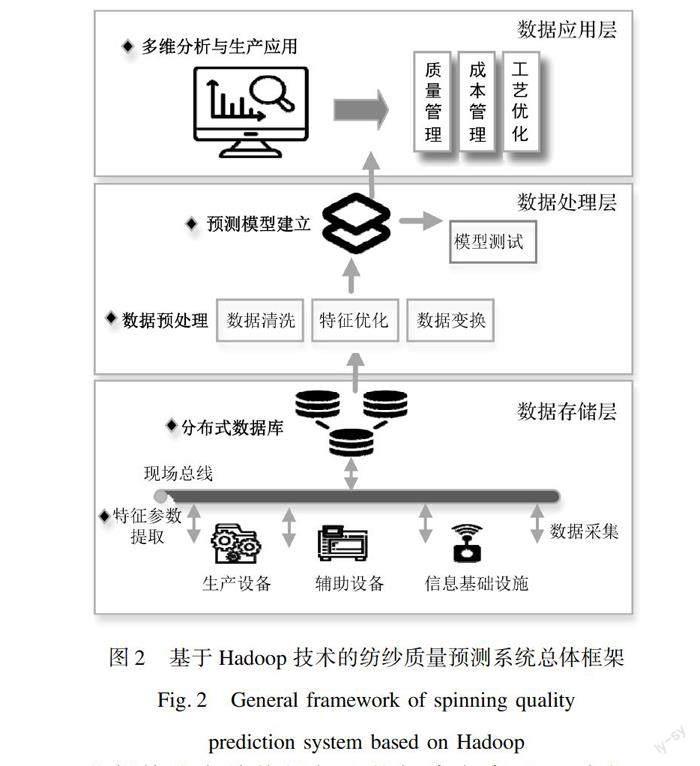
圖2是基于Hadoop大數據平臺的紡紗質量預測系統總體框架,整體框架一般為三層:數據存儲層、數據處理層和數據應用層。數據存儲層主要是存儲紡紗生產環境中產生的數據,將全流程數據進行融合,過濾處理后進行分布式存儲;數據處理層經過數據預處理后利用先進的智能方法建立紡紗質量預測模型,進行快速分析;數據應用層是根據預測結果為企業生產提供決策支持。
根據前述有關紡織行業的解決方案可以看出,基于Hadoop技術的大數據驅動框架,建立紡紗質量預測模型的數據處理與分析平臺具有重要意義。以大數據平臺為載體,依賴于并行計算方式,同時構建適應于海量數據的紡紗質量預測算法與模型,挖掘出紡紗數據之間潛在的關系和價值,從而根據結果進行紡織行業的預測與研判[13-16]。
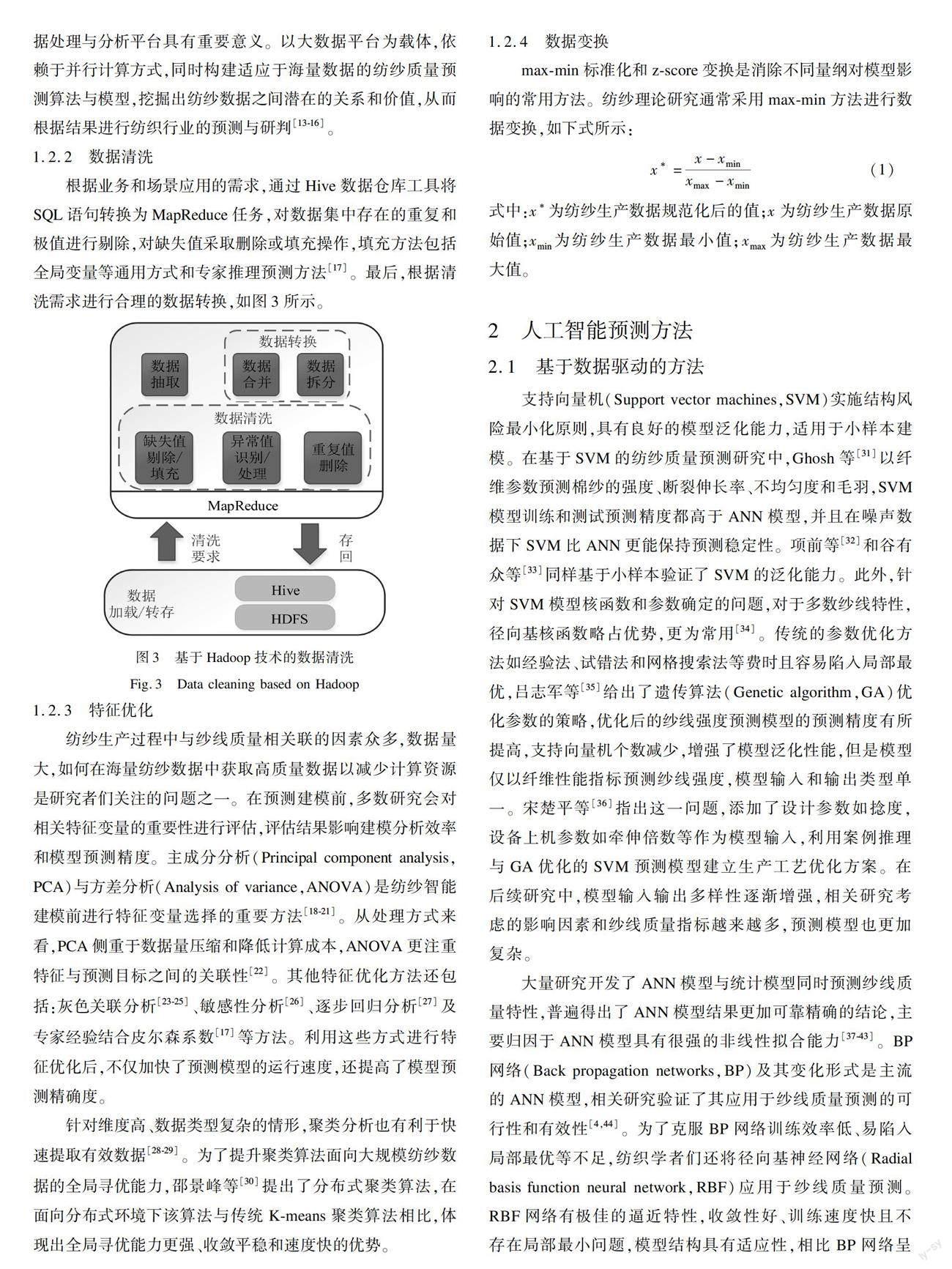
1.2.2 數據清洗
根據業務和場景應用的需求,通過Hive數據倉庫工具將SQL語句轉換為MapReduce任務,對數據集中存在的重復和極值進行剔除,對缺失值采取刪除或填充操作,填充方法包括全局變量等通用方式和專家推理預測方法[17]。最后,根據清洗需求進行合理的數據轉換,如圖3所示。
1.2.3 特征優化
紡紗生產過程中與紗線質量相關聯的因素眾多,數據量大,如何在海量紡紗數據中獲取高質量數據以減少計算資源是研究者們關注的問題之一。在預測建模前,多數研究會對相關特征變量的重要性進行評估,評估結果影響建模分析效率和模型預測精度。主成分分析(Principal component analysis,PCA)與方差分析(Analysis of variance,ANOVA)是紡紗智能建模前進行特征變量選擇的重要方法[18-21]。從處理方式來看,PCA側重于數據量壓縮和降低計算成本,ANOVA更注重特征與預測目標之間的關聯性[22]。其他特征優化方法還包括:灰色關聯分析[23-25]、敏感性分析[26]、逐步回歸分析[27]及專家經驗結合皮爾森系數[17]等方法。利用這些方式進行特征優化后,不僅加快了預測模型的運行速度,還提高了模型預測精確度。
針對維度高、數據類型復雜的情形,聚類分析也有利于快速提取有效數據[28-29]。為了提升聚類算法面向大規模紡紗數據的全局尋優能力,邵景峰等[30]提出了分布式聚類算法,在面向分布式環境下該算法與傳統K-means聚類算法相比,體現出全局尋優能力更強、收斂平穩和速度快的優勢。
1.2.4 數據變換
max-min標準化和z-score變換是消除不同量綱對模型影響的常用方法。紡紗理論研究通常采用max-min方法進行數據變換,如下式所示:
x*=x-xminxmax-xmin(1)
式中:x*為紡紗生產數據規范化后的值;x為紡紗生產數據原始值;xmin為紡紗生產數據最小值;xmax為紡紗生產數據最大值。
2 人工智能預測方法
2.1 基于數據驅動的方法
支持向量機(Support vector machines,SVM)實施結構風險最小化原則,具有良好的模型泛化能力,適用于小樣本建模。在基于SVM的紡紗質量預測研究中,Ghosh等[31]以纖維參數預測棉紗的強度、斷裂伸長率、不均勻度和毛羽,SVM模型訓練和測試預測精度都高于ANN模型,并且在噪聲數據下SVM比ANN更能保持預測穩定性。項前等[32]和谷有眾等[33]同樣基于小樣本驗證了SVM的泛化能力。此外,針對SVM模型核函數和參數確定的問題,對于多數紗線特性,徑向基核函數略占優勢,更為常用[34]。傳統的參數優化方法如經驗法、試錯法和網格搜索法等費時且容易陷入局部最優,呂志軍等[35]給出了遺傳算法(Genetic algorithm,GA)優化參數的策略,優化后的紗線強度預測模型的預測精度有所提高,支持向量機個數減少,增強了模型泛化性能,但是模型僅以纖維性能指標預測紗線強度,模型輸入和輸出類型單一。宋楚平等[36]指出這一問題,添加了設計參數如捻度,設備上機參數如牽伸倍數等作為模型輸入,利用案例推理與GA優化的SVM預測模型建立生產工藝優化方案。在后續研究中,模型輸入輸出多樣性逐漸增強,相關研究考慮的影響因素和紗線質量指標越來越多,預測模型也更加復雜。
大量研究開發了ANN模型與統計模型同時預測紗線質量特性,普遍得出了ANN模型結果更加可靠精確的結論,主要歸因于ANN模型具有很強的非線性擬合能力[37-43]。BP網絡(Back propagation networks,BP)及其變化形式是主流的ANN模型,相關研究驗證了其應用于紗線質量預測的可行性和有效性[4,44]。為了克服BP網絡訓練效率低、易陷入局部最優等不足,紡織學者們還將徑向基神經網絡(Radial basis function neural network,RBF)應用于紗線質量預測。RBF網絡有極佳的逼近特性,收斂性好、訓練速度快且不存在局部最小問題,模型結構具有適應性,相比BP網絡呈
現出較好的預測精確度和收斂能力[45-46]。然而李翔等[47]在精紡毛紗的條干不勻率和斷裂強度預測研究中曾指出,在精度要求相同前提下,BP網絡對于異常樣本的容錯能力更強。
ANN模型結構或重要參數的優化也在相關文獻中被廣泛討論。例如,比較各類訓練算法如LM算法[22,48-50]、貝葉斯正則化算法[51]等對于模型預測結果的影響,通過試錯法或經驗法判斷最佳隱層數量和隱層神經元個數[52-53]。Ghorbani等[54]研究了不同隱層數量、隱層神經元個數、訓練算法和激活函數下的ANN模型,隱層數量和神經元個數以預測精度為評判標準,后幾項主要看訓練速度和消耗內存。結果表明,具有兩個隱層,每個隱層有8個神經元,使用LM算法的網絡預測紗線毛羽最準確。
與SVM模型類似,ANN模型結合群智算法能夠實現模型參數調優,使得模型更加快速準確地收斂,如基于遺傳算法優化的BP網絡可以提高紗線質量預測模型的預測精度和穩定性,其性能優于單一BP網絡[55]。在GA算法優化ANN模型的研究中,研究人員還對GA算法的編碼方式、適應度函數的設計、遺傳算子機理等方面進行改進,如思維進化算法(Mind evolutionary algorithm,MEA)[56]、免疫遺傳算法(Immune genetic algorithm,IGA)[57-58]與遺傳模擬退火算法(Genetic simulation annealing algorithm,GSAA)[59]等。這些研究主要解決GA迭代冗余、后期無法成熟收斂的問題,也驗證了基于混合優化算法的紗線質量預測模型比基于GA的模型預測精度和泛化性能更好。
除了模型參數的搜索尋優,群體智能算法還被用于反演紗線原料性能等參數,即通過重要質量特性等目標建立反演模型,推導出最佳纖維、工藝等參數組合[60]。由于紗線質量指標多且可能相互沖突,需要轉化為多目標優化問題獲取最優解集。Barzoki等[61-62]建立了兩個有關紗線強度和纖維質量的優化目標,旨在利用非支配排序遺傳算法(Non-dominated sorting genetic algorithm Ⅱ,NSGA-Ⅱ)制定紗線質量較好且成本較低的配棉方案。在此工作基礎上,Chakraborty等[63]采用包含NSGA-Ⅱ在內的四種群智算法對紗線質量特性進行多目標優化,粒子群算法的優化性能優于其他算法。這些研究注重優化目標的建立和優化算法的選取,獲得最優解集之后,涉及為企業提供指導的決策問題較少被提到。
相關研究嘗試了一些新型優化算法,如灰狼算法和帝王蝶算法等。Hadavandi等[64-65]將灰狼算法作為賽洛紡紗線強度預測模型的權值優化器,與其他三種基于傳統群智算法的模型相比具有更高的預測精度,并且根據類似研究得出帝王蝶算法同樣有效。目前新型優化算法在紡紗理論研究中應用相對較少,其適用性和通用性尚有待深入。
目前深度學習模型在紡紗質量相關研究中應用相對較少,其主要原因在于樣本數據規模、類型有限。胡臻龍等[66-67]基于卷積神經網絡(Convolutional neural networks,CNN)建立深度神經網絡預測模型,將纖維、設備和工藝參數等多個特征參數作為模型輸入,其預測誤差相比淺層ANN和MLR均控制在1%以內。在后續研究中,考慮到紡紗生產前紡工序對于紗線最終質量的影響,又基于長短期記憶網絡(Long short-term memory,LSTM)建立了考慮紡紗時序性的深度預測模型,如圖4所示,所考慮的時序性體現每個LSTM單元對應紡紗生產不同工序的設備參數,前紡工序與后紡之間存在的關聯及對最終紗線質量的影響。其結果表明,LSTM模型在動態工序數據集上的預測精度比不考慮時序性的人工智能模型高。
大量紡紗理論研究集中在多個特征參數與紗線質量之間的非線性逼近,沒有根據工業數據的動態時序性特點考慮有關質量的態勢預測問題。在同一批原料的前提下,紡紗加工過程產生的數據隨時間變化,如機器部件的速度等特征參數,而這些數據的實時性可能映射出更加準確的紗線質量,使得生產模擬更加真實。利用流行的時序分析方法,如LSTM、門控循環單元網絡(Gated recurrent unit,GRU)等建立多工序關聯的人工智能模型,學習工序之間、時序之間的相關性,預測未來的質量態勢,還可延伸至工藝優化、質量異常追蹤和在線質量檢測等領域。
目前的紡紗質量預測研究主要應用于試紡和工藝優化兩方面。在基于數據驅動的智能建模技術體系中,結合群體智
能算法建立的混合智能模型比單一模型具有更大的靈活性,是目前提高預測性能的普遍做法[27]。
2.2 基于知識驅動的方法
模糊方法建立在模糊規則之上,模糊推理通過制定模糊邏輯將給定輸入映射為輸出,相對于人工神經網絡來說適用于不精確、模糊的或不完備的數據建模,不需要大量示例數據來訓練模型。最常用的兩種模糊推理算法為Mamdani型和Sugeno型[68]。
研究人員將模糊方法應用到紡紗質量預測領域,通過模糊規則提取和模糊系統結構優化等方面,主要解決如何提高模型精度、保持算法效率,同時兼顧完備性和魯棒性及提高可解釋性等問題。
在針對模糊規則優化和模糊系統結構參數優化方面,主要通過群智算法和神經網絡這兩種優化技術以混合方式實現。如遺傳算法可以從數值數據中自動生成模糊規則[27],還可以進行隸屬函數參數調優[69],提高模糊系統預測精度。神經網絡結合模糊系統同時具有易于表達和自適應學習的能力,其中自適應模糊神經推理系統(Adaptive neuro fuzzy inference system,ANFIS)在與SVM、ANN的對比中體現出了學習能力強和預測精度高的優點[70-72]。
前述解決問題的總體思想是利用數據驅動方式強大的尋優能力實現知識驅動方法中結構或參數的優化,即數據調優的知識驅動方法,旨在減少依靠專家制定的知識規則。知識驅動方法與數據驅動方法的協同驅動可以體現為數據調優的知識驅動,知識增強的數據驅動及并聯或串聯的互補結合[73]。在紡紗質量預測研究中,神經模糊系統是知識與數據的互補并聯結合。除此之外,Ghanmi等[74-75]利用了一種級聯模式下的神經模糊混合模型來預測全局質量指標,根據烏斯特統計數據建立幾種紗線特性與整體質量指數的規則,將ANN預測的多種紗線質量特性作為第二階段模糊專家系統的輸入,預測輸出綜合質量指標。這個兩階段預測方法也體現了知識與數據的串聯互補結合思想。
研究人員利用各種數據驅動方式致力于降低專家經驗的依賴性,但并不能完全由數據策略代替現有規則。知識驅動方法可解釋性強、執行效率高,但存在難以自學習、獲取知識困難等缺點;數據驅動方法通用性強、可持續學習,但需要具備高質量數據、強大算力等基本條件。可見知識驅動方法與數據驅動方法各有優勢和不足,將數據驅動方法與知識驅動方法相結合,如利用數據驅動方法的預測分析,結合知識驅動方法的智能決策等,有望為紡紗領域研究提供更多思路。綜上所述,近年來相關研究中典型人工智能預測方法的對比如表1所示。
2.3 模型評估
預測模型評估指標主要包括:
1) 預測精度。通過比較實測值與預測值的一致性或近似誤差來評估模型的預測精度[55],常用的統計學指標有相關系數(R)、決定系數(R2)、平均絕對誤差、均方誤差、均方根誤差等。
2) 泛化能力(穩定性)。利用交叉驗證或適當分配數據集方式多次測試,以檢驗模型的泛化能力。
3) 收斂速度。一般以算法整體響應時間為主。
3 共性問題及發展趨勢
如何建立一個合理有效的紡紗質量預測模型一直是紡織領域的一個熱點、難點問題。基于海量紡紗數據集成處理、現有模型適用性較低及各加工工序之間的強相關性無法被有效表達等視角,本文對紡紗質量預測的共性問題及發展趨勢進行了總結與展望。
1) 由于對分散的紡紗生產數據缺乏集成管理,紡紗質量預測缺少高效高可用的底層數據支撐,同時預測算法和模型也不具備面向海量數據的分析能力。建立基于Hadoop技術的紡紗質量預測系統,融合集成全流程紡紗生產數據,利用大數據關聯分析技術挖掘影響紡紗質量的關鍵因素,同時提出適應海量數據的紡紗質量預測模型,提高模型在海量數據環境下的穩定性和精確度。
2) 以往研究方法聚焦于多種特征參數與多個紗線質量特性的非線性逼近問題,沒有考慮利用具有時序性的生產過程數據進行未來的態勢預測。基于LSTM、GRU等時序分析方法建立多工序關聯的人工智能模型,提前發現質量異常,及時調整方案,維護生產過程。
3) 從企業角度出發,人工智能方法應用在紡紗質量預測領域不能只關注制造過程建模,更重要的是智能決策。基于紡紗制造工藝的領域知識與預測結果,綜合成本、質量、資源等各種優化目標,利用群智算法、模糊方法及先進的深度強化學習等決策技術,為企業提供決策支持,實現制造過程模擬、優化和決策的生產閉環。
4) 數據驅動方法與知識驅動方法各有優勢和不足,任何一方都不能被完全替代,知識與數據的融合驅動才是未來人工智能方法在紡織領域走向實體化的關鍵。利用知識與數據驅動方法的互補結合方式,或是其他先進的協同算法,以知識引導數據模型的產生,再基于數據模型生成新知識,形成知識與數據的交替迭代。
4 結 語
本文以紡紗質量預測建模流程為導向,對人工智能技術在紡紗質量預測領域中的發展現狀進行了研究,分析了Hadoop技術作為紡紗質量預測建模分析平臺的優勢,重點分析對比了智能建模方法在紡紗質量預測領域的應用,最后基于平臺、算法和模型角度總結了紡紗質量預測研究的共性問題及發展趨勢。
參考文獻:
[1]董奎勇, 于偉東. 基于BP神經網絡的紡紗質量預報模型[J]. 東華大學學報(自然科學版), 2005(2): 88-92.
DONG Kuiyong, YU Weidong. Yarn property prediction models based on BP neural network[J]. Journal of Donghua University (Natural Science), 2005(2): 88-92.
[2]HE Z L, XU J, TRAN K P, et al. Modeling of textile manufacturing processes using intelligent techniques: A review[J]. International Journal of Advanced Manufacturing Technology, 2021, 116(1/2): 39-67.
[3]GURUPRASAD R, BEHERA B K. Soft computing in textiles[J]. Indian Journal of Fibre & Textile Research, 2010, 35(1): 75-84.
[4]EL-GEIHEINI A, ELKATEB S, ABD-ELHAMIED M R. Yarn tensile properties modeling using artificial intelligence[J]. Alexandria Engineering Journal, 2020, 59(6): 4435-4440.
[5]宇宏達, 吳麗莉, 陳廷. 群體智能算法在紡織領域的應用[J]. 紡織導報, 2021(1): 93-96.
YU Hongda, WU Lili, CHEN Ting. Applications of swarm intelligence algorithm in textiles[J]. China Textile Leader, 2021(1): 93-96.
[6]《工業物聯網互聯互通白皮書》在無錫發布[J]. 模具工業, 2018, 44(10): 10-11.
Industrial Internet of Things Connectivity White Paper was released in Wuxi[J]. Die & Mould Industry, 2018, 44(10): 10-11.
[7]汪松松, 彭來湖, 戴寧, 等. 基于工業互聯網的針織機械互聯互通結構研究[J]. 紡織學報, 2020, 41(1): 165-173.
WANG Songsong, PENG Laihu, DAI Ning, et al. Research on knitting machinery interconnection and interoperability structure based on industrial internet[J]. Journal of Textile Research, 2020, 41(1): 165-173.
[8]NAIDU D, THAKUR A. A systematic literature review of big data and the hadoop frameworks[J]. International Journal of Early Childhood Special Education, 2022, 14(2): 2969-2973.
[9]程隆棣, 張潔, 張紅霞, 等. 棉紡智能化紡紗關鍵技術芻議[J]. 紡織導報, 2021(6): 50-53.
CHENG Longdi, ZHANG Jie, ZHANG Hongxia, et al. Discussion on the key technology of intelligent cotton spinning[J]. China Textile Leader, 2021(6): 50-53.
[10]邵景峰, 賀興時, 王進富, 等. 大數據環境下的紡織制造執行系統設計[J]. 機械工程學報, 2015, 51(5): 160-170.
SHAO Jingfeng, HE Xingshi, WANG Jinfu, et al. Design of textile manufacturing execution system based on big data[J]. Journal of Mechanical Engineering, 2015, 51(5): 160-170.
[11]葛陳鵬, 季承, 糜娜, 等. 基于制造執行系統的紡紗企業智能化轉型探討[J]. 棉紡織技術, 2021, 49(10): 42-46.
GE Chenpeng, JI Cheng, MI Na, et al. Intelligent transformation discussion of spinning enterprise based on manufacturing execution system[J]. Cotton Textile Technology, 2021, 49(10): 42-46.
[12]馮立增, 宋久祥, 魏敬典, 等. 基于HBase的雙數據庫在紡織信息化平臺的改造與實現[J]. 工業儀表與自動化裝置, 2020(2): 123-127.
FENG Lizeng, SONG Jiuxiang, WEI Jingdian, et al. Transformation and implementation of double database based on HBase in textile information platform[J]. Industrial Instrumentation & Automation, 2020(2): 123-127.
[13]劉佩全. 紡織行業數據處理過程中大數據技術的選擇與應用[J]. 紡織導報, 2017(3): 90-91.
LIU Peiquan. Application of big data technology in textile industry for data processing[J]. China Textile Leader, 2017(3): 90-91.
[14]鄭健. 基于大數據的棉紡織設備數據管理系統開發[J]. 上海紡織科技, 2015, 43(6): 77-80.
ZHENG Jian. Study on cotton textile equipment data management system development based on big data[J]. Shanghai Textile Science & Technology, 2015, 43(6): 77-80.
[15]張潔, 呂佑龍, 汪俊亮, 等. 大數據驅動的紡織智能制造平臺架構[J]. 紡織學報, 2017, 38(10): 159-165.
ZHANG Jie, L Youlong, WANG Junliang, et al. Big-data-driven framework for intelligent textile manufacturing[J]. Journal of Textile Research, 2017, 38(10): 159-165.
[16]SASAKI Y. A survey on IoT big data analytic systems: Current and future[J]. IEEE Internet of Things Journal, 2022, 9(2): 1024-1036.
[17]JIANG H, SONG J X, ZHANG B W, et al. Prediction of yarn unevenness based on BMNN[J]. Journal of Engineered Fibers and Fabrics, 2021, 16: 15589250211037978.
[18]DORAN E C, SAHIN C. The prediction of quality characteristics of cotton/elastane core yarn using artificial neural networks and support vector machines[J]. Textile Research Journal, 2020, 90(13/14): 1558-1580.
[19]FAULKNER W B, HEQUET E F, WANJURA J, et al. Relationships of cotton fiber properties to ring-spun yarn quality on selected High Plains cottons[J]. Textile Research Journal, 2012, 82(4): 400-414.
[20]MOGHASSEM A R, FALLAHPOUR A R. Processing parameters optimization of draw frame for Rotor spun yarn strength using gene expression programming (GEP)[J]. Fibers and Polymers, 2011, 12(7): 970-975.
[21]DEMIRYUREK O, KOC E. The mechanism and/or prediction of the breaking elongation of polyester/viscose blended open-end rotor spun yarns[J]. Fibers and Polymers, 2009, 10(5): 694-702.
[22]SU T L, KUO C F J, WEI H J. Prediction system of open-end rotor spinning process based on LM-neural network for bamboo charcoal fibers[J]. Fibers and Polymers, 2011, 12(5): 657-663.
[23]曹繼鵬, 張志丹, 張明光, 等. 生條中短纖維含量與成紗指標的相關性分析[J]. 紡織學報, 2018, 39(12): 30-36.
CAO Jipeng, ZHANG Zhidan, ZHANG Mingguang, et al. Correlation analysis on relationship between short fiber content of card sliver and yarn parameters[J]. Journal of Textile Research, 2018, 39(12): 30-36.
[24]YIN X G, YU W D. The virtual manufacturing model of the worsted yarn based on artificial neural networks and grey theory[J]. Applied Mathematics and Computation, 2007, 185(1): 322-332.
[25]張羽彤, 沈卓爾, 代利花, 等. 小規模樣本精梳毛紡紗線質量預測[J]. 毛紡科技, 2020, 48(12): 1-5.
ZHANG Yutong, SHEN Zuoer, DAI Lihua, et al. Prediction of worsted yarn quality with small-scale samples[J]. Wool Textile Journal, 2020, 48(12): 1-5.
[26]KHAN Z, LIM A E K, WANG L J, et al. An artificial neural network-based hairiness prediction model for worsted wool yarns[J]. Textile Research Journal, 2009, 79(8): 714-720.
[27]SHAHRABI J, HADAVANDI E, SOLTANI P. Developing an intelligent fiber migration simulator in spun yarns using a genetic fuzzy system[J]. Fibers and Polymers, 2013, 14(5): 844-853.
[28]YILDIRIM P, BIRANT D, ALPYILDIZ T. Data mining and machine learning in textile industry[J]. WIREs Data Mining and Knowledge Discovery, 2018, 8(1): e1228.
[29]MOZAFARY V, PAYVANDY P. Application of data mining technique in predicting worsted spun yarn quality[J]. Journal of the Textile Institute, 2014, 105(1): 100-108.
[30]邵景峰, 賀興時, 王進富, 等. 基于海量數據的紡紗質量異常因素識別方法[J]. 計算機集成制造系統, 2015, 21(10): 2644-2652.
SHAO Jingfeng, HE Xingshi, WANG Jinfu, et al. Identification method for abnormal factors of spinning quality based on massive data[J]. Computer Integrated Manufacturing Systems, 2015, 21(10): 2644-2652.
[31]GHOSH A, CHATTERJEE P. Prediction of cotton yarn properties using support vector machine[J]. Fibers and Polymers, 2010, 11(1): 84-88.
[32]項前, 楊建國, 程隆棣. 基于支持向量機的紗線質量預測[J]. 紡織學報, 2008(4): 43-46.
XIANG Qian, YANG Jianguo, CHENG Longdi. Yarn quality prediction by support vector machine method[J]. Journal of Textile Research, 2008(4): 43-46.
[33]谷有眾, 高衛東, 盧雨正, 等. 應用遺傳算法優化支持向量回歸機的噴氣渦流紡紗線質量預測[J]. 紡織學報, 2016, 37(7): 142-148.
GU Youzhong, GAO Weidong, LU Yuzheng, et al. Prediction of vortex yarn properties based on hybrid genetic algorithm and support vector regression[J]. Journal of Textile Research, 2016, 37(7): 142-148.
[34]ABAKAR K A A, YU C W. Performance of SVM based on PUK kernel in comparison to SVM based on RBF kernel in prediction of yarn tenacity[J]. Indian Journal of Fibre and Textile Research, 2014, 39(1): 55-59.
[35]呂志軍, 楊建國, 項前. 基于遺傳算法參數優化的紗線質量預測技術[J]. 東華大學學報(自然科學版), 2012, 38(5): 519-523.
L Zhijun, YANG Jianguo, XIANG Qian. GA based parameters optimization on prediction method of yarn quality[J]. Journal of Donghua University (Natural Science), 2012, 38(5): 519-523.
[36]宋楚平, 蔡彬彬, 李少芹. 基于SVM的紗線生產工藝智能優化研究[J]. 毛紡科技, 2015, 43(7): 13-17.
SONG Chuping, CAI Binbin, LI Shaoqin. Intelligent optimization study of yarn production processes based on SVM[J]. Wool Textile Journal, 2015, 43(7): 13-17.
[37]AZIMI B, TEHRAN M A, MOJTAHEDI M R M. Prediction of false twist textured yarn properties by artificial neural network methodology[J]. Journal of Engineered Fibers and Fabrics, 2013, 8(3): 97-101.
[38]GHAREHAGHAJI A A, SHANBEH M, PALHANG M. Analysis of two modeling methodologies for predicting the tensile properties of cotton-covered nylon core yarns[J]. Textile Research Journal, 2007, 77(8): 565-571.
[39]HAGHIGHAT E, JOHARI M S, ETRATI S M, et al. Study of the hairiness of polyester-viscose blended yarns. Part III: Predicting yarn hairiness using an artificial neural network[J]. Fibres and Textiles in Eastern Europe, 2012, 20(1): 33-38.
[40]ALMETWALLY A A, IDREES H M F, HEBEISH A A. Predicting the tensile properties of cotton/spandex core-spun yarns using artificial neural network and linear regression models[J]. Journal of the Textile Institute, 2014, 105(11): 1221-1229.
[41]OZKANZKAN I, KUVVETLI Y, BAYKAL P D, et al. Comparison of the neural network model and linear regression model for predicting the intermingled yarn breaking strength and elongation[J]. Journal of the Textile Institute, 2014, 105(11): 1203-1211.
[42]DEMIRYUREK O, KOC E. Predicting the unevenness of polyester/viscose blended open-end rotor spun yarns using artificial neural network and statistical models[J]. Fibers and Polymers, 2009, 10(2): 237-245.
[43]ABD-ELLATIF S A M. Optimizing sliver quality using Artificial Neural Networks in ring spinning[J]. Alexandria Engineering Journal, 2013, 52(4): 637-642.
[44]王雯, 費樹岷, 鄭波, 等. 基于BP網絡的成紗質量預測的數據挖掘[J]. 上海紡織科技, 2006(12): 8-10.
WANG Wen, FEI Shumin, ZHENG Bo, et al. Data mining of yarn quality based on BP neural network[J]. Shanghai Textile Science & Technology, 2006(12): 8-10.
[45]袁利華. 基于HVI指標與RBF神經網絡的紗線質量預測[J]. 絲綢, 2014, 51(11): 17-21.
YUAN Lihua. Yarn quality prediction based on HVI indicator and RBF neural network[J]. Journal of Silk, 2014, 51(11): 17-21.
[46]TURHAN Y, TOPRAKCI O. Comparison of high-volume instrument and advanced fiber information systems based on prediction performance of yarn properties using a radial basis function neural network[J]. Textile Research Journal, 2013, 83(2): 130-147.
[47]李翔, 彭志勤, 金鳳英, 等. 基于神經網絡的精紡毛紗性能預測模型比較[J]. 紡織學報, 2011, 32(3): 51-56.
LI Xiang, PENG Zhiqin, JIN Fengying, et al. Comparing prediction models for worsted yarn performances based on neutral networks[J]. Journal of Textile Research, 2011, 32(3): 51-56.
[48]ERBIL Y, BABAARSLAN O, ILHAN I. A comparative prediction for tensile properties of ternary blended open-end rotor yarns using regression and neural network models[J]. Journal of the Textile Institute, 2018, 109(4): 560-568.
[49]AHMAD G G. Using artificial neural networks with graphical user interface to predict the strength of carded cotton yarns[J]. Journal of the Textile Institute, 2016, 107(3): 386-394.
[50]FAROOQ A, CHERIF C. Development of prediction system using artificial neural networks for the optimization of spinning process[J]. Fibers and Polymers, 2012, 13(2): 253-257.
[51]MALIK S A, FAROOQ A, GEREKE T, et al. Prediction of blended yarn evenness and tensile properties by using Artificial Neural Network and multiple linear regression[J]. Autex Research Journal, 2016, 16(2): 43-50.
[52]查劉根, 謝春萍. 應用四層BP神經網絡的棉紗成紗質量預測[J]. 紡織學報, 2019, 40(1): 52-56.
ZHA Liugen, XIE Chunping. Prediction of cotton yarn quality based on four-layer BP neural network[J]. Journal of Textile Research, 2019, 40(1): 52-56.
[53]李惠軍, 朱磊. 基于BP人工神經網絡的紗線毛羽預測研究[J]. 棉紡織技術, 2011, 39(1): 32-34.
LI Huijun, ZHU Lei. Research of yarn hairiness forecast based on BP Artificial Neural Network[J]. Cotton Textile Technology, 2011, 39(1): 32-34.
[54]GHORBANI V, VADOOD M, JOHARI M S. Prediction of polyester/cotton blended rotor-spun yams hairiness based on the machine parameters[J]. Indian Journal of Fibre & Textile Research, 2016, 41(1): 19-25.
[55]劉彬, 項前, 楊建國, 等. 基于遺傳神經網絡的紗線質量預測[J]. 東華大學學報(自然科學版), 2013, 39(4): 504-508.
LIU Bin, XIANG Qian, YANG Jianguo, et al. Combining the genetic algorithm with Artificial Neural Networks for yarn quality forecasting[J]. Journal of Donghua University (Natural Science), 2013, 39(4): 504-508.
[56]吳志剛, 方璐, 郁崇文. 基于思維進化神經網絡的細紗斷裂強度預測[J]. 棉紡織技術, 2020, 48(2): 6-9.
WU Zhigang, FANG Lu, YU Chongwen. Prediction of spun yarn breaking tenacity based on mind evolutionary neural network[J]. Cotton Textile Technology, 2020, 48(2): 6-9.
[57]查劉根, 謝春萍. 免疫遺傳神經網絡算法的紗線原料性能反演[J]. 棉紡織技術, 2019, 47(2): 18-23.
ZHA Liugen, XIE Chunping. Property inversion of yarn raw material for immune genetic neural network algorithm[J]. Cotton Textile Technology, 2019, 47(2): 18-23.
[58]查劉根, 謝春萍. 基于免疫遺傳算法的BP神經網絡在紗線條干預測上的應用[J]. 絲綢, 2019, 56(2): 19-26.
ZHA Liugen, XIE Chunping. Application of BP neural network in yarn evenness prediction based on immune genetic algorithm[J]. Journal of Silk, 2019, 56(2): 19-26.
[59]谷有眾, 劉建立, 高衛東. 基于遺傳模擬退火神經網絡的紗線強力預測[J]. 上海紡織科技, 2016, 44(1): 45-49.
GU Youzhong, LIU Jianli, GAO Weidong. Prediction of yarn strength based on genetic simulated annealing BP neural network[J]. Shanghai Textile Science & Technology, 2016, 44(1): 45-49.
[60]DAS S, GHOSH A, MAJUMDAR A, et al. Yarn engineering using hybrid artificial neural network-genetic algorithm model[J]. Fibers and Polymers, 2013, 14(7): 1220-1226.
[61]BARZOKI P K, VADOOD M, JOHARI M S. Multi-objective optimization of rotorcraft compact spinning core-spun yarn properties[J]. Journal of Textiles and Polymers, 2018, 6(1): 47-53.
[62]GHOSH A, DAS S, BANERJEE D. Multi objective optimization of yarn quality and fibre quality using evolutionary algorithm[J]. Journal of The Institution of Engineers (India): Series E, 2013, 94(1): 15-21.
[63]CHAKRABORTY S, DIYALEY S. Multi-objective optimization of yarn characteristics using evolutionary algorithms: A comparative study[J]. Journal of The Institution of Engineers (India): Series E, 2018, 99(2): 129-140.
[64]HADAVANDI E, MOSTAFAYI S, SOLTANI P. A Grey Wolf Optimizer-based neural network coupled with response surface method for modeling the strength of siro-spun yarn in spinning mills[J]. Applied Soft Computing, 2018, 72: 1-13.
[65]SOLTANI P, HADAVANDI E. A monarch butterfly optimization-based neural network simulator for prediction of siro-spun yarn tenacity[J]. Soft Computing, 2019, 23(20): 10521-10535.
[66]HU Z L, ZHAO Q, WANG J. The prediction model of cotton yarn intensity based on the CNN-BP neural network[J]. Wireless Personal Communications, 2018, 102(2): 1905-1916.
[67]HU Z L, ZHAO Q, WANG J. The prediction model of worsted yarn quality based on CNN-GRNN neural network[J]. Neural Computing and Applications, 2019, 31(9): 4551-4562.
[68]HAGHIGHAT E, JOHARI M S, ETRATI S M, et al. Study of the hairiness of polyester-viscose blended yarns. Part IV: Predicting yarn hairiness using fuzzy logic[J]. Fibres & Textiles in Eastern Europe, 2012, 20(3): 39-42.
[69]VADOOD M, BARZOKI P K, JOHARI M S. Multi objective optimization of rotorcraft compact spinning system using fuzzy-genetic model[J]. Journal of the Textile Institute, 2017, 108(12): 2166-2172.
[70]NURWAHA D, WANG X H. Prediction of rotor spun yarn strength using support vector machines method[J]. Fibers and Polymers, 2011, 12(4): 546-549.
[71]ADMUTHE L S, APTE S. Adaptive neuro-fuzzy inference system with subtractive clustering: A model to predict fiber and yarn relationship[J]. Textile Research Journal, 2010, 80(9): 841-846.
[72]MAJUMDAR A, CIOCOIU M, BLAGA M. Modelling of ring yarn unevenness by soft computing approach[J]. Fibers and Polymers, 2008, 9(2): 210-216.
[73]蒲志強, 易建強, 劉振, 等. 知識和數據協同驅動的群體智能決策方法研究綜述[J]. 自動化學報, 2022, 48(3): 627-643.
PU Zhiqiang, YI Jianqiang, LIU Zhen, et al. Knowledge-based and data-driven integrating methodologies for collective intelligence decision making: A survey[J]. Acta Automatica Sinica, 2022, 48(3): 627-643.
[74]GHANMI H, GHITH A, BENAMEUR T. Prediction of rotor-spun yarn quality using hybrid artificial neural network-fuzzy expert system model[J]. Indian Journal of Fibre & Textile Research, 2019, 44(1): 31-38.
[75]GHANMI H, GHITH A, BENAMEUR T. Ring spun yarn quality prediction using hybrid neural networks[J]. Journal of the Textile Institute, 2023, 114(1): 66-74.
Research progress on yarn quality prediction based on artificial intelligence technology
ZHAO Weiling1,3,4, ZHANG Junhui2,3,4, CHEN Mingliang1,3,4, LI Qing1,3, CHEN Dapeng1,3
(1.School of Integrated Circuits, University of Chinese Academy of Sciences, Beijing 100049, China; 2.School of Electrical and AutomaticEngineering, Changshu Institute of Technology, Suzhou 215500, China; 3.Wuxi IoT Innovation Center Co., Ltd.,Wuxi 214135, China; 4.Institute of Microelectronic Technology of Kunshan, Suzhou 215347, China)
Abstract:
The yarn production process is a complex multi-step process, and the yarn quality is affected by raw material properties, process parameters and equipment parameters. The spinning mills attempt to predict and control the yarn quality in advance through the spinning data, so they can adjust the production process parameters in time according to the individual needs of customers, and achieve the goal of reducing raw material waste, improving yarn quality and even reducing costs. With the development of artificial intelligence technologies such as big data and intelligent modeling, artificial intelligence technology has been gradually applied in the spinning industry. Aiming at the problem of yarn quality prediction, researchers have conducted a lot of research on platform framework, algorithms and models, accelerating the application of artificial intelligence technology in the spinning industry.
Most of the statistical correlation methods such as simple mathematical models and multiple linear regression have certain idealized assumptions, which are strongly dependent on production experience and involve obvious subjective factors. At present, researchers are committed to the application of artificial intelligence methods in the field of spinning, and propose a variety of spinning quality prediction models based on neural networks. Compared with the traditional method, the self-learning and adaptive ability of neural networks can quickly learn the nonlinear relationship between fiber parameters, process and equipment parameters and yarn quality indicators. The model has high prediction accuracy and generalization ability. Aiming at the parameter optimization problem of neural networks, the related research combines the improved swarm intelligence algorithm to realize model parameter tuning, accelerate model convergence and improve prediction accuracy. Aiming at the problem of spinning small sample modeling, related research uses support vector machine combined with swarm intelligence algorithm to propose a small sample modeling method with strong adaptability. Related research also applies the swarm intelligence algorithm to the inversion of yarn raw material parameters, and obtains the optimal solution set by converting it into a multi-objective optimization problem. There are also some researches devoted to the design of computing platform framework for yarn quality prediction modeling, which mainly uses Hadoop technology to provide reliable and efficient underlying technical support for yarn quality prediction process. In addition, the fuzzy method is another important method in the research of yarn quality prediction. The related research has gone through simple fuzzy logic to the combination of swarm intelligence algorithm, neural network and fuzzy system, which preliminarily reflects the fusion idea of the knowledge-driven method and the data-driven method, and provides more ideas for the research of the spinning field.
At present, although artificial intelligence technology has accumulated a lot of achievements in the field of yarn quality prediction, there are still some common problems in the existing research, which are mainly reflected in the fact that the model does not have the ability to adapt to massive data, and that the research lacks sequential situation prediction problems and intelligent decision-making. Therefore, researchers still need to carry out in-depth research on these problems and continue to tap the application potential of artificial intelligence technology in the field of yarn quality prediction.
Key words:
yarn quality prediction; artificial intelligence; Hadoop technology; hybrid intelligent model; objective optimization; development trend
收稿日期:
2022-07-15;
修回日期:
2023-03-03
基金項目:
江蘇省博士后科研資助計劃項目(2020Z411)
作者簡介:
趙薇玲(1998),女,碩士研究生,研究方向為人工智能、工業大數據建模。通信作者:章軍輝,博士,zhangjunhui@ime.ac.cn。
猜你喜歡
西安航空學院學報(2022年2期)2022-07-04 07:45:42
商界(2019年12期)2019-01-03 06:59:05
IT經理世界(2018年20期)2018-10-24 02:38:24
小康(2017年16期)2017-06-07 09:00:59
現代經濟信息(2016年19期)2016-10-20 18:10:09
現代經濟信息(2016年19期)2016-10-20 15:51:16
現代經濟信息(2016年19期)2016-10-20 15:26:02
中國科技博覽(2016年19期)2016-10-19 13:03:52
中國科技博覽(2016年18期)2016-10-19 09:22:46
中國市場(2016年35期)2016-10-19 01:55:52