Michelia taishanensis Y. H. Tong, X. E. Ye, X. H. Ye & Yu Q. Chen (Magnoliaceae), A New Species from Guangdong
2021-08-09 12:39:50YEXingerYEXueheCHENYuqiangLIUYueyaoTONGYihua
熱帶亞熱帶植物學報 2021年4期
關鍵詞:實驗室
YE Xing-er, YE Xue-he,3, CHEN Yu-qiang, LIU Yue-yao, TONG Yi-hua*
Y. H. Tong, X. E. Ye, X. H. Ye & Yu Q. Chen (Magnoliaceae), A New Species from Guangdong
YE Xing-er1,2, YE Xue-he1,2,3, CHEN Yu-qiang4, LIU Yue-yao5, TONG Yi-hua1,2*
(1. Key Laboratory of Plant Resources Conservation and Utilization & Guangdong Provincial Key Laboratory of Digital Botanical Garden, South China Botanical Garden, Chinese Academy of Sciences,Guangzhou 510650, China; 2. Center of Conservation Biology, Core Botanical Gardens, Chinese Academy of Sciences,Guangzhou 510650, China; 3. Zhongkai University of Agriculture and Engineering,Guangzhou 510225, China; 4. Taicheng Town, Taishan 529200, Guangdong, China; 5. Guanghai Middle School,Taishan 529231, Guangdong, China)
A new species of Magnoliaceae,Y. H. Tong, X. E. Ye, X. H. Ye & Yu Q. Chen is reported, which is currently known only from Beifeng Mountain in Taishan City, Guangdong, China. This species is similar toY. H. Yan, Q. W. Zeng & F. W. Xing, but differs from the latter by its more slender petioles, leaf blades with glabrescent abaxial surface, and more and longer stamens with white filaments and much shorter anther connectives.
Magnoliaceae;;; New species; Taishan
The genusL., with ca. 70 species, mainly occurs in India, Sri Lanka, China, Indochina, Malaysia and South Japan[1–4]. As one of the centers of modern distribution and diversity of the genus, China harbors 39 or 37 species ofincluding one or two hybrid species[2].
During a recent field trip to Beifeng Mountain in Guangdong, China, an interesting species ofwith slender petioles and white flowers with numerous stamens draw our attention. At first glance, it seems much likeY. H. Yan, Q. W. Zeng & F. W. Xing in having obovate white tepals and hairy leaf blades (at least when young). However, the abaxial surface of leaf blade of this unknown species is reddish brown sericeous only when young and becomes glabrous soon, whilehas leaf blades with persistent dense rufous hairs on abaxial surface[5]. After a detailed examination of morphological characters of this unknown species, we concluded that it is new to science, as described and illustrated below.
Y. H. Tong, X. E. Ye, X. H. Ye & Yu Q. Chen, sp. nov(Figs. 1 & 2)
Type: China. Guangdong Province: Taishan City, Beifeng Mountain, Sanyashi, elev. 792 m, Taishan Expedition 440181190321027LY (holotype IBSC, iso- types IBSC).
Diagnosis: Similar to, but differs by its more slender petiole, leaf blades with glabrescent abaxial surface and much more and longer stamens with white filaments and much shorter anther connectives.

Fig. 1 Michelia taishanensis. A: Habit; B: Trunk; C: Flower buds, showing reddish brown sericeous bracts; D: Flower (apical view); E: Fruit, showing open mature carpels and pink seeds. (Photographed: A by X. E. Ye, B–D by G. T. Wang, E by Y. H. Tong)
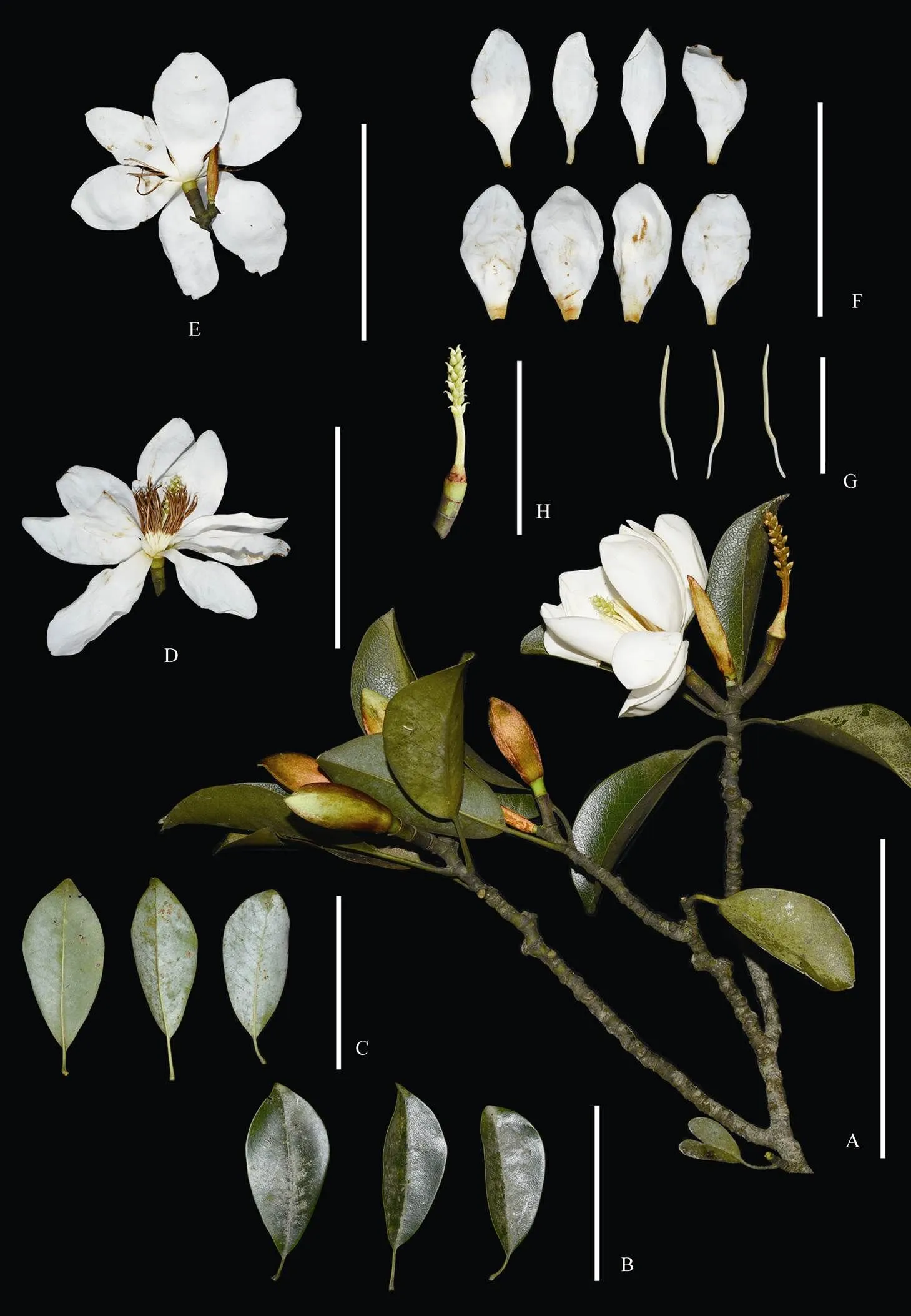
Fig. 2 Michelia taishanensis. A: Flowering branch; B: Leaves (adaxial view); C: Leaves (abaxial view); D: Flower (side view); E: Flower (back view); F: Tepals (from top to bottom): Inner (3), middle (3) and outer (3); G: Stamens (from left to right: back, front and side view); H: Gynophore and brachyblast. Bars: A–F=10 cm, G=2 cm, H=5 cm (All photographed by X. E. Ye)
Evergreen trees or shrubs, to 6 m tall, to 20 cm DBH. Bark grayish white. Young twigs and buds densely reddish brown sericeous. Petiole slender, 1.5– 2.5 cm×ca. 0.15 cm, adaxially narrowly furrowed, without a stipular scar, reddish brown sericeous when young, glabrescent when old; leaf blade obovate, elliptic-obovate or oblong-obovate, 5.5–10.7 cm×3.0– 4.7 cm, leathery, reddish brown sericeous on both sides when young, glabrescent when old, secondary veins 7–10 pairs, slender, anastomosing near the margins, with reticulate veins prominent on both sides, reticulate veins slender, forming a honeycomb pattern, base cuneate to broadly cuneate, apex shortly acumi- nate. Brachyblasts 1.1–2.3 cm×0.3–0.4 cm, initially reddish brown sericeous, glabrescent; spathaceous bract 1, reddish brown sericeous. Flower buds obovoid to ellipsoid, apex acute. Tepals (8–)9(–10), white, base slightly greenish abaxially, glabrous, outer 3 tepals broadly obovate to obovate-elliptic 4.0–6.3 cm× 2.6–3.2 cm; middle 3 obovate-elliptic, 4.4–6.2 cm× 2.6–3.0 cm; inner (2–)3(–4) elliptic, 2.9–4.6 cm× 1.6–2.3 cm. Stamens 77–100, 2.0–2.3 cm long; filaments flat, white, ca. 5 mm long; anthers slightly incurved, yellowish, 1.4–1.7 cm long; connective mucronate, mucro triangular, ca. 0.2 mm long. Gyno- phore green, terete, 0.8–1 cm long, together with gynoecium green sericeous when fresh, reddish brown when dry; gynoecium 1.8–2 cm long; carpels 21–25; ovules 4–6 per carpel; style yellowish-green, recurved, 1–1.4 mm long. Fruit 6.5–10 cm long; mature carpels ellipsoid to ovoid, 0.8–1.5 cm×ca. 1 cm, scattered with white lenticels externally, apex with a short tip. Seeds pink, ovoid or subglobose, slightly angled.
Phenology: Flowering from March to April, fruiting from August to September.
Distribution and habitat:is currently known only from the type locality, Bei- feng Mountain in Taishan City of Guangdong Province. It grows in montane forest at the mountain top at elevations of 740–800 m. The companion species includesW. T. Lin,(Siebold et Zucc.) Mez,Sieb. et Zucc. and so on.
Etymology: The species epithet refers to the type locality, Taishan City.
Chinese vernacular name: 臺山含笑(tái shān hán xiào).
Taxonomic notes:is assigned tosubg.sect.according to Xia’s classification[4], as it has fleshy tepals with outer ones larger and long petiole (>5 mm long) without a stipular scar. It is most similar to, but differs from the latter by its more slender petioles (15–25 mm×ca. 1.5 mm vs. 5–15 mm× 1.8–2.2 mm), leaf blades with glabrescent abaxial surface (vs. persistently reddish brown sericous) and more and longer stamens (77–100 vs. 50–70 in number, 2.0–2.3 cm vs. 1.1–1.5 cm) with white filaments (vs. purplish red) and much shorter anther connectives (ca. 0.2 mm vs. ca. 1 mm)[5].
Additional specimens examined (paratypes): China, Guangdong: Taishan City, Beifeng Mountain, 22 August 2018, N. H. Xia et al. TYH-1720 (IBSC).
Mr. Wang Gang-tao from Hangzhou Xingse Technology Co. LTD is thanked for providing good photos. Our thanks also go to the staffs in Beifeng Mountain National Forest Park for their kind help during our field trip.
[1] Law Y H, Xia N H, Yang H Q. The origin, evolution and phyto- geography of Magnoliaceae [J]. J Trop Subtrop Bot, 1995, 3(4): 1–12.
[2] Xia N H, Law Y W, Nooteboom H P. Magnoliaceae [M]// Wu Z Y, Raven P H. Flora of China, Volume 7. Beijing: Science Press & St. Louis: Missouri Botanical Garden Press, 2008: 48–91.
[3] Law Y W. Magnoliaceae [M]// Law Y W. Flora Reipublicae Popu- laris Sinicae, Tomus 30(1). Beijing: Science Press, 1996: 151–191. (in Chinese)
[4] Xia N H. Taxonomic revision on the family Magnoliaceae from China [D]. Kunming: Kunming Institute of Botany, Chinese Academy of Sciences, 2007: 371.
[5] Yan Y H, Zeng Q W, Xing F W.(Magnoliaceae), a new species from China [J]. Ann Bot Fenn, 2004, 41: 491–493.
臺山含笑,廣東木蘭科一新種
葉幸兒1,2, 葉雪荷1,2,3, 陳裕強4, 劉悅堯5, 童毅華1,2*
(1. 中國科學院華南植物園,中國科學院植物資源保護與可持續利用重點實驗室,廣東省數字植物園重點實驗室,廣州 510650;2. 中國科學院核心植物園保護生物學中心,廣州 510650;3. 仲愷農業工程學院,廣州 510225;4.臺城鎮,廣東 臺山 529200;5. 廣海中學,廣東 臺山 529231)
報道了木蘭科(Magnoliaceae)含笑屬(L.)一新種:臺山含笑(Y. H. Tong, X. E. Ye, X. H. Ye & Yu Q. Chen)。該新種目前僅分布于我國廣東臺山市的北峰山,與廣東含笑(Y. H. Yan, Q. W. Zeng & F. W. Xing)近緣,但其葉柄更纖細,葉背老時變無毛,雄蕊較多且較長,花絲白色,藥隔短小而與后者區別。
木蘭科;含笑屬;臺山含笑;新種;臺山
10.11926/jtsb.4359
2020–12–12
2021–01–27
This work was supported by the National Survey of Traditional Chinese Medicine Resources from National Administration of Traditional Chinese Medicine (Grant No. GZY-KJS-2018-004), the Fund for Improving Medical Service and Security Capacity of Department of Social Security, Ministry of Finance [Grant No. (2019)39], and the Project for Biological Resources in Chinese Academy of Sciences (Grant No. KFJ-BRP-017-33).
YE Xing-er, male, research in the taxonomy of seed plants. E-mail: xeye@scbg.ac.cn
. E-mail: yh-tong@scbg.ac.cn
猜你喜歡
電子競技(2020年8期)2020-12-23 04:09:40
電子競技(2020年7期)2020-10-12 10:45:48
電子競技(2020年5期)2020-08-10 08:43:10
電子競技(2020年4期)2020-07-13 09:18:06
電子競技(2020年2期)2020-04-14 04:40:38
電子競技(2020年11期)2020-02-07 02:49:36
電子競技(2020年9期)2020-01-11 01:06:21
電子競技(2020年10期)2020-01-11 01:06:06
電子競技(2019年22期)2019-03-07 05:17:26
電子競技(2019年21期)2019-02-24 06:55:52