
非相干電離注入導致自由感應衰變信號的擦除效應
2023-06-16 06:53:54梅海城張翔PEZSantiago盧琦秦思宇許亮OLIVAEduardo劉一
光子學報
2023年4期
梅海城,張翔,LóPEZ Santiago,盧琦,秦思宇,許亮,OLIVA Eduardo,劉一
(1 上海理工大學 光電信息與計算機工程學院 上海市現代光學系統重點實驗室, 上海 200093)
(2 馬德里理工大學 工業能源工程系, 西班牙 馬德里 28006)
(3 馬德里理工大學 核聚變研究所, 西班牙 馬德里 28006)
0 Introduction
Nitrogen molecules illuminated by an intense femtosecond pulse in the near-infrared or mid-infrared regime give rise to coherent forward emission at a series of wavelengths, including 391.4, 427.8, 357.8 nm, etc[1].Because optical amplification of an external seeding pulse may appear in such nitrogen gas plasma pumped by 800 nm pulses, this effect together with other optical amplification effects inside air plasma has been coined as“air lasing”[2-4].These cavity-free air lasing effects have attracted many interests in recent 10 years since they hold the unique potential to generate a remote virtual lasing source in ambient air, which is expected to bring revolutionary improvement in optical remote sensing[2,5-6].Recently, it has been demonstrated that lasing emission of neutral or ionic nitrogen molecules can serve as the light source for detection of gas with ppm sensitivity[6].Concerning the underlying mechanism for the coherent emission of neutral N2, it is now well accepted that the 337.4 nm emission is Amplified Spontaneous Emission (ASE)and the population inversion between the third electronic excited state C3Π+uand second excited state B3Π+ghas been established[7].In contrast, the mechanism for lasing of N+2is much more complicated and it is still under intense debate[8-14].This debate stems partially from the mysterious fact that the coherent 391.4 and 427.8 nm emission can always be observed regardless the pump laser wavelength is 400 nm, 800 nm, 1 100 to 1 900 nm, or even 3 900 nm[15-19].Very recently, it became clear that the nature of the 391.4 and 427.8 nm emission is distinct when pump lasers with different wavelengths were used as the driving pulse[10,20-21].
When tunable MIR femtosecond pulses were employed as the pump laser, it has been observed that coherent forward emission at a series of wavelengths including 391.4, 427.8 nm superposed on the third or fifth harmonics of the pump laser[1,21-22].It was now recognized that the nature and mechanism of the 391.4 and 427.8 nm emission in case of MIR pumping is different from that of 800 nm pumping[10,21].A significant difference between the 391.4 nm emission pumped by MIR pulses and the 800 nm pulses lies in the fact that in the former case no optical amplification occurs when external seeding pulses were injected into the plasma[10].At the same time, due to the limited pulse energy of the MIR pump pulses used in different laboratories(typically 0.1~0.5 mJ), the forward coherent 391.4 or 427.8 nm emission is much weaker than their counterpart in case of 800 nm pump pulse with typical pulse energy of 1~10 mJ.Recently, the temporal profile of coherent 391.4 nm emission pumped by intense MIR pulses was characterized with Sum-Frequency Generation (SFG)technique,in case that the 391.4 nm signal was well separated from the 3rdor 5thharmonic when some particular pump laser wavelengths were chosen[21].Based on the spectral and temporal features, the 391.4 nm emission obtained with MIR pumping has been identified as Free Induction Decay (FID)where the resonant excitation of the B-X coherence by the tunable MIR laser pulse plays an important role[21].However, in most of the case with the mid-infrared pump pulses, the 391.4 nm emission was superposed on the harmonics in the spectral domain[1,10,22].The spectral overlap of the 391.4 nm radiation with the harmonics, together with its relatively weak intensity, hinders its measurement with the nonlinear SFG technique and other method for temporal characterization is highly desired.
In this work, we injected a delayed 800 nm pulse into the plasma after the main mid-infrared pump pulse and observed an erasing effect of the free-induction decay emission.It was found that the erasing effect lasts for a couple of picoseconds for the pump wavelengths of 1 250 and 1 550 nm.In particular, for the pump pulse at 1 550 nm, a significant enhancement of the emission around temporal overlapping of the pump and control pulses was observed, while for the 1 250 nm pump pulse such enhancement was not found.Furthermore, this erasing effect was studied for different gas pressures and control pulse energies.We attribute this erasing effect to the incoherent ionization injection of 800 nm control pulse and the change ofρBXcoherence in the system caused by the 800 nm pulse.This erasing effect provides a simple method for temporal characterization of the weak FID emission in case it overlaps with the harmonics in the spectral domain.
1 Experimental setup
In the experiment, a femtosecond laser system (Coherent Legend DUO)delivers 40 fs pulses with pulse energy of 12 mJ at a repetition rate of 1 kHz.A dielectric beam splitter separates the pulses into two beams of almost equal energy.One of the beams with 5 mJ pulse energy was employed to pump an Optical Parametric Amplification (OPA)system, which provides wavelength-tunable femtosecond pulses ranging from 1 100 nm to 2 600 nm.The other 800 nm beam was attenuated properly before it was combined with the MIR pump by a dichroic mirror.The experimental setup is schematically presented in Fig.1.Both the MIR pump laser and the 800 nm control pulse were linearly polarized in the same direction, since it is known that the emission was optimized for a linearly polarized MIR pump pulse[22].An optical delay line was mounted into the 800 nm control pulse in order to vary the time delayτdbetween the MIR pump and 800 nm control pulse.The collinear MIR and 800 nm beams were focused into a gas chamber filled with nitrogen by a convex lens off= 30 cm or 50 cm (LA1256-C or LA1380-C, Thorlabs).In our experiments, the pulse energy of the MIR pump pulse was 400~600 μJ, while the energy of the 800 nm control pulse was 200~300 μJ.Both the MIR pump and the 800 nm control pulse were capable to produce a visible plasma in the gas chamber.At the exit of the gas chamber, the forward emission from the gas plasma was collected into a fiber by a lens off= 10 cm(LA4545, Thorlabs)for spectral analysis with a spectrometer (HR 4 000, Ocean Optics).Several shortpass filters (BG 40)were installed before the fiber for proper spectral filtering.In the experiment, the forward spectrum from the plasma in the UV range was recorded as a function of the time delay between the pump and control pulses.
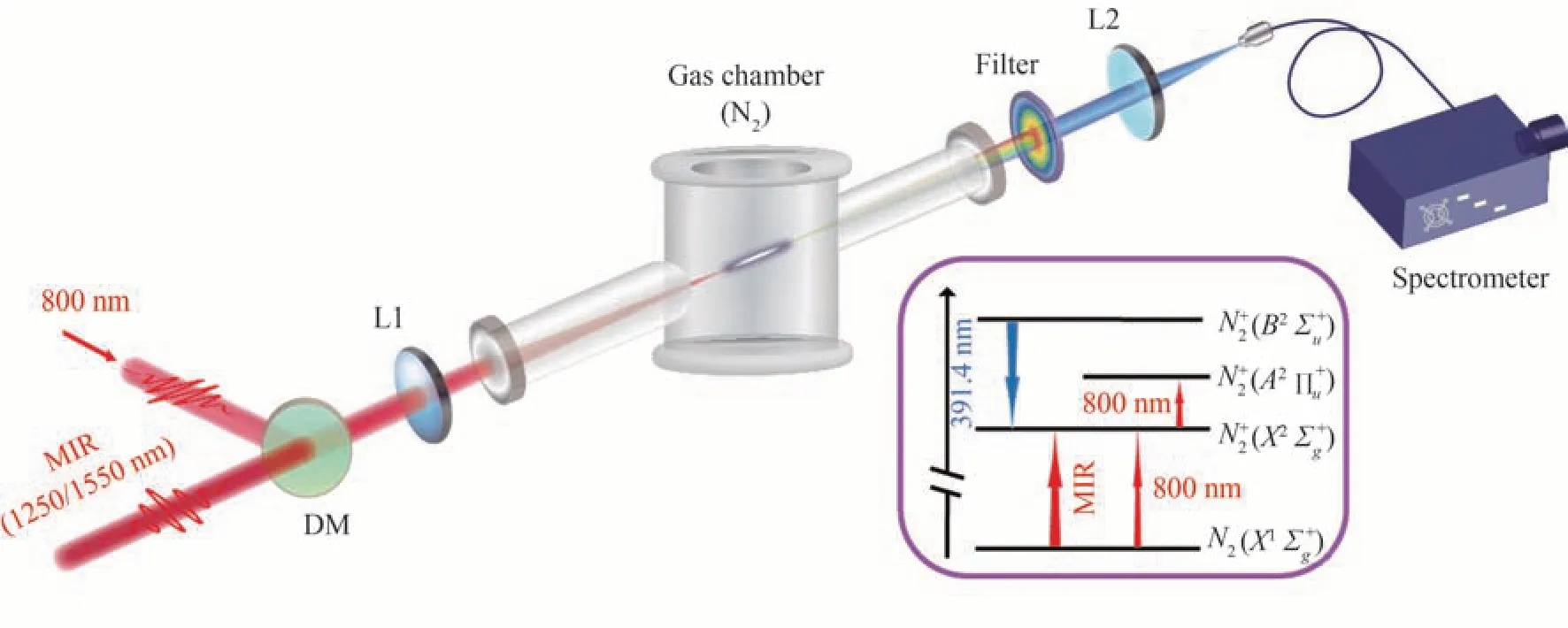
Fig.1 Experimental setup.Inset, energy-level diagram of neutral and ionic nitrogen molecule
2 Experimental results
2.1 Lasing emission at 391.4 nm from molecular nitrogen ion
In Fig.2, the forward emission spectra from the nitrogen plasma were presented for tuned pump wavelength.For the pump laser wavelengths investigated, a narrow and sharp emission peak at 391.4 nm and a series of spectral peaks around 389 nm were observed, which correspond to the P and R branches of the transition of the nitrogen ions from the second excited state B2Σ+u(ν′=0) to the ground state X2Σ+g(ν=0).This emission has been observed in several previous reports and has been recently attributed to free-induction decay enabled by resonant excitation with the MIR pump pulses[1,10,21].In case of pump wavelengthλp= 1 250 nm,the sharp 391.4 nm peak was found to superpose on the relatively broad 3rdharmonic emission spectrum.While for 1 550 nm pump laser, the FID emission is clean in the spectral domain since both the 3rdand 5thharmonics are located away from the spectral peak.

Fig.2 Spectrum of the forward emission as a function of the pump laser wavelength
2.2 The erasing effect by 800 nm control pulses
In Fig.3, we present the emission spectra with the injection of a subsequent 800 nm control pulse for pump wavelength of 1 250 nm and 1 550 nm.The time delay between the MIR pump and the 800 nm control pulse wereτp= 1 ps.We observed that the FID emission in both cases was substantially suppressed.Interestingly,we noticed that the relatively broad 3rdemission in Fig.3(a)remains untouched.This indicate that the FID emission lasts for more than 1 ps while the duration of the 3rdharmonic is less than 1 ps since it is not changed.
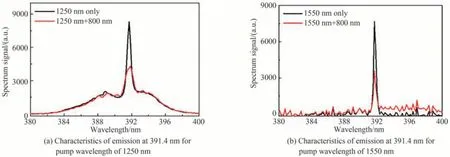
Fig.3 Suppression of the emission obtained at different pump wavelength
The time-resolved results for pump laser wavelength of 1 250 nm and 1 550 nm are presented in Fig.4 and Fig.5.Here the positive delay corresponds to that the control pulse lags the MIR pump pulse.In Fig.4 (a), it was observed that the 391.4 nm FID signal experiences a sudden decrease around theτd= 0 and recovers to its initial level after a delay of about 3 ps, regardless of the gas pressure.This indicates that for gas pressure ranging from 50 mbar to 200 mbar the FID signal presents a similar duration of 3 ps.We note that this feature is in sharp contrast with the superradiance of nitrogen ions where the emission duration is inversely proportional to the gas pressure[8].We also varied the energy of the control pulse and the results are presented in Fig.4(b).It was found that the FID signal was suppressed by about 75% for control pulse energy of 300 μJ and 200 μJ,while for 100 μJ pulse the FID signal is less suppressed.This is understandable since the higher energy control pulse results in much ionization, which will be discussed later.In Fig.4 (c), we presented the emission spectrum as a function of the time delay.It is observed that the entire free induction decay emission was suppressed for a time interval of about 3 ps.

Fig.4 Experimental results of 1 250 nm pump wavelength
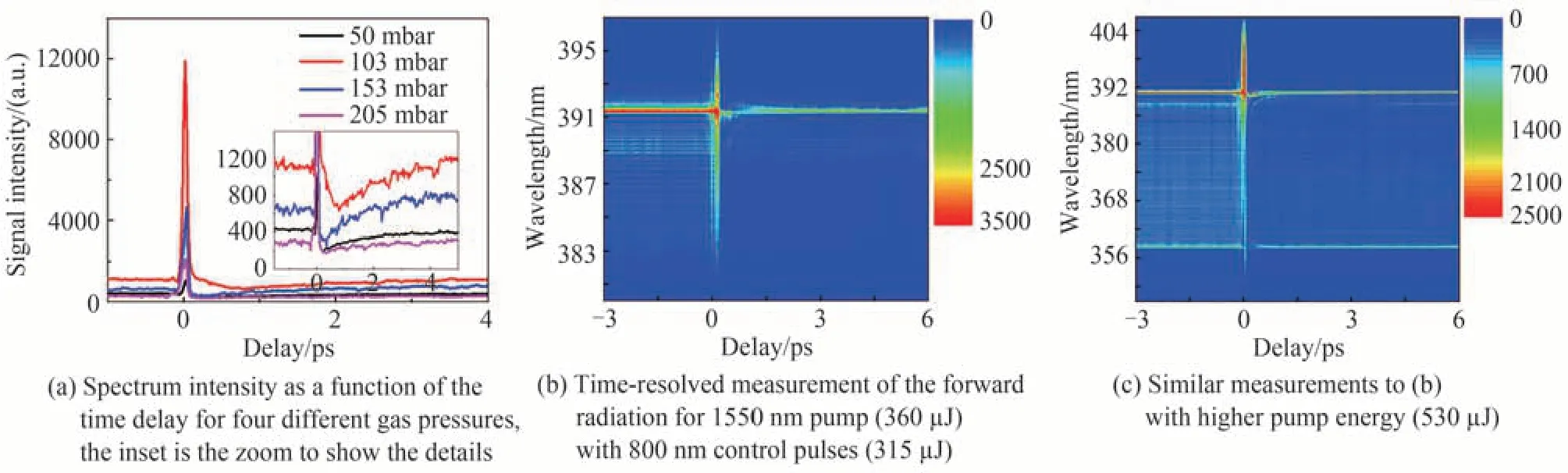
Fig.5 Experimental results of 1 550 nm pump wavelength
In Fig.5 (a), the corresponding results forλp= 1 550 nm are presented.A similar erasing effect lasting for ~3 ps was observed, which is clear in the inset of Fig.5(a).In addition to the erasing effect, a significant enhancement of the signal intensity at zero delay was observed.In case ofp=100 mbar, the signal intensity was enhanced by one order of magnitude (red line).As to the mechanism for this enhancement, we noticed that such an enhancement has been observed in a previous report where an 800 nm pulse was used as the main pump laser and a synchronized MIR pulse at 1 580 nm served as a control pulse[23].This enhancement has been attributed to the fact that the 1 580 nm pulse can excite the A-B coherence by a two-photon resonance process[23].In our current experiment, when the 800 nm and 1 550 nm pulses are synchronized in the time domain, such enhancement should also be expected since the 1 550 nm is very close to two-photon resonance occurring at 1 580 nm.While for 1 250 nm pump pulse, its photon energy is far away from A-B resonance with two photons and no such enhancement at temporal overlap was observed.To have a complete knowledge of the evolution of the emission spectrum, we present in Fig.5(b)the whole spectrum intensity as a function of the time delay.In additional to the main emission peaked at 391.4 nm, a series of relatively low intensity peaks around 388.5 nm show up, which correspond to the R branch of the B-X transition[24].We noticed that the erasing effect and the enhancement at zero delay occur simultaneously for both the P and R branch.We also tested higher energy of the pump pulse at 530 μJ and the result is presented in Fig.5(c).In addition to the P and R branches of the B-X transition, another emission peak located at 357.8 nm appears, which corresponds to transition between the levels B (ν′ = 1)and X (ν = 0)[1].Between the optical transitions at 391.4 nm and 357.8 nm, a continuous broad band emission was observed.Recently, it has been revealed that this broadband emission origins from the optical transition that has been shifted in energy due to the dynamic Stark effect of the intense laser pulses[21,25].Here it is observed that this broad continuum was also substantially suppressed by the delayed 800 nm control pulse.
3 Discussion
How should we understand this erasing effect of the free induction decay radiation by the delayed 800 nm femtosecond laser pulse? It is known that the 391.4 nm emission in case of MIR pump is due to the macroscopic polarization formed between the B and X states which is resonantly excited by multiple photons[21,23].In the recent study of Yaoet al, a theoretical description of the nitrogen ions system by the density-matrix formulism has been developed and the radiation field was described by the Maxwell equation[23].The macroscopic polarization between the B and X states corresponds to the off-diagonal termρBXof the density matrix[23].
Here, we speculate that the suppression of the radiation at 391.4 nm by the 800 nm pulse could be due to two reasons.The first reason lies in the fact that the control pulse also ionizes the neutral nitrogen molecules.Due to its limited pulse energy and low laser intensity, we expect that most of the produced nitrogen ions is populated in the electronic fundamental X state of the ions, and the additional population to the upper A and B levels is neglectable.Since the 800 nm control pulse is far away from the B-X resonance, the increased population in the X state due to the control pulse is incoherently added to the pre-formed nitrogen ions system by the MIR pump pulse, which can lead to decrease of the B-X coherence due to incoherent mixing.Second,we noticed that the 800 nm field is near resonant with the X(ν = 0)and A (ν = 2)transition.This field, in principle, could excite theρAX,ρBAandρBXcoherences in such way that the latter is depleted, leading to radiation suppression.We modelled this effect with our 1D Maxwell-Bloch code DeepOne[26-27].
In these equationsE2,ωXA, andE3,ωBXare respectively the electric field and frequency of theλ= 800 nm andλ= 391 nm radiation fields.Pij,ρijandμBXare respectively the macroscopic polarization density,coherences and electric dipoles between X, A and B levels of the ionized nitrogen molecules.Nis the density of ionized nitrogen molecules andNithe population of each level.Finally,Tij=2 ×1111s?1are depolarization characteristic times andTi=500 ×10-12s are the radiative lifetimes of the levels.
To model the experiment we asume a 1 mm nitrogen plasma, at 50 mbar pressure and 10% ionization with an initial B-X coherence, (ρBX=0.001)We inject a 100 μJ, 100 fs, IR pulse in resonance with the X-A transition (λ~800 nm)at different delays and compare the total energy of the UV radiation (λ=391 nm)emitted due to the initialρBXcoherence.
The results of our 1D Maxwell-Bloch modelling are shown in Fig.6.The dependence of the intensity of the emitted 391 nm radiation with the delay of the 800 nm control pulse is shown in Fig.6(a)for two different pressures, 30 mbar (black)and 50 mbar (red).As expected, a sudden drop in the intensity and posterior recovery when the delay of the IR control pulse is increased is apparent in Fig.6(a).This is explained as follows.The IR control pulse and the initialρBXcoherence strongly induces a negative imaginary part on theρBAcoherence, as shown in Fig.6(b).TheρBAcoherence then interacts with the IR control pulse, depleting theρBXcoherence, as depicted in Fig.6(c).Since most of the emission induced by theρBXcoherence takes place during less than one picosecond, the intensity recovers when the delay increases.

Fig.6 Results of the 1D Maxwell-Bloch modelling
In view of these results, we can affirm that the two aforementioned mechanisms(further ionization by the IR control pulse and depletion of theρBXcoherence by the interaction of the IR control pulse and theρBAcoherence)play a role in the dynamics of the system.
4 Conclusion
We have demonstrated that the FID emission of nitrogen ions pumped by femtosecond MIR pulses can be substantially suppressed by a subsequent 800 nm control pulse.This erasing effect occurs universally for different pump laser wavelength, gas pressure and control pulse energy.In addition to the erasing effect, a significant enhancement of the spectral signal was also found forλp= 1 550 nm, where two-photon resonance between the B and A levels occurs.Based on the numerical simulation of the density matrix and Maxwell equation, we attribute this erasing effect to the further photoionization by the 800 nm pulse and the change of coherence between the B and X states of the nitrogen ions.Specifically, the 800 nm pulses directly leads to the change of coherence between the B and A states (ρBA) .The further coupling of theρBAwith the 800 nm pulse results in the reduction of the coherence of the B and X states (ρBX), which gives rise to the corresponding suppression of the 391.4 nm radiation.This erasing effect provides a simple method for measurement of the temporal duration of the FID emission, which is particularly useful when the weak FID emission overlaps with the harmonics of the pump laser in the spectral domain.
登錄APP查看全文
