
基于一維卷積循環(huán)神經(jīng)網(wǎng)絡(luò)的雷達輻射源信號識別
2023-04-29 01:09:44劉濤濤田春瑾普運偉郭江
四川大學學報(自然科學版)
2023年4期
劉濤濤 田春瑾 普運偉 郭江


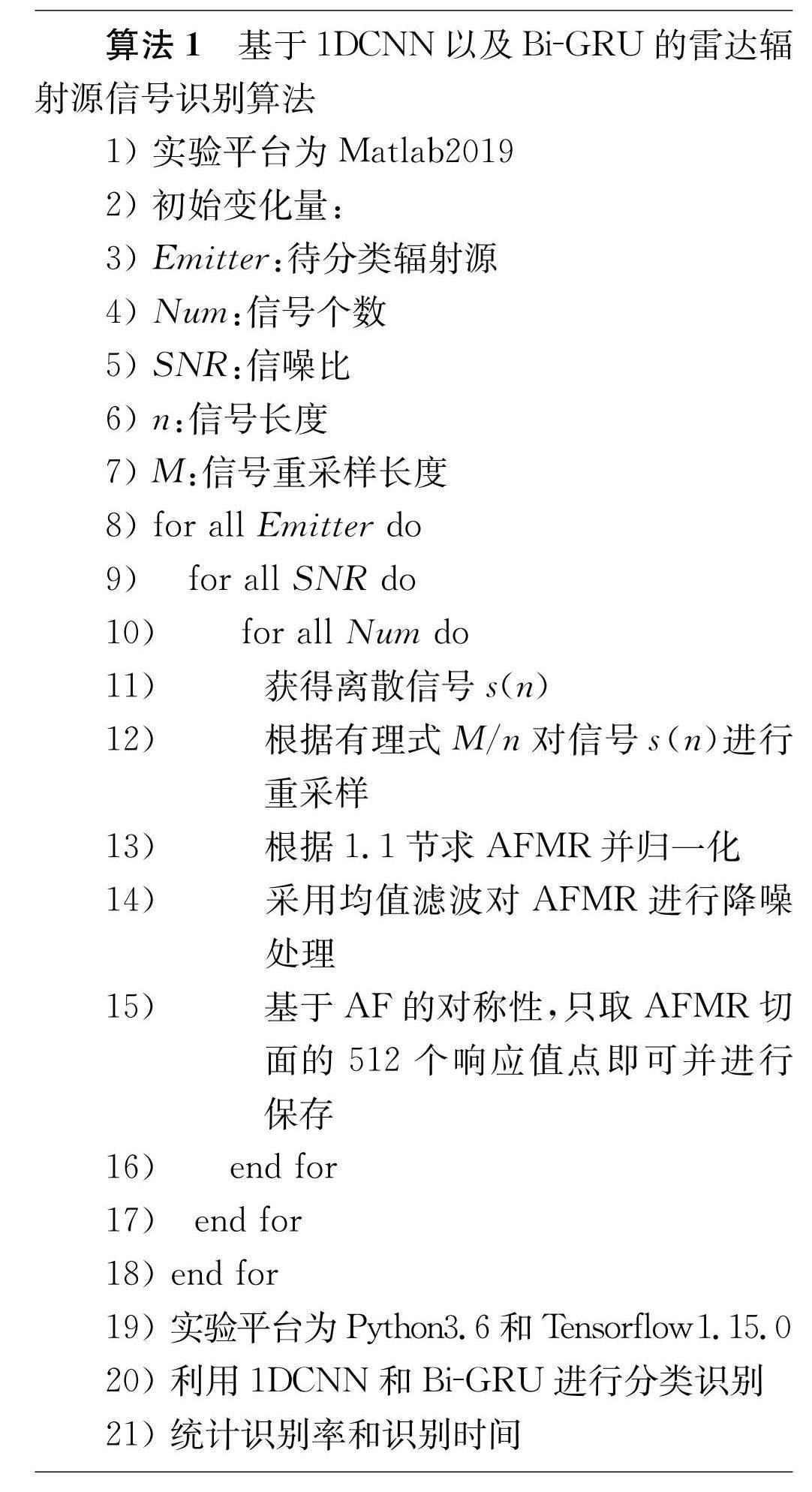
摘 要 ???:針對人工提取雷達輻射源信號特征不完備、時效性低等問題,提出一種基于一維卷積神經(jīng)網(wǎng)絡(luò)和雙向門控循環(huán)單元的識別方法.首先,提取信號的模糊函數(shù)主脊并進行去噪處理;其次,利用一維卷積神經(jīng)網(wǎng)絡(luò)學習模糊函數(shù)主脊的內(nèi)在抽象特征;然后引入雙向門控循環(huán)單元對一維卷積神經(jīng)網(wǎng)絡(luò)提取到的特征進行再處理;最后,將特征映射到特征空間并通過Softmax分類器進行分類識別.實驗結(jié)果表明,該方法在信噪比為0 dB時能保持99.67%的識別率,即使在-6 dB環(huán)境中識別率仍能達到90%左右,證實了該方法的有效性和在低信噪比下的穩(wěn)定性.
關(guān)鍵詞 :雷達輻射源信號識別; 模糊函數(shù)主脊; 一維卷積神經(jīng)網(wǎng)絡(luò); 雙向門控循環(huán)單元
中圖分類號 : TN974 文獻標識碼 :A DOI : ?10.19907/j.0490-6756.2023.043001
Radar emitter signal recognition based on one-dimension ?convolutional recurrent neural network
LIU Tao-Tao ?1, TIAN Chun-Jin ?2, PU Yun-Wei ?1,2, GUO Jiang 1
(1.Faculty of Information Engineering and Automation, Kunming University ?of Science and Technology, Kunming 650500, China; 2.Computer Center, Kunming University of Science and Technology, Kunming 650500, China)
Aiming at the problem of incomplete features and low timeliness in artificial extraction of radar emitter signal, a novel recognition method is proposed based on one-dimension convolutional neural network and bidirectional gated recurrent unit. First, the main ridge of ambiguity function is extracted and denoised, then one-dimensional convolutional neural network is used to learn the intrinsic abstract characteristics of the main ridge of ambiguity function. The features extracted from the one-dimensional convolutional neural network are reprocessed by introducing the bidirectional gated recurrent unit. Finally, a deep neural network is constructed to map features to feature space and the classifier is Softmax. The results show that the proposed method can maintain 99.67% recognition rate when the SNR is 0 dB, and the recognition rate can still reach about 90% even in the -6 dB environment, which demonstrates the effectiveness and stability of the method at low SNR.
Radar emitter signal recognition; Main ridge of ambiguity function; One-dimensional convolutional neural network; Bidirectional gated recurrent unit
1 引 言 傳統(tǒng)的雷達輻射源信號識別是指從截獲的敵方信號中分選出單部雷達信號并將該信號的主要參數(shù)同先驗信息庫逐條匹配的過程.然而隨著不同體制輻射源的投入使用,戰(zhàn)場信號密度達百萬量級,電磁環(huán)境也更加的復雜多變,致使僅依賴常規(guī)五參數(shù)的分選方法不再適用于戰(zhàn)場,因此亟需挖掘更深層有效的脈內(nèi)特征參數(shù).
而模糊函數(shù)(Ambiguity Function,AF)能較為全面的反映信號內(nèi)在信息,蘊含大量的時頻域特征信息.同時模糊函數(shù)主脊(Ambiguity Function Main Ridge, AFMR)又能較好的描述AF分布性質(zhì),因此,對AFMR進行研究有助于輻射源信號分選識別.普運偉等 ?[1]采用窮舉法搜索AFMR并提取其矩特征,該方法的識別率較高且抗噪性能良好,但該方法運算量大、耗費時間長;……
登錄APP查看全文