
Abel數(shù)域的導(dǎo)子計算公式
2023-04-29 14:54:30鄧先濤彭國華
四川大學(xué)學(xué)報(自然科學(xué)版)
2023年3期
鄧先濤 彭國華

基于Kronecker-Weber定理本文利用素數(shù)在Abel 數(shù)域中的分歧指數(shù)明確給出Abel 數(shù)域的導(dǎo)子計算公式. 特別地,二次數(shù)域的導(dǎo)子公式可以容易地從該公式推導(dǎo)出來.
導(dǎo)子; Kronecker-Weber定理; 慣性群; 分歧指數(shù)
O156.2A2023.031003
收稿日期: 2022-02-22
基金項目: 國家自然科學(xué)基金(12171331)
作者簡介: 鄧先濤(1996-), 男, 湖南懷化人, 博士研究生, 主要從事數(shù)論及其應(yīng)用方向研究. E-mail:xiantaodeng@126.com
通訊作者: 彭國華. E-mail:peng@scu.edu.cn
A conductor formula for Abelian number fields
DENG Xian-Tao, PENG Guo-Hua
(School of Mathematics, Sichuan University, Chengdu 610064, China)
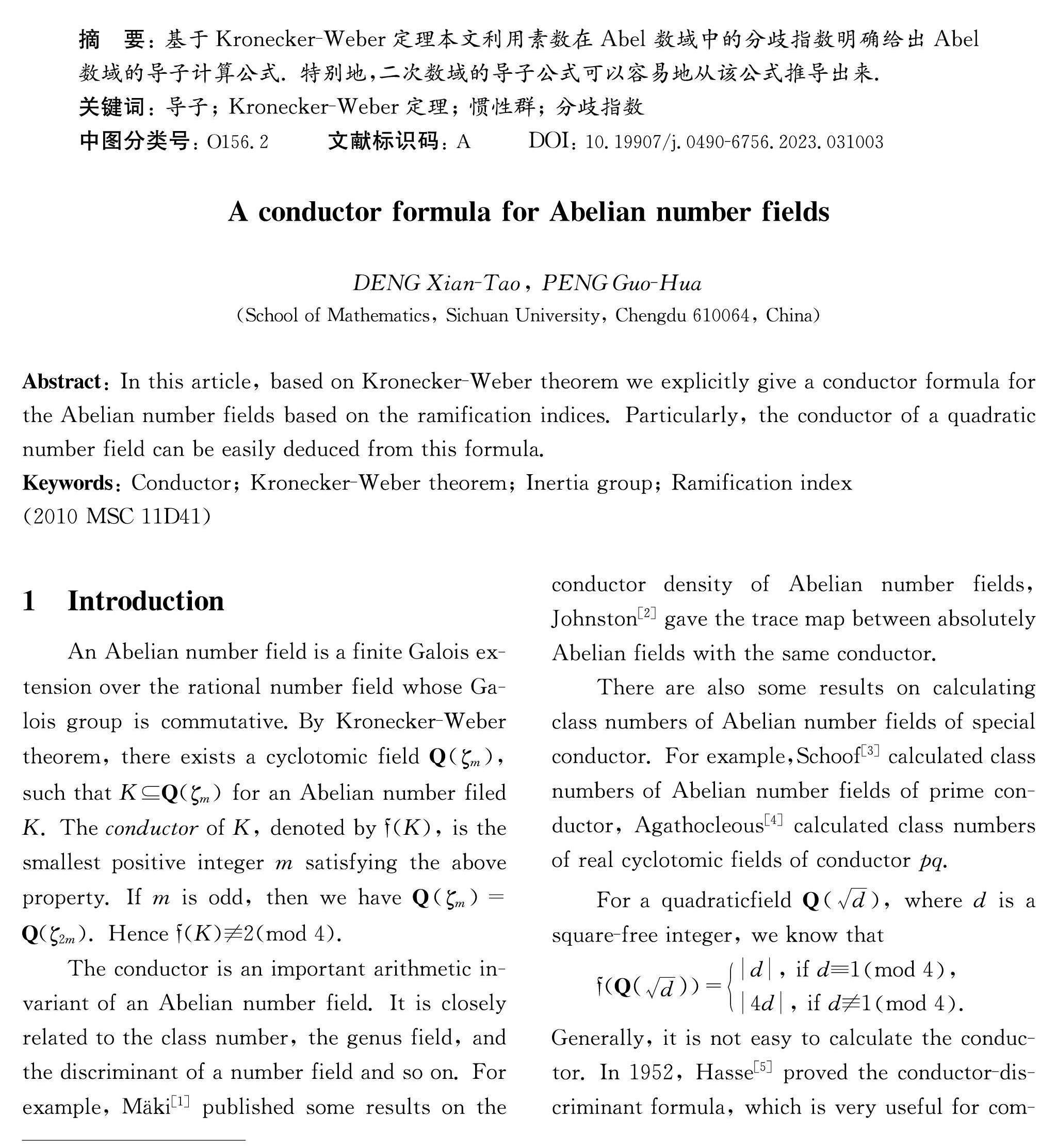
In this article, based on Kronecker-Weber theorem we explicitly give a conductor formula for the Abelian number fields based on the ramification indices. Particularly, the conductor of a quadratic number field can be easily deduced from this formula.
Conductor; Kronecker-Weber theorem; Inertia group; Ramification index
(2010 MSC 11D41)
1 Introduction
An Abelian number field is a finite Galois extension over the rational number field whose Galois group is commutative.By Kronecker-Weber theorem, there exists a cyclotomic field? Q(ζm), such that KQ(ζm) for an Abelian number filed K. The conductor of K, denoted by f(K), is the smallest positive integer m satisfying the above property. If m is odd, then we have Q(ζm)=Q(ζ2m). Hence?? f(K)2(mod 4).
The conductor is an important arithmetic invariant of an Abelian number field. It is closely related to the class number, the genus field, and the discriminant of a number field and so on. For example, Mki[1] published some results on the conductor density of Abelian number fields, Johnston[2] gave the trace map between absolutely Abelian fields with the same conductor.
There are also some results on calculating class numbers of Abelian number fields of special conductor. For example,Schoof[3] calculated class numbers of Abelian number fields of prime conductor, Agathocleous[4] calculated class numbers of real cyclotomic fields of conductor pq.
For a quadraticfield Q( d), where d is a square-free integer, we know that
f(Q d)=d, if d≡1mod 4,
4d, if d1mod 4.
Generally, it is not easy to calculate the conductor. In 1952, Hasse[5] proved the conductor-discriminant formula, which is very useful for computing the discriminant of an Abelian number field. In 1985, Zhang[6] gave a result on the genus field which is the maximal absolute Abelian number field containing the Abelian number field. The aim of this article is to give an explicit formula on conductor by some methods different from Zhang.
鄧先濤, 等: Abel數(shù)域的導(dǎo)子計算公式
Let p be a prime number, and we fix a prime ideal p of K lying above p. Define
Ip(K)={σ∈Gal(K/Q)|σ(x)≡xmod p,
x∈OK}.
Since Gal(K/Q) is Abelian, Ip(K) is independent of the choice of p and hence well-defined. We call Ip(K) the inertia group of p in K, whose order is called the ramification index of p in K, denoted by ep(K). If ep(K)=1, p is said to be unramified in K, otherwise we say p is ramified. The fixed subfield of Ip(K) in K, denote by KIp, is the inertial field of p. A basic fact is that p is unramified in KIp.
Theorem 1.1 Let K be an Abelian number field of degree n. Write
n=2t0qt11qt22…qtmm,
where q1,q2,…,qm are distinct odd primes, and t0≥0,ti≥1 for 1≤i≤m. Let p1, p2,…,ps be all ramified primes in K. For a prime p and an integer k, denote the standard p-adic order of k by vp(k). Then we have
(i) If 2 is unramified in K, then
f(K)=p1p2…ps∏mi=1qvqi(eqi(K))i,
(ii) If 2 is ramified in K, then
f(K)=Ws,m, ife2K -1=e2(K),2Ws,m, otherwise,
where
Ws,m=2v2(e2(K))p1p2…ps∏mi=1qvqi(eqi(K))i.
Remark 1 Zhang[6] gave a similar result for an Abelian number field K of degree pr, where p is a prime number. But if p is ramified in K, Zhang's result did not give the explicit power of p in the conductor formula. In Ref. [7], Zhao and Sun gave the conductor formula for an Abelian number field of degree p, where p is a prime number. This article generalizes the above two conclusions. In our formula (Theorem 1.1), we give the explicit power of all primes which are wildly ramified in K, where K is any Abelian number field.
Let K, L and F be Abelian number fields such that FL, then we define
resLK:Gal(L/Q)→Gal(F/Q)σ→σ|F(1)
where σ|F(α)=σ(α)(α∈F). Additionally, we also define that
ΩQ(K,L):Gal(KL/Q)→
Gal(K/Q)Gal(L/Q),σ→σ|K,σ|L(2)
Our proof depends on the explicit analysis of the ramification index, and the key idea in our proof is to determine the structure of the inertia groups of an Abelian number field (Proposition 2.1 and Corollary 2.2) by using Kronecker-Weber theorem. In Section 2, we first deal with the case of a cyclic number field of prime power degree (Proposition 2.6), which is the main part of our discussion. The general case is established in Section 3 by viewing an Abelian field as a compositum of cyclic subfields of prime power degree.
2 Cyclicnumber fields of prime power degree
We start with a general result on the inertia group. The following result shows that the inertia group of a number field is determined by the inertia group of its Galois extension.
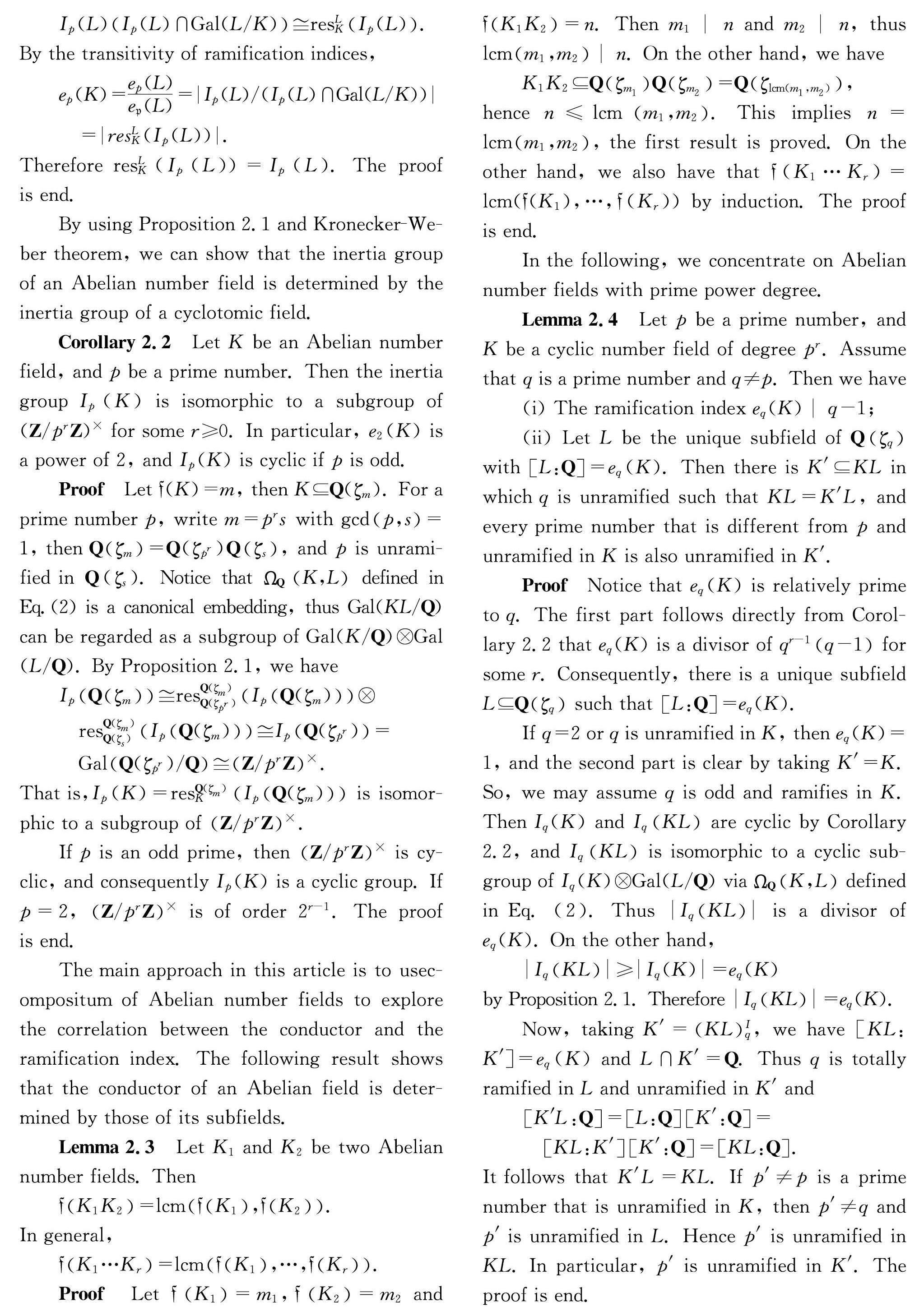
Proposition 2.1 Let K and L be Abelian number fields with KL. Then resLKIp(L)=Ip(K) holds for every prime number p, where resLK is defined in Eq.(1).
Proof Let p be a prime ideal in OK lying above p. By the definition of inertia group, we have resLKIp(L)Ip(K).
Let P be a prime ideal in OL lying above p, and Ip(L) be the inertia group of p in L, then Ip(L)={σ∈Gal(L/K)|σ(x)≡xmod P,x∈OL}. Thus
Ip(L)∩Gal(L/K)=Ip(L).
Noticing that the restriction map resLK is surjective with ker resLK=Gal(L/K), we have
Ip(L)Ip(L)∩Gal(L/K)resLKIp(L).
By the transitivity of ramification indices,
ep(K)=ep(L)ep(L)=|Ip(L)/(Ip(L)∩Gal(L/K))|
=|resLK(Ip(L))|.
Therefore resLK(Ip(L))=Ip(L). The proof is end.
By using Proposition 2.1 and Kronecker-Weber theorem, we can show that the inertia group of an Abelian number field is determined by the inertia group of a cyclotomic field.
Corollary 2.2 Let K be an Abelian number field, and p be a prime number. Then the inertia group Ip(K) is isomorphic to a subgroup of (Z/prZ)× for some r≥0. In particular, e2(K) is a power of 2, and Ip(K) is cyclic if p is odd.
Proof Let f(K)=m, then KQ(ζm). For a prime number p, write m=prs with gcdp,s=1, then Qζm=Q(ζpr)Qζs, and p is unramified in Q(ζs). Notice that ΩQK,L defined in Eq.(2) is a canonical embedding, thus Gal(KL/Q) can be regarded as a subgroup of Gal(K/Q)Gal(L/Q). By Proposition 2.1, we have
IpQζmresQ(ζm)Q(ζpr)IpQ(ζm)
resQ(ζm)Q(ζs)IpQ(ζm)IpQ(ζpr)=
GalQ(ζpr)/QZ/prZ×.
That is,Ip(K)=resQ(ζm)KIpQ(ζm) is isomorphic to a subgroup of Z/prZ×.
If p is an odd prime, then Z/prZ× is cyclic, and consequently Ip(K) is a cyclic group. If p=2, Z/prZ× is of order 2r-1. The proof is end.
The main approach in this article is to usecompositum of Abelian number fields to explore the correlation between the conductor and the ramification index. The following result shows that the conductor of an Abelian field is determined by those of its subfields.
Lemma 2.3 Let K1 and K2 be two Abelian number fields. Then
fK1K2=lcmfK1,fK2.
In general,
fK1…Kr=lcmfK1,…,fKr.
Proof Let fK1=m1,fK2=m2 and fK1K2=n. Then m1∣n and m2∣n, thus lcmm1,m2∣n. On the other hand, we have
K1K2Qζm1Qζm2=Qζlcm(m1,m2),
hence n≤lcmm1,m2. This implies n=lcmm1,m2, the first result is proved. On the other hand, we also have that f(K1…Kr)=lcm(f(K1),…,f(Kr)) by induction. The proof is end.
In the following, we concentrate on Abelian number fields with prime power degree.
Lemma 2.4 Let p be a prime number, and K be a cyclic number field of degree pr. Assume that q is a prime number and q≠p. Then we have
(i) The ramification index eq(K)∣q-1;
(ii) Let L be the unique subfield of Qζq with L:Q=eq(K). Then there is K′KL in which q is unramified such that KL=K′L, and every prime number that is different from p and unramified in K is also unramified in K′.
Proof Notice that eq(K) is relatively prime to q. The first part follows directly from Corollary 2.2 that eq(K) is a divisor of qr-1q-1 for some r. Consequently, there is a unique subfield LQζq such that L:Q=eq(K).
If q=2 or q is unramified in K, then eq(K)=1, and the second part is clear by taking K′=K. So, we may assume q is odd and ramifies in K. Then Iq(K) and IqKL are cyclic by Corollary 2.2, and IqKL is isomorphic to a cyclic subgroup of Iq(K)Gal(L/Q) via ΩQK,L defined in Eq. (2). Thus IqKL is a divisor of eq(K). On the other hand,
IqKL≥Iq(K)=eq(K)
by Proposition 2.1. Therefore IqKL=eq(K).
Now, takingK′=KLIq, we have [KL:K′]=eq(K) and L∩K′=Q. Thus q is totally ramified in L and unramified in K′ and
K′L:Q=L:QK′:Q=
KL:K′K′:Q=KL:Q.
It follows that K′L=KL. If p′≠p is a prime number that is unramified in K, then p′≠q and p′ is unramified in L. Hence p′ is unramified in KL. In particular, p′ is unramified in K′. The proof is end.
The following result can be proved in the same way as the above lemma.
Lemma 2.5 Let p be a prime number, and K be a cyclic number field of degree pr. Ifep(K)≠1, and L is an Abelian number field such that
ep(L)=epKL=L:Q,
then KLIpL=KL.
Proposition 2.6 Let p be a prime number, and K be a cyclic number field of degree pr. Let q be a prime number that is ramified in K. Then
vqf(K)=
1, if q≠p;vpep(K)+1,if q=p is odd,
2, if q=p=2 , e2K -1=2,
vpep(K)+1, if q=p=2,
e2K -1=2.
Proof Let n=vqf(K). Then f(K)=qnh such that gcdq,h=1.
Case 1? If q≠p, let L and K1 be two Abelian number fileds satisfying the properties in Lemma 2.4. Then we have
K1L=KL, f(L)=q, q∣f(K)
and qfK1. By Lemma 2.3, we have
fKL=lcmf(K),f(L)=qnh,
and fK1L=lcmfK1,f(L)=qfK1.
It follows that n=1.
Case 2?? If q=p, we assume that p is ramified in K with ramification index ep(K)=puu≥1. Since ep(K)∣epQζf(K) and epQζf(K)=pn-1p-1, we have that n≥u+1. Let L1 be a subfield of Qζpu+1 such that L1:Q=pu. Then we obtain that
fL1=pu+1, fKL1=f(K).
Subcase 2.1? If p is odd, IpKL1 is cyclic by Corollary 2.2. Notice that IpKL1 can be embedded as a subgroup of Ip(K)GalL1|Q via ΩQK,L1 defined in Eq. (2). But both Ip(K) and GalL1|Q are cyclic group of order pu, and epKL1≥ep(K)=pu. It follows ep(KL1)=pu.
Let K2=KL1Ip. Since p is totally ramified in L1 and L1:Q=epKL1, we have K2L1=KL1 by Lemma 2.5. Since p is unramified in K2, we have pfK2. Thus
fK2L1=pu+1fK2,? fK2L1=f(K).
Consequently n=vpf(K)=u+1.
Subcase 2.2? If q=p=2, then L1=Qζ2u+1, thus we know that GalL1|QZ/2u+1Z×. Since fKL1=2nh, and the inertia group I2Qζ2nh is isomorphic to (Z/2nZ)×, I2KL1 is isomorphic to a subgroup ofZ/2nZ×. Then I2KL1 is cyclic or isomorphic to Z/2mZ× for some 3≤m≤n.
(i) If I2KL1 is cyclic, then Gal(L1|Q) must be cyclic by Proposition 2.1. Consequently u=1, and e2L1=2. By Lemma 2.5, we have K2L1=KL1 for K2=KL1Ip. Notice
fKL1=f(K), fK2L1=4fK2.
Thus n=2.
(ii) If I2KL1 is isomorphic to Z/2mZ× for some 3≤m≤n, then we obtain that
I2KL1Z/2ZZ/2m-2Z.
Notice that resKL1KI2KL1=I2(K) is cyclic of order 2u, we have e2KL1=2u+1 , m=u+2. Let L2=Qζ2u+2, then eKL2=2u+1 by Corollary 2.2. Setting K3=KL2I2, we have K3L2=KL2 by Lemma 2.5. Since fK3L2=2u+2fK3, we have fKL2=2nh. Thus n=u+2.
The above discussion shows thatI2KL1 is cyclic if and only if e2K -1=2. The proof is end.
Let K be same as Proposition 2.6, and we assume that p1,p2,…,ps are all prime numbers that are ramified in K. If pi≠p, then vpi(f(K))=1, by Proposition 2.6. If p is ramified or equivalently pi=p for some i, then we have
vpf(K)=
vpep(K)+1, if p is odd,
2, if p=2 , e2K -1=2,
vpep(K)+2, if p=2
e2K -1≠2.
Thus
f(K)=ep(K)p1p2…ps, if allpi≠2,
2p1p2…ps, if p1=2 , e2K -1=2,
2e2(K)p1p2…ps, ifp1=2,
e2K -1≠2.
We summarize the result in the following theorem.
Theorem 2.7 Let p be a prime number, and K be a cyclic number field of degree pr. Let p1,p2,…,ps be all primes which are ramified in K. We have
(i) If 2 is unramified in K, then
f(K)=ep(K)p1p2…ps;
(ii) If 2 is ramified in K, then
f(K)=2p1…ps, if e2K -1=2,
2p1…p2e2(K), otherwise.
Based on the conductor formula in Theorem 2.7, we can easily compute the conductor of a quadratic field.
Corollary 2.8 Let d be a square-free integer, and K=Q d. Then
fQ d=d, if d≡1mod 4,
4d, if d1mod 4.
Proof Let d=±p1p2…pm be the prime decomposition of d, and d(K) be the discriminant of K. Then
d(K)=d, if d≡1mod 4,
4d, if d1mod 4.
Notice that a prime numberp is ramified in K if and only if p|d(K).
If d≡1mod 4, then 2 is unramified in K, and p1,p2,…,pm are all primes which are ramified in K. By Theorem 2.7, we have
f(K)=p1p2…pm=d.
If d≡2mod 4, then p1,p2,…,pm are all primes which are ramified in K. Since K -1 has exactly three quadratic subfields: Q -1, Q d and Q -d, in which 2 is ramified, then e2K -1=4. By Theorem 2.7, we have. f(K)=4d.
If d≡3mod 4, then 2,p1,p2,…,pm are all primes which are ramified in K. Since Q -dK -1 and 2 is unramified in Q -d, then e2K -1=2. Again f(K)=4d.
3 The conductor of general Abelian number fields
In this section, we prove the main result for general Abelian number fields.
Proof of Theorem 1.1 Let K be an Abelian number field with Galois group G. By the structure theorem for finite Abelian groups, G is a direct product of cyclic subgroups of prime power order. For each such direct summand H of G, there exists a subgroup H′ such that G=HH′. Let M be the fixed field of H′ in K. We know that M is Galois over Q and GalM/Q is isomorphic to H. Hence M is cyclic number field of prime power order. It follows that there exist cyclic subfields Ki of prime power order such that K=K1K2…Kr. In other words, K is a compositum of cyclic subfields of prime power degree.
Let K:Q=2t0qt11qt22…qtmm, where q1,q2,…,qm are distinct odd primes, and t0≥0,tj≥1 for 1≤j≤m. Then Ki:Q is a power of 2 or qj. Let p1,p2,…,ps be all ramified primes in K. Then, for each Ki, p1,p2,…,ps are the only possible prime divisors of fKi. Notice that the transitivity of ramification index implies epKi∣ep(K) for any prime integer p.
Case 1? If 2 is unramified in K, then e2(K)=1, and all pi are odd. By Theorem 2.7, fKi is a divisor of p1p2…pseqj(K) for some j. In virtue of Lemma 2.3, we have
f(K)∣p1p2…ps∏mj=1qvqj(eqj(K))j.
Herevp(K) denotes the standard p-adic valuation of k. Let L=Qζf(K), we have
KL, eqj(K)∣eqj(L).
If qj=pi for some i, due to Corollary 2.2, Iqj(K) is cyclic, hence
vqjeqj(K)≤vqjeqj(L)=vqjf(K)-1.
If qj≠pi for all i, then eqj(K)=0. It follows
p1p2…ps∏mj=1qvqj(eqj(K))j∣f(K).
Therefore,
f(K)=p1p2…ps∏mj=1qvqj(eqj(K))j.
Case 2? If 2 is ramified in K, by Lemma 24, K:Q must be even. Similarly, based on Corollary 2.2 and Lemma 2.4, we have
2v2(e2(K))p1…ps∏mj=1qvqj(eqj(K))j∣f(K)
In particular, v2f(K)≥v2e2(K)+1. By Theorem 2.7, we can assume that
f(K)=2tp1p2…ps∏mj=1qvqj(eqj(K))j,
where t=v2e2(K) or v2e2(K)+1. We know from Proposition 2.1 that I2Ki=resKKiI2(K) is always cyclic.
Subcase 2.1? If the inertia group I2(K) is not cyclic, then 2e2Ki∣e2(K) holds for all i. On the other hand, Theorem 2.7 implies
v2fKi≤v2e2Ki+2.
Therefore, v2f(K)≤v2e2(K)+1, which forces t=v2e2(K). Now
e2K -1≤e2Qζf(K)=
e2(K)≤e2K -1.
Hence e2K -1=e2(K) and t=v2e2(K).
Subcase 2.2 If I2(K) is cyclic, we set L=Qζn, where n=2e2(K). Notice that I2KL can be embedded as a subgroup of I2(K)GalL/Q via the canonical map ΩQ(K,L).
(i) If I2(KL) is cyclic, then I2(K) is cyclic by Proposition 2.1. Thus e2(K)=2 and L=Q -1. Eventually e2KL=2. Let K′=KLI2, then K′L=KL and
f(K)=fKL=fK′L=4fK′.
Hence t=v2e2(K)=1.
(ii) If I2KL is not cyclic, then e2KL=2e2(K) by Corollary 2.2. Thus
v2fKL≥v2e2(K)+2.
Therefore v2f(K)≥v2e2(K)+2.
Then we have t=v2e2(K)+1.
(iii) We next have a close analysis on the condition that I2KL is not cyclic. If
v2e2(K)=1, one must has
e2K -1>e2(K).
If v2e2(K)>1, then we know that
K -1=KR -1,
and I2KR is a cyclic group, where KR denotes the maximal real subfield of K -1. Thus ΩQKR,Q -1 is an isomorphism, which induces an isomorphism:
I2K -1I2KRGalQ -1Q/
is not a cyclic group. It follows that
I2K -1 is not cyclic and
e2(K)≠e2K -1.
This shows that I2KL is not cyclic if and only if e2K -1≠e2(K).
In summary, if 2 is ramified in K, then
f(K)=Ws,m, ife2K -1=e2(K),
2Ws,m, otherwise,
where
Ws,m=2v2(e2(K))p1p2…ps∏mj=1qvqj(eqj(K))j.
The proof is end.
References:
[1] Mki S. The conductor density of Abelian number fields [J]. J London Math Soc, 1993, 47: 18.
[2] Johnston H. On the trace map between absolutely Abelian number fields of equal conductor [J]. Acta Arith, 2006, 122: 63.
[3] Schoof R. Class numbers of real cyclotomic fields of prime conductor [J]. Math Comp, 2003, 72: 913.
[4] Agathocleous E. On the class numbers of real cyclotomic fields of conductor pq [J]. Acta Arith, 2014, 165: 257.
[5] Hasse H. ber die klassenzahl abelscher zahlkrper [M]. Berlin: Springer-Verlag, 1985.
[6] Zhang X K. A simple construction of genus fields of Abelian number fields [J]. Proc Amer Math Soc, 1985, 94: 393.
[7] Zhao Z J, Sun G R. A note on the conductor of cyclic number fields [J]. Acta Math Sin, 2016, 59: 761.
引用本文格式:
中 文:? 鄧先濤, 彭國華. Abel數(shù)域的導(dǎo)子計算公式[J]. 四川大學(xué)學(xué)報:? 自然科學(xué)版, 2023, 60:? 031003.
英 文:? Deng X T, Peng G H. A conductor formula for Abelian number fields [J]. J Sichuan Univ:? Nat Sci Ed, 2023, 60:? 031003.
登錄APP查看全文