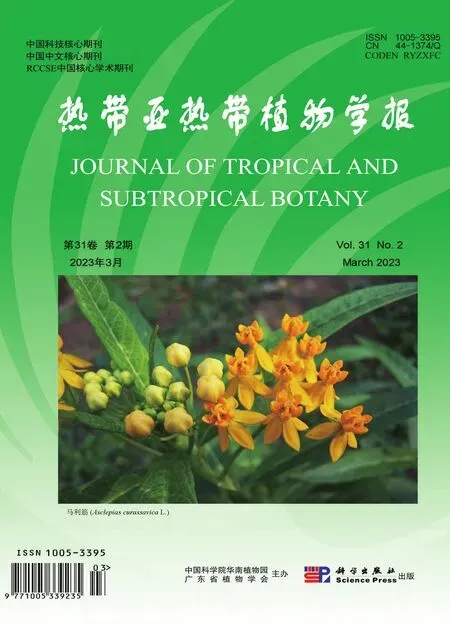
Bulbophyllum dresslerianum (Malaxideae: Orchidaceae), a New Species from Southern Yunnan, China
2023-04-11 03:22:16HanZhoudongRenZongxinJiangHongWangHong
熱帶亞熱帶植物學(xué)報 2023年2期
Han Zhoudong,Ren Zongxin, Jiang Hong, Wang Hong*
(Malaxideae: Orchidaceae), a New Species from Southern Yunnan, China
Han Zhoudong1,2,Ren Zongxin1, Jiang Hong3, Wang Hong1*
(1.Key Laboratory for Plant Biodiversity and Biogeography of East Asia, Kunming Institute of Botany, Chinese Academy of Sciences,Kunming 650201, China; 2.University of Chinese Academy of Sciences, Beijing 100049, China; 3. Yunnan Academy of Forestry/Yunnan Laboratory for Conservation of Rare, Endangered & Endemic Forest Plants, National Forestry and Grassland Administration,Kunming 650204, China)
Z. D. Han & H. Wang (Orchidaceae), a new species from southern Yunnan, China, is described and illustrated. The new species belongs to sectionSeidenf., sharing some vegetative and floral traits with,,and, but differs on the basis of a suite of floral characters. Globular papillae decorate the lip epichile with the abaxial side and margins bearing sparse short glandular hairs. In addition, its lateral sepals are brownish-yellow and glabrous. A key toand its related species is provided. Currently, this species is only found in one population, its conservation status requires further assessment.
New species;; Labellum/lip; Section; Sourthern Yunnan
Thouars is the largest genus in the orchid family in the subfamily Epidendroideae, with ca. 2 200 species[1–3]. It is widely distributed in tropicaland subtropical regions of the Americas, Africa, Mada- gascar, Asia, and Australasia[4]. Most species within the genusare epiphytic or lithophytic with long, creeping or dangling rhizomes. Secondary stems grow as pseudobulbs with one or two usually fleshy or leathery leaves at their apices. The scape arises from the base of the pseudobulb producing a racemose or umbellate inflorescence. The dorsal sepal is free from the lateral sepals while the lateral sepals are free or connate. The petals are also free from each other and smaller than the lateral sepals. The lip (labellum) is often fleshy, curved and hinged at the base of the column. Variation in floral modifi- cations based on size, organ shape, pigmentation patterns and epidermal sculpturing makesone of the most complicated genera within the family[2,5].
Approximately 110 species of the genusare distributed through tropical and subtro- pical forests in southern China[6]and this includes several new taxa described in recent years[7–9]. Ongoing biogeographic analyses ofwith ancestral area reconstructions identify the Asian- Pacific region as the ancestral area of the lineage suggesting an early-to-late Miocene dispersal from east to west with subsequent speciation events[10].
During fieldwork in Mojiang County, Yunnan Province, we found some small plants of an uniden- tifiedspecies growing on the trunks of nativetrees in February and March 2017. We collected some plants for cultivation in the nursery of Yunnan Academy of Forestry. Three plants flowers in March 2017 providing us with sufficient material for comparative morphological analyses and a subsequent description of a new species. The surviving plants showed vegetative and floral traits indicative to SectionSeidenf.
Sectionremains a small section within genus. Almost all members of this section are deciduous, dropping their leaves at the onset of winter. The section consists currently of 13 species[11–12]distributed from India to Indochina, Thailand, Java, and China. Seven species are distri- buted in Yunnan, China[13]. Therefore, we needed to compare these Yunnan specimens with previously described taxa within sectionfocusing on four congeners with distributions in southern Asia. This permitted segregating and describing a new species in section.
1 Materials and methods
All morphological traits and measurements of the three plants in the vegetative state were taken from living specimensMeasurements and obser- vations continued using the same plants as they flowered in the greenhouse of the Yunnan Academy of Forestry. Flowering plants were photographed using Nikon D300. Floral traits were recorded using a fresh flower from a plant designated as the holotype. Floral organs were carefully dissected, photographed and measured with digital calipers to an accuracy of 0.1 mm, prior to pressing them with the holotype. We pressed other plants in flowers as isotypes.
We developed a data set based on vegetative and floral traits using our living plantsand.We also checked additional herbarium sheets ofspecies belonging to the Yunnan Academy of Forestry (YAF), the Kunming Institute of Botany, the Chinese Academy of Sciences (KUN) with additional sheets from Chinese collections at PE and IBSC.Unfortuately, there were no specimens available of the four species in sectionconsidered most closely allied to our plants (Table 1). Therefore, to compare floral traits of our plants toSeidenf.,Seidenf.,Seidenf.,andCSP Parish & Rchb. f., we used photos of flowers of online herbarium sheets including types from AMES, MNHN, NL and K. We also used Seidenfaden[11]to compare previous descry- ptions of related species in sectionto our own measurements and descriptions.
2 Results
Z. D. Han & H. Wang sp. nov. Figs. 1, 2
Diagnosis:is similar to,,, andin terms of morphological structure of flowers. This new species can be distinguished fromby dorsal sepal ovate to narrowly ovate, lateral sepals absent rugose-papillae, and the margins and adaxial side of epichile with sparely short glandular hairs. It can be distinguished fromwith the epichile of lip with globular papillae. In addition, the new species can be distinguished fromandwith the margins of dorsal sepals irregularly fimbriated, the petal ovate-lanceolated and the margins of petal fimbriated.
Type: CHINA. Yunnan: Kunming, voucher from the cultivated plant at Yunnan Academy of Forestry, 15 March 2016, H. Jiang et al. 07360 (Holotype: KUN!; Isotypes: YAF!), collected originally in CHINA. Yunnan: Mojiang County, Mengnong Town, Bingman village, in mixed broadleaf-conifer forest. Alt. 1 400 m, 23°45′ N, 101°30′ E.
Description: Epiphytic herb. Pseudobulbsclumped and congested, brownish-green, depressed ovoid, 1.5– 2.0 cm in diameter, with 2 leaves at each apex. Leaves deciduous prior to anthesis, oblong, ca. 13.0 cm× 2.0 cm, leaf lamina with an acute apex. Inflorescenceracemose and noddingarising from the base of the current year’s pseudobulb, terminating in ca. 20 overlapping flowers, 20 cm long, with 3 tubular sheaths, ca. 6.0 cm. Floral bracts yellowish, ovate- lanceolate, ca. 5.0 mm, apex acuminate. Dorsal sepal brownish yellow,wide ovate-lanceolate, ca. 5.0 mm× 2.0 mm, margins irregular and minutely dentate, apex long acuminate. Lateralsepals brownish yellow with purple spots, narrowly oblong, 27.0 mm×3.5 mm, glabrous, twisted near bases, and connate on lower edges, margins entire, apex obtuse. Lateral petals with whitish centers and purple-red margins,obliquely ovate-triangular, ca. 2.0 mm×1.0 mm, margins irre- gular fimbriate-ciliate, apex long acuminate.Labellum/ Lipsurfacedeep purple-maroon with a white abaxial surface, subligulate, ca. 2 mm long, fleshy, basal part attached to a column foot by a mobile hinge, margins and abaxial side of epichile sparsely deco- rated with short hairs, epichile densely ornamented with shiny globular papillae, apex obtuse. Column white and reduced, ca. 2.0 mm long, column wings triangular-falcate, ca. 0.5 mm long with a white, short, column foot. Anther cap subglobose, apex densely papillate. Pollinia 4, in 2 pairs.
Etymology: The species is named for the late Robert Louis Dressler (1927—2019), an authority on the taxonomy of Neotropical Epidendroideae (including the Malaxideae) and his contributions to the evolu- tionary ecology of the Orchidaceae.
Chinesevernacular name:斯勒卷瓣蘭(sī lè juǎn bàn lán)
Phenology: This new species was observed flowering in March, and fruiting from May to June.
Distribution and habitat:is currently found only in one location in southern Yunnan. We did investigate other possible locations near Mojiang in 2017, but without success. It is an epiphytic species growing on oak tree trunks in the mixed coniferous forest at an elevation of 1 400 m.
Specimens of related species examined using herbarium sheet photos:: Burma, Ranpetlet, Chin Hills, 7 500 ft (c. 2 300 m), Dickason 8 444 (holotype AMES!); Manipur, Chandel Distr., Chakpikarong, 24°23.484′ N, 94°07.088′ E, alt. 1 434 m, in subtropical rain forest, 25 Jan. 2013, Chowlu 00333 (CAL);Chowlu 000325 (Herbarium of Centre for Orchid Gene Conservation Eastern Hima- layan Region, Hengbung).: Vietnam, Annam: un peu au sud de la station agricole de Blao, prov. du Haut Dona?, 750 m, Poilane, E. 22157 (MNHN-Paris); Thailand, Province: Chiang Mai, District: Chiang Dao, Doi Chiang Dao Animal Sanctuary, near Huay Mae Gawk Station, 1 450 m, 4 March, 1995, Maxwell, J F95-200 (NL); Myanmar, Parish, C. S. P. 308, K000829091 (K).
Conservation status: The new species is kown only from the type locality. It is restricted to one population of ca. 20 individual plants discovered during our field trips. As more populations may be found with additional field surveys in these under- explored regions we regard this species as Data Deficient (DD: IUCN 2019)[14].
3 Discussion
Orchids in this section are unique among the Asianspecies as they have two leaves per pseudobulb and leaf like foral characteristics similar to those described in of section(Lindl.) Rchb. f.[5]. Most plants in sectionare deciduous, the leaves dropping in the winter, and then the inflorescence arises from the leafless pseudobulbs during the winter or in the following spring. These distinct characters made this section easy to distinguish from other in the genus. Sectionoccurs through subtropical- tropical regions withis distributed from India to Myanmar,found in Myanmar and Thailand,in Thailand, whileoccurs in Myanmar, northern Thailand, and Vietnam. Our new species expanded the distri- bution of this section further north into southern Yunnan.

Fig. 1 Bulbophyllum dresslerianum. A: Bract; B: Dorsal sepal; C: Petals; D: Plant; E: Sepals, petals, and lip; F: Flower (front view); G: Column with ovary; H: Lip (lateral view); I: Lip (dorsal view). All photos from a flower of the holotype.

Fig. 2 Comparison of three related species with Bulbophyllum dresslerianum. A: Plant of B. dresslerianum; B: B. dresslerianum;C: B. tripudians;D: B. dickasonii;E: B. rugosisepalum;1: Flower (front view); 2: Dorsal sepal; 3: Petal; 4: Lip (Drawn by Lan Yan and Lin Wang based on type photos of B. dresslerianum and B. dickasonii, and drawing of B. tripudians).
The new species,, does not have vegetative characters distinct from,,. andIt does not have unique floral traits absent in all, four, allied, species either (Table 1). Instead, the new species is unique due to a linked suite of labellum and lateral petal traits that do not link in the remaining four species. It is the only species in which the epichile surface is densely decorated with globular papillae while its abaxial surface wears a few, short glandular hairs. In turn, these labellum traits link with the flower’s ovate lateral petals with fimbriate margins. A key to distinguishwith other four allied species was provided.
The transition from tropical, to subtropical, to temperate into montane vegetation in sourthern Yunnan allows some orchid lineages, including the genus, to colonize new niches based on extensive variations in topology and climate[15]. With the description of, Sectionextends northward into a cooler, coniferous- oak ecosystem. It is not surprising that new plant taxa are found continuously in this biodiversity hotspot[16]. With further field investigations, we expect to find more populations of this new species and perhaps more newspecies considering the high vagility of orchid seeds and the speciation model proposed by Trenblay et al.[17].

Table 1 Comparative floral morphology ofBulbophyllum dresslerianum and four allied species in section Tripudianthes
Key to the four species related to
1. Lateral sepals with densely rugose-papillose papillae surface································································
1. Lateral sepals with smooth suface
2. Dorsal sepal with entire margin
3. Lip with very sparsely and short hair································································································
3. Lip with densely fine hair················································································································
2. Dorsal sepal with irregularly fimbriate margin
4. Lip without globular papillae············································································································
4. Lip with globular papillae··········································································································
Acknowledgements We are grateful to Mr. Changfei Peng for his help in the field, Mr. Jidong Ya for checking a part of specimens of related species, Ms. Lan Yan and Lin Wang for the illustration.We would also like to thank Prof. Peter Bernhardt of the Missouri Botanical Garden for his suggestions on improving the manuscript.
[1] LANG K Y, TSI Z H.Thouars [M]// Wu Z Y. Flora Xizangica, Vol. 5. Beijing: Science Press, 1987: 817–829. (in Chinese)
[2] PRIDGEON M A, CRIBB P J, CHASE M W, et al., genera, Epidendroideae (part three) [M]. Oxford: Oxford University Press, 2014: 4–51.
[3] GYELTSHEN P, GURUNG D B, KUMAR P.(Orchidaceae: Epidendroideae: Dendrobieae), a new species from Bhutan [J]. Phytotaxa, 2020, 436(1): 85–91. doi: 10.11646/phy totaxa.436.1.9
[4] VERMEULEN J J.[M]// Pridgeon A M, Cribb P J, Chase M W, et al. Genera Orchidacearum 6, Epidendroideae (Part three). Oxford: Oxford University, 2014: 4–51.
[5] TEOH E S.Thouars. [M]// Orchid Species from Hima- laya and Southeast Asia, Vol. 1 (A-E). Cham: Springer, 2021: 97–169.
[6] CHEN S C, VERMEULEN J J.Thouars. [M]// WU Z Y, Raven P R, Hong D Y. Flora of China, Vol. 25. Beijing: Science Press & St. Louis: Missouri Botanical Garden Press, 2009: 404–440.
[7] ZHOU T T, JIN X H.(Orchidaceae; Epidendroideae; Malaxideae), a new species from Yunnan, China [J]. Phytotaxa, 2015, 234(1): 95–97. doi: 10.11646/phytotaxa.234.1.8
[8] ZHAI J W, CHEN X P, CHEN Y Q, et al., a new species from Yunnan, China: Morphological and molecular evidence (Orchidaceae; Epidendroideae) [J]. Phytotaxa, 2017, 298(1): 77–82. doi:10.11646/phytotaxa.298.1.8
[9] YA J D, ZHANG T, PANDEY T R, et al. New contributions to Goodyerinae and Dendrobiinae (Orchidaceae) in the flora of China [J]. Plant Diver, 2021, 43(5): 362–378. doi: 10.1016/j.pld.2021.05.006
[10] GAMISCH A, COMES H P. Clade-age-dependent diversification under high species turnover shapes species richness disparities among tropical rainforest lineages of(Orchidaceae) [J]. BMC Evol Biol, 2019, 19: 93. doi: 10.1186/s12862-019-1416-1
[11] SEIDENFADEN G. Orchid Genera in Thailand VIII (Thou.) [M]. Dansk Botanisk Arkiv, 1979, 33(3): 188–198.
[12] SEIDENFADEN G. Contributions to the orchid flora of Thailand, XII [J]. Opera Bot, 1995, 124: 37–38.
[13] XU Z H, JIANG H, YE D P, et al. The Wild Orchids in Yunnan [M]. Kunming: Yunnan Science & Technology Press, 2010: 367–415. (in Chinese)
[14] IUCN. Guidelines for Using the IUCN Red List Categories and Criteria, Version 14 [M]. UK: Gland, Switzerland and Cambridge, 2019: 5–98.
[15] CHEN S C, TSI Z H, LUO Y B. Native Orchids of China in Colour [M]. Beijing: Science Press, 1999: 25–48. (in Chinese)
[16] CAI J, YU W B, ZHANG T, et al. China’s biodiversity hotspots revisited: A treasure chest for plants [J]. PhytoKeys, 2019, 130: 1–24. doi: 10.3897/phytokeys.130.38417
[17] TREMBLAY R L, ACKERMAN J D, ZIMMERMAN J K, et al. Variation in sexual reproduction in orchids and its evolutionary consequences: A spasmodic journey to diversification [J]. Biol J Linn Soc, 2005, 84(1): 1–54. doi: 10.1111/j.1095-8312.2004.00400.x
斯勒卷瓣蘭,中國云南南部蘭科一新種
韓周東1,2, 任宗昕1, 蔣宏3, 王紅1*
(1. 中國科學(xué)院昆明植物研究所東亞植物多樣性與生物地理學(xué)重點實驗室,昆明 650201;2. 中國科學(xué)院大學(xué),北京 100049;3. 云南省林業(yè)和草原科學(xué)院/國家林業(yè)和草原局云南珍稀瀕特森林植物保護和繁育重點實驗室,昆明 650204)
描述并繪制了云南南部蘭科石豆蘭屬一新種:斯勒卷瓣蘭(Z. D. Han & H. Wang)。該新種屬于雙葉卷瓣蘭組(sectionSeidenf.),在形態(tài)上與該組的4種,即狄氏卷瓣蘭()、堪布里石豆蘭()、皺掌卷瓣蘭()和擬雙葉卷瓣蘭()近似,主要區(qū)別在于該種唇瓣前緣具囊泡,側(cè)面及腹面被稀疏的短腺毛;側(cè)萼片棕黃色,表面光滑。編制了斯勒卷瓣蘭及其近緣種的檢索表。目前,該種僅在云南南部墨江縣發(fā)現(xiàn)一個居群,瀕危狀況有待評估。
新種;石豆蘭屬;唇瓣;雙葉卷瓣蘭組;云南
10.11926/jtsb.4578
2021-11-25
2022-01-27
This work was supported by the Special Foundation for the National Science and Technology Basic Research Program of China (Grant No. SQ2021FY010017), and the National Wild Seed Resource Center (Grant No. ZWGX1809).
HAN Zhoudong (Born in 1996), Undergraduate, interesting in taxonomy of Orchidaceae. E-mail: hanzhoudong@mail.kib.ac.cn
Corresponding author. E-mail: wanghong@mail.kib.ac.cn