富氧空位的非晶氧化銅高選擇性電催化還原CO2制乙烯
2023-03-15 10:05:32韋天然張書勝劉倩邱園羅俊劉熙俊
物理化學(xué)學(xué)報(bào) 2023年2期
關(guān)鍵詞:實(shí)驗(yàn)室
韋天然,張書勝,劉倩,邱園,羅俊,5,劉熙俊,*
1廣西大學(xué)有色金屬及材料加工新技術(shù)教育部重點(diǎn)實(shí)驗(yàn)室,廣西有色金屬及特色材料加工重點(diǎn)實(shí)驗(yàn)室,資源環(huán)境與材料學(xué)院,南寧 53004
2鄭州大學(xué)化學(xué)學(xué)院,鄭州 450000
3成都大學(xué)高等研究院,成都 610106
4電子科技大學(xué)深圳高等研究院,廣東 深圳 518110
5天津理工大學(xué)新能源材料與低碳技術(shù)研究院,材料科學(xué)與工程學(xué)院,天津 300384
1 Introduction
Ethylene (C2H4), one of the most critical hydrocarbons, is mainly produced by the cracking reaction of naphtha or the distillation of cracking gas1-3. Accordingly, great efforts have been made to develop an eco-friendly and cost-effective route for C2H4production. In this regard, the electrocatalytic CO2reduction (ECR)to C2H4under ambient conditions offers a promising pathway to replace the industrial steam cracking process4-10, which enables to use renewable energies and also reduces anthropogenic CO2emissions11-14. However, the chemical inert of CO2molecule and multielectron transfer processes involved in the ECR-to-C2H4hinder the economic feasibility of this proposed conversion process6,7,15.
Copper oxides (CuOx)or their derived Cu materials have been proved to possess high activity for the ECR-to-C2H4. For instance, O2plasma-activated CuOxafforded a C2H4faradaic efficiency of 60% at -0.9 Vversusthe reversible hydrogen electrode (vs.RHE)5. Cu-CuOx/rGO catalyst achieved a high C2H4faradaic efficiency of 54% and a corresponding C2H4partial current density of -11.64 mA·cm-2at -1.2 Vvs.RHE16.Operando and theoretical studies confirmed that the presence of Cu+is responsible for enhanced C2H4selectivity during the CO2electrolysis5,10,17. Meanwhile, oxygen vacancy (Vo)has been considered as the Lewis base site that can activate CO2molecule to generatemoiety18. Thus, the co-existence of Cu+and Vo synergistically contributes stronger affinities to *CO and *COH,which can optimize the C2H4pathway4. Therefore, this inspires us to seek a catalyst with abundant Cu+and Vo species by employing the atomic regulation strategy19-27, which is considered to be active for C2H4production.
Herein, amorphous CuOxnanofilm (denoted asm-CuOx)deposited on carbon paper was reported to show highly selective electroreduction of CO2to C2H4with a remarkable high C2H4faradaic efficiency and stability, and these performance metrics obtained are comparable with the recently best-reported Cubased ECR catalysts (see details in Table S1, Supporting Information). The presence of abundant oxygen vacancies are beneficial to the activation of CO2molecule and optimization of the affinities to the *CO and *COH key intermediates.Furthermore, when examined in a membrane electrode assembly(MEA)cell, the adhesive-free catalyst delivers a notable high C2H4partial current density and long-term durability.
2 Experimental
2.1 Synthesis of m-CuOx
The vacuum evaporation method was adopted to depositm-CuOxnanofilm on a piece of gas-diffusion layer (GDL)-modified carbon paper (Sigracet 39 BC GDLs were purchased from Fuel Cell Store)using a DM-450 vacuum evaporation machine. The commercial CuO slugs on a tungsten boat were used as precursors. The heating current imposed on the tungsten boat was kept at ~1.5 A, and the evaporation rate was kept at 0.3 nm·s-1during the experiment. The thickness of the evaporated film was monitored by a quartz crystal oscillator. The asobtained carbon paper was directly used as a cathode for CO2electrolysis without further treatment.
2.2 Characterizations
The morphologies and microstructures of samples were characterized by scanning electron microscopy (SEM, FEI Verios 460)and transmission electron microscopy (TEM, Talos F200X)equipped with an energy dispersive spectrometer (EDS).Powder X-ray diffraction (XRD)pattern was recorded by an X-ray diffractometer (Rigaku SmartLab 9 kW)at a scan rate of 10 (°)·min-1with CuKαradiation (λ= 0.154598 nm). X-ray photoelectron spectroscopy (XPS)measurement was collected on a Thermo Scientific K-alpha XPS system with the AlKαradiation as the X-ray source, and the C 1speak was referred to the binding energy of 284.8 eV. Electron paramagnetic resonance (EPR)signals were collected on a JES FA200 spectrometer. CO temperature programmed desorption (COTPD)experiments were performed with a 10 °C·min-1temperature ramp from 50 °C up to 350 °C.
2.3 ECR performance
ECR tests were first conducted with an electrochemical station (CHI 760E)in an H-type cell with 50 mL 0.1 mol·L-1KHCO3solution. The two compartments were separated by a Nafion membrane. Ag/AgCl and graphite rod were used as the reference and counter electrodes, respectively. Carbon paper coated with them-CuOxnanofilm was used as the working electrode. Prior to the ECR, the cathodic electrolyte was saturated with CO2/Ar for 30 min, and the rate of CO2flow was 20 mL·min-1. The linear sweep voltammetry (LSV)curves were recorded at a sweep rate of 10 mV·s-1.iRcompensation was applied to all initial data. All of the potential values were calculated based on the equation:ERHE=EAg/AgCl+ 0.0591pH +0.197. The gaseous products were detected by gas chromatography (Agilent GC-7890). The liquid products were analyzed by1H NMR on AVANCE AV III 400 with water peak suppression. The controlled potential electrolysis was performed at each potential for 2 h.
2.4 MEA tests
Accoridng to our previous work13, an aqueous MEA cell was assembled usingm-CuOxas the cathode, and a Ti felt coated with commercial IrO2catalyst was applied as the anode. The humidified CO2gas was kept at 50 standard cubic centimeter per minute (sccm)during the testing and the anodic electrolyte(3 mol·L-1KHCO3)was circulated. The feed gas of humidified CO2was first heated to 50 °C and then injected into the cathode chamber. The anode and cathode were physically separated by an anion exchange membrane (AEM). The used AEM is FBAPK-13 with a thickness of 130 μm. The operating temperature is 25 °C, and the electrode area is 2 cm2.
2.5 DFT calculations
According to the literature4, our computational simulations were performed by Viennaab-initiosimulation package (VASP)with the projector augmented wave pseudo-potentials (PAW)to describe the interaction between atomic cores and valence electrons with DFT. The Perdew-Burke-Ernzerhof (PBE)functional within the generalized gradient approximation (GGA)were used to implement DFT calculations. Pure Cu2O and Cu2O/CuO slab models with a (3 × 3)unit cell was employed to simulate the catalyst surface.
3 Results and discussion
As presented in Fig. 1a, for the synthesis ofm-CuOxnanofilm,a peice of carbon paper was first placed on the sample holder,and then the Cu2O powder was evaporatedviahigh-temperature pyrolysis, and subsequently coated on the surface of carbon paper to obtainm-CuOxnanofilm28,29. It is expected that the nano-scale thickness of deposited catalyst layer is beneficial to the mass and charge transfer during the CO2electrolysis. Of note, this synthetic approach provides good scalability and fidelity of the product, verified by Fig. S1. For comparison,commercial crystalline Cu2O (namelyc-Cu2O)powder was used as the reference sample (Fig. S2).
The XRD pattern ofm-CuOxin Fig. 1b only shows one broad peak at about 25.5°, implying the amorphous nature ofm-CuOx,which is different from those ofc-Cu2O with notable diffraction peaks at 29.6°, 36.4°, 42.3°, 52.5°, 61.3°, 73.5°, and 77.3°corresponding to Cu2O (JCPDS No. 05-0667, Fig. S3).
The SEM image in Fig. 1c reveals thatm-CuOxis uniformly distributed on the carbon paper surface to form a thin film layer.(TEM and SEM images reveal that the amorphous layer is composed of many nanoparticles (Fig. 1d and S3). Highresolution TEM (HRTEM)and the corresponding selected-area electron diffraction (SAED)analysis further confirms the amorphous feature ofm-CuOx(Fig. 1e), which is consistent with the XRD result.

Fig. 1 Synthesis and characterizations of m-CuOx.

Fig. 2 Chemical characterizations of m-CuOx.
Furthermore, the high-resolution XPS spectra for Cu 2pin Fig. 2a can be deconvoluted into two peaks located at 932.2 and 935.0 eV, which are ascribed to Cu+and Cu2+, respectively30-33.Accordingly, the ratio of Cu+/Cu2+is calculated to be 2 :3 by integrating peak areas, and this value is obviously smaller than that ofc-Cu2O (Fig. S5). It has been demonstrated that the mixed valence Cu species are beneficial to C2H4formation34,35.In addition, from the O 1sXPS spectrum (Fig. S6), one peak at 531.7 eV corresponds to the Vo in the lattices18,36,37and the ratio of the lattice oxygen in them-CuOx(54%)is found to be less than that ofc-Cu2O (68%). Moreover, EPR spectra in Fig.2b further demonstrate that there are more Vo sites in them-CuOxas compared toc-Cu2O38, which is in line with XPS analyses.
Vo is known to possess weakly bounded electrons, and can act as excellent Lewis base sites, which favors CO2adsorption and donors electrons to yield4,11,25. Thus, DFT calculations were performed and the results are depicted in Fig. S7, which indicates that a higher CO2adsorption energy (ΔEads)was achieved onm-CuOxas compared toc-Cu2O, which agrees well with the literature4,6. Furthermore, volumetric CO2adsorption measurements were performed and verified thatm-CuOxabsorbs more CO2than that ofc-Cu2O (Fig. 2c), suggesting the increased CO2adsorption capacity ofm-CuOx28,39.
For the selective ECR-to-C2H4, the affinity with *CO intermediate on the catalyst surface plays an important role in determining the C2H4pathway1,4. Therefore, the CO-TPD result shows a positive shift form-CuOx, implying its enhanced CO binding capability, which is in accordance with the calculated results (Fig. S8). Apart from *CO intermediate, the affinity with*COH and *CH2species also affect the C2H4selectivity ofm-CuOx7,10,17. Based on the calculated ΔEadsvalues in Fig. S8,m-CuOxexhibits a larger ΔEadsvalue than that ofc-Cu2O for *COH adsorption, and meanwhilem-CuOxfavors the desorption of*CH2species. All the above results demonstrate thatm-CuOxis highly active for the ECR-to-C2H4.
The ECR experiments ofm-CuOxwere further examined in a gastight H-cell with CO2-saturated electrolyte under ambient conditions. All the reported potentials in this work areversusthe RHE scale according to the Nernst formula. As indicated by the LSV curves in Fig. S9, the obtained current density ofm-CuOxrecorded in CO2-saturated electrolyte is larger than that in the Ar-saturated case, suggesting that the higher ECR selectivity ofm-CuOxin comparison with the hydrogen evolution28,40.Meanwhile,m-CuOxshows a distinctly higher reduction current density than that onc-Cu2O in the applied potential range(Fig. 3a). This indicates thatm-CuOxhas higher ECR activity than that ofc-Cu2O. Moreover, the geometric current densities ofm-CuOxandc-Cu2O were further normalized by the electrochemical surface area (ECSA)estimating from the double-layer capacitance measurements41-45. As indicated by the ECSA-corrected LSV curves in Fig. S10,m-CuOxdelivers a larger current density than that ofc-Cu2O, confirming the superior intrinsic ECR activity46.

Fig. 3 ECR performance of m-CuOx.
With continuous CO2flow, electrochemical CO2reduction was checked under different potentials, and the gas/liquid products were characterized by gas chromatography and1H NMR. Product analysis indicates C2H4as the predominant ECR product in the cathode compartment and an amount of H2, CO,and CH4over the potential range examined (Fig. S11). Fig. 3b shows the C2H4faradaic efficiencies at different applied potentials. As seen,m-CuOxshows a maximal C2H4faradaic efficiency of 85% ± 3% at -1.3 Vvs.RHE, which is significantly higher than that ofc-Cu2O counterpart (21% ± 2% at -1.3 Vvs.RHE). It should be noted that the maximal C2H4faradaic efficiency value ofm-CuOxcan be one of the best reported results of Cu-based catalysts (Table S1). No liquid products can be observed (Fig. S12). The Tafel slope as a descriptor of the ECR kinetics was analyzed (Fig. 3c), which gives a value of 147 mV·dec-1form-CuOx. This value is obviously smaller than that ofc-Cu2O (290 mV·dec-1), implying the faster ECR kinetics ofm-CuOxin comparison withc-Cu2O47-50.
The chronoamperometric stability of the ECR-to-C2H4onm-CuOxwas evaluated at -1.3 Vvs.RHE. Strikingly,m-CuOxdisplays a stable C2H4faradaic efficiency and current density during the 48 h electrolysis (Fig. 3d). Additional SEM/TEM images, XRD/SAED patterns, impedance plots, and EPR characterizations further verify the morphological and electrochemical stability ofm-CuOx(Fig. S13-S17).Interestingly, XPS spectrum ofm-CuOxrecorded after the catalytic test (Fig. S18)suggests that the catalyst was partially reduced under reaction conditions, in line with the literature51,52.Meantime, the presence of Cu+species and residual subsurface oxygen were recently confirmed to be responsible for the high selectivity of CO2-to-C2H44,6,53-55.
In order to evaluate the electrocatalytic CO2reduction ofm-CuOxat high current density, an MEA electrolyzer was adopted(Fig. 4a). Commercial IrO2-coated Ti foam was employed as the anode to drive the oxygen evolution reaction56-60. The anionexchange membrane was used to separate the cathodic from the anodic compartment. Of note, the amorphous CuOxnanofilm was deposited on the GDL-modified carbon paper and in direct contact with the AEM, both of which induce a minimal ohmic resistance61-63. As observed in Fig. 4b, LSV curves show thatm-CuOxachieved much higher current density than c-Cu2O, a sign of higher activity ofm-CuOx. As presented in Fig. 4c,m-CuOxexhibits a peak C2H4faradaic efficiency of 78% ± 2% at a cell voltage of -1.75 V, which is significantly higher than that ofc-Cu2O (17% ± 3% at -1.75 V).
Furthermore, the C2H4partial current density was observed to be greatly increased form-CuOxin comparison withc-Cu2O(Fig. 4d). This suggests that mass transport onm-CuOxis more efficient especially at more negative cell voltage64-66. The peak current density ofm-CuOxfor C2H4production reaches ~115.4 mA·cm-2, significantly higher than that ofc-Cu2O (~3.7 mA·cm-2), further confirming the superiority ofm-CuOx.
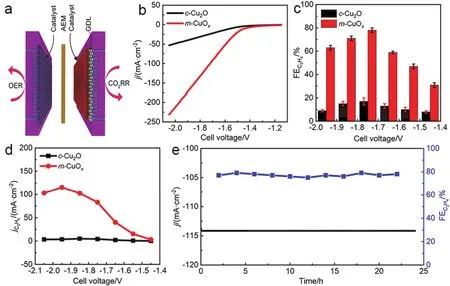
Fig. 4 ECR performance of m-CuOx in an AEM-based MEA electrolyzer.
To evaluate the stability ofm-CuOxbased electrode, the chronoamperometry at a fixed cell voltage potential of -1.75 V was conducted (Fig. 4e). Apparently, the current density and corresponding C2H4faradaic efficiencyshow no notable decay during the 24-h electrolysis, implying the favorable stability ofm-CuOx. Consequently, under high current density, the achieved high activity and stability ofm-CuOxtoward C2H4production greatly enhance the economic viability of ECR.
4 Conclusions
In summary, an efficient ECR catalyst with abundant Cu+and oxygen vacancies was achieved by simply depositing amorphous CuOxlayer on the carbon paper. The amorphous CuOxcatalyst can synergistically activate CO2molecule and optimize the affinity with *CO, *COH, and *CH2intermediates. Accordingly,the catalyst shows high selectivity of CO2-to-C2H4with a maximal faradaic efficiency of 85% ± 3% and an outstanding durability over 48 h in an H-cell. In addition, this catalyst also demonstrates a high C2H4selectivity when operating in an AEM-based MEA electrolyzer and delivers a high faradaic efficiency(> 75%)at a large partial current density (~115.4 mA·cm-2),suggesting a compelling alternative to the steam cracking process. This work offers an effective avenue to develop highperformance amorphous Cu-based catalysts for the highly selective CO2-to-C2H4.
Supporting Information:available free of chargeviathe internet at http://www.whxb.pku.edu.cn.
猜你喜歡
電子競(jìng)技(2020年8期)2020-12-23 04:09:40
電子競(jìng)技(2020年7期)2020-10-12 10:45:48
電子競(jìng)技(2020年5期)2020-08-10 08:43:10
電子競(jìng)技(2020年4期)2020-07-13 09:18:06
電子競(jìng)技(2020年2期)2020-04-14 04:40:38
電子競(jìng)技(2020年11期)2020-02-07 02:49:36
電子競(jìng)技(2020年9期)2020-01-11 01:06:21
電子競(jìng)技(2020年10期)2020-01-11 01:06:06
電子競(jìng)技(2019年22期)2019-03-07 05:17:26
電子競(jìng)技(2019年21期)2019-02-24 06:55:52