
LAND OF MILK TEA AND HONEY
2022-12-30 03:42:18TEXTBYSAMDAVlESPHOTOGRAPHYBYYUKAlPENGADDlTlONALPHOTOGRAPHSFROMVCG
漢語(yǔ)世界 2022年6期
TEXT BY SAM DAVlES, PHOTOGRAPHY BY YUKAl PENG ADDlTlONAL PHOTOGRAPHS FROM VCG
How a budget brand rose to become China’s biggest milk tea franchise
蜜雪冰城為什么這么惹人愛(ài)?
Right now ought to be a tough time to sell milk tea in China. Around three years into the Covid-19 pandemic,approximately 370,000 food and beverage outlets in the country have closed, nearly 22 percent of them milk tea shops, according to business news publication Late Post.
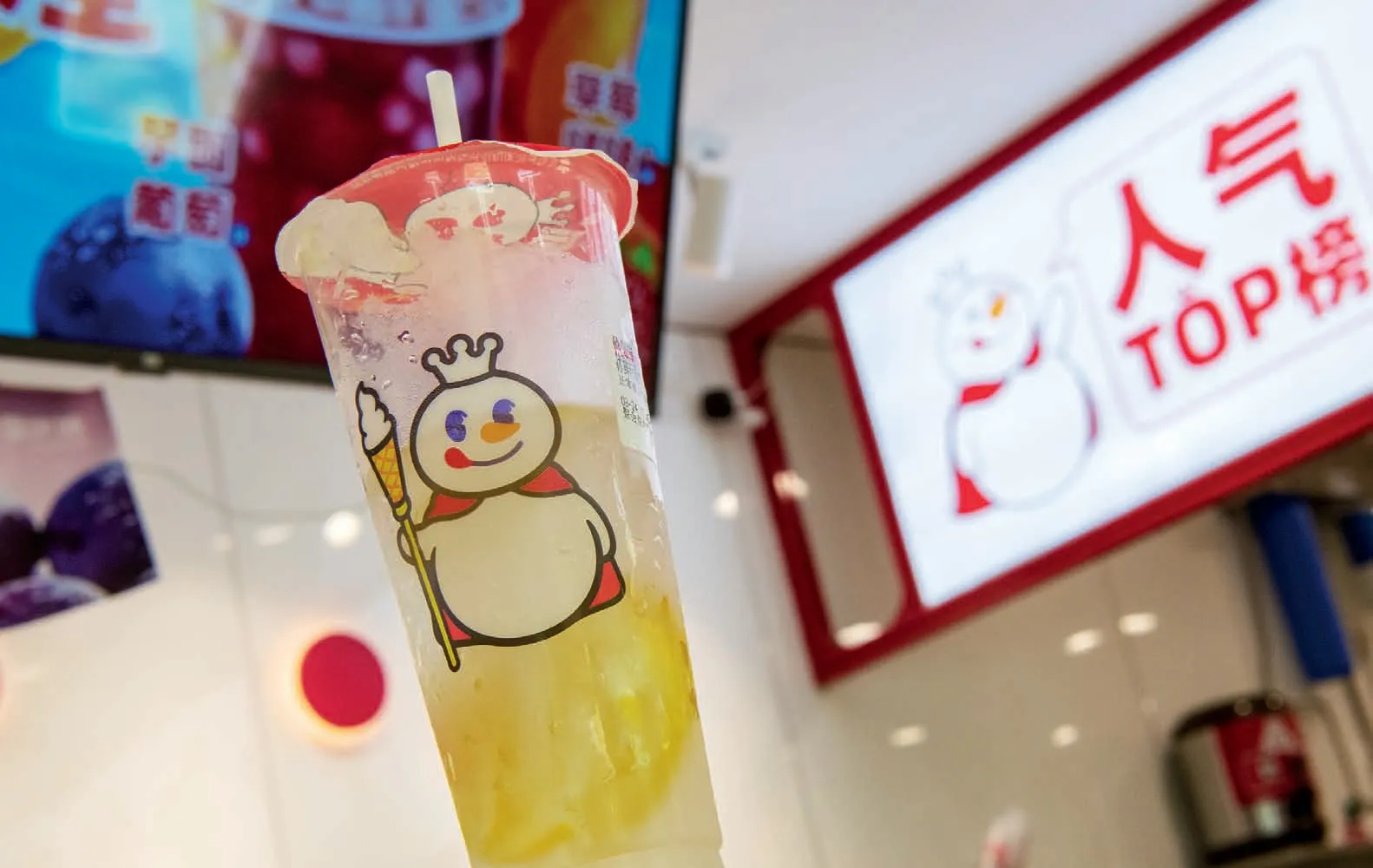
Yet amid this industry-wide carnage,with consumers tightening their belts and rolling lockdowns suppressing street commerce, one budget milk tea brand with garish marketing, almost no fresh ingredients, a bizarre snowman(known as the “Snow King”) as its brand ambassador, and 2 yuan ice cream is expanding at around 6,000 new stores a year.
Mixue Bingcheng, or Mixue Ice Cream and Tea, was founded in 1997 by brothers Zhang Hongchao and Zhang Hongfu from rural Henan province, as a small ice cream, drinks,and fast-food joint in a dusty part of the provincial capital, Zhengzhou. It has since developed into the largest and probably most profitable milk tea and ice cream empire in the country,with over 20,000 stores—mostly in less affluent provincial hubs, suburbs,student areas, and “l(fā)ower-tier” cities.The company made 1.91 billion yuan in profits in 2021 (a year when it sold an estimated 3.5 billion drinks),has a viral social media presence, and has even gone international, with hundreds of stores mainly across Southeast Asia. It has boomed via a low-price strategy and low-cost business model which first targeted less affluent customers in smaller cities, and has even inspired higherend brands to lower prices and follow its lead.
For consumers, the price of Mixue is the main draw. “A large cup of lemon tea costs just 4kuai,” says 30-yearold Beijing resident Li Zhengyi,explaining that he buys it to feel“cool and refreshed.” Used to more expensive drinks priced around 20 yuan or higher, Li, who works in social media marketing for food products,first came across Mixue in a small city in Sichuan province, and initially“thought it was a copycat version of one of the more high-end milk tea shops.”
With the country’s economy slowing,graduate unemployment high, and pandemic controls weighing on demand, some consumers have been drawn toward low-priced alternatives t
o their favorite brands. In the milk tea industry, that has meant budget brands like Mixue are now expanding even into the largest cities like Beijing and Shanghai. Consumers increasingly want “relatively cheaper goods but with a similar experience,”says Hu Yuwan, vice president at Daxue Consulting, a marketing consultancy firm.
For others, the brand’s unpretentious nature and low prices trigger nostalgia. “Their ice cream brings me close to my childhood memories,”Zhang Meng, a 29-year-old from Baotou, Inner Mongolia, tells TWOC,explaining Mixue reminds her of the stalls that used to sell ice cream outside her high school. “It’s not as good as ice cream from [highend milk tea brand] HeyTea, but the memory is wonderful,” Zhang reminisces.
At Mixue, there’s iced lemon tea for 4 yuan, bubble milk tea for 6 yuan,Oreo sundae for 6 yuan, and—the jewel in the Snow King’s crown for nearly 20 years—a soft serve ice cream cone for 2 yuan. Other large brands price their milk tea from around 15 yuan and up, while premium joints such as HeyTea and Lelecha sell at around 30 yuan a drink. Mixue effectively has no major competitors in its price range.
The low prices are suppressed via a franchise system where the company produces its own ingredients and then sells them to stores in vast quantities.
While most other milk tea brands operate their own stores, just 47 of Mixue’s 20,000 outlets are directly operated by the company. The rest are franchisees who pay a management fee typically between 7,000 and 11,000 yuan a year, depending on the shop’s location.
Management fees bring in about 2 percent of Mixue’s annual revenue,while ingredients rake in 72 percent,and equipment like cups and bags make up 20 percent. In 2021, the co
mpany made over 300 million yuan just from selling straws. It might be more accurate to call Mixue a food production and logistics company,rather than a milk tea outlet, since nearly all of its revenue comes from selling ingredients to stores that bear its logo and brand.
The company established its own supply chain in 2012 to produce nearly all its own ingredients, few of which are fresh. Most of their drinks are made from powders, which also reduces cold-chain transportation and storage costs. Using powdered milk instead of fresh, for example, reduces the cost of producing a cup of milk tea by 1.5 yuan, and that’s without the cost of the cold logistics chain required to transport fresh milk.It’s a business model that has proved immensely successful in the last few years. Mixue went from 36 stores in 2007, the year it began to operate via the franchise model, to over 1,000 in 2014, 7,225 stores in 2017, and then over 20,000 today. The next largest milk tea brand, Shuyi, has around 6,000 shops, while premium brand HeyTea has fewer than 1,000. The company’s revenue quadrupled from 2019 to 2022. It may soon float on the Hong Kong Stock Exchange.
But the market is still fiercely competitive, and becoming saturated.On a street in Tongzhou district, an outer suburb of Beijing, there are four different milk tea brands operating stores, in addition to two Mixue outlets, within around 100 meters of each other. At one of the Mixue shops,located at the main entrance to Beijing Wuzi University, 18-year-old Yu Nuoli works 12-hour shifts for a base salary of 4,900 yuan per month plus dorm accommodation.
“If the shop sells a lot, I can make up to 6,000 yuan [with sales-related bonuses],” she tells TWOC in between handling takeout orders and making drinks for a steady stream of customers. The shop can take in around 7,000 yuan on a good day in the summer, she says, though in the winter business is slower, “then we make maybe 3,000.”

As little as 300,000 yuan is all it takes to set up a Mixue store
The store is cramped, around the size of a shipping container, and Yu is the only person on duty when TWOC visits on a Thursday morning.When it gets busier later in the day,she explains, two colleagues will work with her until closing time at midnight.The tiny size and low requirements for opening a Mixue franchise are another advantage for the brand in t
he cut-throat world of China’s milk tea market: Potential franchisees only need 20 square meters to qualify to open a Mixue outlet, and can operate
with as few staff as they like. The short
menu with easy-to-learn drinks took
Yu about seven days to master.
It allegedly took Mixue’s founders almost 20 years to strike the right balance between cost and volume that is now proving so effective. When Zhang Hongchao, who grew up in a village near Kaifeng and didn’t go into further education after middle-school,set up his first store in 1997 under the name Hanliu Shaved Ice, it sold cheap Western fast food like fries too.
He changed the name to Mixue Bingcheng in 1999, and it became a diner selling shredded potatoes for 1.5 yuan. In 2006, they brought out a product that would become their signature: an ice cream cone for 2 yuan, often with a 1 yuan discount.After brother Zhang Hongfu joined the company, Zhang Hongchao thought about changing the brand to be more upmarket. Zhang Hongfu even allegedly worked at a nearby Dairy Queen outlet in Zhengzhou for a week as research, opening a gelato store in 2009. It was a failure, closing in under three years, reportedly making the brothers just 6,500 yuan in that time.
That convinced them for good that low prices, less affluent customers,and a franchise model were where the brand’s future lay. “Mixue is well suited to people living in lower tier cities…or the suburbs where rents and incomes are relatively lower compared to people living in large city centers,”says Hu. Although the economy’s overall growth rate is slowing in China, “in lower-tier cities, there is still a lot of space for brands to grow,”she believes.
Operating as a franchise business,however, brings quality control problems for head office. Since the shops operate independently and are run by different bosses, Mixue’s regional managers struggle to maintain standards. Various outlets have been exposed for food safety scandals, and “[The previous owner of my shop] was often late paying us salary,” says Yu, who started working at her outlet around 18 months ago after moving to Beijing from her hometown in Anhui province. She tells TWOC she sometimes had to borrow money from friends and family to get by.

Founded in Zhengzhou,and once mainly found in less affluent towns and cities, Mixue now operates all across China
The company’s rapid expansion from smaller cities into the mainstream is also due in no small part to its theme song—which Zhang Meng describes as “catchy and brainwashing.” The marketing jingle and music video, featuring crudely animated Snow Kings dancing on multicolored backgrounds singing“I love you, you love me, Mixue Bingcheng super sweet,” to the tune of American folk song “Oh!Susanna,” made Mixue a viral sensation when they were released in June 2021.
The brand clearly hasn’t lost its kitsch and grassroots character.While other milk tea chains seek celebrity brand ambassadors, “the Snow King is [Mixue’s] sole brand representative...and he is ubiquitous on all of their social media channels and their storefronts,” says Eva Hsu,founder of Ripplr, a digital branding company in Shanghai. “Their content speaks to people’s daily lives,daily struggles, and how a cup of tea can make the day better,” Hsu adds, referencing video posts on the company’s social media channels where Snow King meets everyday challenges that he overcomes with tea-based solutions.
While some argue the milk tea market is becoming saturated, for now the Snow King is sitting upon a sweet empire. Mixue has even started a coffee chain called Lucky Cup. The business strategy is simple: low cost,high volume, a franchise model, and a funky mascot—this time modelled after the King in a deck of playing cards, named Grandpa K.
