
Experimental observation of interlayer perpendicular standing spin wave mode with low damping in skyrmion-hosting[Pt/Co/Ta]10 multilayer
2022-11-21 09:30:06ZhenDongChen陳振東MeiYangMa馬眉揚SenFuZhang張森富MangYuanMa馬莽原ZiZhaoPan潘咨兆XiXiangZhang張西祥XueZhongRuan阮學(xué)忠YongBingXu徐永兵andFuShengMa馬付勝
Chinese Physics B 2022年11期
Zhen-Dong Chen(陳振東) Mei-Yang Ma(馬眉揚) Sen-Fu Zhang(張森富) Mang-Yuan Ma(馬莽原)Zi-Zhao Pan(潘咨兆) Xi-Xiang Zhang(張西祥) Xue-Zhong Ruan(阮學(xué)忠)Yong-Bing Xu(徐永兵) and Fu-Sheng Ma(馬付勝)
1Jiangsu Key Laboratory of Opto-Electronic Technology,Center for Quantum Transport and Thermal Energy Science,School of Physics and Technology,Nanjing Normal University,Nanjing 210046,China
2Jiangsu Provincial Key Laboratory of Advanced Photonic and Electronic Materials,School of Electronic Science and Engineering,Nanjing University,Nanjing 210093,China
3School of Physical Science and Technology,Lanzhou University,Lanzhou 730000,China
4Physical Science and Engineering Division(PSE),King Abdullah University of Science and Technology(KAUST),Thuwal 23955-6900,Saudi Arabia
An interlayer perpendicular standing spin wave mode is observed in the skyrmion-hosting [Pt/Co/Ta]10 multilayer by measuring the time-resolved magneto-optical Kerr effect. The observed interlayer mode depends on the interlayer spin-pumping and spin transfer torque among the neighboring Co layers. This mode shows monotonically increasing frequency-field dependence which is similar to the ferromagnetic resonance mode, but within higher frequency range.Besides, the damping of the interlayer mode is found to be a relatively low constant value of 0.027 which is independent of the external field. This work expounds the potential application of the[heavy-metal/ferromagnetic-metal]n multilayers to skyrmion-based magnonic devices which can provide multiple magnon modes, relatively low damping, and skyrmion states,simultaneously.
Keywords: dynamic properties of magnetization,spin waves,domain structure,magnetic properties of interfaces
1. Introduction
With the development of conventional complementary metal–oxide–semiconductor (CMOS) devices approaching to the limit of the Moore’s law, people have paid much attention to beyond-CMOS devices which use other degrees of freedom to code information instead of electron charge.[1–5]Since the 1990s, magnonics has been identified to be particularly promising in all approaches to developing beyond-CMOS devices.[6–14]Magnonics is a new research field which focuses on the characteristics of spin waves, and they are used to carry and process information.[8,10,11]Magnonic devices are expected to possess significant advantages such as high speed, low energy dissipation, broad frequency ranges from gigahertz to terahertz,et al.[10,11]Because of such advantages, lots of magnonic devices have been designed, such as magnon based nano-oscillators, interferometers, logic gates,and transistors.[10,11,13,15–20]
Further studies of magnonics and magnonic devices require a platform to be able to excite different spin wave modes. Thus, the concept of magnonic crystals (MCs) was put forward, in which spin waves can be modulated into magnon bands via artificial periodical structures of magnetic properties.[10,12,21–25]Among new magnetic media,skyrmionbased MCs (SMCs) have attracted much attention in which the periodical structures are constituted by skyrmions.[12,26–31]The SMCs show great potential applications in dynamic and functional magnonic devices due to their dynamical tunability.[26,28]And in recent years,the topological nontrivial magnon bands and the chiral edge magnon states were predicted to exist in SMCs, which provides a new kind of platform for topological physics study and application of the chiral edge magnon states with low energy dissipation.[29–31]In experimental studies, there are a variety of artificial thin-film skyrmion systems with interfacial Dzyaloshinskii–Moriya interactions (iDMI) which can be the candidates for building SMCs, such as Pt/CoFeB/MgO, Pt/Co/Ta, Ir/Fe/Co/Pt,etc.[32–37]Additionally, the artificial systems with iDMI can be providers of chiral spin waves,and show a potential application in functional chiral magnonics.[38–40]However, there are rare experimental researches of the dynamic properties of these skyrmion-hosting thin-film systems, and the SMCs based on these platforms remains unrealized. The most significant factor to limit the study of their dynamic properties and their applications in SMCs is the large damping value which is mostly above 0.1.[41,42]In recent years,the skyrmion-hosting thin-films in the form of [heavy-metal (HM)/ferromagneticmetal (FM)/heavy-metal (HM)]nmultilayers are reported to show relatively low damping of less than 0.05.[37,43]These findings provide a promising platform for studying the dynamic spin wave modes of the skyrmion-hosting thin-film systems,and promotes the experimental realization of SMCs.
In this work,we experimentally study the dynamic properties of the skyrmion-hosting[Pt/Co/Ta]10multilayer by measuring the time-resolved magneto-optical Kerr effect (TRMOKE). An interlayer perpendicular standing spin wave(PSSW)mode in the multilayers is observed. We declare that this interlayer PSSW mode depends on the spin pumping and spin transfer torque among the neighboring Co layers.Furthermore, by comparing the effective damping of the interlayer PSSW mode and the ferromagnetic resonance (FMR) mode,we find that the damping of the interlayer PSSW mode keeps a relatively low constant value of 0.027 and is independent of the external magnetic field. Our results point out prospect of obtaining multiple and tunable spin wave modes with specific frequency and relatively low damping in skyrmion-hosting[HM/FM/HM]nmultilayer structures,thus can make the multilayers a potential platform for SMCs.
2. Experiments
The multilayer stack, Ta(3 nm)/[Pt(1.5 nm)/Co(2.1 nm)/Ta(1 nm)]10, is deposited on thermally oxidized Si substrate by DC magnetron sputtering at room temperature. The pressure of the Ar gas is 0.4 Pa. The base pressure is lower than~2×10⁻⁵Pa. The in-plane and out-of-plane hysteresis loops of the multilayer film are measured at room temperature by vibrating sample magnetometry (VSM). And the anomalous Hall resistance is measured by a custom-built system for magnetoelectronic transport measurements at room temperature.In order to directly clarify the existence of the skyrmion state,the multilayer film is also deposited on the Si3N4membrane by the same method and structure. The Lorentz transmission electron microscopy (L-TEM) imaging is carried out by using an FEI Titan Cs image TEM in Lorentz mode(the Fresnel imaging mode)at 300 kV,and the out-of-plane field is set to be at a tilt angle ofθ=30°with respect to the normal direction of the film.[36,44]The dynamic characteristics of the multilayer stack are investigated via polar TR-MOKE measurements at room temperature. The sketch of the multilayer stack and the geometric configuration of the TR-MOKE measurements are shown in Fig.1(a). During the TR-MOKE measurements,the pump laser is vertically injected on the surface of the film,and the probe laser is nearly vertically injected at a small angle deviated from the normal direction. The wavelength,spot diameter focused onto the film surface,and the fluence of the pump(probe) laser are 800 nm (400 nm), 300 μm (180 μm), and 3.10 mJ/cm2(20.54 μJ/cm2),respectively. The pulse duration of the pump laser and the probe laser are both~50 fs. The external magnetic fields are set to be in thex–zplane with the azimuth angleθ=60°,70°,80°,and their magnitudes change from 429.4 mT to 992.0 mT.
3. Results
In order to obtain the saturation field and magnetization processes of the multilayer stack,VSM measurements are executed with the field along out-of-plane(θ=0°)and in-plane(θ=90°) direction as shown in Fig. 1(b). It obviously exhibits that the saturation fields are both~300 mT for the above two cases. The similar saturation fields along the in-plane direction and the out-of-plane direction imply the presence of a perpendicular magnetic anisotropy which has a magnitude similar to the demagnetization energy in the Co layer of the stack.[45]The saturated magnetization(Ms)of the Co layer is also obtained to be~378 kA/m (378 emu/cm3). This magnetization value is comparable to the values of Pt/Co/Ta multilayers in previous researches,but much lower than those of Co monolayers.[46,47]The low magnetization of the [Pt/Co/Ta]10multilayer stack is attributed to the intermixing at the interface of the Co layers and the Ta(Pt) layers. Furthermore,the minor loops can be found whileμ0His around 180 mT and-180 mT,whose irreversible characters can be attributed to the skyrmion texture.[36,44]The inset of Fig. 1(b) shows a zoom-in view of the minor loop withμ0Haround 180 mT,serving as an example.
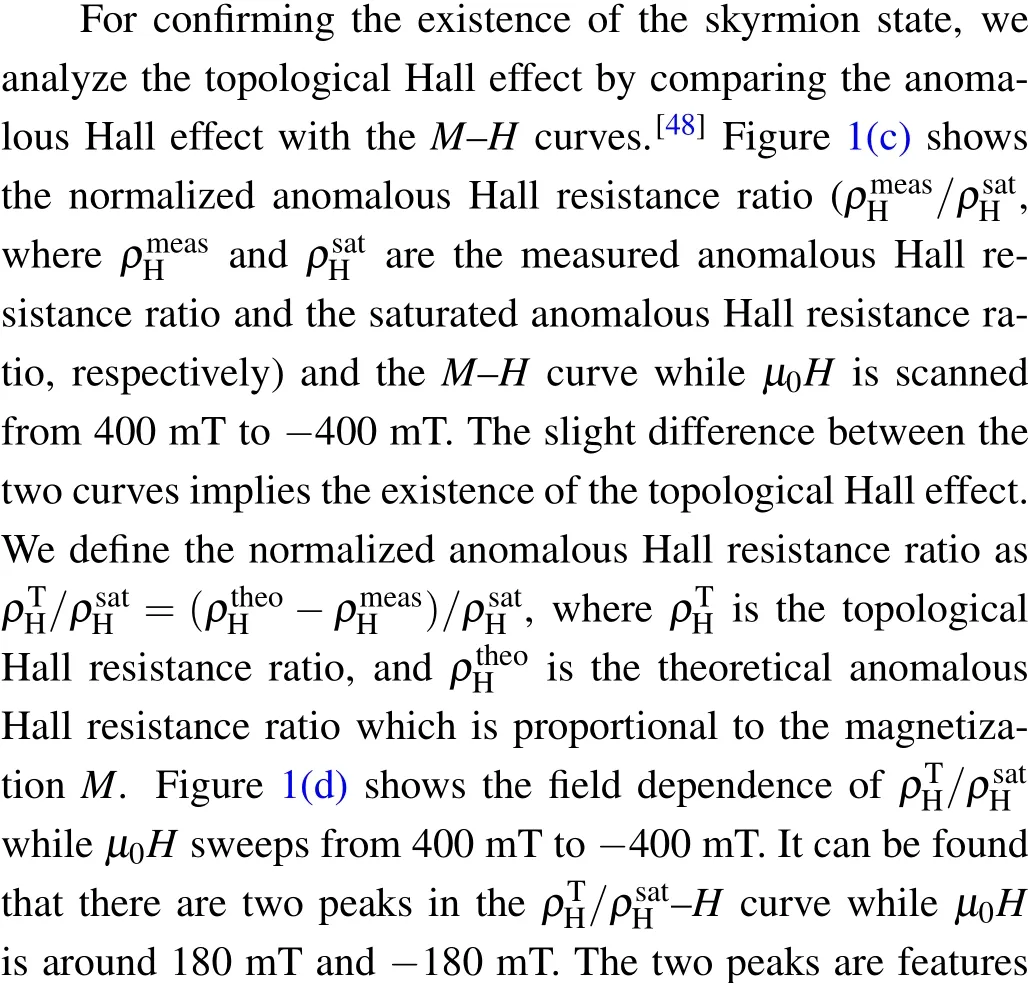

To directly observe the domain structures of the multilayer, the L-TEM measurements are executed for the same multilayer stack deposited on the Si3N4membrane withθ=30°. Figures 1(e)and 1(f)show the L-TEM image atμ0H=0 mT and the L-TEM image atμ0H=170 mT,respectively. It is exhibited obviously that whenμ0H=0 mT,the multilayer stack shows a stripe domain state; whenμ0H=170 mT, the disk patterns with dark–bright contrast demonstrate the presence of N′eel-type skyrmions.[44]The existence of the stripe domain state and the N′eel-type skyrmion state observed by LTEM conform to the suggestion of the out-of-plane magnetization hysteresis loop and the topological Hall effect,and are also in agreement with previous observations on the L-TEM image of[Pt/Co/Ta]nmultilayer stacks.[36,44]

Fig.1. (a)Illustration of Ta/[Pt/Co/Ta]10 multilayer stack,and geometric configuration of TR-MOKE measurements,where external field H (yellow arrow)is set to be in x–z plane,θ is angle between H and z axis.Red wavy line and blue wavy lines represent pump laser and probe laser,respectively.(b)Magnetization hysteresis loop of multilayer with θ =0° and 90°,with inset showing zoom-in view of loop with θ =0° and μ0H around 180 mT.(c)ρTH/ρsatH and M–H curve with μ0H scanning from 400 mT to -400 mT. (d) ρTH/ρsatH curve with H scanning from 400 mT to -400 mT. L-TEM images with a tilt angel θ =30°,μ0H=0 mT(e)and 170 mT(f),respectively. The unit“a.u.” in the inset of Fig.1(b)is short for arb. units.
In order to investigate the dynamic processes of the stack,TR-MOKE measurements are performed under the externally applied fields atθ=60°, 70°, and 80°; as well as the magnitudes ofμ0Hchanging from 429.4 mT to 992.0 mT. It should be noticed that the TR-MOKE measurements are performed under the condition of saturated magnetization with the external fields larger than 300 mT. Figure 2(a) shows a representative result of the TR-MOKE measurements withH=752.3 mT andθ=80°. The obvious nodes and antinodes of the damped oscillation curve demonstrate that there are multiple dynamic modes in the multilayer stack which are excited simultaneously by the pump laser. The frequency spectrum obtained from the fast Fourier transform (FFT) result of this curve [Fig. 2(b)] shows that there are two precession modes in the multilayer stack with frequencies of 24.48 GHz and 30.15 GHz,respectively. Figures 3(a)–3(c)show the TRMOKE curves with eachθunder different external fields and Figs. 3(d)–3(f) display the corresponding frequency spectra obtained from the FFT results. Like Figs.2(a)and 2(b),it can also be identified in Figs.3 that there are two dynamic modes under each external field withθ=60°, 70°, and 80°. From the frequency spectra,it can also be found that for eachθ,the frequency–field (f–H) dependence of both the two dynamic modes show similar monotonically increasing trends, which conform to the Kittel model.[49]
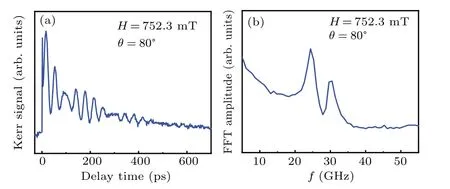
Fig. 2. (a) TR-MOKE curve with H =7.523 kOe (1 Oe=79.5775 A·m-1)and θ =80°,and(b)corresponding frequency spectrum obtained from FFT result,respectively.
4. Discussion
Since the[Pt/Co/Ta]10multilayer stack is an in-plane uniform medium, and the probe laser spot focused on the multilayer is overlapped with the pump laser spot with smaller diameter, the probe laser cannot detect multiple in-plane spin wave modes in the multilayer.[50–52]Considering the similar monotonically increasingf–Hrelations, the two dynamic modes can be recognized as the FMR mode and the PSSW mode.[49,53,54]However, the PSSW mode in the single Co layer cannot arise in the measurements due to its high frequency which should be hundreds of gigahertz or near terahertz. This high frequency is induced by the ultrathin film with a thickness of 2.1 nm and the strong Heisenberg exchange coupling.[55,56]Thus,it can be expected that the multilayer structures can provide interlayer PSSW modes depending on interlayer coupling. In previous researches, researchers have investigated several interlayer couplings which have an effect on spin wave propagation in a multilayer structure,such as dipolar coupling,[57–60]interlayer exchange coupling,[56,61,62]Ruderman–Kittel–Kasuya–Yosida (RKKY)coupling,[63,64]spin pumping, and spin transfer torque.[65]However, the first three factors can be excluded from the[Pt/Co/Ta]10multilayer stack: the interlayer spin waves propagating via interlayer dipolar coupling are demonstrated to be degenerated with the FMR mode;[57]the interlayer exchange coupling and the RKKY coupling among the Co layers can be blocked by the Pt and Ta layers which possess a total thickness of 2.5 nm. Thus,we declare that the two dynamic modes excited in the [Pt/Co/Ta]10stack are the FMR mode and the interlayer PSSW mode, which depend on spin pumping and spin transfer torque,respectively.[65]Figures 4(a)and 4(b)illustrate the moment precession of the FMR mode and the interlayer PSSW mode,as well as the effect of the spin pumping and spin transfer torque. While the moments of a single Co layer are precessing,the layer will inject two spin currents into neighboring nonmagnetic metal layers. The two spin currents are attributed to spin pumping effect and spin accumulation effect,respectively. And they will propagate through the nonmagnetic metal layer,and result in a damping-like torque(τSP)and a field-like torque(τST)at the interface between the nonmagnetic metal layer and the nearest two Co layers. Owing to the torques,spin waves can propagate through different Co layers, resulting in the generation of interlayer PSSW modes in the [Pt/Co/Ta]10multilayers. Thef–Hdependence of the interlayer PSSWs in such ferromagnetic/nonmagnetic multilayers can be written as follows:[65]

wherefis the frequency of the spin wave,γis the gyromagnetic ratio,His the magnitude of the external fields,Msis the saturation magnetization of the Co layers,Aexis the exchange coupling constant,K⊥is the perpendicular magnetic anisotropy constant, andkis the wave vector of the PSSWs. Whenk=0, equation (1) will reduce to the FMR form; and whenk/=0, equation (1) can describe the characteristics of PSSWs. For PSSWs in single ferromagnetic films,k=2π/λ=pπ/dwhereλis the wavelength of the PSSW,pis an integer number, anddis the thickness of the ferromagnetic films. Owing to the positive value ofAexin Co layers,it can be noticed that under the same external fieldH,the frequency of perpendicular spin waves is higher than that of the FMR mode. Thus, the two dynamic modes observed in the [Pt/Co/Ta]10multilayer stack can be identified to be that the low frequency mode is FMR mode and the high frequency mode is PSSW mode. The experimentally observedf–Hrelations withθ=60°,70°,and 80°are shown in Figs.4(c)–4(e).By fitting thef–Hrelations of the FMR mode and the PSSW mode via Eq.(1)withk=0 andk/=0 respectively, it can be obtained thatγ/2π=28.3 GHz/T,K⊥=3.68×104J/m3,and 2Aexk2/μ0Ms=143 mT. While we setAex=10 pJ/m,[66,67]then we can obtain the wavelengthλ=2π/k=130 nm;while we setAex=5 pJ/m,we can obtainλ=82 nm. Theseλvalues are much larger than the thickness of the single Co layer(2.1 nm), and are comparable to the doubled total thickness of the[Pt/Co/Ta]10multilayer stack,which also confirms that the high-frequency mode is the interlayer PSSW mode. In the above analysis, the effect of iDMI is not taken into account.Since it has been demonstrated that if the in-plane wave vector of the spin wave is zero, the iDMI will not affect the characteristics of the spin waves.[40,47,68,69]
Furthermore, we compare the effective damping of the FMR mode and the interlayer PSSW mode. The effective damping can be obtained by the following equations:[70,71]

Fig. 4. Illustrations of the moment precession for (a) FMR mode and (b) interlayer PSSW mode in multilayers, respectively, with blue arrows with double ends representing effect of spin pumping and spin transfer torque, and for [(c)–(e)] f–H dependence of FMR mode and PSSW mode with θ =60°,70°,and 80°,with pink lines denoting fitting results with Eq.(1).

whereαFMR(αPSSW),fFMR(fPSSW),andτFMR(τPSSW)are the effective damping,frequency,relaxation time of the FMR(interlayer PSSW)mode,respectively. The relaxation timeτFMRandτPSSWcan be obtained by fitting the TR-MOKE data via the equation:
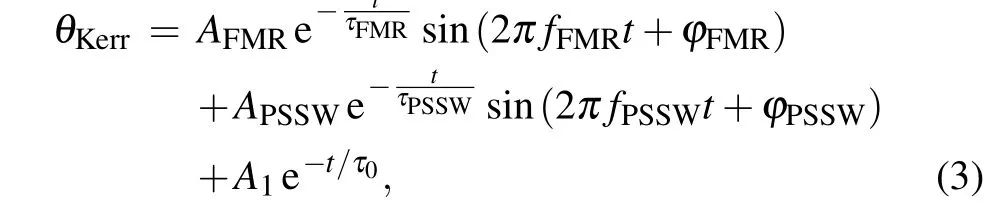
whereθKerris the Kerr rotation,AFMR(APSSW) andφFMR(φPSSW) are the amplitude and phase of the FMR (interlayer PSSW) mode, respectively, andA1e-t/τ0is the exponential decay background. The first term on the right-hand side of Eq. (3) corresponds to the precession of the FMR mode, and the second term corresponds to the interlayer PSSW mode.Figures 5(a)–5(c)show the curves of effective damping versus external field withθ=60°, 70°, and 80°. It can be clearly seen thatαFMRreduces and approaches to 0.03 with external field increasing. It is a normal rule forαFMRbecauseαFMRis mainly determined by the extrinsic factors such as the inhomogeneous magnetization which is attributed to the inhomogeneous magnetic anisotropic field. The increasingHwill suppress the contribution of the inhomogeneous magnetization,and makesαFMRapproach to the intrinsic Gilbert damping value.[70,71]However, it can be found thatαPSSWalways maintains a relatively low value around 0.027 which is independent of the magnitudes and the directions of the external fields. The stableαPSSWwith a relatively low value can be attributed to the weak inhomogeneity of the exchange field.UnlikeαFMR,theαPSSWis mainly determined by the inhomogeneity of the exchange field which is generally weaker than the inhomogeneity of the magnetic anisotropic field. Thus,theαPSSWis lower thanαFMRand closer to the intrinsic value of the Gilbert damping of the magnetic films.[72]And more importantly, it suggests that the[Pt/Co/Ta]10multilayer stack possesses a relatively low intrinsic damping, which is much lower than the intrinsic damping of most of skyrmion-hosting thin-film systems(mostly above 0.1).[38,39]This low damping means that the [Pt/Co/Ta]10multilayers are also the potential platforms for studying the dynamic properties of the thin-film skyrmion systems and experimentally realizing SMCs.

Fig.5. Effective damping of the FMR mode and the PSSW mode with θ =60° (a),70° (b),and 80° (c).
5. Conclusions
In this work, we have experimentally studied the dynamic properties of the skyrmion-hosting [Pt/Co/Ta]10multilayers by TR-MOKE measurements. An interlayer PSSW mode is observed. This interlayer dynamic mode is attributed to the spin pumping and spin transfer torque,and shows similar monotonically-increasingf–Hrelationships to that from the FMR mode. Furthermore, the damping of the interlayer PSSW mode is observed to be independent of the magnitudes and the directions of the external fields,and show a relatively low valuecompared with that of FMR mode. Our findings provide a new approach to obtaining the multiple and tunable spin wave modes,relatively low damping,and skyrmion states via building[HM/FM/HM]nmultilayer structures with iDMI,thus can expand the scope of applications of the [HM/FM/HM]nmultilayers as potential platforms for the experimental realization of SMCs.
Acknowledgements
Project supported by the National Natural Science Foundation of China(Grant Nos.12074189,11704191,11774160,and 61427812), the Natural Science Foundation of Jiangsu Province,China(Grant Nos.BK20192006 and BK20211144),and the Postdoctoral Research Funding Program of Jiangsu Province,China(Grant No.2021K503C).
- Chinese Physics B的其它文章
- Microwave absorption properties regulation and bandwidth formula of oriented Y2Fe17N3-δ@SiO2/PU composite synthesized by reduction–diffusion method
- Amplitude modulation excitation for cancellous bone evaluation using a portable ultrasonic backscatter instrumentation
- Laser-modified luminescence for optical data storage
- Electron delocalization enhances the thermoelectric performance of misfit layer compound(Sn1-xBixS)1.2(TiS2)2
- TiO2/SnO2 electron transport double layers with ultrathin SnO2 for efficient planar perovskite solar cells
- Sputtered SnO2 as an interlayer for efficient semitransparent perovskite solar cells