Additions to Goniothalamus (Annonaceae) in the flora of China
2022-11-16 12:50:00YANGBinWANGLiyanZHOUShishunLIJianwuXIAOChunfenTANYunhong
廣西植物 2022年10期
YANG Bin, WANG Liyan, ZHOU Shishun, LI Jianwu, XIAO Chunfen, TAN Yunhong,3*
( 1. Southeast Asia Biodiversity Research Institute, Chinese Academy of Sciences & Center for Integrative Conservation, Xishuangbanna Tropical Botanical Garden, Chinese Academy of Sciences, Mengla 666303, Yunnan, China; 2. The Key Laboratory of Rare and Endangered Forest Plants of National Forestry and Grassland Administration & The Key Laboratory for Silviculture and Forest Resources Development of Yunnan Province, Kunming 650201, China; 3. Center of Conservation Biology, Core Botanical Gardens, Chinese Academy of Sciences, Mengla 666303, Yunnan, China; 4. Management and Conservation Bureau of Yunnan Tongbiguan Provincial Nature Reserve, Dehong 678400, Yunnan, China; 5. Center for Gardening and Horticulture, Xishuangbanna Tropical Botanical Garden, Chinese Academy of Sciences, Mengla 666303, Yunnan, China )
Abstract: Goniothalamus sesquipedalis (Colebr. ex Wall.) Hook. f. & Thomson and G. peduncularis King & Prain are reported as two new records for the flora of China, the two species were found in Yingjiang County, Yunnan Province, China and conserved in Xishuangbanna Tropical Botanical Garden. G. lii X.L. Hou & Y.M. Shui has been treated as synonym with G. yunnanensis W. T. Wang in Flora of China. Here, we clarified its taxonomical status and treated as a new synonym with G. peduncularis based on living plants observation, the type specimens and the literatures revision. G. sesquipedalis was previously known from India, Bangladesh and Myanmar, and G. peduncularis was only in Myanmar. In this paper, we update the description and illustrate them based on the herbarium specimens and living collections. The voucher specimens are deposited in the Herbarium of Xishuangbanna Tropical Botanical Garden (HITBC).
Key words: Goniothalamus, Annonaceae, new record, Yingjiang County, taxonomy
Goniothalamus(Blume) Hook.f. & Thomson, comprising over 130 species of trees and shrubs, is one of the largest palaeotropical genera in the Annonaceae, mainly distributed from India and Sri Lanka to tropical Australia and the South Pacific Islands (Saunders & Chalermglin, 2008; Nakkuntod et al., 2009; Turner, 2014; Thomas et al., 2017). In China, 11 species are currently recognized (Li & Gilbert, 2011).
During monitoring the living collections of Annonaceae in Xishuangbanna Tropical Botanical Garden, Chinese Academy of Sciences from 2018 to 2021, twoGoniothalamusspecies with flowers and fruits were observed. The two species were introduced to Xishuangbanna Tropical Botanical Garden (XTBG) in 1997 and 2002. After a detailed examination of the morphological characters of our materials, related literatures, and herbarium specimens, we identified them asGoniothalamussesquipedalis(Colebr. ex Wall.) Hook. f. & Thomson andG.peduncularisKing & Prain, respectively.G.sesquipedaliswas originally distributed in India, Bangladesh and Myanmar (Turner, 2015, 2018), andG.pedunculariswas only reported in Myanmar (Turner, 2015, 2018). The two species therefore represent two new records for the flora of China, in which we update the descriptions and illustrate them herein.
皺葉哥納香新擬, 圖版I; 圖版Ⅲ: A
Goniothalamussesquipedalis(Colebr. ex Wall.) Hook. f. & Thomson, Fl. Ind.: 108, 1855. (Plate I; Plate Ⅲ: A)
Type:GuatteriasesquipedalisColebr. ex Wall. in Wallich, Pl. Asiat. Rar. 3: 42, t. 266, 1832. Type: Wallich, Pl. Asiat. Rar. 3: t. 266, 1832. (lectotype, designated by Turner, Nordic J. Bot. 33: 270, 2015).
Shrubs, to 2 m tall. Young branches glabrous. Leaf laminas oblong, 22-47 cm long, 5.7-10.5 cm wide, length/width ratio 3.4-7.2, apex acuminate to caudate, base cuneate, sometimes attenuate, coriaceous, glabrous abaxially and adaxially; midrib glabrous and (strong) prominent abaxially, glabrous and impressed adaxially; secondary veins 16-22 pairs, interarching 5-10 mm from recurved margin, impressed adaxially, raised abaxially; tertiary veins reticulate, distinct; petioles 1.3-2 cm long, 2.5-5 mm in diameter, glabrous. Flowers greenish-yellow, solitary, axillary or extra-axillary, often on the main trunk (cauliflory) and on older branches (ramiflory); flowering pedicels 3-5 mm long; pedicel bracts 2-6, 2-4 × 1.5-3 mm. Sepals 3, 5 -11 mm long, 5-7 mm wide, basally connate, apex acute to obtuse, ovate, puberulent abaxially, sparsely puberulent adaxially, greenish-yellow. Outer petals 3, 25 - 28 mm long, 6-8 mm wide, length/width ratio 3.1-4.6, lanceolate, puberulent abaxially and adaxially, greenish-yellow. Inner petals 3, shortly clawed and free in lower part, cohering and forming an ovate-caudate cone at apex, 15-18 mm long, 5-6.5 mm wide, length/width ratio 2.5-3, ovate-lanceolate, puberulous abaxially and adaxially, sometimes shortly lanate abaxially and adaxially in upper part, yellowish green, base obtuse to a 4.5-5 mm claw. Stamens 70-80 per flower, 2-2.2 mm long, 0.8-0.9 mm wide; connectives apiculate. Carpels ca. 12 per flower, ovary 2.5-3 mm long, light green, white pubescent; stigma and style 2-2.2 mm long, puberulous. Immature fruits green, mature fruits orange-red; fruiting pedicels 7-8.5 mm long, 2.5-3 mm in diameter. Monocarps one seeded, fresh monocarps 21-24 mm long, 10-12 mm wide, length/width ratio 2-2.2, dry monocarps 16-18.8 mm long, 6.9-7.4 mm wide, length/width ratio 2.2-2.7, ovoid to ellipsoid-ovoid, base rounded, apex attenuate, sparsely puberulous, glossy, pericarp medium-thick, ca. 2 mm thick, stipes 2-3 mm long, ca. 3 mm in diameter. Seeds 13-14 mm long, 6.5-7 mm wide, ovoid, testa slightly with latitudinal stripes, dark brown to black brown, aril yellowish brown, endosperm ruminations lamellate.
Distribution: China (Yunnan) (new record); India (Sikkim, Assam, Nagaland, Manipur, Meghalaya) (Grierson, 1984; Karthikeyan et al., 2009); Bangladesh (Khanam & Rahman, 2002); Myanmar (Kress et al., 2003; Kang et al., 2017).
Additionalspecimensexamined: China(中國(guó)). Yunnan(云南): Yingjiang County(盈江縣), Xima Township(昔馬鄉(xiāng)), Nabangba(那邦壩), 24°44′ N, 97°33′ E, 400 m, 5 November 1974, Tao Guoda(陶國(guó)達(dá))013190 (specimen No. 001927 [barcode, HITBC0040552!], specimen No. 001928 [barcode, HITBC0040553!]); the same location, April 1979, s. coll. (specimen No. 066463 [barcode, HITBC0040554!]); Yingjiang County(盈江縣), Xima Township(昔馬鄉(xiāng)), 24°45′ N, 97°42′ E, 260 m, 3 December 1981, Tao Guoda(陶國(guó)達(dá)) 12774 (specimen No. 001929 [barcode, HITBC0040551!]); Yingjiang County(盈江縣), Nabangba(那邦壩), Tongbiguan Natural Reserve(銅壁關(guān)自然保護(hù)區(qū)), 10 October 2011, Zhou Shishun(周仕順)11197 (HITBC 0040504); Yingjiang County(盈江縣), Labang(拉邦), voucher from a cultivated plant at the Xishuangbanna Tropical Botanical Garden, Chinese Academy of Sciences, 21 July 2019, Yang Bin(楊斌), XTBG0077 (HITBC); 15 February 2020, Yang Bin(楊斌), XTBG0079 (HITBC); 9 May 2020, Yang Bin(楊斌) & Xiao Chunfen(肖春芬), XTBG0114 (HITBC); 24 May 2021, Yang Bin(楊斌), XTBG0243 (HITBC)。
Notes:The specimens ofGoniothalamussesquipedalisdeposited in Herbarium of Xishuangbanna Tropical Botanical Garden (HITBC specimen No. 001927, 001928, 001929, 066463) was previously misidentified asGoniothalamusmultiovulatusAst, which is native to Vietnam (Turner, 2018).G.multiovulatuscan be differentiated fromG.sesquipedalisby having 4.5 -5.5 cm long, 2-2.5 cm wide, cylindrical monocarps with 2-4 hairy seeds per monocarp (Ast, 1938). Hou (2003) misidentified them (HITBC specimen No. 001927, 001928, 001929) asGoniothalamusmacrophyllus(Bl.) Hook. f. et Thoms, which is distributed in Malaysia, Singapore, Indonesia, Thailand (Saunders, 2002; Saunders & Chalermglin, 2008; Turner, 2018).G.macrophyllusdiffers fromG.sesquipedalisby having the leaves with a distinctive and diagnostically important ‘granular’ appearance abaxially because of immersion of tertiary and lower order veins (Saunders, 2002; Saunders & Chalermglin, 2008).G.sesquipedalisdiffers fromG.macrophyllusin several important respects: the leaves ofG.sesquipedaliswith secondary venation very prominent adaxially and forming intramarginal vein, tertiary venation prominent and reticulate, whereas the leaves ofG.macrophylluswith secondary venation ± plane to impressed adaxially and not forming intramarginal vein, tertiary venation unconspicuous (Saunders, 2002);G.sesquipedaliscan also be distinguished fromG.macrophyllusby having 3-5 mm (vs. 5-11.5 mm) long flowering pedicels; lanceolate, greenish-yellow (vs. ovate, orange-pink) outer petals when mature; ovate-lanceolate (vs. ovate), 15-18 mm (vs.7-15 mm) long inner petals (Saunders, 2002; Saunders & Chalermglin, 2008).
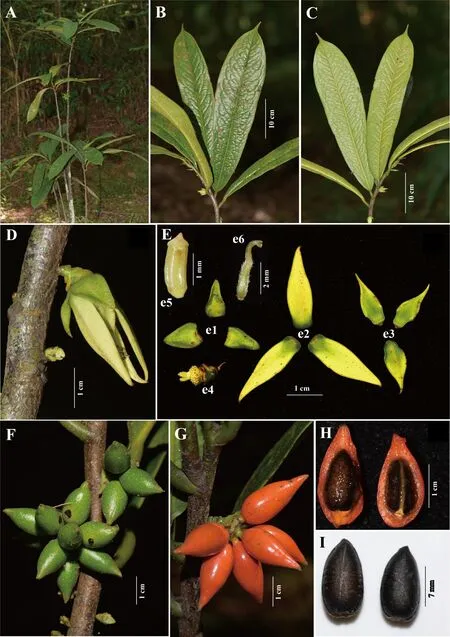
A. Plant; B. Flowering branch (front view); C. Flowering branch (back view); D. Flower; E. Dissection of a flower (e1. Sepals; e2. Outer petals; e3. Inner petals; e4. Stamens and carpels; e5. Stamen; e6. Carpel); F. Immature fruits; G. Mature fruits; H. Longitudinal section of monocarps; I. Seeds. Photographed by YANG Bin from Xishuangbanna Tropical Botanical Garden (XTBG).Plate I Goniothalamus sesquipedalis (Colebr. ex Wall.) Hook. f. & Thomson
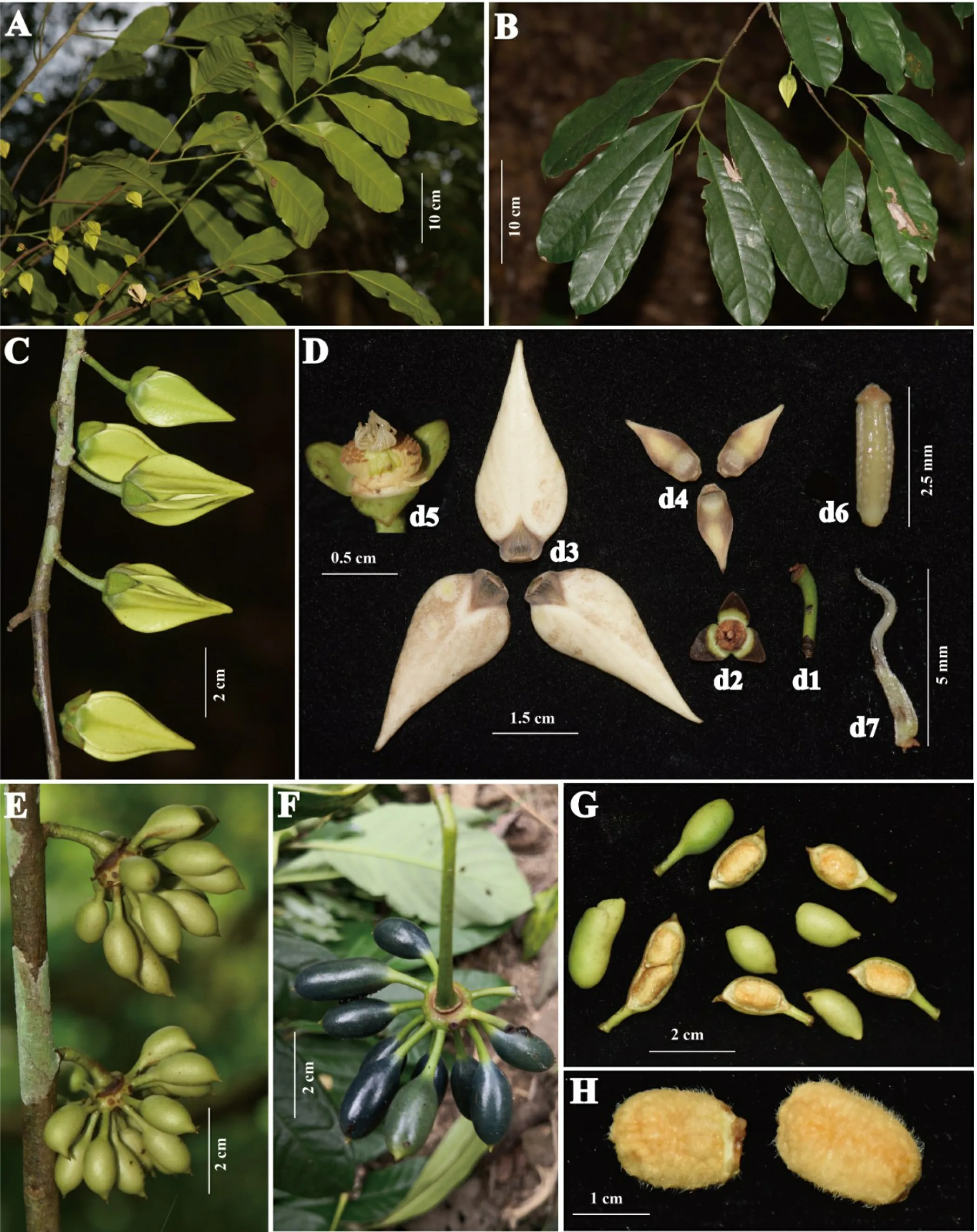
A-B. Flowering branches; C. Flowers; D. Dissection of a flower (d1. Pedicel; d2. Sepals; d3. Outer petals; d4. Inner petals; d5. Flower stamens and carpels; d6. Stamen; d7. Carpel); E. Immature fruits; F. Mature fruits; G. Monocarps; H. Seeds. Photos: A-E, G-H photographed by YANG Bin from XTBG; F photographed by WANG Liyan from Yingjiang.Plate Ⅱ Goniothalamus peduncularis King & Prain
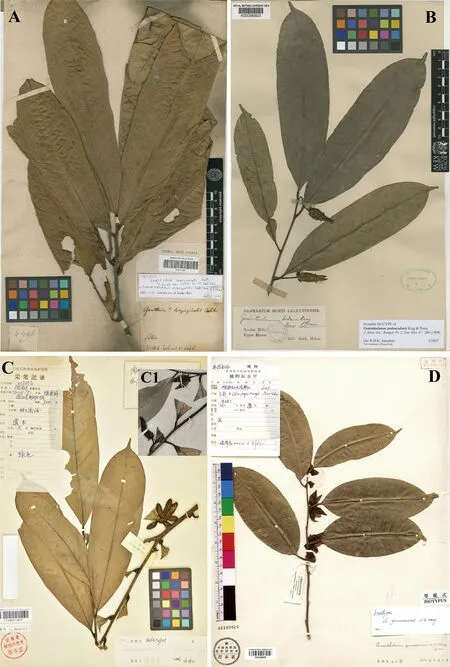
A. Isotype of Goniothalamus sesquipedalis (Colebr. ex Wall.) Hook. f. & Thomson; B. Isotype of G. peduncularis King & Prain; C. Holotype of G. lii X. L. Hou & Y. M. Shui [C1. Flowers voucher specimen (HITBC0040546)]; D. Isotype of G. yunnanenis W. T. Wang.Plate Ⅲ Type specimens and voucher specimen in the protologue of four species of Goniothalamus
長(zhǎng)梗哥納香新擬, 圖版Ⅱ; 圖版Ⅲ: B
GoniothalamuspeduncularisKing & Prain, J. Asiat. Soc. Bengal, Pt. 2, Nat. Hist. 67: 284, 1898. (Plate Ⅱ; Plate Ⅲ: B)
Type: Burma, Upper Burma,Kachin Hills, Sima Road, 1 000 feet, 1897,ShaikMokims.n.(lectotype CAL [CAL000004500], designated by Turner, Gard. Bull. Singapore 70 (1): 523, 2018; isolectotype K [K000380823], Plate Ⅲ: B).
GoniothalamusliiX. L. Hou & Y. M. Shui, Acta Bot. Yunnan., 25(3): 258, 2003.Syn.nov.Type: China(中國(guó)). Yunnan(云南): Yingjiang County(盈江縣), Xima Township(昔馬鄉(xiāng)), Nabangba(那邦壩), 300 m, 7 November 1974, Tao Guoda(陶國(guó)達(dá)) 013254 (holotype, KUN1263140, Plate Ⅲ: C; isotype, HITBC [specimen No. 001921, barcode 0040594!])
Shrubs, to 4 m tall. Young branches glabrous. Leaf laminas oblong, elliptic-oblong to oblanceolate-oblong, 15-23 cm long, 4.4-7 cm wide, apex acuminate, base cuneate, thinly papery, glabrous abaxially and adaxially; midrib raised abaxially, impressed adaxially; secondary veins 10-16 pairs, interarching 3-7 mm from recurved margin, impressed adaxially, raised abaxially; tertiary veins reticulate, raised abaxially, unconspicuous adaxially; petioles 8-13 mm long, with shallow furrows adaxially, glabrous, black when dry. Inflorescence often solitary, sometimes 2-flowered, axillary, often on the main trunk (cauliflory) and rarely on older branches (ramiflory); peduncle degenerate, 1-2 mm long; flowering pedicels 9-15 mm long; pedicel bracts 2-4, 1-2 mm long, ca. 1 mm wide. Sepals 3, ovate, 5-7 mm long, 3-6 mm wide, basally connate, apex acute to obtuse, sparsely puberulent abaxially, conspicuous puberulent along margin, puberulent adaxially, yellowish-green. Outer petals 3, 25-37 mm long, 12-16 mm wide when fresh, 24-34 mm long, 9-12 mm wide when dry, ovate to ovate-lanceolate, puberulent abaxially and adaxially, often yellowish-green, grey white when mature. Inner petals 3, shortly clawed and free in lower part, cohering and forming an ovate-attenuate to ovate-acuminate cone at apex, 13-15 mm long, 5-6 mm wide when fresh, 12-14 mm long, 4-5 mm wide when dry, ovate-lanceolate to oblong-lanceolate, puberulous abaxially and adaxially, densely in upper part, greenish yellow, base obtuse to a 2-3 mm claw, apex attenuate to acuminate. Stamens ca. 100 per flower, 2.5 mm long; connectives slightly apiculate, sometimes hemispherical when dry, yellowish brown pubescent. Carpels 20-30 per flower, ovary ca. 2 mm long, greenish-yellow, white pubescent; stigma and style 2-3 mm long. Immature fruits green, mature fruits deep blackish blue; fruiting pedicels 1.2-1.5(-4.8) cm long. Monocarps 4-25, 1-2 seeded per monocarp, fresh monocarps 17-25 mm long, 8-9 mm wide, ellipsoid to ellipsoid-oblong, base rounded, apex rounded with a small tip, sub-glabrous to sparsely puberulent, pericarp ca. 1 mm thick when fresh, stipes 5-12 mm long. Seeds 10-13 mm long, 6.5-8 mm wide, ellipsoid, testa with white puberulous hairs outside, yellowish brown when immature, endosperm ruminations lamellate.
Distribution:China (Yunnan: Yingjiang, Cangyuan, Menghai) (new record); Myanmar (Kress et al., 2003; Turner, 2015, 2018).
Additionalspecimensexamined: China(中國(guó)). Yunnan(云南): Yingjiang County(盈江縣), Xima Township(昔馬鄉(xiāng)), Nabangba(那邦壩), 300 m, 10 December 1978, Tao Guoda(陶國(guó)達(dá))17895 (specimen No. 002077 [barcode, HITBC0040544!]); Menghai County(勐海縣), Mengman Town(勐滿(mǎn)鎮(zhèn)), 995 m, 22°9′25.23″ N, 100°5′34.29″ E, 28 June 2021, Zhou Shishun(周仕順)19431 (HITBC); 909 m, 22°10′50.79″ N, 100°4′32.98″ E, 29 June 2021, Zhou Shishun(周仕順)19474 (HITBC); Cangyuan County(滄源縣), Banhong Township(班洪鄉(xiāng)), Fabaomangkuhe(法保芒庫(kù)河)700 m, 30 May 1974, Li Yanhui(李延輝)11770 (specimen No. 001923 [barcode, HITBC0040547!], specimen No. 001925 [barcode, HITBC0040545!]); 780-800 m, 2 June 1974, Li Yanhui(李延輝)11873 (specimen No. 001926 [barcode, HITBC0040546!], Plate Ⅲ: C1); Banlao Township(班老鄉(xiāng)), Shangbanlao(上班老)900 m, 21 May 1975, Li Yanhui(李延輝)20975 (specimen No. 001922 [barcode, HITBC0040548!]); Yingjiang County(盈江縣), Longmen(隴門(mén)), voucher from a cultivated plant at the Xishuangbanna Tropical Botanical Garden, 21 April 2021, Xiao Wenqiang(肖文強(qiáng)), C400663 (HITBC0031632!); 6 May 2019, Sheng Caiyu(盛才余), C400846 (HITBC0031129!); 26 May 2020, Yang Bin(楊斌) & Xiao Chunfen(肖春芬), XTBG0128 (HITBC).
Notes:GoniothalamusliiX. L. Hou & Y. M. Shui was characterized by its oblong or oblong-lanceolate leaf blades with (10-)13-21 pairs of lateral veins, pedicels 9-13 mm long, sepals ca. 5 × 4 mm, outer petals 2.5 × 1.3 cm, the stamens with hemispherical connectives, sometimes with densely brownish puberulent (Hou & Shui, 2003), all these characters are consistent withG.peduncularis. Moreover, examination of relevant type materials ofG.liiand observations on living plants ofG.peduncularisintroduced from Yingjiang County show that both species share the liner style and ellipsoid monocarps. Therefore,G.liiis considered as conspecific withG.peduncularis, and we propose it as a synonym with the latter in this study. InFloraofChina, Li & Gilbert (2011) synonymizedG.liiwithG.yunnanenisW. T. Wang (Plate Ⅲ: D) (Wu & Wang, 1957) without further explanation. We don not agree with that treatment, however. As Hou & Shui (2003) mentioned in the protologue ofG.lii, it is morphologically similar toG.yunnanenis, but clearly differs by having 10-21 (vs. 7-9) pairs of lateral veins and pedicels 9-13 mm (vs. ca. 4 mm) long. Moreover, based on our observations of living plants, the distinction between these two species is obvious on many other characters.G.lii(here asG.peduncularis) has grey white outer petals when mature (Plate Ⅱ: d3), styles linear (Plate Ⅱ: d7), monocarp stipes 5-12 mm long (Plate Ⅱ: E, F, G), and monocarps deep blackish blue when mature (Plate Ⅱ: F); whereasG.yunnanenishas redidish brown outer petals when mature, styles stick shape (Jiang & Li, 1979), and monocarp stipes very short, less than 2 mm, and monocarps orange red to dark red when mature.
AcknowledgementWe are grateful to Mr. WANG Yuan for providing the specimens image and Prof. ZHU Xiangyun for useful discussion.