Two new tetraploid quillwort species, Iso?tes longpingii and I. xiangfei from China (Iso?taceae)
2022-11-16 13:28:42SHUJiangpingGUYufengOUZhiguoSHAOWenYANGJuanLUQiyongZHANGXianchunLIUBaodongWANGRuijiangYANYuehong
廣西植物 2022年10期
SHU Jiangping, GU Yufeng, OU Zhiguo, SHAO Wen, YANG Juan, LU Qiyong, ZHANG Xianchun, LIU Baodong, WANG Ruijiang, YAN Yuehong
( 1. Key Laboratory of National Forestry and Grassland Administration for Orchid Conservation and Utilization, the Orchid Conservation & Research Center of Shenzhen, Shenzhen 518114, Guangdong, China; 2. Key Laboratory of Plant Resources Conservation and Sustainable Utilization, South China Botanical Garden, Chinese Academy of Sciences, Guangzhou 510650, China; 3. Life Science and Technology College, Harbin Normal University, Key Laboratory of Plant Biology in Colleges of Heilongjiang Province, Harbin 150025, China; 4. Hunan Shangjie Instrument Co., Ltd., Changsha 410000, China; 5. Shanghai Chenshan Botanical Garden, Shanghai Chenshan Plant Research Center, Chinese Academy of Sciences, Shanghai 201602, China; 6. Tongdao Dong Autonomous County Forestry Bureau, Huaihua 418500, Hunan, China; 7. State Key Laboratory of Systematic and Evolution Botany, Institute of Botany, Chinese Academy of Sciences, Beijing 100093, China )
Abstract: Two new tetraploid quillwort species, Iso?tes longpingii and I. xiangfei, from China are described and illustrated. I. longpingii is a fully submerged plant found in a small pond of Hunan Province. It is morphologically similar to I. sinensis, but differs in its small and tuberculate-cristate megaspores and soft slender leaves that grow up to 60 cm. It is also similar to hexaploid I. orientalis, but differs in its 44 chromosomes and tuberculate-cristate megaspores. I. xiangfei is most similar to diploid I. yunguiensis in megaspore ornamentation, but differs in its microspore ornamentation, oblong sporangium, and 44 number of chromosomes. There are a few individuals of I. longpingii found in Ningxiang City of Hunan Province, and I. xiangfei is distributed in the wetlands of Tongdao and Huitong counties of Hunan Province. Because of their limited geographic ranges, small populations, fewer individuals and disturbed habitats, I. longpingii and I. xiangfei are evaluated as critically endangered (CR) and vulnerable (VU) category, respectively, according to the IUCN Red List criteria. A key to all the current known Chinese quillworts is also provided for further taxonomic identification and conservation of these rare and endangered plants in China.
Key words: new taxon, Iso?tes, Lycopods, polyploid, heterosporous, aquatic plants
Iso?tesL. (1753: 1100) is the only extant genus of the family Iso?taceae, with an extensive fossil record dating from the Devonian Period (Pigg, 2001; Wang et al., 2019) to rapid diversification in the Cenozoic Era (Pereira et al., 2017b, 2021; Wood et al., 2020). The genus contains about 250 species, widely distributed from tropical to subarctic regions, and grows in various habitats in most parts of the world (PPGI, 2016; Troia et al., 2016). However, manyIso?tesspecies have restricted habitats and small populations, putting them at risk of extinction (Kang et al., 2005; Liu X et al., 2005; Gentili et al., 2010; Troia et al., 2016; Brunton & Troia, 2018; Singh et al., 2021). Interestingly, hybridization and polyploidization frequently occur inIso?tes, and more than half of the known species are polyploid ranging from tetraploid to dodecaploid (Hickey, 1984; Taylor & Hickey, 1992; Liu et al., 2004; Kim et al., 2010; Pereira, 2015; Troia et al., 2016; Grigoryan et al., 2020). Although this ancient genus is widely distributed in various habitats and has a complex evolutionary history, its simple morphology — a tuft of linear sporophylls on the lobed rootstock — are remarkably similar among species, making interspecific identification difficult (Taylor & Hickey, 1992; Troia et al., 2016).Iso?tesspecies are mostly distributed in America, southern Europe, Africa and Australia, with relatively few species in Asia (Troia et al., 2016; Pereira et al., 2017b, 2021; Brunton & Troia, 2018; Choi et al., 2018; Singh et al., 2021). TheIso?tesspecies diversity in Asia is probably underestimated, and many cryptic species may not be identified (Schafran, 2019).
Characteristics such as habitat, velum, ligule, megaspore size and texture, chromosome count, and DNA sequences are generally employed to distinguish species ofIso?tes(Hickey, 1986; Pereira, 2015; Troia et al., 2016); however, the characteristics of leaf morphology and anatomy are influenced by local environmental conditions (Liu et al., 2006; Cavalheiro-Filho et al., 2021; Singh et al., 2021). Several species have recently been described and illustrated around the world (Mora-Olivo et al., 2016; Schafran et al., 2016; Pereira et al., 2016, 2017a, 2019; Li et al., 2019; Lu et al., 2021). In China, seven species —I.yunguiensisQ. F. Wang & W. C. Taylor,I.hypsophilaHand. -Mazz.,I.taiwanensisDe Vol,I.shangrilaensisX. Li & Y.Q. Huang,I.baodongiiY. F. Gu, Y. H. Yan & Yi J. Lu,I.sinensisT. C. Palmer andI.orientalisH. Liu & Q.F. Wang — have been reported (Handel-Mazzetti, 1923; Palmer, 1927; De Vol, 1972; Wang et al., 2002; Liu H et al., 2005; Zhang & Taylor, 2013; Li et al., 2019; Lu et al., 2021).
We conducted several field surveys of the genus in China and collected some tetraploid samples (2n=4x=44) previously considered asI.sinensis(2n=4x=44) with morphological and anatomical variation (Liu et al., 2004; Liu et al., 2006; Dai et al., 2020, 2021). By comparing morphological features and spore textures, these samples from Ningxiang City and Tongdao County in Hunan Province were found to be different fromI.sinensis. In addition, our plastid phylogenomic analysis indicated that these samples formed monophyletic clades, which did not cluster together withI.sinensis. The sample from Ningxiang City, here namedI.longpingii, is similar toI.orientalis(2n=6x=66) on megaspore ornamentation and that from Tongdao County, here namedI.xiangfei, is similar toI.yunguiensis(2n=2x=22) on megaspore ornamen-tation. These two new species are described and illustrated in the present study.
1 Materials and Methods
Iso?tesspecies possess prominent spore morpholo-gical characteristics, and the spore ornamentation terminology established by Hickey (1986) was used in the present study. Megaspores and microspores of samples were examined under a scanning electron microscope. Spores were mounted on a double-sided adhesive tape attached to metal stubs, sputter-coated with platinum, and observed under a field emission scanning electron microscope (Quanta 250; FEI, Hillsboro, Oregon, U.S.A.) at 30 kV. Megaspore and microspore sizes from 3-5 individuals were measured using Photoshop CS5 (Adobe Systems Inc., USA).
To determine the chromosome number, young root tips of the sporophytes were pretreated in a saturated aqueous solution of p-dichlorobenzene for 3-5 h and subsequently fixed in Carnoy’s solution (1∶3, glacial acetic acid∶95% ethanol) for 1 h at 4 ℃. Subsequently, the samples were hydrolyzed with a mixture of 3% cellulase and 2.5% pectinase for 10 min at room temperature. They were then stained with carbol fuchsin. The chromosomes of the samples were counted and photographed using a Carl Zeiss Axio Scope A1 photomicroscope (Jena, Germany).
2 Taxonomic Treatment
2.1 Iso?tes longpingii Y.H. Yan, Y.F. Gu & J.P. Shu (Fig. 1, Fig. 3: A-D)
Diagnosis: —Iso?teslongpingiiis similar toI.sinensis, but differs in its small megaspores (310-410 μm, mean=350 μm,n=20), sparsely tuberculate-cristate [vs. larger (mean 410 μm), densely tuberculate-cristate]and bilobed rhizome corms (vs. trilobed inI.sinensis). It is also similar to hexaploidI.orientalis, but differs in its megaspores tuberculate-cristate, and 44 chromosomes (vs. 66 inI.orientalis) (Fig. 3, Fig. 4, Table 1).
Type: — CHINA. Hunan Province, Changsha City, Ningxiang City, Yujia’ao Village, 28°14′27.91″ N, 112°17′44.86″ E, alt. 131 m, June 15, 2019. Zhiguo Ou YYH15160 (holotype, PE! barcode 02347221;isotype: NOCC!, IBSC!).
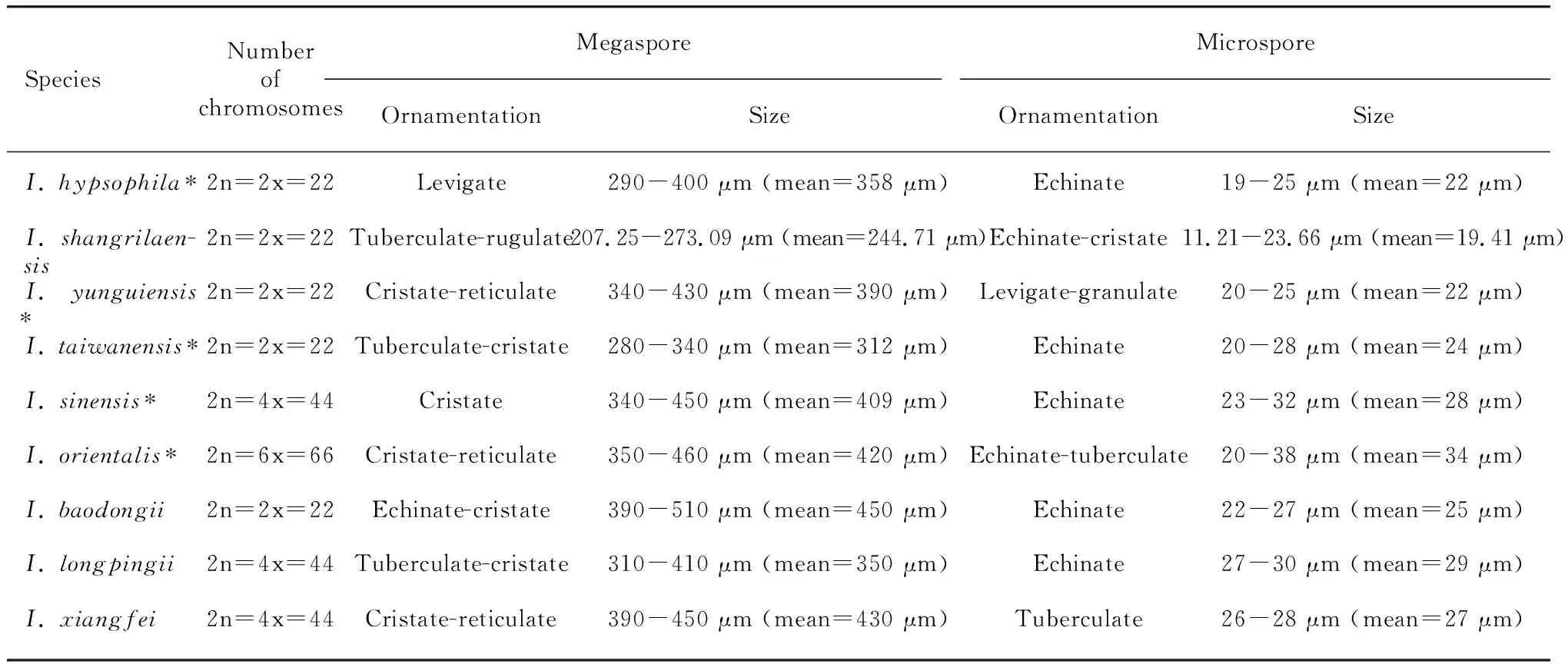
Table 1 Spore features of Iso?tes from China
Description: — Plants aquatic. Rhizome corms: 2-lobed. Sporophylls: widely spreading, 40-60 in a tuft, white at base, green above, spirally arranged, 20-60 cm long, ca. 1 mm wide, flattened on the adaxial side, rounded on the abaxial side, base flat and alate, peripheral fibrous bundles present, central intrastelar canal 4. Sporangia: basal, obovate, 3.5-4.5×2.5-3.0 mm. Ligule: cuniform, 2.3-2.6×1.1-1.3 mm. Mega-spores: white when dry, earthy yellow when wet, 310-410 μm (mean=350 μm,n=20) in diameter, proximal hemisphere tuberculate, distal hemisphere echinate-cristate. Microspores: grayenmasse, elliptic, vertical axis length 27-30 μm (mean=29 μm,n=20), surface echinate. Chromosome numbers 2n=4x=44.
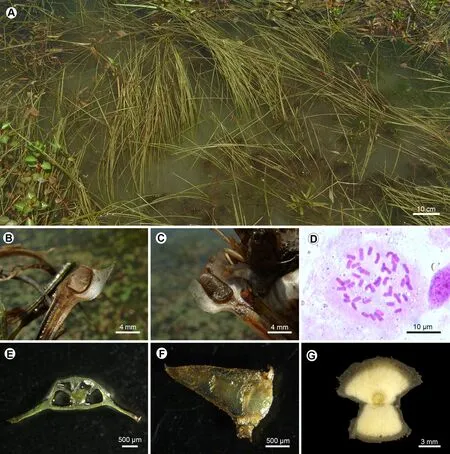
A. Habitat; B. Microsporangium; C. Megasporangium; D. Chromosomes (2n=4x=44); E. Transection of leaf base; F. Ligule; G. Transection of rhizome (2-lobed).Fig. 1 Morphological and anatomic characteristics of Iso?tes longpingii Y.H. Yan, Y.F. Gu & J.P. Shu
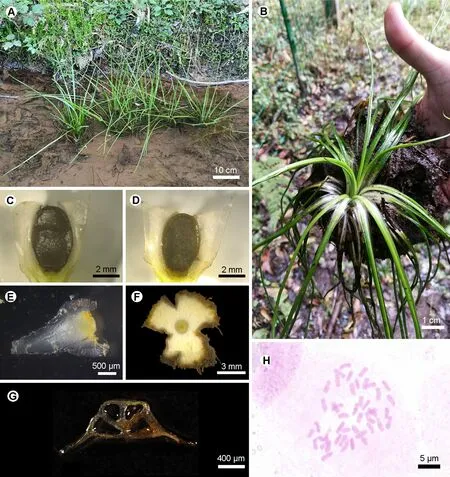
A. Habit; B. Plants with wide wing at the base of leaf; C. Microsporangium; D. Megasporangium; E. Ligule; F. Transection of rhizome (3-lobed); G. Transection of leaf base; H. Chromosomes.Fig. 2 Morphological and anatomic characteristics of Iso?tes xiangfei Y.H. Yan, Y.F. Gu & J.P. Shu
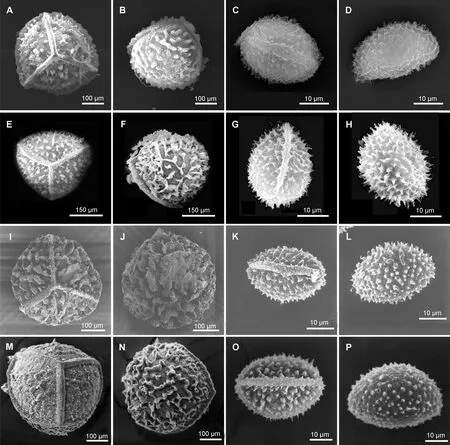
A-D. Iso?tes longpingii (YYH15160. A. Proximal view of megaspore; B. Distal view of megaspore; C. Proximal view of microspore; D. Distal view of microspore). E-H. I. sinensis from China [cited from Liu et al. (2008). E. Proximal view of megaspore; F. Distal view of megaspore; G. Proximal view of microspore; H. Distal view of microspore]. I-L. I. sinensis from Japan [cited from Watanabe et al. (1996). I. Proximal view of megaspore; J. Distal view of megaspore; K. Proximal view of microspore; L. Distal view of microspore]. M-P. I. sinensis from Korea [cited from Takamiya (2001). M. Proximal view of megaspore; N. Distal view of megaspore; O. Proximal view of microspore; P. Distal view of microspore].Fig. 3 Palynological comparison between Iso?tes longpingii and I. sinensis
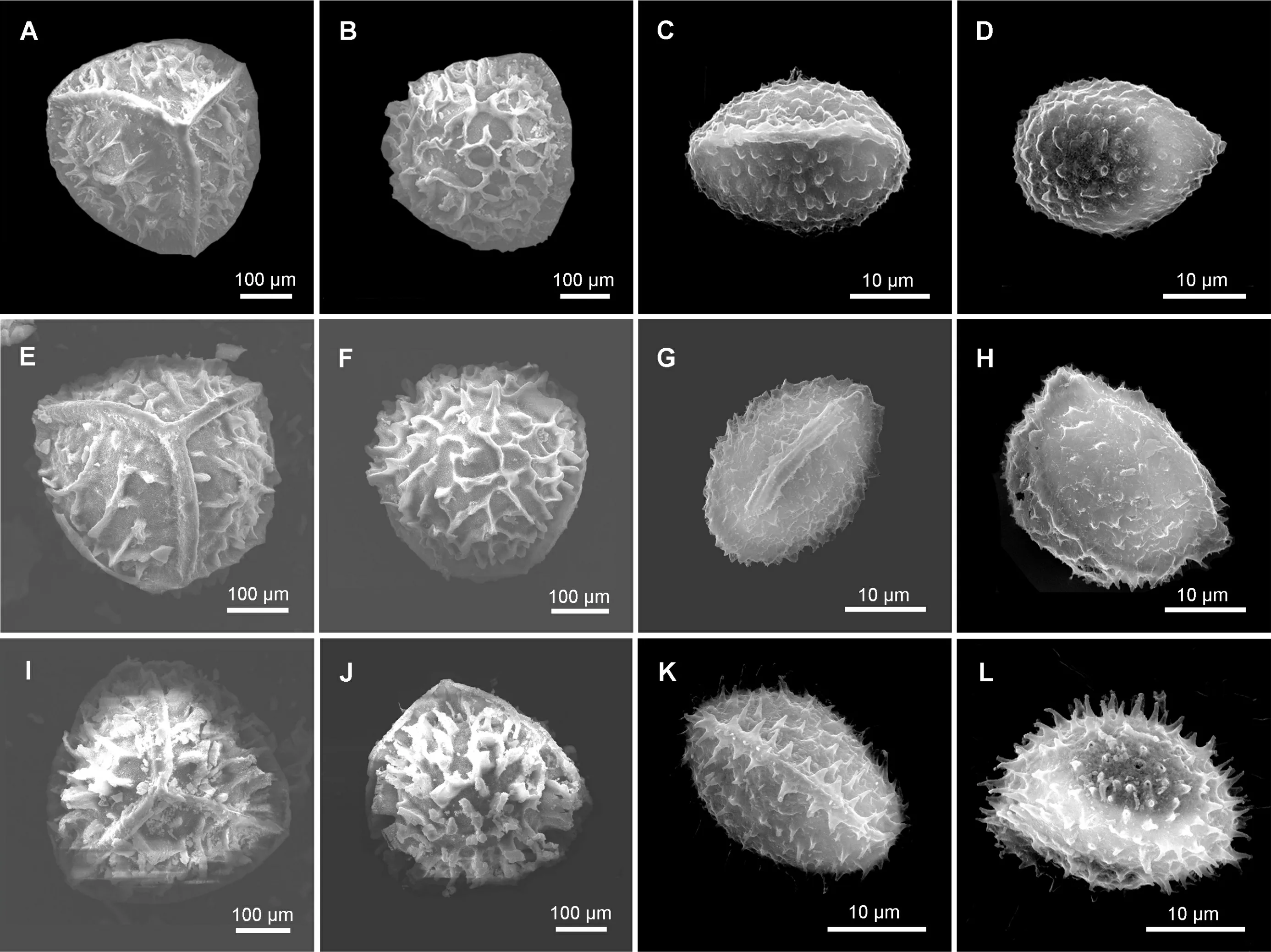
A-D. Iso?tes xiangfei (Fern08928. A. Proximal view of megaspore; B. Distal view of megaspore; C. Proximal view of microspore; D. Distal view of microspore). E-H. I. yunguiensis (YYH15163. E. Proximal view of megaspore; F. Distal view of megaspore; G. Proximal view of microspore; H. Distal view of microspore). I-L. I. orientalis (Fern08748. I. Proximal view of megaspore; J. Distal view of megaspore; K. Proximal view of microspore; L. Distal view of microspore).Fig. 4 Palynological comparison between Iso?tes xiangfei, I. yunguiensis and I. orientalis
Distribution: — Ningxiang City, Changsha City, Hunan Province.
Ecology: — Submerged in a small pond; alt. 131 m.
Etymology: — The specific epithet “l(fā)ongpingii” is derived from the name of the late Prof. YUAN Longping, who devoted his entire life to hybrid rice research in Changsha City (where the species was discovered) and greatly contributed to global food security and poverty alleviation (Wang, 2021).
IUCNRedListcategory: — A single population of about 10 individuals is found in only one location in Yujia’ao Village, Ningxiang City, Hunan Province.Iso?teslongpingiiis critically endangered (CR) [A1a; B2ab(iv)c; C2a(ii); D(2)] according to the Red List Categories and Criteria (IUCN, 2022).
2.2 Iso?tes xiangfei Y.H. Yan, Y.F. Gu & J.P. Shu (Fig. 2, Fig. 4: A-D)
Diagnosis: —Iso?tesxiangfeiis a tetraploid, morphologically similar to the diploidI.yunguiensisand the tetraploidI.sinensisin megaspore ornamentation, but differs in its less reticulate, lower megaspore ornamentation, and densely low-tuberculate (vs. sparsely tuberculate-echinate) microspores (Fig. 3, Fig. 4, Table 1).
Type: — CHINA. Hunan Province: Huaihua City, Tongdao County, 26°14′56.82″ N, 109°50′0.33″ E, alt. 298 m, December 28, 2019. Juan Yang Fern08928 (holotype: PE! barcode 02347220;isotype: NOCC!, IBSC!).
Description: — Plants aquatic. Rhizome corms 3-lobed. Sporophylls 20-60 in a tuft, widely spreading, white at the base, green above, spirally arranged, 15-35 cm long, 2-3 mm wide, flattened on the adaxial side, rounded on the abaxial side, base flat and alate, peripheral fibrous bundles present, central intrastelar canal 4. Sporangia: basal, oblong, 4.4-5.0×2.9-3.3 mm. Ligule: oval triangle, 2.5-2.7×1.4-1.6 mm. Megaspores: white when dry, earthy yellow when wet, 390-450 μm (mean=430 μm,n=20) in diameter; proximal hemisphere cristate, distal hemisphere reticulate.
Microspores: grayenmasse, elliptic, monolete, vertical axis 26-28 μm (mean=27 μm,n=20), surface echinate. Chromosome numbers 2n=4x=44.
Distribution: — Tongdao and Huitong counties, Huaihua City, Hunan Province.
Ecology: — Wetlands and small gullies; alt. 298 m.
Etymology: — The specific epithet “xiangfei” is derived from the name of Xiangfei, who are two respectable goddesses of the Xiangjiang River in Hunan Province, where the aquatic plant was discovered. “Xiang” is the name of the longest river in Hunan Province, and “fei” is the wife of the king in Chinese. Xiangfei, two sisters, married the legendary King Shun at the same time.
IUCNRedListcategory: —Iso?tesxiangfeiis found in Tongdao and Huitong counties, Hunan Province. There are about 200 individuals, which are well conserved by the local forestry department. It is vulnerable (VU) [B2ab(iii); C2a(i)] according to the Red List Categories and Criteria (IUCN, 2022).
3 Key to Iso?tes of China
(1) Individual diploid.
(2)
(1) Individual polyploid.
(6)
(2) Megaspore levigate or just tuberculate-regulate.
(3)
(2) Megaspore with various types of ornamentation.
(4)
(3) Leaves 2-5 cm long, microspores echinate.
I.hypsophila
(3) Leaves 3-18 cm long, microspores echinate to cristate.
I.shangrilaensis
(4) Megaspore tuberculate-cristate, just distributing in Taiwan.
I.taiwanensis
(4) Megaspore echinate or cristate-reticulate.
(5)
(5) Microspore echinate, distributing in Zhejiang.
I.baodongii
(5) Microspore levigate-granulate, distributing in Yunnan and Guizhou.
I.yunguiensis
(6) Leaves ca. 1 mm wide at mid-length.
(7)
(6) Leaves 2-3 mm wide at mid-length.
I.xiangfei
(7) Megaspore ornamentation cristate-reticulate, chromosome numbers 66.
I.orientalis
(7) Megaspore without reticulate ornamentation, chromosome numbers 44.
(8)
(8) Rhizome 2-lobed, megaspore 310-410 μm (mean=350 μm).
I.longpingii
(8) Rhizome 3-lobed, megaspore 340-450 μm (mean=409 μm).
I.sinensis
AcknowledgmentsThe authors thank Prof. YU Xunlin from Central South University of Forestry & Technology for assisting in the field surveys, Prof. YANG Qiner and Prof. DENG Yunfei from South China Botanical Garden, Chinese Academy of Sciences for their assisting in the correction of Latin name.