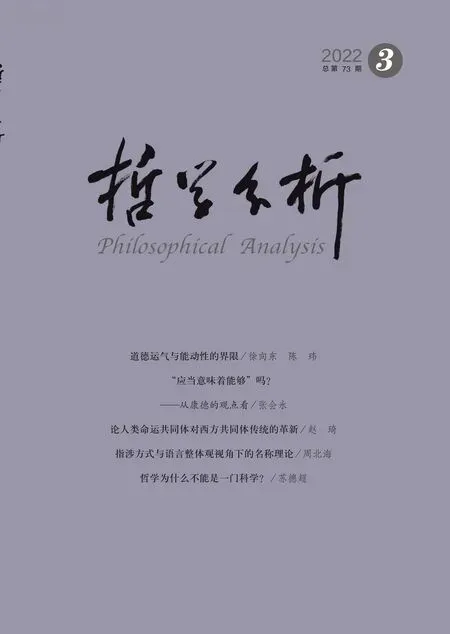
Abstracts and Key Words
2022-10-31 15:38:46
哲學(xué)分析 2022年3期
Abstract: The issue of moral luck has been a focus of debate in contemporary moral philosophy since it was raised by Bernard Williams and Thomas Nagel, not merely because it is concerned with the important question of whether human moral life will be vulnerable to luck, but because it is also relevant to our understanding of the nature of moral values, the function of moral evaluation, and the conditions for moral responsibility. This paper is neither aimed to give a comprehensive presentation or discussion of the main solutions proposed at the present to it, nor does attempt to offer a decisive solution to it. Instead, we will try to show that significant intuitions concerning moral luck can be explained or explained away from some other perspectives, and that we will come to find the claim that the attribution of moral responsibility is subject to luck is implausible to the extent that the conditions for attributing responsibility are adequately clarified. Meanwhile, we will also show that an important idea which Williams derives from his account of moral luck is still worthy of being maintained, namely, that it is difficult or even undesirable to isolate moral values from human values of other kinds in the practice of our moral judgment. In fact, it can be argued that this idea is of significant ethical implications.
Key words: morality; luck; control; moral responsibility; agency
Abstract: Descartes inherited Plato’s and other ancient Greek thinkers’ conception of a completely self-sufficient human rational life, and absorbed the recognition of free will and its importance by medieval theologians such as Augustine, and built his own unique theory on luck, which had an important influence on Kant’s ethics. Descartes’ theory on luck can be summarized into the following four points: First, Descartes advocated that luck is an illusion caused by people’s misuse of reason, so people should abandon the so-called luck. Secondly, Descartes believed that a world composed purely of objects is completely controlled by fate,and fate means the invariable and inevitable laws of nature, so people should psychologically conform to the known laws of nature. Furthermore, Descartes proposed that people have free will and can choose whether to follow rational arrangements. Only the will and the actions it inspires can have moral value and bear moral responsibility. Therefore, morality has nothing to do with luck. Finally, Descartes admitted that there are two kinds of happiness—the happiness brought by luck or fate and the happiness that depends entirely on one’s own.He declared that conforming to fate with reason and embracing virtue with will is the power to master the real happiness of oneself. There are some theoretical flaws in Descartes’ theory of luck. It unilaterally emphasizes the control of luck by reason and avoids the influence of luck on reason itself. It also closes moral responsibility,ethical judgment and even all problems into the mind itself, without motivation of changing society. Nevertheless,Descartes’ theory on luck still has some fascinating points, which are worth pondering.
Key words: Descartes; luck; fate; virtue; happiness
Abstract: How to treat luck is one of the focal points in contemporary discussions of distributive justice.Rawls argues that, intuitively, the effects of arbitrary factors in social circumstances and natural endowments on distributive shares are unjust. The luck egalitarians share the similar intuitions with Rawls whose view was designate as a prototype and early expression of luck egalitarianism. This article attempts to show that this designation is problematic. Rawls starts from an “intuitive argument,” but his approach to treat luck differs from that of the luck egalitarians, because Rawls neither allows natural endowments to influence people’s fates too much,nor ignores the issue of individual responsibility. Rather, Rawls identified responsibility on the basis of an attempt to distinguish between the “social” and the “individual” responsibility. The article will conclude by arguing that Rawls’ theory anchors in a broader conception of equality, namely, it is rooted in the idea of a society in which citizens relate to one another as equals, without falling into the trap of the current debate on distributive equality.
Key words: John Rawls; luck egalitarianism; responsibility; intuition; distributive justice
Abstract: In Critique of the Gotha Program, Marx describes the difference of labors’s income caused by the difference of individual talent in the first stage of communist society as a kind of “defect” . In his Lectures on the History of Political Philosophy, Rawls accused Marx of failing to adopt the principle similar to his difference principle to overcome this defect. This accusation reflects Rawls’ neglect of Marx’s historical-materialism method of dealing with the chance that affects life. This method is implied in the historical discussion of “the difference between the individual with personality and the individual by chance” in the German Ideology. Based on Marx’s point of view, we can see Rawls’s deficiency in dealing with luck from moral intuition.
Key words: Marx; Rawls; chance; luck; the difference principle
Abstract: “Ought implies can” (OIC) is widely thought as a Kantian principle, but he does not justify it in detail. This article will point out that “ought” means the command of moral law to human beings as limited rational beings, and “can” means the possibility of the production of “ought” in an empirical world. This article will also argue that general conditions of nature and human beings can guarantee the possibility of “ought” in empirical world, and particular conditions of that can lead to the impossibility. OIC depends on Kant’s two-kinds-of-world perspective of human beings, which is obviously different from contemporary philosophers’ use of it.
Key words: Kant; ought; can; possibility; reality
Abstract: The doctrine of “eighteen times of enlightenment and countless small enlightenments” of Dahui-Zonggao, a master in the Southern Song Dynasty, is a well-known saying that has been circulating in the Chan Sect for a long time and has great influence. In fact, this is a misrepresentation. In the early Ming Dynasty, Song lian borrowed Jin Bifeng’s words to refer to Dahui, which was just a preliminary view, but was not unanimously recognized by Chan Sect. To the end of the Ming Dynasty, because of the promotion of master Lianchi and Ouyi,the statement was mistaken for the correct one. This paper combs the relevant historical data and discusses the controversy about the author of this theory since Ming and Qing Dynasties. It is clear that not only does Dahui never say this in all his works, but philosophers such as Lizhi, Master Miyun-Yuanwu and Liangting Jingting believed that “Enlightenment eighteen times” originated from a Confucianism scholar Yangjian in the Song Dynasty. But most of them were denied by Confucian scholar-bureaucrats, and there was no such saying in the existing Ming Dynasty engraved edition of Yang’s individual literature. Until the reign of Kangxi in the Qing Dynasty, Buddhist circles began to acknowledge that “Enlightenment eighteen times” was not Dahui, and it was recognized by the descendants of two systems, Dahui and Miyun Yuanwu.
Key words: eighteen times of enlightenment; Song Lian; Yang Jian; Li Zhi; Miyun-Yuanwu; Liangting-Jingting
Abstract: There are vital differences in their mode of research on “a community of shared future for mankind” between Chinese and foreign scholars. Chinese scholars often appeal to Marxism and Chinese traditional culture while foreign scholars are used to approach “a community of shared future for mankind” from western tradition of community. Deep dialogue around the idea of community is rare. Up till now, few researches focus on the comparative study between the western idea of community and the underlying idea of “a community of shared future for mankind” . The western idea of community raises some valuable thoughts while it rejects the existence of worldwide community. Communitarianism is also becoming infeasible nowadays even within western counties due to the silence of general will and value pluralism. The idea underlying “a community of shared future for mankind” not only makes great innovation of the foundation and the ontology of western theories on community, but also reforms the monistic value system behind. It also avoids the fundamental dilemma of it.
Key words: a community of shared future for mankind; political community; common value system of mankind
Abstract: In recent years, there is a widespread concern on “pragmatic encroachment” in epistemology.The disputing question is: what factors determine the rational status of belief? Intellectualists hold that the rationality of belief depends solely upon the factors which are related to truth. However, practicists argue that the rationality of belief partly relies on some practical factors which are not related to truth. The dualism strategy proposed by E. Jackson in 2019 has made outstanding contributions to resist the “encroachment” , but it faces some serious problems. Returning to the source of this dispute, through the analysis of William James’ classical argument, we find that a key distinction on which the practicists rely in their argument does not pose a threat to the rationality of belief. The insights they provide are more limited to the field of philosophy of mind than epistemology.
Key words: Pragmatic encroachment; the rationality of belief; dualism strategy; William James
Abstract: Environmental theatre which emerged in the 1970s has significantly expanded the boundary of western orthodox theatre. It replaced the traditional dead space with intriguing flowing space, changed the ossified conventional show over by instant co-written performance, and developed a passionate motivation from rigid and repetitive action. Environmental theatre has evolved a new form of theater which accepts any deconstructive or reconstructive space, invites any interruption or participation, and encourages all kinds of discovering from sense perception to mentally contemplation. Thus it has formed a triangle co-relationship composed by “spectators-space-performers” . Environmental theatre brings immediate life experience and tempting perceptual sensations to stage, which subverts the passive “imitating reality” by “constructed reality” ,thereby a new aesthetic paradigm is more likely to be utterly wrapped up in the contemporary theatre.
Key words: environmental theatre; theatrical aesthetics
Abstract: There are two opposing theories of names regarding the relationship between names and reference-descriptive theory of reference and direct reference theory. The former argues that names refer to things through sense or feature description, while the latter argues that names directly refer to things like labeling without using sense or feature description. Both theories start with proper names and then extend their theories to common names. The key difference lies in the two ways of referring, but the debate revolves around the problem whether the proper name and common name have senses, which deviates from the heart of the issue.Names can be divided into direct and indirect ones according to the ways of referring. Every language has its own lexical system with primitive and defined names, which correspond to direct and indirect names respectively.Direct reference theory and descriptive theory of reference are theories of name about direct and indirect names respectively. It is a misunderstanding that whether proper or common names have senses, and its formation has historical reasons. Today, the theory of names should go beyond its historical limitations.
Key words: descriptive theory of reference; direct reference theory; the way of referring; primitive name;defined name
Abstract: Although human has surpassed by algorithm in accuracy, many people still tend to refuse algorithm recommendation and decision-making, which known as algorithm aversion. This essay argues that the main reasons for this phenomenon include human cognitive characteristics and the limitations of the algorithm itself. At the same time, some people adhere more to advice when they think it comes from an algorithm than from a person, which known as an algorithm appreciation. We should construct reasonable algorithm trust from the three dimensions of technology, user and human-machine interaction, in order to avoid the digital divide in the intelligent era.
Key words: algorithm aversion; algorithm appreciation; algorithm trust
Abstract: Philosophical scholars have never reached a consensus on the disciplinary nature of philosophy.Recently, some scholars, represented by Chen Bo, emphasized the cognitive attribute of philosophy, and held that philosophy is a science. This view ignores the complexity of philosophical activities. In contemporary times,philosophical activities have four dimensions: earning a living, transforming, cognition and belief. The goals of philosophical activities in different dimensions are not the same. According to Isaiah Berlin, philosophy deals with the problems that are neither empirical nor formal, and cannot be science or mathematics. Human conceptual activity is a continuum, with humanities and science as two ends, and philosophy in between.Philosophy and science are intertwined in the frontier of science and the underlying assumption of scientific community. But in characterizing meaning, especially presenting the world as a whole, philosophy stands outside science. It is impossible to prove the homogeneity between philosophy and science by appealing to the continuity of human conceptual activities; On the contrary, this argument is in danger of self-defeating.
Key words: philosophy, science, humanities, cognition, experience, continuity of human conceptual activities