Sino-German Relations Built on Sound Economic and Cultural Principles
2022-10-16 15:57:32MENGHONG
CHINA TODAY 2022年10期
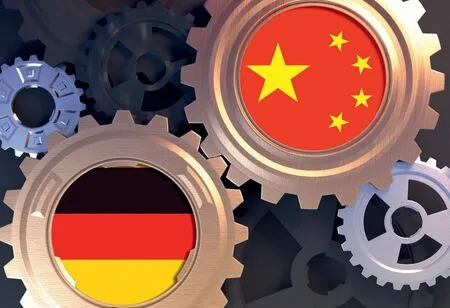
Sound bilateral relations should be based on economic and trade cooperation and supported by cultural diplomacy.
By MENG HONG
ECONOMIC and trade cooperation has always constituted an important pillar of the Sino-German relations. As early as the late 19th century, German railroad and mechanical engineering technology was already well-known in China. After the establishment of diplomatic relations between the People’s Republic of China and the Federal Republic of Germany in 1972, bilateral trade cooperation began to develop rapidly.
At present, China has become Germany’s largest trading partner and its largest source of imports for six consecutive years. For many years, Germany has also been one of the EU countries with the largest direct investment and technology transfer to China.The trade volume between China and Germany rose from US $274 million at the time of the establishment of diplomatic relations to €245.3 billion in 2021,an increase of nearly 900 times in 50 years. Last year,China’s exports to Germany were valued at €141.7 billion and imports €103.6 billion, up 20.8 percent and 8.1 percent year-on-year respectively. At the same time, China was Germany’s largest investor, after the United States and Switzerland, with a total of 149 projects, although slightly less than the previous year.
In general, the rapid development of economic and trade cooperation between the two countries is driven by the needs of China’s modernization, industrialization, and urbanization, as well as a series of technical and financial assistance provided by Germany after recognizing China as a developing country in 1979. In addition, after China’s accession to the WTO in 2001, tariffs were significantly reduced and the two governments made two decisions to double the bilateral trade and economic volume, and established a series of comprehensive and diversified promotion mechanisms, such as the Sino-German Joint Commission for Economic Cooperation, the German-Sino Forum on Economic and Technical Cooperation, the Sino-German economic policy consultation, the SME policy consultation and other fruitful cooperation platforms.
In addition, Germany established the Asia-Pacific Committee of German Business in 1993, and has set up business coordination and promotion institutions such as Delegation of German Industry& Commerce and the German Center in Beijing,Shanghai and Guangzhou. In 2014, Chinese enterprises operating in Germany also established in Berlin the German Chamber of Commerce in China,which signed up to the Lobbying Register for the Representation of Special Interests, vis-à vis the German Bundestag and the Federal Government in Germany in 2022, to actively represent the interests of Chinese enterprises in Germany at the German federal level. These moves have greatly promoted smooth development of economic and trade relations between China and Germany.
Since the outbreak of the European debt crisisin 2008, some new highlights of bilateral economic and trade cooperation have emerged. First, although Germany ended its traditional development cooperation assistance to China in 2009, the two governments decided to continue to strengthen cooperation under the new strategic partnership framework on climate, environmental protection,energy programs and economic and legal reforms,given that China was still a large developing country with a GDP per capita of less than US $5,500, only one-sixth of Germany’s.

The China-European Railway (Qilu),takes off from Qingdao, China to Mannheim, Germany, on February 18, 2022.
Second, after 2010, based on the new economic policy goals set out in China’s 12th Five-Year Plan,the focus of bilateral cooperation shifted to emerging strategic industries such as new energy, new materials, information networks, bio-breeding,pharmaceutical technology, energy conservation and environmental protection, aerospace, shipping,and electric vehicles, while cooperation in service sectors such as finance and insurance has been strengthened.
Third, cooperation between small and mediumsized enterprises (SME) has been emphasized and strengthened. During the first Sino-German government consultation in 2011, it was decided to set up a Sino-German special loan for SME development with a total amount of US $2 billion to help Chinese enterprises “go global.” As a result, China surpassed the United States to become the destination of the largest direct investment from Germany.
Fourth, after the two countries signed a memorandum of understanding on tourism in 2002, the number of Chinese citizens traveling to Germany increased, with 1.53 million outbound trips made by Chinese mainland residents to Germany and 622,000 trips by German citizens to China in 2019.
The rapid development of Sino-German relations is also facilitated by the high importance attached by the two governments to the training of personnel and cooperation in the fields of culture, education and science. Since the founding of the Federal Republic of Germany, the federal government has actively promoted the reconstruction of cultural exchange institutions such as the German Academic Exchange Center (DAAD) and the Alexander von Humboldt Foundation (AvH), which were founded in the 1920s. In the early 1970s, cultural diplomacy was elevated to the third pillar of national diplomacy by the federal government. At the same time,“culture for all” and “education for all” became important goals in the construction of a “cultural nation” and “cultural state” in Germany.
After entering the 21st century, in order to enhance Germany’s international image as an “ideological power,” the federal government has brought science and media into the scope of cultural diplomacy and expanded Sino-German cooperation in the fields of culture and education. At the policy framework level, in addition to the agreement on scientific and technological cooperation and the cultural exchange agreement, the two countries signed a mutual agreement for cooperation in higher education in 2002, introduced the strategic dialogue mechanism for Sino-German cooperation in higher education in 2006, and established strategic partnerships among Chinese and German universities. In 2011 and 2012, during the Sino-German governmental consultations, the two countries started a strategic partnership between universities as well as cooperative alliance of vocational education and a bio-science innovation platform. In 2017, to celebrate the 45th anniversary of the establishment of their diplomatic relations, the two countries established the high-level people-to-people exchange and dialogue mechanism.
Sino-German cooperation
ln regard to cultural exchange and cooperation,the focus of Sino-German cooperation has expanded from the fields of language,education, music, painting,and drama, to the dialogue and exchange of ideas and concepts.
In terms of institution building, the Goethe-Institut was the first such to establish a branch in Beijing in 1988. After the reunification of Germany,German academic exchange centers, political party foundations, corporate foundations, as well as universities, also started to set up offices in China one after another. With cultural diplomacy being included into China’s national diplomacy in 2004, the Chinese Cultural Center was inaugurated in 2008 in the heart of Berlin. In addition, more than 10 Confucius Institutes and Confucius classrooms have been established in Germany by Chinese universities, in cooperation with German universities and cultural institutions.
In the field of science and technology, the National Natural Science Foundation of China and the German Research Foundation established the Sino-German Center for Research Promotion in Beijing in 2000, and four major research institutions, including the German Max Planck Institute, are also actively cooperating with China. Meanwhile the Chinese Academy of Sciences held a frontier exploration roundtable with the German Max Planck in November 2016, to discuss a plan of strategic cooperation between them in the fields of nuclear physics, radio astronomy, biophysical chemistry, and big data. After the outbreak of the COVID-19 pandemic in 2020,the roundtable switched to video conferencing,which is still held regularly.
In regard to cultural exchange and cooperation,the focus of Sino-German cooperation has expanded from the fields of language, education, music,painting, and drama, to the dialogue and exchange of ideas and concepts that have a profound impact on the development of national modernization and urbanization. In recent years, the participants of Sino-German cooperation have expanded from universities to primary and secondary schools, from metropolitan areas to most provinces and cities,and from officials to civil society.
At present, China and Germany have established 103 sister provincial (city) relations and nearly 750 exchange programs. The number of Chinese students studying in Germany has increased from below 10 in 1974, to about 40,000 in 2020, thus becoming the largest group of overseas students in Germany; the number of German students in China has also increased from three in 1973 to nearly 5,000 before the outbreak of the pandemic. At present,more than 1,300 cooperation projects are implemented jointly by Chinese and German universities.Young people in both countries have also become more interested in each other’s language and culture, with more than 150 universities in China offering German language courses and more than 30,000 people in Germany studying Chinese.
Facing the current global crisis triggered by the Ukraine crisis, China and Germany should actively work together to restore and reconstruct world peace, support the economic recovery in the postpandemic era, and promote the climate and energy transition, to benefti humanity and to achieve sound development of our “global village.”C
MENG HONG is a professor in the German Department of the School of Foreign Languages at Renmin University of China, a standing member of the China Association of German History Studies, and a member of the German Studies of the Chinese Association of European Studies.