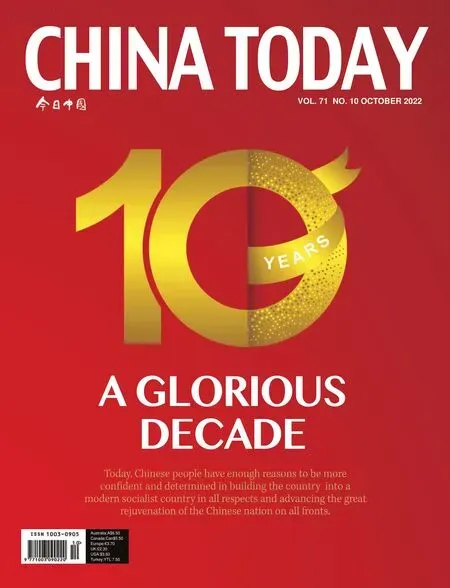
China’s Unique Path to Modernization
2022-10-16 15:57:26XIAYIPU
CHINA TODAY 2022年10期

The success of China’s modernization drive proves that there is no universally applicable model of modernization, and every country should find the one most suitable to themselves.
By XIA YIPU
IN his speech at the ceremony marking the centenary of the Communist Party of China(CPC) on July 1, 2021, Xi Jinping, general secretary of the CPC Central Committee, declared,“As we have upheld and developed socialism with Chinese characteristics and driven coordinated progress in material, political, cultural-ethical,social, and ecological terms, we have pioneered a new and uniquely Chinese path to modernization,and created a new model for human advancement.”This conclusion was reiterated at the Sixth Plenary Session of the 19th CPC Central Committee that convened in November 2021.
CHINA’S MODERNIZATION
China’s modernization shares some elements of the modernization generally known to humanity, but is also defined by its own national features based on Chinese conditions.
In July 2022 a study session was held in Beijing for principal government officials at the provincial and ministerial level. Speaking at the session, Xi stressed that the Chinese people have successfully advanced and expanded the Chinese model of modernization, on the basis of their exploration and practice since the founding of the People’s Republic of China,especially since the commencement of reform and opening-up, and through the innovation and breakthroughs made since the Party’s 18th National Congress in 2012.
The proposition and implementation of Chinesestyle modernization proves that there is no universally applicable model or standard of modernization. All countries can find their own path according to their specific conditions that conforms with their development stages and is in the best interests of their people.
The upcoming 20th National Congress of the CPC will be convened at a critical moment in China’s journey toward building a modern socialist country in all respects. At this meeting the Party will draw up its goals, tasks, and major policies, along with the state’s undertakings for the next five years and beyond, all of which will have a bearing on the future of Chinese socialism and the rejuvenation of the Chinese nation. In the next five years, a critical period in its endeavors to build a modern socialist country in all respects, China will continue to advance modernization under the leadership of the CPC, and pursue national rejuvenation through modernization. “We will not take the old path of a rigid closed-door policy or an erroneous path by abandoning socialism. Instead we will rely on our own efforts to drive the nation’s development, and take our fate firmly into our own hands,” Xi noted at the study session in July.
Ye Jia, a farmer who formerly lived a life under the poverty line,is working at a bamboo products factory in Gaofu Town, Fuzhou City of Jiangxi Province,on July 12, 2022.
“We will not take the old path of a rigid closed-door policy or an erroneous path by abandoning socialism.Instead we will rely on our own efforts to drive the nation’s development, and take our fate firmly into our own hands.”
Defying Doubts
Since the birth of the People’s Republic of China,the CPC has led the Chinese people in building a modern country with Chinese characteristics. At the First Session of the Third National People’s Congress (NPC), held from December 21, 1964 to January 4, 1965, the central government for the first time set the goal of “building China into a strong socialist country with modern agriculture, modern industry,modern national defense, and modern science and technology.” In a meeting with Japanese Prime Minister Ohira Masayoshi in December 1979,Deng Xiaoping said, “The four modernizations we are striving to achieve are modernizations with Chinese characteristics. Our concept of the four modernizations is different from yours.By achieving the four modernizations, we mean achieving a comparative prosperity.” From his remarks, we can understand that China’s modernization shares some elements of the modernization generally known to humanity, but is also defined by its own national features based on Chinese conditions.
This is why China’s modernization drive has drawn wide attention globally. Dating back to the 1970s, many foreign scholars have expressed doubts about its feasibility. They thought that China’s economic development model could not ease the burden on its people, and instead would send them deeper into poverty. They predicted that China would definitely increase military spending in response to the Cold War, adding more financial stress on its people. Besides, they thought that China, a socialist country, had no chance of breaking away from egalitarianism in wealth distribution.
These doubts and qualms are, in a sense, a reflection of the difficulties China had to surmount in pursuing modernization. Guided by sound theories and through innovative, hard work, China did not turn out to be what these foreign pundits predicted.By focusing on economic development as the central task, it has significantly increased citizens’incomes: Per capita disposable income soared from RMB 171 in 1978 to close to RMB 30,000 in 2021,and its middle-income group has been expanding steadily. From 1978, the year when China launched reform and opening-up, to 2020, 770 million rural poor in the country had risen above the poverty line. This number accounts for more than 70 percent of the world’s total, according to the World Bank. With this outstanding achievement, China brought about a historic resolution to the problem of absolute poverty within its borders, and created a miracle in the human history of poverty reduction.
Remarkable progress has also been made in other aspects of people’s lives. The completion rate of nine-year compulsory education exceeds 94 percent; basic old-age insurance and medical insurance cover more than 1 billion and 1.3 billion people respectively; the share of permanent urban residents in the population has reached 63.9 percent; and average life expectancy rose from 67.8 years in 1981 to 77.5 years in 2021.
Meanwhile China has kept its defense expenditure at a comparatively low level. The report on draft central and local budgets submitted to the Fourth Session of the 13th NPC shows that its national defense spending for 2021 was RMB 1.355343 trillion, up 6.8 percent from 2020. This is below US $150 per person. China’s military spending was merely a quarter of that of the United States in the same year,and a paltry 1/16 when measured per head.
On the issue of income distribution, China abolished the egalitarian distribution system, and has established a unique system based on Marxist theory and its realities, under which distribution according to work is the mainstay while multiple forms of distribution exist alongside it. This system allows more pay for more work, and also strikes a balance between efficiency and fairness. Meanwhile the government leverages the adjusting role of taxation, social security, and transfer payments,and uses targeted measures to narrow the income gap by expanding the middle-income group, helping the low-income group earn more, regulating high incomes, and banning illegal income. The goal is to achieve prosperity for all.
A TRAIL
China has steered clear of the traps threatening developing countries,and blazed a trail of Chinese modernization.
Refuting the Doomsayers
Past experience shows that the path to modernization taken by developed economies in the West cannot be indiscriminately copied in all countries.Some countries that tried to do so ended up in the middle-income trap, Tacitus trap or Thucydides trap. And some, without the guidance of sound theories or strategic resolve, have failed to maintain social stability while pursuing rapid economic growth. The result is a vicious circle of laggard economic development and lengthy social unrest.
China has steered clear of the traps threatening developing countries, and blazed a trail of Chinese modernization. Many in the West believe that to realize modernization, developing countries have to accede to the capitalist system of the West, at the cost of part of, or their entire sovereignty. This approach to modernization nevertheless is often unfeasible, as it involves blindly mimicking the systems of other countries. What’s more, it carries the risks of losing political sovereignty and independence.

The downtown area of Ganzhou City in southern Jiangxi Province is dotted with skyscrapers, parks,and public sports facilities.
China’s modernization path maintains the socialist nature and national identity, it therefore ensures the independence of the country’s socialist market economy. With independence in economy, politics and national defense, China has tried to shape a modernization that is not manipulated by capital and is instead centered on well-rounded personal development. On the basis of full, coordinated modernization, China is creating a new form of civilization that features material, political, cultural, social,and ecological progress.
When reviewing the modernization process of many countries after WWII, we can see the paradox that modernization is expected to bring social stability and prosperity, but the process to achieve it often gives rise to instability and poverty. This is the so-called Huntington’s Paradox. The cause of this phenomenon is that the political system of these countries is not developed to the point of accommodating the needs of economic progress.In the course of modernization, many highly active new social groups emerge. Their yearning for progress drives social development if well handled,and hinders it if not. It is always difficult to balance the interests of different groups. When the state cannot mediate or defuse disputes, and fail to build broad consensus on political and economic issues,tensions rise and rivalry between political parties intensify, causing unrest.
This paradox however is not repeated in China’s modernization process. Though we are building modernization in the world’s most populous country, the cause is led by the CPC, which harbors no selfish motives and puts the people above all else in its governance. The Party works for happiness of the Chinese people, rejuvenation of the Chinese nation,human progress and world harmony. It therefore can bring together all social strata and groups,converge their respective interests under the overall national interests, and foster a strong sense of community for the Chinese nation.
China’s modernization drive is people-centered rather than capital-centered. It therefore can meet,to the fullest extent, both the immediate and longterm interests of the Chinese people. The people play the principal role in China’s modernization process, and decide who and how to share the fruits of development. This has effectively ensured both prosperity and stability in China.
On the basis of full,coordinated modernization, China is creating a new form of civilization that features material, political,cultural, social, and ecological progress.
International Significance
When addressing the second full assembly of the Sixth Plenary Session of the 19th CPC Central Committee, Xi Jinping said that under the leadership of the CPC,the Chinese people have achieved the dual miracles of rapid economic growth and lasting social stability that is rare in the world;pioneered a uniquely Chinese path to modernization; and created a new model for human advancement. With these unprecedented achievements, China has solved many intractable problems in human development, avoided the capital-centered modernization in Western countries that causes polarization, excessive materialism, international expansion and plundering, and opened a new path for developing countries to realize modernization. It is the Chinese approach to humanity’s exploration for a better social system.
On July 28, 2022, the Academy of Contemporary China and World Studies released a research reportKeywords to Understand the Chinese Path to Modernization. It concludes, “China’s modernization will be shared by a large population, and features common prosperity of all its people, coordinated material and cultural-ethical progress, harmony between humanity and nature, and peaceful development.”
China’s path shares some common characteristics and conforms to the laws governing social development worldwide. Meanwhile, it opens up new horizons for advances in human civilization by presenting a new approach that is grounded in China’s realities and is unique to the country. It is a perfect combination of commonality and individuality. As this country of 1.4 billion people joins the ranks of modern countries, the global modernization landscape has been reshaped, the definition of modernization revised, and its direction reset.Humanity, especially developing countries, hence have more options in this pursuit.C
XIA YIPU is an associate researcher with the Academy of Marxism, Chinese Academy of Social Sciences.