
PATHS OF FAITH
2022-10-15 12:44:36
漢語世界 2022年5期
關鍵詞:信仰
Moments of transformation in modern pilgrimages in China

TEXT AND PHOTOGRAPHY BY MADS VESTERAGER NIELSEN ILLUSTRATION BY CAI TAO ADDITIONAL PHOTOGRAPHS FROM VCG
三個人的朝圣:現代朝圣者和他們的信仰之旅
On the dazzling heights of the Tibetan plateau,howling winds can blow at 120 kilometers per hour.Up here,the rock and gravel plains can stretch for hundreds of kilometers,only broken by the sharp zig-zag of mountain peaks.This terrain was 32-year-old Dhondup’s home for months as he made his way up the “roof of the world,” spending more time on his hands and knees than on his feet.
In 2014,Dhondup,a Tibetan who heralds from Hongyuan county,in northern Sichuan province,flew to Lhasa to walk and pray along a circular route around the Potala Palace for several days as an act of devotion,known as thekora.While circling the palace,he felt a calling to display even greater faith,and decided to re-do the entire 2,094-kilometer journey from his home to Lhasa by prostration,as the most devout Tibetan Buddhists do: throwing his body onto the ground in prayer for every three steps taken,before getting up and doing it all over again.
For thousands of years,pilgrims have made their way across the varied landscape of China for various convictions,from deep religious devotees to secular travelers on journeys of self-expression.Today,there are even so-called “Red pilgrims,”who recreate the journeys made by Chinese Communist revolutionaries of the past.With the availability of technology and new reasons to go on transformative journeys,ordinary people are embarking on novel forms of pilgrimage—and documenting them along the way.
Crawling for blessings
Religious pilgrimages were not traditional concepts to China: “While one’s parents are living,one must not make long journeys,” Confucius stated in theAnalects.Yet the often-forgotten second half of the saying—“If one must journey,one ought to have a destination”—perhaps made the idea of pilgrimage more palatable to Chinese Buddhists when the religion reached the country late in the Western Han dynasty (206 BCE—25 CE),and to Daoists when their faith became codified as a religion in the Eastern Han (25—220 CE).
In Chinese,journeys made for religious devotion are known aschaosheng(朝圣,“toward holiness”)and a pilgrim is referred to asxiangke(香客)—one who “offers incense.”Traditionally,pilgrimages were journeys made with the intention of paying respect or ritualistic offerings to the object of one’s faith.

Devout Tibetans practice prostration in front of the Jokhang Temple in Lhasa
Perhaps the best known Chinese pilgrim is the Buddhist monk Xuanzang (玄奘),whose journey from the Tang dynasty capital Chang’an,present day Xi’an in Shaanxi province,to India in search of Buddhist scriptures in the seventh century became the inspiration for the literary classicJourney to the West.Other monks like Faxian (法賢) and Yijing (義凈) also ventured to India through perilous terrain on a quest for religious purification as well as holy texts.Famous Daoists have also undertaken epic journeys of conviction,like Laozi,the spiritual founder of Daoism who,according to legend,travelled west on a water buffalo because he was tired of the increasing moral corruption in the court of the Zhou dynasty (1046—256 BCE).
Places associated with these religious figures have themselves already become sites of pilgrimage,and major historic transportation arteries have doubled as conduits for religion and trade through the ages.The Silk Road is the obvious example of this,where pilgrimage sites such as the Mogao Grottoes in Dunhuang or the mosques in oasis towns between Xi’an and Kashgar,can still be found.However less obvious are other routes,like the north-south roads between Urga(today Ulan Bator in Mongolia) and Lhasa,that intersect the Silk Road around Lanzhou in Gansu province.
For Tibetan Buddhists,pilgrimages remain an important part of their spiritual practice today.It is widely believed among devotees that pilgrimage can have miraculous effects: All your sins will be washed away,physical pains can be cured,and wishes and blessings can be granted by the Buddha.Some pilgrims travel to natural sites: holy water bodies and mountain peaks like Qinghai Lake in Qinghai province or Mount Kailash in the Tibet Autonomous Region.Others,like Dhondup,do thekoraaround man-made sites such as the Potala Palace,holy cities,stupas,or monasteries.
The number of people who perform this type of pilgrimage each year is unknown,but it is not uncommon to see Tibetans—both men and women—well into their 50s conducting this act of devotion.“Sometimes I had very little to eat,”Dhondup says.“And the cold wind bit my face.Praying to the Buddha kept me going forward.”
Some believe that faithful Buddhists should make 100,000 prostrations of kneeling and praying in their lifetime.By that measure,Dhondup is probably not far off after he spent more than a year on his pilgrimage,walking from dawn to dusk every day.
Religious devotees seem to recognize a simple equation for pilgrimages: distance plus pain endured equals the quantity of the blessing.Thus,the journey matters as much as (if not more than) the destination,as overcoming perilous paths is considered a means of selftransformation as well as a display of deep religious piety and devotion.Lhasa is often the destination of choice for Tibetan Buddhist pilgrimages;however,other holy sites such as the monasteries of Labrang in Gansu and Kumbum in Qinghai also see their share of prostrating pilgrims.
Before he set out,Dhondup and his family made preparations for the pilgrimage.He had special clothes made that could withstand the constant friction caused by praying on his hands and knees,along with a kind of apron that would serve as a mat when he prostrated on the ground,and two wooden pads to protect his hands.
Even with these precautionary measures,it did not take long before his clothes were filthy with dust and dirt.Beside him,a group of followers would assist him and carry his tent and supplies of tea,snacks,Buddhist texts,prayer wheels,and amulets.“My pace was so slow,” Dhondup says with a smile,“[they] had time to cook while I continued forward.”
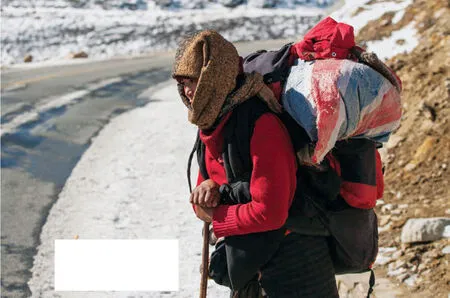
On the roads near sacred mountains of Tibet,it is common to meet pilgrims swathed in all their gear
Along the road Dhondup would spend the night in guesthouses or in the tent with his supporters.From Hongyuan,he passed through highland grasslands before entering the mountainous areas to the west,through Qamdo in Tibet before making his way to his final destination—Lhasa.
However,long pilgrimages don’t just require sacrifices for one person alone.“It was difficult,” Dohna,Dhondup’s wife,says.“I had to take care of the children alone while he was away.”The pilgrimage itself required the family to save up thousands of yuan for Dhondup to sustain himself during his journey.The family spent almost two years accruing funds for Dhondup and his assistants by operating a tea house in Hongyuan county,and he received additional financial support from members of his extended family,who found the idea of a pilgrimage auspicious.
“At every temple I prayed,but I also donated money,” Dhondup says.This became a substantial expense for the pilgrimage,but it also doubled as a reason for locals to bestow money on him.Giving money to pilgrims like Dhondup is an indirect way to support Tibetan Buddhist temples,which is why the pilgrims are held in such high regard.
Pilgrimages are not unique to Tibetan Buddhists—and such extreme journeys as Dhondup’s are far from the norm.In fact,all over China,followers of different religions participate inchaoshengeach year to offer incense at local temples and other holy sites such as the Four Sacred Peaks of Buddhism (Mount Wutai,Mount Emei,Mount Putuo,and Mount Jinhua) and Five Sacred Peaks of Daoism (Mount Taishan,Mount Huashan,Mount Hengshan in Hunan,Mount Hengshan in Shaanxi,and Mount Songshan),which drew hundreds of thousands of people during the Lunar New Year holiday before the pandemic.
Today,tour companies even offer religious pilgrimages to China’s sacred mountains,for Daoists and Buddhists alike.The act of pilgrimage has been modernized to such an extent that ordinary people,rather than only religious devotees,can get in touch with history and spirituality.

Wang Rui livestreaming along his journey on the “Long March”
Dhondup opens a drawer in a wooden cabinet.Inside there are pictures,amulets,and necklaces that he wore on his pilgrimage.He shows me a picture of himself on the way to Lhasa.Even though Dhondup has an athletic profile,he looks worn and skinny in the photo,his face weary,with red cheeks caused by the relentless winds on the barren heights of the Tibetan mountains.
“I did not fear death or anything else,because I knew that it would benefit me in the next life.”
The TikTok transformation of a Red pilgrim
In the secular realm,Chinese history and folk tales are filled with stories of revered travelers who break away from their normal life to undertake superhuman journeys.Xu Xiake (徐霞客),a legendary geographer and explorer who lived in the late 16th and early 17th century,wandered across China for 30 years,mapping rivers and mountains in ink,before returning to society once more to write of his harrowing journey in a series of travelogues.
No less memorialized in legend and folklore is the most famous secular journey in China’s modern history,the Long March.This strategic retreat by the Red Army across China in the 1930s has become synonymous with the PRC’s founding ethos: a nation born of struggle and hardship,amid the varied landscapes and people of China.
“Look here! Chairman Mao had to wander across this dangerous landscape,” Wang Rui says as he sweeps his phone camera across the grasslands in Sichuan.He is wearing a worn-out light blue uniform in the style of the early Red Army,which he bought online before his journey.“I wanted to walk the Long March to transform myself,” says the 42-year-old,who used to be the owner of a convenience store in the city of Ankang in northwestern China’s Shaanxi province.
Wang sold off his shop in late 2019 in order to finance his journey.In the eight months that followed,he walked in the footsteps of China’s revolutionary leaders,while building up a fanbase of some 20,000 people on Douyin,China’s version of TikTok,who regularly check in on his journey.
Douyin had been the original inspiration of Wang’s journey,as he saw other people walking in the footsteps of Chinese historical personages,and felt like he could do it himself.Douyin also equipped him for the trip:He’d seen other livestreamers push metal carts with sleeping and storage compartments as they walked.After selling his shop,he had a cart custom made and shipped to Ruijin in Jiangxi,the starting point of the March.
“My main concern was the cart,” he says.“I never went far away from it,in case it got stolen.” According to Wang he spent all his nights sleeping in the back of the cart to keep expenses low,and cooked on a propane stove that he brought from Ankang.
“Sometimes I get comments from followers that they think I eat too little and too simple,” he says.“Yesterday one fan sent me 20 yuan so I could buy a bowl of noodles.”
Following the route of Mao Zedong and the Communist leadership from Jiangxi to Shaanxi province,Wang walked through six of China’s southern provinces.He persevered through thick forests in Hunan,the characteristic karst mountains of Guangxi,and nothing but mountains and valleys as he moved north from Guizhou to Sichuan.“There were floods and rockslides in the south,but I managed to get past them,” he says.
“Red pilgrimages” are not a new phenomenon.During the Cultural Revolution,many young people,especially Red Guards,set out to visit important sights of the Communist revolution,such as Jinggang Mountain in Jiangxi,the site of the Zunyi Conference in Guizhou,and the revolutionary capital in Yan’an in the red hills of northern Shaanxi.
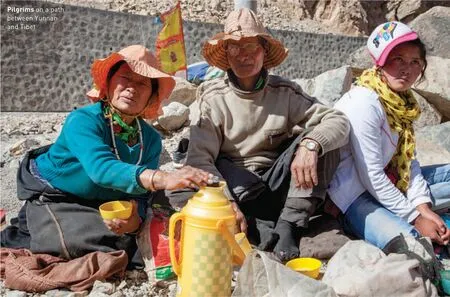
Pilgrims on a path between Yunnan and Tibet
However,the Red pilgrimages of today are a far cry from the heady dogmatic days of the 1960s.Today the majority of visitors to these Red sites consist of millions of Communist Party members who engage in study visits to learn Party history and experience life in Communist base areas by plowing fields or eating Red Army rations.
Just as the official Chinese story of the Long March tells of grateful locals who fed and housed the Red Army on their journey of liberation across the country,so Wang relied upon the kindness of ordinary strangers to fund his many months on the road.A group on WeChat of about 50 of his most dedicated fans checks in with him every day,asking questions and sending donations to keep his pilgrimage going.
Ordinary fans of his livestream can also send him donations via“virtual gifts” which can be replaced for money or other services on the platform.“Thank you all,my friends!”He exclaims at his smartphone during one livestream.“Now let me show you the road where the Red Army walked in the 30s.” He pans the camera out over a part of the grasslands where a narrow path leads into the distance.
The gifts from locals still exist too,albeit in another form.“I will livestream for a while,OK sir?” Wang asks the owner of a small store in the Tibetan grasslands,who is more than happy to comply.Livestreamers like Wang keep the wheels turning in the tourism economy of remote localities like the Ruo’ergai grasslands in Aba prefecture.
With their technical savvy and large base of urban followers in search of novelty,they can also helpdaihuo(帶貨),or sell local products on camera.“This is saffron,” Wang instructs in one stream,on the outskirts of Ruo’ergai township,as thumbs-up emojis and comments start pouring in on the smartphone screen.“It is a rare spice whose flower grows in the Tibetan areas–100 yuan per gram!”

Pilgrims frequent National Highway 248 in northern Sichuan's Aba region en route to worshiping the Guanyin bodhisattva in Jinchuan county
His image and appeal to netizens gain far more from feelings of patriotism,wanderlust,and curiosity than any revolutionary ideal.For many people who tune in,he provides an on-the-ground conduit for curious viewers,who may get a history lesson one day,and the next,an instruction in how to stay street-smart when on the lookout for exotic flora in the Chinese countryside.
“You have to be careful not to buy fakes,” Wang says,waving his index finger at the camera.“If the flower has three stems it is real.A businessman friend of mine bought more than 30,000 yuan’s worth of saffron,but they had all been dyed red.If you crush them between your fingers,and see colored dust,they are fake.”
About six months later,I reach out to Wang over WeChat.He finished his pilgrimage after 12 months on the road and I am eager to find out if his transformation has been realized as he expected.“I don’t feel a great difference,” he admits.“But I started livestreaming in my hometown every evening,about products from local producers.” He forwards pictures of jujubes,mushrooms,chili sauces,ginger roots,and smoked pork ribs.
The transformation is perhaps not always what the pilgrim expects it to be.For Wang,his arduous streaming journey has transformed him into a local food blogging celebrity,earning him a new livelihood as well as 20,000 followers on Douyin.“I learn while I visit these places,but I feel like I am passing my knowledge on to my fans as well,” he says.
Secular self-enlightenment of modern pilgrims
Despite modern transformations,conventions still cling to pilgrimages,such as rules of how to behave and what to wear.After I posted photos from a Buddhist temple I visited in 2019,a friend called me out on wearing a robe that the local monks had lent me,as he’d spotted a wooden pin on the robe signaling a clerical rank that I could not possibly have obtained within just a few years in China.The friend staunchly claimed the monks to be imposters.
In the revolutionary areas in Jiangxi province,Red tourism instructors,who advise official tours of Party members,bemoaned “fake” Long Marchers who drive in jeeps and take pictures at sights,rather than journeying through some of China’s most difficult terrain on foot like “true” Red pilgrims.
However,in Shaanxi’s Qinling Mountains,a 27-year-old Daoist follower named Xu Menghui who was planning to throw away all his belongings and walk in asceticism through China,relayed to me that we should free ourselves of such conventions and focus on the road ahead on the pilgrim’s own terms.
Today,such individual forms of pilgrimage are becoming increasingly popular,and many people quit their jobs to go backpacking or cycling,hoping for a transformative experience in the process.
In a Universidad Pontificia Comillas study from 2021,a team of Chinese and Spanish anthropologists conducted interviews with Chinese pilgrims on the Camino de Santiago,a network of pilgrimage routes dating from the medieval period converging at the Tomb of St.James in Galicia,Spain.The study found that the greatest motivations for embarking on pilgrimages were to promote personal well-being,provide an escape from stress and “experience life.” Many were on a quest for clarification and direction after graduation or change of jobs.Only a very few reported walking for religious reasons.
“Many things happened before the Camino,” one respondent noted to the team of anthropologists.“I was preoccupied and felt split in two: one being the body and the other the mind.On the Camino the two ‘I’s became one again…I recalled what I originally intended to pursue.”
Guozi,a self-styled “wandererexplorer” whom I met in 2020 in the port city of Qingdao,Shandong province,had spent years on the road searching for meaning in all corners of China since 2003.“I wanted to travel,but I did not have any money,so I rode my bicycle west,” he says.His motivation was to find inspiration for writing novels and short stories later in his life.“After three months I arrived in Kashgar.I had biked about 5,000 kilometers.”
His Yongjiu (Forever) brand bicycle,the kind that have been a fixed item on the tapestry of any Chinese street from the 1960s onward,is parked in the hallway of the guesthouse he owns in downtown Qingdao.I met Guozi over a decade after he finished his ride through China.After his ride to Kashgar,he spent more than five years trekking and has visited all the mainland Chinese provinces,while sleeping in cheap guesthouses or in his sleeping bag outdoors when the weather permitted.
Guozi did not spend a long time saving up for these journeys,instead hitting the road as soon as he could,sometimes even resorting to begging for money or working odd jobs along the way to make ends meet.
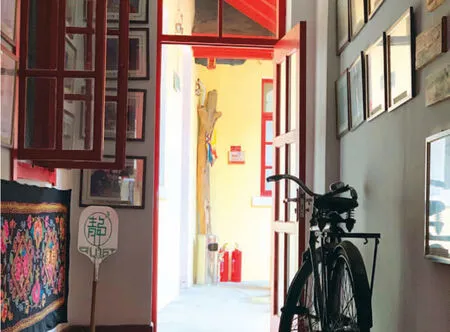
Guozi now runs a guesthouse in Qingdao,where his bike is parked next to photos of his travels

Photos and memorabilia Guozi collected on his travels to various parts of China

He says he learned many things on the trip.“One important lesson: A traveler’s temperament must match the speed of traveling.Some people prefer trains,they see things fly by like in a television,while the changing scenes stimulate their thoughts.Others like bicycles or motorbikes for mobility.”
“I found that the bicycle was too fast for me,” Guozi laughs.“So I turned to ‘Line 11’ instead.” This is neither a highway or some bespoke bus service for travelers.Instead,in Chineseshiyi hao lu(“Line 11”) is slang for traveling on foot: each of the numbers “1”resembling the legs of the trekker.“Instead of a city,my destination became the people and corners of China.From 2003,I wandered for five years,to the northernmost,southernmost,easternmost,and westernmost points of the country.”
Guozi rode “Line 11” alone to the farthest corners of the People’s Republic.He crossed the scorching sands of the Taklamakan desert on foot and wandered past snow-covered Himalayas,sometimes camping alone at dizzying heights in freezing temperatures.
He returned to Qingdao and opened a guesthouse to assist other travelers.His dream was to write a book,but they were dashed when his draft was rejected by a writers’association in Beijing.“I sent them a big envelope and I waited for months,but they never even returned the manuscript!” Guozi exclaims.“I wrote it by hand.Just think about that.”
The walls of the guesthouse are covered with photos from Guozi’s travels.In one room he has framed hundreds of sheets of paper,stamped with the date and insignia of local post offices all over China,that documented his route and now serve as personal souvenirs.“When you are on your own,there is a lot of time to think.The stars become your friends at night,the sun and road your companions by day,” Guozi says.He advises travelers to strike up conversation with owners of local tea houses and restaurants.“These are the communication hubs of the local communities.Spend one hour there and you will know everything worth knowing within a 20-kilometer radius.”
During times of extreme solitude on the road,Guozi says his mood and thoughts would swing dramatically.From elation at the fact that he was alone experiencing truly awesome wonders of nature in western China,suddenly cascading over to loneliness and doubt.On a mountainside in southern Tibet,he decided that his life would be in the city once again—among people.
“Whatever road you take,” he says,“feel the places you are and listen to the people you meet.You will learn lessons that will stay with you forever.”
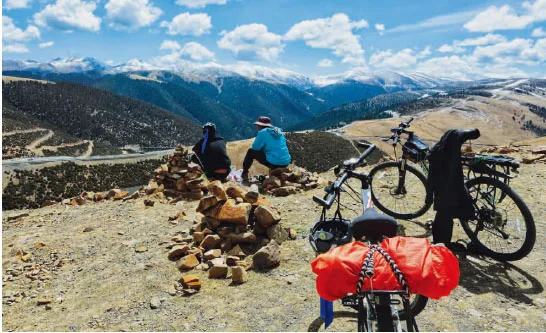
Riding bicycles around China, especially to the Tibetan highlands,has grown popular among young Chinese

猜你喜歡
黃河之聲(2021年19期)2021-02-24 03:27:46
心聲歌刊(2021年6期)2021-02-16 01:12:34
文史春秋(2019年11期)2020-01-15 00:44:32
心聲歌刊(2019年1期)2019-05-09 03:21:26
當代陜西(2019年6期)2019-04-17 05:03:50
軍營文化天地(2018年2期)2018-12-15 17:39:08
知識經濟·中國直銷(2018年6期)2018-06-29 07:56:30
下一代英才(酷炫少年)(2017年6期)2017-06-28 11:37:47
中國三峽(2017年3期)2017-06-09 08:14:59
當代音樂(下旬刊)(2017年1期)2017-04-29 00:00:00
