South African markets:More investors on the sidelines
2022-09-14 03:32:52ByZhaoXinhua
China Textile
2022年4期
By Zhao Xinhua
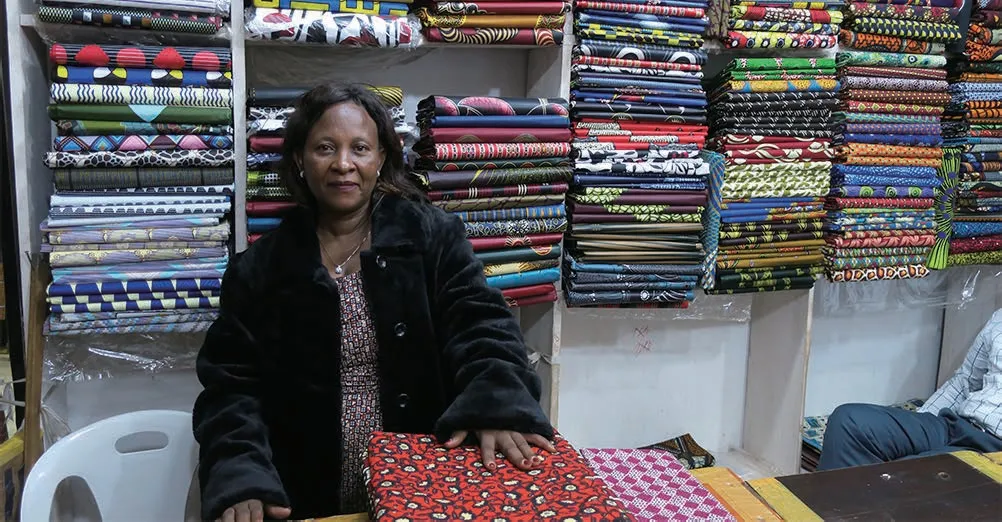
South Africa is one of the most economically developed countries in Africa. Textile and garment industry is an important industrial sector in South Africa, with a relatively complete textile industry chain and a good industrial base. South Africa is the world’s largest producer and supplier of mohair raw material, accounting for about 54 percent of global production. In addition, South Africa is also a major producer of man—made fibers such as nylon and polyester. 80 percent of the world’s nylon and poly—ester sewing threads are produced in South Africa.
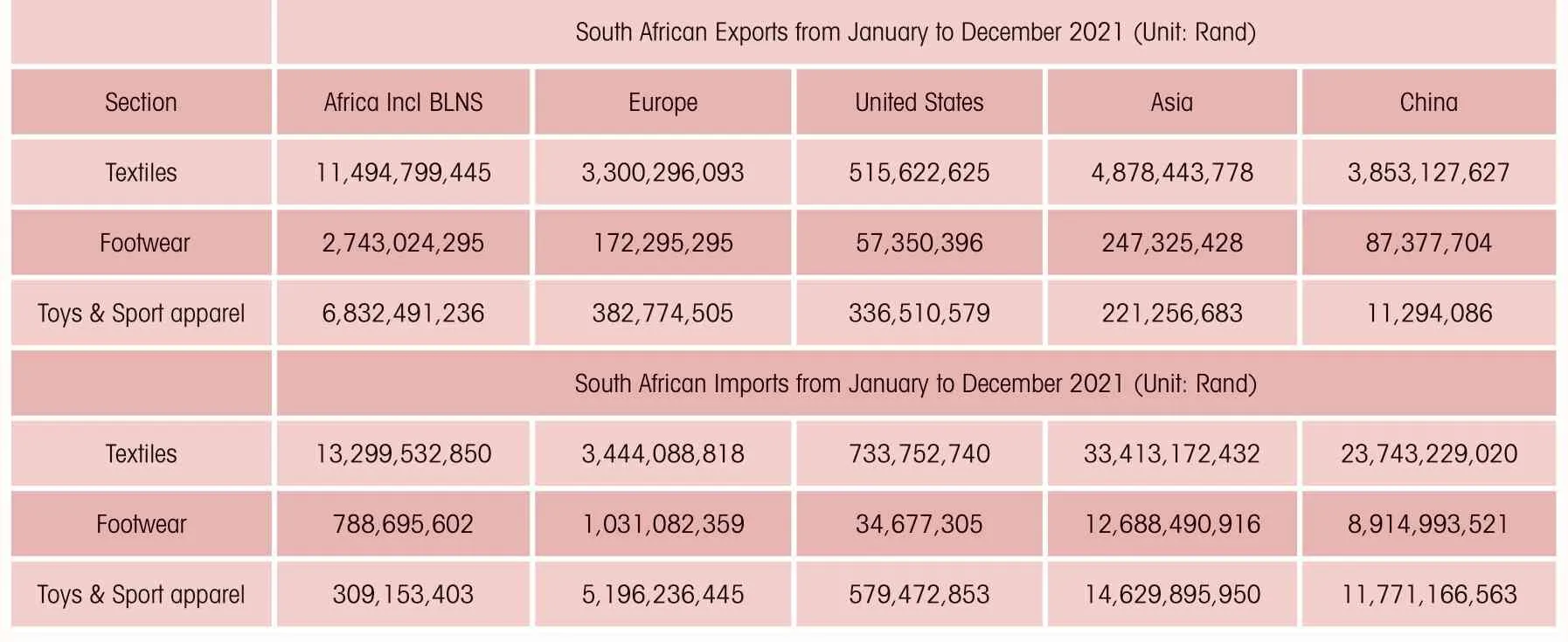
Textile and Garment Import and Export Trade between South Africa and Major Countries and Regions from January to December 2021
South Africa is considered to be one of the most promising emerging markets in the world, because it not only has a broad industrial base and productive economic development speed, but also has become an important trade and investment partner of China due to its outstanding advantages in geographical lo—cation, economic environment, trade policy and other aspects. South Africa has a large market capacity and diversified consumer needs. Africa has a middle class of over 200 million people and is seen as the next big growth market after China and India, South Africa provides traders with easy access to other markets in sub—Saharan Africa.
South Africa’s domestic textile and garment production capacity is insufficient, about 56 per—cent of the country’s textile and garment procure—ment from the international market. South Africa’s textile and fabric processing, dyeing and printing and finishing are relatively weak, knitting and in—dustrial textile industry develops slowly, domestic wool raw material resources are rich, but the deep processing capacity is insufficient, and capacity cooperation can be carried out with Chinese textile industry in relevant sub—sectors.
The huge industrial complementarity has made the textile trade between China and Africa grow continuously in recent years. South Africa’s main export markets for textiles and garments include China, Africa and EU countries. In 2021, China is still the largest export market of South Africa’s textile and apparel, with the value of textile exportsreaching about R3.853 billion. From the perspective of export product categories, wool textiles are the most important export products of South Africa’s textile industry. In 2021, South Africa imported about R23.743 billion of textiles and R11.712 billion of toys and sportswear from China, according to the statistics of South African Customs.
The COVID—19 pandemic has had a significant negative impact on South Africa’s economy and trade, particularly as the country enters the peak of the fifth wave of COVID—19, and the deteriora—tion of its business and investment climate, cou—pled with frequent extreme weather and climate disasters, will deal a serious blow to South Africa’s economic recovery.
The social situation in South Africa is still un—stable now, with continuous tension in labor relations and frequent strikes, which bring great challenges to enterprises investing in South Africa. Meanwhile, the wage level of labor and the price of water and electric—ity in South Africa are rising year by year, which di—rectly affects the cost competitive advantage of South Africa’s manufacturing industry.
The International Monetary Fund (IMF) did not downgrade its growth forecast for South Africa in its recent global economic outlook, but the country remains one of the world’s underperformers and has yet to return to pre—pandemic levels. The IMF expects South Africa’s economy to grow 1.9 per—cent in 2022 and 1.4 percent in 2023. It expects average inflation to be 5.7 percent in 2022 and 4.6 percent in 2023. But Moody’s Investors Services forecasted in a report in early May that South Af—rica’s inflation rate would rise to 8 percent this year,above the central bank’s target, because of the Russia—Ukraine conflict and rising interest rates in the United States.
In the face of the current development pressure of the textile and garment industry, the Ministry of Trade and Industry of South Africa recently released an industrial development plan, which stated that it would increase the circulation of the domestic mar—ket, improve the demand and supply capacity of the domestic market, and suggested to increase the pro—portion of domestic textile and garment procurement from 44 percent to 65 percent, while reducing the proportion of overseas procurement to 35 percent. In the future, Chinese textile and garment products en—tering the South African market will face more fierce competition environment.
登錄APP查看全文