
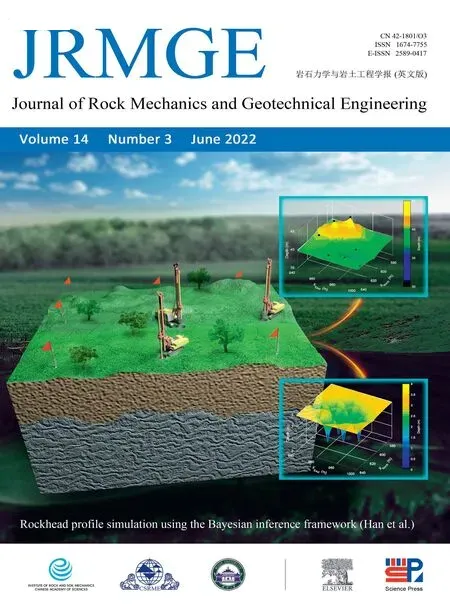
Rockhead profile simulation using an improved generation method of conditional random field
2022-08-24 16:58:02LingHnLinWngWengngZhngBomingGengShngLi
Ling Hn, Lin Wng, Wengng Zhng,b,c,*, Boming Geng, Shng Li
a School of Civil Engineering, Chongqing University, Chongqing, 400044, China
b Key Laboratory of New Technology for Construction of Cities in Mountain Area, Chongqing University, Chongqing, 400044, China
c National Joint Engineering Research Center of Geohazards Prevention in the Reservoir Areas, Chongqing University, Chongqing, 400044, China
d China Railway 19th Bureau Group Sixth Engineering Co., Ltd., Wuxi, 214028, China
Keywords:Rockhead profile Borehole Conditional random field (CRF)Bayesian Mean uncertainty
A B S T R A C T
1. Introduction
Rockhead refers to the level of moderately decomposed granite/volcanic rocks, namely Grade III weathered rock (Dasaka and Zhang, 2012; Liu and Leung, 2015; Li et al., 2016; Qi et al., 2021;Zhang et al.,2021a).Rockhead profile belongs to geological profiles,and it has been confirmed that the inherent spatial variability of geological profiles is one of the main sources causing property uncertainties in geo-material and has significant impacts on the design and construction of geotechnical engineering structures,including the design of driven piles (Dasaka and Zhang, 2012;Zhang and Chu, 2012; Ma et al., 2019; Zhang et al., 2021b), determination of the foundation surface of dams (Fan et al., 2015),tunneling(Wu and Wang,2011;Hasanpour et al.,2017;Zhang et al.,2021c), braced excavation (Zhang et al., 2018, 2019, 2020), mining projects(Afeni et al.,2021),and even slope stability analysis(Johari et al., 2016). In addition, rockhead profile also plays an important role in the assessment of seismic vulnerability(Grasso and Maugeri,2009; de Magistris et al., 2014; Gupta et al., 2021). Therefore, it is necessary to conduct studies related to rockhead profile simulation in geotechnical engineering practice.
Several methods have been developed for the analysis of geological profiles,including the traditional hand-drawing method based on borehole information (Lan et al., 2003), automatic drawing with the aid of commercial software - COMGIS (Yin et al.,2009), interpolation techniques such as kriging interpolation(Dasaka and Zhang, 2012), coupled Markov chain modeling (Li et al., 2019; Deng et al., 2020), random filed approach (Zhao et al.,2021), conventional Bayesian-based methods (Li et al., 2016,2018), Bayesian compressive sensing (Zhao and Wang, 2020a; b,2021), and artificial intelligence (AI) techniques (Qi et al., 2021).Indeed, the above methods have made a great contribution to the development of the identification of geological profiles. However,the traditional hand-drawing method cannot take the spatial variability into consideration, and it largely relies on the practitioners’ experience. In addition, automatic drawing using COMGIS does not consider the uncertainty of geological conditions.
Among the above methods,several of them are mainly used for the simulation of rockhead profile, including the Kriging interpolation technique(Dasaka and Zhang,2012),conventional Bayesianbased method (Li et al., 2016), and AI techniques (Qi et al., 2021).Additionally, Du et al. (2019) attempted to determine the soilbedrock interface using micro-tremor signals. However, these investigations have various limitations. For instance, according to Cami et al. (2020), the definitions of autocorrelation function and scale of fluctuation in the Kriging method are different from the commonly used ones in geotechnical engineering.In the work of Li et al. (2016), conditional random field (CRF) was applied for the simulation of rockhead profile using the Bayesian theory,while the final simulation was achieved with the aid of the Monte Carlo Markov Chain(MCMC).As MCMC can be time-consuming,it would be better if an analytical solution can be proposed. Although AI techniques can lead to a satisfactory result,the solving procedure is generally a black-box. Hence, it is necessary to develop a useful analytical method to reverse rockhead profiles based on limited site information.
Moreover, several researchers have devoted their efforts to the characterization of spatial variability of geo-material properties(Liu and Leung, 2015; Liu et al., 2017), and planning of site investigation (Leung et al., 2018). According to Phoon and Kulhawy(1999a, b), apart from the inherent variability, measurement error,and transformation uncertainty,the mean uncertainty is also a major source of uncertainty in geotechnical engineering.Jiang et al.(2018) and Papaioannou and Straub (2017) have investigated the effect of mean uncertainty on the performance of geotechnical engineering,and the results show that the mean uncertainty has an evident effect on the responses of some geotechnical engineering structures. Generally, limited data can lead to relatively large uncertainty in the estimation of mean values, and hence, it is suggested that the mean uncertainty can also be considered in the simulation of rockhead profile.
The Bayesian theory is a useful tool for handling limited data as it can integrate the prior information with the observed information, and at the same time, the uncertainty can be naturally considered. Jiang et al. (2018) proposed a simplified approach for generating the CRF of undrained shear strength for the reliability analysis of a slope, where the mean uncertainty was considered.Inspired by the work of Jiang et al. (2018), this paper aims at proposing a simulation method about the rockhead profile using the CRF with the aid of the Bayesian theory.The proposed method has two advantages:(1)the mean uncertainty can be incorporated into the simulation;and(2)the simulation procedure is achieved in an analytical form so that the time-consuming sampling work can be avoided.To demonstrate the performance of the proposed method and implementation procedure, two examples (i.e. an artificial example and an actual example) are presented in this study.Additionally,the effects of the prior mean and its hyper-parameters on the simulated results are also explored.This research is expected to provide useful references for actual projects and relevant studies.
2. Methodology for simulating rockhead profile
In this study, the simulation of rockhead profile is achieved by the CRF because it can take full advantage of available data which in turn minimizes the level of uncertainty (Johari and Gholampour,2018). There are several methods for generating CRF, such as the Hoffman method (Hoffman and Ribak, 1991; Lo and Leung, 2017;Gong et al., 2018), Kriging interpolation technique (Lloret-Cabot et al., 2012, 2014; Johari et al., 2016; Johari and Gholampour,2018; Johari and Fooladi, 2020), and the Bayesian-based method(Li et al.,2016;Papaioannou and Straub,2017;Jiang et al.,2018).In this study,the Bayesian-based method is employed.This is because the Bayesian framework can conveniently integrate prior information with available data,and more importantly,it is more likely to provide an analytical solution (Papaioannou and Straub, 2017;Jiang et al., 2018).
2.1. Bayesian framework
In geotechnical engineering, engineers generally need to make decisions based on the relevant information available, including direct or indirect measurements, engineering experiences, judgements from experts, etc. To this end, the Bayesian framework is a suitable tool as it has significant advantages in integrating measurement data with the prior information,and hence,the limitation of conventional methods that cannot effectively consider the prior information can be avoided(Sivia and Skilling,2006;Ang and Tang,2007; Cao et al., 2017; Wang et al., 2019a, b; Zhao and Wang,2020a). In the Bayesian framework, the unknown parameters are defined as random variables. When measurement data are available, the posterior distribution about these unknown parameters can be obtained so that these unknown parameters can be updated.The main procedure of Bayesian updating is explained as follows.
Assume θ = [θ1,θ2, …,θn] is the unknown parameter vector, in which each component is defined as a random variable,andY=[Y1,Y2,…,Ym]represents the observed data vector in site investigation.Through Bayesian inference, the prior distribution of unknown parameter vector θ can be updated, and as a result, the posterior distribution of the unknown parameter vector θ can be expressed as follows:

whereP(θ|Y) andP(θ) represent the posterior and prior distributions, respectively;P(Y|θ) is equivalent toL(Y|θ), which represents the likelihood function about θ; andKis a constant (or normalization factor), which can be expressed as follows:

Therefore,P(θ|Y) is directly proportional toL(Y|θ)P(θ), which is expressed as follows:

In the Bayesian inference framework, the prior information provides the pre-estimation about the unknown parameters, and the likelihood function is used to characterize the matching degree between the measurements and the modeling results. If the measurements are independent of each other, the likelihood function can be expressed in the form of cumulative multiplication. For example, ifYiinYfollows the normal distribution with the parameters of μiand σi, the likelihood function about θ is as follows:

whereYiis the measurement atith location;μiand σirepresent the mean and standard deviation (SD) ofYi, respectively; andmrepresents the number of measurements.
For dependent measurements,the likelihood function should be expressed as the joint distribution of the observed data vector.For example, ifYfollows the joint normal distribution, the likelihood function can be expressed as follows:

where μ=[μ1,μ2,…,μm]represents the mean vector;and Σ is the covariance matrix, which can be expressed as follows:

where ρijis the correlation coefficient between theith andjth locations.
Therefore, the distribution parameters can be denoted as follows:

2.2. Estimation of posterior distribution
2.2.1. Prior statistical information and the hyper-parameters of prior mean
Based on Baecher and Christian (2003), the parametric data of geo-material properties can generally follow a normal or lognormal distribution. In this study, a lognormal distribution model is adopted for rockhead depth as it cannot be negative, and additionally, the values are skewed towards the low range (Cho and Park, 2010). Indeed, if the occurrence probability of negative values is dramatically small,even close to 0,the normal distribution can also be adopted to reflect the distribution characterization of geotechnical properties without negative values. Nevertheless,through Kolmogorov-Smirnov testing, it is found that the lognormal model is acceptable for describing the statistical characteristics of rockhead depth. Therefore, a lognormal distribution with parameters of λdand ξdis applied to reflect the distribution characteristics of rockhead depth (d):

where μdandCOVdare the mean and variance coefficient ofd,respectively. To take the mean uncertainty into consideration, it is assumed that μdfollows a prior distribution, which is also the lognormal distribution with parameters λμdand ξμd: Based on Papaioannou and Straub(2017),if the lower and upper bounds of μd(i.e.) are provided, λμdand ξμdcan be estimated using Eq. (9), whereare taken as thep1andp2quantiles of μd, respectively:

where φ(?) is the cumulative distribution function of the standard normal variable, and φ-1(?) is the inverse function of φ(?). Hence,the prior mean and SD of μd, i.e. μμdand σμdcan be expressed as follows:

As μdfollows the lognormal distribution with parameters of μμdand σμdthe prior distribution of λdis a normal distribution with the mean of μλdand SD of σλd(Eq. (8)) as follows:

2.2.2. Updating the statistical characteristics of prior mean
The joint probability distribution function (PDF) of lndat the locations with observed data is as follows:

wheredis the vector of rockhead depth data, the subscript “o”represents the observed information,mrepresents the number of measurements(observed data)or locations,and μlnd,oandClnd,oare mean vector and covariance matrix about lndat the locations with observed information. Indeed, there are multiple types of autocorrelation functions that can be selected for the simulation based on the characterization results of spatial variability. Nevertheless,the single exponential autocorrelation function (SEACF) (see Eq.(15)) is more likely to build a positive-definite correlation matrix,and the non-positive-definite matrix cannot be used for Cholesky decomposition. In light of this, SEACF is adopted in the proposed method.

whereriandrjare the spatial coordinates of theith andjth locations in the study domain, respectively; and δ is the scale of fluctuation.
According to Eq.(12),the likelihood function about λdis defined as follows:

The prior distribution of λdfollows the normal distribution as follows:

The normal prior is conjugate to the multivariate Gaussian distribution model,and accordingly,the posterior distribution of λd
has the conjugate form:

The mean vector and covariance matrix at the measurement locations are updated as follows:

Therefore, the distribution of λdat the locations with measurements(λd) has the mean ofand SD of:
According to Eq.(11),the parameters of posterior distribution of μdat the measurement locations are as follows:

2.2.3. Establishment of posterior predictive PDF of rockhead depth
Based on the analysis in Section 2.2.2, the posterior predictive PDF ofdat the measurement locations can be evaluated using Eq.(21).

It can be derived thatf′d(di) is the lognormal distribution with distribution parameters μ′λdand

The posterior mean vector μ′′lnd(r) and covariance matrixC′′lnd(r,r) incorporating the measurement error can be obtained,and their components are expressed as

where Σlnerepresents the principal diagonal matrix of variance of measurement error formmeasurements,rorepresents the spatial coordinate matrix of measurements,and the covariance matrixes in the right hand of Eq. (23) are obtained using Eq. (24) based on Papaioannou and Straub(2017).Note that if the measurement error is considered, the determination of Σlnecan be found in Appendix A; if not,Σlnecan be ignored.

Sincedis assumed to follow the lognormal distribution, the posterior mean and SD ofd(ri) at locationrican be derived as follows:

2.3. Generation of the CRF
Once the posterior distribution of rockhead depth is determined, several methods can be used to generate the random field such as the midpoint method, local average subdivision method,Karhunen-Loève expansion method, etc. Among them, the midpoint method is the most commonly used method as it is a conceptually simple and easy-to-use approach with acceptable accuracy. Therefore, the midpoint method was adopted in this study. Based on Jiang et al. (2018), one realization of CRF can be achieved using the following equation:

whereLis the lower triangular matrix with a dimension ofnp×np,rrepresents the spatial coordinate matrix in the study domain,ui(i=1,2,…,np)is a series of independent standard normal samples,andnpis the number of coordination points in a mesh model.
The whole analytical procedure above is coded using the Matlab programming software.
2.4. Implementation procedure of the proposed method
In this study, the implementation procedure for generating the rockhead profile with considering mean uncertainty consists of 8 steps:
(1) Determine the prior statistical information, measurement error(if it is possible to be identified from the observations),and the hyper-parameters of prior mean,and collect the sitespecific data about rockhead depth.
(2) Build a mesh model withnp×npcalculation points for visualizing the simulated rockhead profile based on the coordinates of collected site-specific data.
(3) Calculate the statistical characteristics of the prior mean using Eqs. (8)-(10).
(4) Updating the statistical characteristics about the prior mean using Eq. (19) by constructing the likelihood function using Eq.(12)and further building posterior distribution about the prior mean using Eq. (18).
(5) Establish the posterior predictive PDF about the rockhead depth at the locations without measurements using Eq.(21).
(6) Compute the posterior mean vector and covariance matrix for the entire mesh model using Eq. (23).
(7) Obtain one realization of rockhead profile using the midpoint method (or the Cholesky decomposition method).
(8) Repeat Step(7)forNsimtimes,leading toNsimrealizations of rockhead profile using Eqs. (26)-(28).
3. An artificial example
Firstly, we introduced an artificial case in Li et al. (2016) to illustrate the performance of the proposed method for simulating rockhead profile.Similar to Li et al.(2016),the virtual study site has an area of 10 m × 10 m, and this virtual site is discretized into 40×40 elements with the size of 0.25 m×0.25 m.It was assumed that the rockhead depth data are stationary and follow the Gaussian distribution with a mean of 50 m and a SD of 5 m.Besides,to apply the CRF, a measured rockhead depth of 60 m at the coordinate ofx=6 m andy=6 m is considered,and the measurement error with a mean of 0 m and SD of 0.5 m is assumed. The measurement error is an additive error,and its statistical characteristics can be transformed into a multiplicative error utilizing the methodology presented in Appendix B. As a result, the multiplicative error has a mean of 1 and a SD of 0.0083,which will be used here.
3.1. Without considering the mean uncertainty
To investigate the effects of mean uncertainty, the simulation of rockhead proflie without mean uncertainty was performed. Fig. 1 shows two realizations of the simulated rockhead profile without mean uncertainty,where the rockhead depth ranges from 35.53 m to 66.23 m in the first realization and 36.2-68.93 m in the second realization(Table 1).Moreover,the rockhead depth at the coordinate ofx=6 m andy=6 m matches the measurement of 60 m very well(Fig.1).

Fig.1. Two realizations of simulated rockhead profile without considering mean uncertainty: (a) First realization, and (b) Second realization.
Using Eq.(25),the posterior mean and SD throughout this study area can be analytically calculated.Fig.2a shows the updated mean distribution, where the minimum and maximum values are 50.01 m and 59.25 m,respectively(Table 1).It can be observed that the updated mean value at the measurement location is fairly close to 60 m and approaches the prior mean of 50 m at the locations far away from the measurement point. Fig. 2b shows the updated SD distribution, in which the minimum and maximum values are 2.14 m and 5.09 m, respectively (Table 1). The measurement location has the lowest SD, indicating that the existing measurement can largely reduce uncertainty. Throughout the study domain, the updated SD has a mean of 5.01 m in this case.
However, the results in Fig. 2a show that the discrepancy of updated mean between the measurement location and another location about 3 m away from it is dramatic, being up to 10 m.Generally, this is not in line with the realistic situation, and apparently can be attributed to the selection of prior mean. In this case,there is just one measurement point at the coordinate ofx=6 m andy= 6 m,and thus,the measurement data are very limited.Accordingly,it is not straightforward to specify a suitable prior mean,and its selection will depend on human subjectivity to a large extent.
3.2. With considering the mean uncertainty
To tackle the problem about the selection of prior mean, the mean uncertainty is incorporated into the simulation of rockhead profile using CRF,where the mean is regarded as a random variable throughout the whole study area and assumed to follow the lognormal distribution.According to Eq.(9),we need to specify the hyper-parameters including the lower and upper bounds of μd(i.e.) corresponding to thep1andp2quantiles of standard normal distribution, respectively. In this case, the lower and upper bounds are taken as 40 m and 65 m, andp1andp2are 10% and 90%, respectively. Using Eqs. (8)-(23), the updated prior mean is equal to 58.37 m and the corresponding SD is also updated to 7.81 m, i.e. the COV is 0.134. Obviously, SD is greater than the specified one, and this is because of the introduction of mean uncertainty as explained in Eq. (22). Finally, two realizations of simulated profile with considering mean uncertainty are shown in Fig.3,in which the rockhead depth ranges from 49.95 m to 88.87 m in the first realization and 41.67 m-88.07 m in the second realization(see Table 2).When the mean uncertainty is considered,the updated SD has a mean of 7.72 m that is greater the result in Section 3.1, and at the same time, it can be observed that the rockhead depth has intensive fluctuation. Accordingly, the incorporation of mean uncertainty leads to the increase of uncertainty in the simulation of rockhead profile.

Fig. 2. Posterior statistical characteristics without considering mean uncertainty: (a)Updated mean, and (b) Updated SD.

Table 1 The minimum and maximum values (m) of simulated results without considering mean uncertainty.
Fig.4a shows the distribution of updated mean throughout the study area with the minimum and maximum values of 58.37 m and 59.92 m,respectively(Table 2).It can be seen that the results match very well with the measurement of 60 m.Obviously,once the mean uncertainty is considered, the maximum discrepancy between the locations without and with measurements decreases to less than 2 m within the study domain,which agrees better with the general understanding of rockhead profile. In terms of the updated SD,Fig. 4b shows a similar result with that in Fig. 2b, while the minimum and maximum values are 2.86 m and 7.81 m (Table 2),respectively. The magnitude in Fig. 4b is marginally greater than that in Fig. 2b, indicating that the mean uncertainty can be transferred to the final results.

Table 2 The minimum and maximum values (m) of simulated results considering mean uncertainty.

Fig. 3. Two realizations of simulated rockhead profile considering mean uncertainty:(a) First realization, and (b) Second realization.
4. An actual example
4.1. Database introduction
The borehole data used in this study are from a site investigation in the weathered ground with an area of 50 m×50 m in Hong Kong(see Fig. 5), where the east and north coordinates are denoted byXEastandXNorth, respectively. Based on Dasaka and Zhang (2012),this site is rather flat,and the ground surface is,on average,at 5.7 m above sea level.In addition,no geological fault was reported in this study site. This site includes three investigation phases, namely Phases I, II, and III, in which 8, 23, and 18 boreholes were drilled,respectively.The statistical characteristics(i.e.mean and SD)of this database are listed in Table 3.For the whole investigation scheme,the mean and SD are 39.7 m and 2.72 m, respectively; and the statistical characteristics for each investigation phase are close to the ones from the database composed of all three phases.

Fig. 4. Posterior statistical characteristics considering mean uncertainty: (a) Updated mean, and (b) Updated SD.

Fig. 5. Layout of boreholes showing three phases in site investigation (after Li et al.,2016).
4.2. Simulation of rockhead profile without considering mean uncertainty
Based on the database shown in Section 4.1, 8 boreholes from Phase I are employed to explore the effect of mean uncertainty,
where the mean and SD of the data from Phases I-III are taken as the prior mean and SD, at 39.7 m and 2.72 m, respectively. In the reference of Li et al. (2016), the authors assumed that the measurement uncertainty follows a normal distribution model with a mean of 0 and a SD of 0.05 m. According to the methodology in Appendix B,the measurement uncertainty about the multiplicative error at each measurement location can be estimated. For more information about the measurement uncertainties,the readers can refer to Table A1 in Appendix B.
Fig. 6 shows one realization of rockhead profile with the minimum and maximum values of 32.28 m and 50.35 m (Table 4),respectively, and the results match very well with the measurement data from 8 boreholes. From Fig. 7a, it can be found that the updated mean is very close to the measurements and converges to the prior mean at the location far away from the measurements,in which the minimum and maximum values are 35.68 m and 44.44 m (Table 4), respectively. Fig. 7b shows that the updated SD increases with the distance between the locations with and without measurements, and it varies from 0.71 m to 2.75 m(Table 4). Additionally, the updated SD has the mean of 2.48 m throughout the study domain.
4.3. Simulation of rockhead profile with considering mean uncertainty
In this section, the mean uncertainty will be taken into consideration,in which the prior information is the same as Section 4.2,and two hyper-parameters(i.e.)are 30 m and 50 m, respectively. Based on the above settings, the updated prior mean is 39.46 m,and the prior SD is also updated to be 2.87 m,that is, the prior COV of d is 0.073. Fig. 8 shows one realization of rockhead profile considering mean uncertainty, in which the minimum and maximum reversed rockhead depths are 29.93 m and 47.32 m,respectively(Table 5).From Table 5,it can be seen that the updated mean ranges from 35.68 m to 44.44 m, and the updated SD varies from 0.77 m to 3 m.Through considering mean uncertainty, the updated SD has the mean of 2.7 m that is greater than 2.48 m in Section 4.2, indicating that the incorporation of mean uncertainty brings more uncertainty to the final results.

Table 3 Statistical characteristics of rockhead depth in three phases.

Fig. 6. One realization of rockhead profile without considering mean uncertainty based on the data in Phase I.

Table 4 The minimum and maximum values (m) of simulated results without considering mean uncertainty using the data in Phase I.
The fluctuation in Fig.8 is similar to the results in Fig.6,and the posterior statistical characteristics shown in Fig. 9 are also similar to the results in Fig.7.This is because the mean of rockhead data in Phase I is 39.49 m(Table 6),close to the updated mean(39.69 m)in this section (Table 3). For the database from Phases I-II and I-III,there is a similar observation, indicating that the rockhead database in this study has relatively small mean uncertainty so that the results are similar no matter the mean uncertainty is considered or not. Nevertheless, the prior mean can be updated using the measurements and the hyper-parameters by considering the mean uncertainty, while if the mean uncertainty is not considered, the prior mean would be fixed at a specified value.

Table 5 The minimum and maximum values(m)of simulated results with considering mean uncertainty using the data in Phase I.

Fig.7. Posterior statistical characteristics without considering mean uncertainty based on the data in Phase I: (a) Updated mean, and (b) Updated SD.
For the simulation results about Phases I-II and I-III, the readers can refer to Appendix C.

Fig.9. Posterior statistical characteristics with considering mean uncertainty based on the data in Phase I: (a) Updated mean, and (b) Updated SD.
5. Effect of prior mean and hyper-parameters on the simulated results
5.1. Effect of prior mean
In the above analysis, the simulation results considering mean uncertainty or not are similar because the prior mean is similar to the updated one and the value of all available data. To explore the effect of prior mean, rockhead depth data in Phase I are adopted again, where the prior mean is taken as 30 m and the hyperparameters are the same as the values used in Section 4.3. Fig.10 shows one realization without mean uncertainty with the minimum and maximum values of 24.54 m and 47.15 m, respectively(Table 7),which is less than the magnitude in Fig.6.From Fig.11a,it can be found that the posterior mean at the measurement locations can match the measurements very well, while the posterior mean at the locations far away from the measurements tends to be equal to the prior mean (30 m). Accordingly, the updated mean ranges from 30.13 m to 43.99 m (Table 7). In terms of the updated SD,Table 7 also shows that the updated SD varies from 0.93 m to 3.09 m, which is generally greater than that in Table 4, indicating that the unsuitable prior mean can lead to the increase of uncertainty in the final results.

Table 6 Updated statistical characteristics of rockhead depths under the hyper-parameter combination of [30 m, 50 m].

Fig. 10. One realization of rockhead profile without considering mean uncertainty under a prior mean of 30 m.

Table 7 The minimum and maximum values (m) of simulated results without considering mean uncertainty using the data in Phase I under the prior mean of 30 m.
Similarly, the prior mean is set as 30 m when the mean uncertainty is taken into account, and the hyper-parametersandare set as 30 m and 50 m, respectively. The updated prior mean and prior SD are 39.76 m and 3.92 m, respectively. One realization of rockhead profile is shown in Fig.12, where the minimum and maximum values are 28.73 m and 53.17 m (Table 8),respectively.It can be seen that the fluctuation of rockhead profile throughout the study area is similar to the results in Fig.8.In terms of the posterior statistical characteristics,the results in Fig.13 and Table 8 are rather close to the results in Fig. 9 and Table 6.Accordingly, even if the pre-set prior mean of rockhead depth deviates significantly from the most likely prior mean,the prior mean can still be adjusted to the best one via the updating mechanism in this proposed method.

Fig.8. One realization of rockhead profile with considering mean uncertainty based on the data in Phase I.

Fig. 11. Posterior statistical characteristics without considering mean uncertainty under a prior mean of 30 m: (a) Updated mean, and (b) Updated SD.

Fig. 12. One realization of rockhead profile considering mean uncertainty under a prior mean of 30 m.
5.2. Effect of hyper-parameters
In this proposed method,the hyper-parameters of prior mean and measurements can be integrated to update the pre-set prior mean and SD, and hence, it is necessary to study the effect of hyperparameters on the simulated results.In actual projects,these hyperparameters are determined from site engineers’experiences or previous investigation at adjacent or similar sites. Nevertheless, the specified hyper-parameters may have various selections. In Section 5.1,the prior mean is 30 m,and the combination of hyper-parameters is[30 m,50 m].To further investigate the effect of hyper-parameters on simulation results, a series of possible combinations of hyperparameters are tested,including[25 m,50 m],[20 m,50 m],[30 m,55m],[20 m,60m],[35 m,50 m],and[45 m,65m],as listed inTable9.There are several findings as summarized below.If the lower bound decreases,namely[25 m,50 m]and[20 m,50 m],the updated mean will decrease slightly. If the upper bound increases, namely [30 m,55 m]and[30 m,60 m],the updated meanwill increase moderately.If the lower bound decreases and the upper bound increases, namely[20 m,60 m],the updated mean can still match the actual mean very well.If the lower bound is more than the prior mean,namely[35,50],the updated mean can increase marginally. If the lower mean is notably higher than the mean of input rockhead depth data in Phase I,namely [45 m, 65 m], both the updated mean and SD can increase slightly.If the upper bound is less than the mean of input data,namely[15 m,20 m],both the updated mean and SD can decrease slightly.In terms of the COV,the variation of updated statistical characteristics is much stable. Accordingly, this proposed method has a good performance in updating the statistical characteristics with the aid of the mean uncertainty information and measurements.

Table 8 The minimum and maximum values (m) of simulated results considering mean uncertainty using the data in Phase I under the prior mean of 30 m.

Table 9 Updating of the prior statistical characteristics of rockhead depth.

Fig.13. Posterior statistical characteristics considering mean uncertainty under a prior mean of 30 m: (a) Updated mean, and (b) Updated SD.
According to the statistical characteristics of the original database of rockhead depth, it can be found that the database about rockhead depth has relatively low mean uncertainty as the statistical characteristics in each phase are all close to the ones obtained from the whole database.At the same time,the updated statistical characteristics are also close to those from the whole database,indicating that if the database has much lower mean uncertainty,satisfactory results can also be obtained using the statistical characteristics from the original data.
6. Conclusions
This paper proposed a method to simulate the rockhead profile using CRF,in which the CRF is achieved by the Bayesian framework.The advantages of the proposed method are that it can consider the mean uncertainty and its simulation procedure is achieved in an analytical form. In addition, the by-products including posterior mean and SD can also be obtained through the analytical process.To illustrate the performance of this proposed method,an artificial example and a set of actual rockhead depth data are taken as examples. The results show that the proposed method can avoid subjectivity in determining the prior mean of rockhead depth via integrating the mean uncertainty information and the measurements with the conventional generation strategy of CRF. If the specified prior mean of rockhead depth is not satisfactory, the statistical characteristics of rockhead profile can be updated so that the simulated rockhead profile has a low discrepancy with the results obtained using a satisfactory prior mean.Moreover,compared with the available data,hyper-parameters generally have less effect on the final results of rockhead profile.If the hyper-parameters are hard to be determined,the hyper-parameters with a relatively wide range can be selected. Finally, if the database has a much lower mean uncertainty, satisfactory results can also be obtained using the statistical characteristics from the original data. This proposed method can also be used in other fields involving the generation of CRF using limited data or the data with relatively greater mean uncertainty.
Declaration of competing interest
The authors wish to confirm that there are no known conflicts of interest associated with this publication and there has been no significant financial support for this work that could have influenced its outcome.
Acknowledgments
We acknowledge the funding support from the National Natural Science Foundation of China (Grant No. 52078086), Program of Distinguished Young Scholars, Natural Science Foundation of Chongqing, China (Grant No. cstc2020jcyj-jq0087), and State Education Ministry and the Fundamental Research Funds for the Central Universities (Grant No.2019 CDJSK 04 XK23).
Appendices A-C. Supplementary data
Supplementary data to this article can be found online at https://doi.org/10.1016/j.jrmge.2021.09.007.
List of symbols
θ Unknown parameter vector in a probability distribution model
θiith component in θ
YObserved data vector for updating θ
Yiith component inY
P(θ|Y) Posterior distribution about θ
P(θ) Prior distribution about θ
L(Y|θ) Likelihood function about θ in a Bayesian equation
KA constant (or normalization factor) in a Bayesian equation
μiMean about the ith observed data sampleYi
σiStandard deviation ith observed data sampleYi
μ mean vector
Σ Covariance matrix
dRockhead depth
dRockhead depth data vector
λdThe distribution parameters in the lognormal distribution aboutd
ξdThe distribution parameters in the lognormal distribution aboutd
μdMean ofd
COVdCOV ofd
L(λd)Likelihood function about λd
λμdThe distribution parameters in the lognormal distribution about μd
ξμdThe distribution parameters in the lognormal distribution about μd
p1Occurring probability ofp1quantile in the standard normal distribution
p2Occurring probability ofp2quantile in the standard
normal distribution
φ(?) Cumulative distribution function of the standard normal variable
φ-1(?) Inverse function of φ(?)
μμdPrior mean of μd
σμdPrior standard deviation of μd
μλdMean in a normal distribution about λd
σλdStandard deviation in a normal distribution about λd
o Observed information
mNumber of measurements
ρijCorrelation coefficient between location i and j
riSpatial coordinate of ith location in the study domain
rjSpatial coordinate of jth location in the study domain
roSpatial coordinate matrix of observed data (or measurements)
δ Scale of fluctuation
μlnd,oMean vector about lnd at the locations with observed information
Clnd,oCovariance matrix about lnd at the locations with observed information
f′λd(λd) Prior distribution of λd
f′′λd(λd) Posterior distribution of λd
μ′λdUpdated mean of λd
σ′λdUpdated standard deviation of λd
f’d(d) Posterior predictive PDF of d
μ′′lnd(r) Posterior mean of lnd
C′′lnd(r,r) Posterior standard deviation of lnd
σ2lneiVariance of measurement error in the logarithmic form at ith location
Llower triangular matrix
uIndependent standard normal data sample vector
npNumber of coordination points in a mesh model
NsimNumber of realizations of rockhead profile simulation
 Journal of Rock Mechanics and Geotechnical Engineering2022年3期
- Journal of Rock Mechanics and Geotechnical Engineering的其它文章
- Editorial for Advances and applications of deep learning and soft computing in geotechnical underground engineering
- A review of methods, applications and limitations for incorporating fluid flow in the discrete element method
- Numerical modeling of contaminant advection impact on hydrodynamic diffusion in a deformable medium
- A modified Kozeny-Carman equation for predicting saturated hydraulic conductivity of compacted bentonite in confined condition
- Geotechnical particle finite element method for modeling of soilstructure interaction under large deformation conditions
- Structural,volumetric and water retention behaviors of a compacted clay upon saline intrusion and freeze-thaw cycles