
Progress of China’s Space Debris Research
2022-08-18 09:01:16LIUJingYANGXuCHENGHaowenJIANGHaiZHANGYaoWANGYueer
空間科學學報 2022年4期
LIU Jing YANG Xu CHENG Haowen JIANG Hai ZHANG Yao WANG Yueer
1(National Astronomical Observatories, Chinese Academy of Sciences, Beijing 100101)
2(School of Astronomy and Space Science, University of Chinese Academy of Sciences, Beijing 100190)
Abstract China has continually worked on space debris research,complying with the White Paper “China’s Space Program:A 2021 Perspective”.This paper aims to clarify China’s research and application progress from 2020 to 2021 in space debris observation,prediction,protection,and mitigation.In this context,it also summarizes the space debris mitigation efforts made by the Chinese government and provides the expectation of future direction for the work.
Key words Space debris,Observation,Prediction,Protection,Mitigation
1 Introduction
Space debris has become a serious threat to space safety,and the rising population of space debris poses a great challenge to long-term sustainability of outer space activities.With the vigorous implementation of large constellation projects,the possibility of collision between space objects has increased dramatically,and the occurrence of catastrophic events such as collisions and break-ups has become an actual existence.Space debris issue has become the hot topic of international scientific research and the focus of the long-term sustainability of outer space activities.
It is of great significance to ensure space safety,maintain the long-term sustainability of outer space activities,and maintain the development of human space by maintaining the dynamic catalog of space debris through long-term continuous observation of large space domain;and improving the prediction accuracy of space debris for accurately grasping for giving timely and precise warning of its threats to space activities and ground personnel and assets;and studying the means and methods of active debris removal or the environment remediation to curb increasing trend of space debris population.
The year 2020 to 2021 is the final year of China’s 13th Five-Year Plan and the planning year of its 14th Five-Year Plan.The White Paper “China’s Space Program:A 2021 Perspective”[1],issued by China National Space Administration (CNSA) in January 2022,concisely generalized and summarized China’s progress in space debris research in chapter 7 “Space Environment Governance” of the second part:With a growing database,China’s space debris monitoring system is becoming more capable of collision warning and space event perception and response,effectively ensuring the safety of on-orbit spacecraft.In compliance with the Space Debris Mitigation Guidelines and the Guidelines for the Long-term Sustainability of Outer Space Activities,China has applied upper stage passivation to all its carrier rockets and completed end of life active deorbit of the Tiangong-2 and other spacecraft,making a positive contribution to mitigating space debris.
This article briefly introduced the progress of China’s space debris research in the past two years from the aspects of observation and prediction,protection and mitigation,national mitigation effort,and standardization.
2 Promotion of the Observation and Prediction Capability
Comprehensive awareness of space debris,accurate prediction of situation and status,and effective disposal capability are the basis for dealing with the problem of space debris.Space debris orbit is affected by various perturbations forces with great uncertainty.Strengthening capability of surveillance facilities and increasing the observation frequency are effective means to improve the orbit data accuracy of space debris.In recent years,China has developped its observation capacity building of space debris.A set of telescopes are deployed,and the distribution of the space debris observation network is continuously optimized.The 1.2 m aperture large field of view telescope has been preliminarily completed with its first image,which is carrying out optimization and debugging of space debris and near-Earth asteroid observation. The Xinglong 60 cm aperture telescope (seeFig.1) for both space debris and asteroid observation,has been put into operation and participated in the international joint observation campaign of near-Earth asteroids organized by the International Asteroid Warning Network (IAWN).The 36 cm test telescope array (seeFig.2) has been put into operation with wide-field survey and synthetic tracking;the construction of Multi-Application Sky Survey Telescope Array (MASTA)project can improve the observation ability of faint and small space debris.The network of the Asia Pacific Space Science Observatory (APSSO) is under joint construction,and will enhance observation and research capabilities for space debris and near-Earth asteroid,and serve for research on space science and time domain astronomy for Member States of Asia-Pacific Space Cooperation Organization (APSCO).
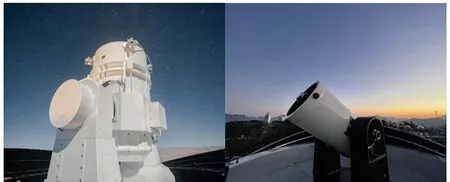
Fig.1 YaoLight telescope and the Xinglong 60 cm diameter telescope

Fig.2 36 cm test telescope array
To effectively avoid the collision of space debris and timely respond to space debris related events,the accuracy of the collision avoidance assessment model and the algorithm has been improved[2],and a new generation of highly automated and efficient data processing and collision risk assessment system supported by a unified database has been built[3,4].The space events analysis models were improved and the analysis and research for space events,including the upper stage reentry analysis,satellite anomaly analysis,rocket body and satellite breakup analysis,were carried out.
China continuously improves the level of re-entry joint observation and prediction,actively participates in the joint re-entry prediction campaign organized by Space Debris Coordination Committee (IADC),and shares relevant data and information.
To serve the research on the long-term sustainability of outer space activities,the space debris long-term evolution model SOLEM was continuously improved by increasing calculation efficiency,expanding application scope,and conducting the research on long-term environmental evolution model comparison under the influence of various natural and human space activities[5]with IADC member agencies.The simulation study has been done on the impact of LEO large constellation on space environment,and the results can support Chinese government in formulating LEO satellite management measures.Also,the model was used to analyze the ranking of potentially dangerous space debris[6],which provided a technical basis for the planning and design of ADR in the future.
The new space debris environment engineering model SDEEM 2019[7]has been developed,and the work on revising standards for space debris models has been completed cooperated with international scholars under the framework of the International Organization for Standardization (ISO).
3 Development and Application of Protection and Mitigation
It is an effective way that design space debris protection methods to deal with the impact threat of the long-duration operating spacecraft among the environment of small space debris and micro-meteoroid.The optimized design model for typical protective structures and the space debris protection design system,which are developed with the support of the China National Space Administration,have been applied to the manned space stations after continuous improvement and accumulation of experiments[8].
The basic work of protection design has been supported.At present,the ground hypervelocity impact test facility has achieved the stable launch velocity of 8 km·s–1[9],and obtained the hypervelocity impact characteristic data of various materials at the speed of 8–10 km·s–1[10].The data has been continuously accumulated and provided basic technical data for spacecraft protection design and impact effect evaluation of components and structural materials.
It has continuously supported and carried out the study on impact vulnerability assessment to promote the refined protection design of spacecraft.The spacecraft survivability assessment calculation has been preliminarily realized by studying the spacecraft impact sensitivity assessment technology[11],vulnerability assessment technology of key components[12],and survivability assessment technology of spacecraft systems[13].
An engineering-oriented design and evaluation system for space debris mitigation was developed to support space debris mitigation.Some ground verification and on-orbit technology validation of drag-enhancing de-orbit technologies[14]have been carried out to routinely implement the work of LEO de-orbit in the future.Debris removal is an effective way to curb the growth of space debris,and various means of space debris removal have been explored and verified,laying a foundation for expanded application in the future.
4 National Effort on Space Debris Mitigation
It promotes the long-term sustainability of outer space activities that China has actively participated in reaching a consensus on the long-term sustainability of outer space activities under the UN framework (e.g.,joining the Space Debris Expert Group,EGB),and also contributed to the unanimous adoption of the first set of 21 UN LTS guidelines for the long-term sustainability of outer space activities.
Meanwhile,cooperation mechanisms,such as the Space Debris Working Group of the China-Russia space cooperation subcommittee and the China-US expert seminar on space debris and space flight safety,will strengthen communication in the fields of space debris and the long-term sustainability of outer space activities.China has actively participated in joint research,test,comparison,and other technical work to support the activities of international organizations,such as the Interagency Space Debris Coordination Committee (IADC)and the Consultative Committee for Space Data Systems (CCSDS).
It promotes the implementation of the space debris mitigation guidelines and effectively supervises space activities that China has published the guidelines “Notice on Promoting the Orderly Development of Microsatellites and Strengthening Safety Management”[15],which defined the further requirements for collision avoidance and mitigation of space debris to microsatellites.For example,Necessary measures should be taken for the design and manufacture of microsatellites so that their bodies can be detected on the ground during the onorbit phase;Microsatellites shall have certain collision avoidance and orbit control capability.When deployed in network or constellation,technical measures shall be taken to avoid a collision;Microsatellites should have the necessary capabilities to facilitate the implementation of de-orbit action,avoid long-term occupation of common orbit,and the adopted de-orbit technology should be mature and reliable;After the end,termination or expiration of the mission,the orbit dwell time of microsatellites with an operating orbit height of no more than 2000 km shall be less than 25 years,and microsatellites with an operating orbit height of more than 2000 km shall actively enter the grave orbit or uncommon orbit;Necessary technical measures shall be taken for microsatellites to avoid the generation of separable debris in orbit,including falling off,discarding,and throwing;Avoid explosion and other breakup events of energy storage components such as fuel storage tank and battery[15].
CNSA has incorporated the review of space debris elements into the space launch project license review procedure.It is necessary to review space debris mitigation measures for spacecraft and launch vehicles before launch,including taking measures to avoid launch vehicle and satellite breakups,avoiding generating new debris,avoiding collision during the on-orbit operation phase,carrying out passivation and de-orbit measures at the end of the mission,and meeting the 25 years requirements of the LEO orbital life.
5 Promotion and Development of Standardization
Chinese government’s regulatory requirements for space debris mitigation are top-level documents,which need to be supported by relevant implementation rules,management standards,and technical standards to facilitate enforcement.Subcommittee 5 on Space debris of National Technical Committee 425 on Space Technology and Operation of Standardization Administration of China(SAC/TC425/SC5) was approved to be established in August 2020.
Space debris subcommittee has proposed a space debris standard system,which consists of four branches:foundation and management,observation and awareness,mitigation and protection,and space traffic management(seeFig.3).The preliminary demonstration includes a total of 68 standards.At present,10 standards have been issued or approved for preparation under the framework system.
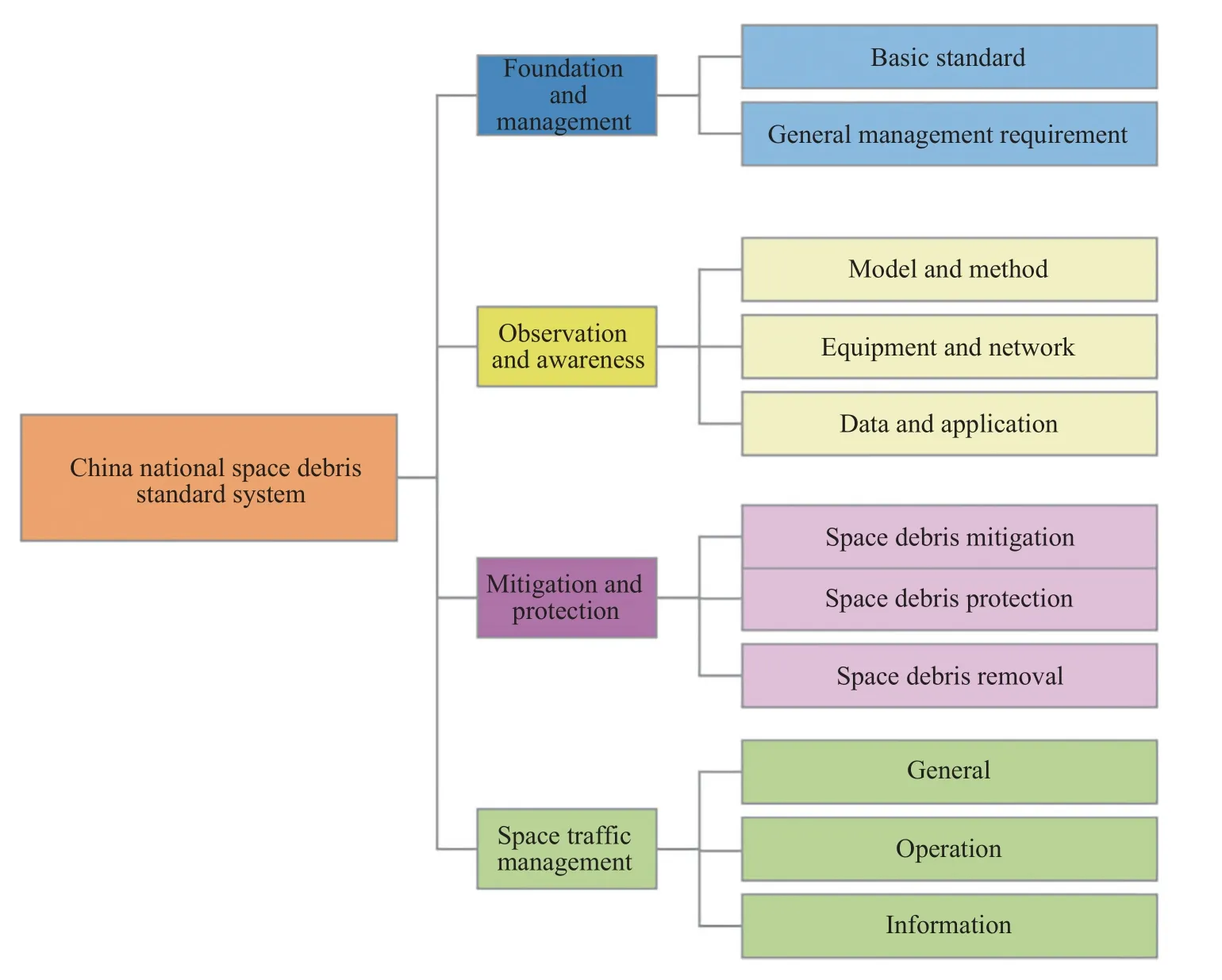
Fig.3 Space debris standard system
The published standards include Requirements for post-mission disposal of GEO satellites,Design requirements for residual propellant venting of a launch vehicle,Space debris mitigation requirements,Estimating methods for the mass of remaining propellant of spacecraft,Design requirements for mitigation of operational debris of launch vehicle,Design requirements for residual propellant venting of Spacecraft. The standards under preparation include Space Object Registration Requirements,Space Objects Observation Data Standard,Space object orbital data standards,and Detailed disposal requirements for launch vehicle orbital stages. A new round of standard collection in 2022 is underway.In the future,China’s space debris management and space debris environmental governance will be steadily promoted with the support of these gradually completed standards.
6 Vision of the Future
In view of the current situation of numerous and rapidly growing space debris and the frequent occurrence of space events,China’s vast space debris research institutes and application departments will focus on searching and tracking centimeter-sized small debris,multiband,and multi-dimensional detection of space debris,and conduct in-depth research in accurate prediction of high uncertainty debris,responding to high-precision sensing and time-sensitive space events,life-span protection of spacecraft and space debris mitigation measures,and new efficient and low-cost removal methods and applications.
At the same time,China will expand bilateral and multilateral cooperation mechanisms with a more active and open attitude,conduct extensive international space exchanges and cooperation under the UN framework,take an active part in the formulation of international outer space rules,and jointly address the challenges facing the long-term sustainable development of outer space activities.China will also actively participate in international discussions and mechanism building in the field of space environment governance.We will actively carry out cooperation in space environment governance,and improve the effectiveness of space crisis management and comprehensive management[1].
- 空間科學學報的其它文章
- Advances in China Space Medical Experiment Research
- Progress of Planetary Science in China*
- Advances in the Researches of the Middle and Upper Atmosphere in China in 2020–2022
- Magnetospheric Physics in China:2020–2021
- Space Solar Physics in China:2020–2022*
- Research Advances of the Chinese Meridian Project in 2020–2021