
Ocular syphilis resurgence in an urban underserved community in the United States
2022-08-10 01:39:48EmilyTamAlexanderPortDianaMartinGabrielleFridmanStevenNessNicoleSiegel
INTRODUCTION
According to the Centers for Disease Control and Prevention (CDC), there has been a surge of newly diagnosed cases of syphilis over the last 10y in the United States, and the numbers continue to rise
. During 2013-2017, primary and secondary syphilis rates rose by 72.7%nationally (from 5.5 to 9.5 cases per 100 000 population)and increased by 155.6% among women (from 0.9 to 2.3 cases per 100 000)
. Ocular syphilis, a rare but potentially blinding disease, would be expected to increase in prevalence in parallel to the rising rates of systemic syphilis
. A clinical advisory was issued in 2016 by the CDC to reflect the resurgence of ocular syphilis after a small cluster of outbreak in San Francisco and Seattle
. Syphilis risk factors identified in previous studies included being men who have sex with men (MSM), human immunodeficiency virus (HIV) positivity,unprotected sexual activity, and reported drug use
.
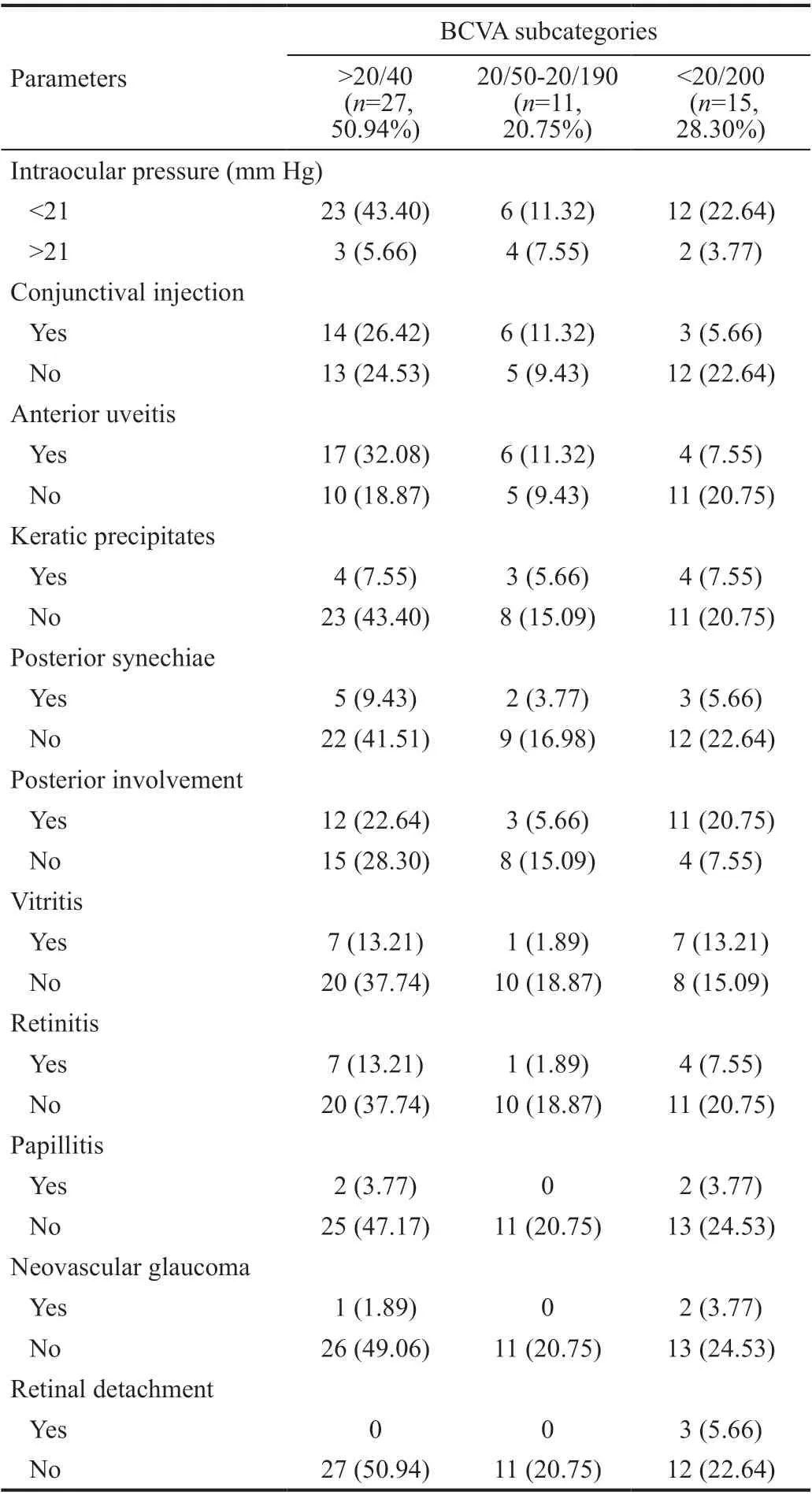
Thirty-eight of 53 eyes (71.70%) had visual acuity of 20/190 or better on presentation, with most visual acuities ranging from 20/20 to 20/40 (50.94%; Table 2). Fifteen eyes (28.30%)had vision of 20/400 or worse. Higher proportions of the subjects with poor vision were Black, had a history of or current tobacco use, and did not have a diagnosis of HIV.
SUBJECTS AND METHODS
The study was approved by Boston University Medical Center’s (BUMC) Institutional Review Board/Ethics Committee. This study was conducted in accordance with the Declaration of Helsinki. The collection and evaluation of all protected patient health information was performed in a Health Insurance Portability and Accountability Act (HIPAA)-compliant manner. In this retrospective chart review study, written informed consent was not required according to protocol.
In this retrospective study, we identified patients diagnosed with syphilis from 2010-2019 using the Boston University School of Medicine Clinical Data Warehouse (CDW), a searchable database of electronic medical records. The database was queried for ICD-9 and ICD-10 diagnosis codes to capture all syphilis-related ocular findings including 091.50 (syphilitic uveitis), 091.89 (other forms of secondary syphilis), 095.8 (other specified forms of late symptomatic syphilis), 363.13 (disseminated choroiditis and chorioretinitis,generalized), A51.43 (secondary syphilitic oculopathy),A51.49 (other secondary syphilitic conditions), A52.71 (late syphilitic oculopathy), H30.131 (disseminated chorioretinal inflammation, generalized, right eye), H30.132 (disseminated chorioretinal inflammation, generalized, left eye), H30.133(disseminated chorioretinal inflammation, generalized,bilateral), 363.13 (disseminated choroiditis and chorioretinitis,generalized). The database was also searched for positive laboratory results consistent with a diagnosis of syphilis including rapid plasma reagin (RPR), Treponema pallidum particle agglutination assay (TPPA), fluorescent treponemal antibody absorption (FTA-ABS), and venereal disease research laboratory (VDRL). A list of likely ocular syphilis cases was generated using a “two-hit” method, in which subjects with both a relevant diagnosis code and a positive test result were included. Individual records were then reviewed in detail to verify diagnoses based on clinic notes and testing results.Patients with verified positive syphilis laboratory results and a diagnosis consistent with ocular syphilis were included in the cohort. The records were reviewed for patient characteristics and exam findings including demographics, medical history,syphilis diagnosis, ocular exam findings, HIV status, MSM status, and recreational drug and alcohol use.
Literature regarding syphilis patient demographics has been overall mixed. While syphilis has been diagnosed in a variety of age distributions in our study cohort starting at age 20,our ocular syphilis data corresponds to CDC national data of syphilis being diagnosed at age 45 and above
. In our cohort, ocular syphilis was more prevalent among Black patients, which corresponds with CDC data that reported the prevalence of general syphilis in Black patients to be 4.5 times the rate among Caucasians
. In our study, 65% of Blacks had ocular syphilis versus 15% of Whites. BMC serves an ethnically, financially, and geographically diverse patient population, with known syphilis risk factors, and has the largest HIV/AIDS programs in New England
. According to Boston Public Health Commission’s analysis of syphilis rates by neighborhood in Boston, MA, the communities with the highest density of syphilis cases are in the neighborhoods surrounding our medical center
. Our cohort of ocular syphilis patients had low rates of HIV co-infection, which brings to light the CDC advisory noting an increase in syphilis cases across all demographics, even among groups not traditionally considered to be high risk
.
Our cohort had a higher prevalence of ocular syphilis (17.62%)compared to prior published studies, which reported a rate of 1.5% among 4232 syphilis patients in North Carolina
.Similarly, the CDC found that within eight jurisdictions in 2016, ocular symptoms were present in 0.65% of those previously reported
. Given the retrospective nature of these studies, detection of ocular syphilis was limited to symptomatic cases. This likely underestimates the true number of ocular syphilis cases because the majority of patients retain good visual acuity and few patients have severe ocular inflammation. It is possible that an increase in the recognition of ocular manifestation may lead to more diagnoses of ocular syphilis
. Furthermore, our search methods may have undercounted overall syphilis cases, given our two hit system, using the CDW data in addition to positive serology testing within our institution. This may explain why although we have a higher proportion of patients with ocular syphilis,our hospital only represents about 2% of the syphilis cases in Boston. For example, in 2018, according to the CDC, there were 973 cases of syphilis in Boston, whilst there were only 25 cases at BMC
.
The forms of uveitis were overall mixed in literature. In our study, the most common form of uveitis among patients with ocular syphilis was non-granulomatous anterior uveitis followed by posterior involvement
However, among the 129 patients in the previously mentioned study by Furtado
found that posterior uveitis accounts for the majority of cases of ocular syphilis most commonly posterior placoid chorioretinitis and syphilitic punctate inner retinitis. Another study from France also found most patients to be mostly posterior placoid chorioretinitis
. Also, in a study showing the resurgence of ocular syphilis in British Columbia from 2013-2016, uveitis(93.5%) was most prevalent as retinal vasculitis in 54.3%of patients
. Vasculitis, retinitis, and choroiditis were less common presenting signs in our cohort. We may be diagnosing more mild cases of uveitis before it becomes more vision threatening, which further explains the larger portion of our ocular syphilis case.
RESULTS
A total of 229 syphilis positive patients at BMC were included in the study. Table 1 reports demographics of patients who were diagnosed with syphilis versus the subset of patients with ocular syphilis. Among the cohort of patients, the majority were males (82.5% in non-ocular syphilis, and 72.5% in ocular syphilis patients) and a significant portion were Black(39.2% in non-ocular syphilis, and 65.0% in ocular syphilis),and tobacco users (44.5% ever or current users in non-ocular syphilis, and 42.5% ever or current use in ocular syphilis).There is an upward trend syphilis cases from 2010 to 2017 at our institution, in Massachusetts and nationally (Figure 1).
要從根本上解決地名檢索中的地理空間的層次結構特性和地名表達的模糊性,就必須結合地名描述、地理空間、計算機、網絡等相關知識和技術,從整體上進行把握,構建基于地名本體的語義網實現基于語義的地名檢索服務[2]。

Ocular syphilis was present in 40 (17.47%) patients with syphilis. When comparing patients with ocular syphilis and patients without ocular involvement, patients with ocular syphilis were above the age of 45 (30/40 or 75.0%), and a greater proportion were Black (26/40 or 65.0%) and less likely to have HIV (7/40 or 17.5%).
There are differences in our study compared to others that may give insight to presenting signs for syphilis resurgence. Similar to other studies, uveitis appears to be a common presentation among patients with ocular syphilis in our study. In a study reporting ophthalmic outcomes of ocular syphilis during the time of re-emergence, ocular involvement in 214 eyes included anterior uveitis (6.1%), intermediate uveitis (8.4%), posterior uveitis (76.2%), and panuveitis (8.4%). Ocular inflammation was bilateral in 87 patients (68.5%), giving a total of 214 involved eyes
. Hong
also found uveitis as a first sign of syphilis.
Though syphilis is a reportable disease, the CDC has not systematically collected surveillance data on its ocular manifestations. In this study, we investigate patients who were diagnosed with syphilis at Boston Medical Center (BMC), an urban, academic safety net hospital, which serves a vulnerable,at-risk patient population
. A majority of patients come from underserved communities at greater risk of syphilis infection,including HIV/acquired immunodeficiency syndrom (AIDS)infection
. This study investigates the patient characteristics and exam patterns of ocular syphilis patients in our institution.


Table 3 compares ocular data among patients with visual acuity of 20/40 or better, 20/50-20/190, or 20/400 or worse.Most patients had intraocular pressure (IOP) of <21 mm Hg on presentation. Among patients with visual acuity of 20/40 or better, non-granulomatous anterior uveitis tended to be a common sign (17/27 patients). However, patients with visual acuity of 20/400 or worse were more likely to have posterior involvement (11/15). Less common presentations across all visual acuity groups included papillitis (7.6%), neovascularization glaucoma (5.7%), and retinal detachment (5.7%).
DISCUSSION
Subjects were excluded if the syphilis diagnosis could not be verified in the electronic medical record or if records were incomplete.
The general trend of syphilis in our data correlates to the CDC data (Figure 1). The aforementioned study in North Carolina also demonstrated a similar trend, especially with a 100%increase from 2014 to 2015
. Our syphilis trends overall aligned with the greater national data. This may correspond to the hospital transitioning to electronic medical record system,Epic (Epic Systems Corporation, Verona, Wisconsin), in mid-2015, leading to a more streamlined tracking system for patients
. It is possible that the surge in diagnosis was driven by the prevalence of risk factors and likely a confluence of factors leading to the rise in syphilis. Decreased fear of HIV and the rise of dating or “hookup” apps are thought to have led to more unsafe sex practices
. In the United States, the nadir in syphilis cases occurred in 2000-2001, a time when HIV positive individuals were living significantly longer, as compared to the 1990s, but fear around HIV and STDs was still high, dating websites were still stigmatized and adherence to safe sex practices were likely greater
. For instance,similar to our study, co-infections such as HIV was present even among patients without ocular syphilis. Since HIV patients are now living longer, they are being diagnosed with such co-infections as clinicians now understand the disease more
. The CDC advisories included an increase in syphilis cases among groups that had not seen significant syphilis numbers earlier in the early 2000s, such as women, men who have sex with women (MSW), and HIV negative patients
.It has also been speculated that the rise of syphilis corresponds to popularity of online dating, as online dating may increase opportunities for sexual contact
.
1.2.1 將護理服務理念更新 護理人員要有服務觀念,能夠以人為本的進行護理,建立和諧的護患關系。護理的時候,對細節給予重視,提供關懷,和患兒家屬進行溝通,開展護理前,和患兒及其家屬進行講解,對患兒進行鼓勵,提供日常護理指導。巡視的時候對患兒的情感狀態進行了解。護理人員開展護理前要增加患兒家屬的配合度。
State level and national level data were collected from CDC National Center for HIV/AIDS, Viral Hepatitis, sexually transmitted disease (STD), and Tuberculosis (TB) Prevention(NCHHSTP) AtlasPlus
. CDC data was compared to BUMC up to 2017 given availability of the data. Microsoft Excel and JMP
Pro 12.0.1 (SAS Institute, Cary, North Carolina,USA) were used to plot the progression of cases over time for comparison.
While most patients with ocular syphilis maintain good visual acuity, our patients with posterior segment involvement tended to have poorer visual outcomes. A British study reported that average vision was 20/60 among ocular syphilis patients with final vision 20/40 or better
. In our study, 11/53 (20.75%)had poor visual outcomes with vision less than 20/400, with 7/11 (63.64%) of those with posterior involvement. However,a study by Furtado
found most patients to have visual acuity of 20/50 or worse, and had posterior involvement.
Research regarding the association between ocular syphilis and IOP is overall mixed. Our study showed that most ocular syphilis patients did not have high IOP on initial presentation.Syphilitic uveitis may be associated with elevated IOP, as syphilis can cause uveitic glaucoma
. Similar to our study, a British 3-year national surveillance study of 59 patients found the mean intraocular pressure to be 13.9 mm Hg, with only one patient with elevated IOP
. Also, a Meta-analysis by Zhang
found IOP increase to arise in about 10% of presentation.Thus, our data supports that IOP can be low in ocular syphilis patients during initial presentation in the time of resurgence.
(1) 信號系統內部采用NTP協議的Meinberg工具,該協議可確保時間精度控制在50 ms之內;對于采用多個時鐘源的情況,不會影響下一層時鐘同步。
XU Sheng-qun, PANG Shi-xiu, CUI Xiang-guo, JIANG Xue-jun, YANG Huai-an
According to a study of 190 patients of 318 eyes, optic nerve involvement was also prevalent in 87.5% (papillitis, optic nerve swelling, or pallor)
. Another study of 670 patients in a meta-analysis found that the most common type of syphilitic uveitis was papillitis
. However, in our study optic nerve involvement was an uncommon presentation. This corresponds to the favorable visual acuity and higher prevalence anterior inflammation seen in our cohort.
A strength of the study includes it is the higher proportion of patients with ocular syphilis compared to other published studies. However, there were limitations to this study. One limitation is its retrospective nature and our data was limited to ophthalmologic data when the patient first presented with ocular syphilis, which provides information on the initial patient presentation but does not trend over time. Due to the retrospective nature of the study, some data was incomplete or limited by clinical practice patterns, for example, there was not enough information on MSM status as this is a voluntary question on clinical intake forms and many of the patients did not choose to answer the question.
列寧在生命垂危之際,以口授的方式留下了《我們怎樣改組工農檢察院》《寧肯少些,但要好些》《給代表大會的信》等文章和書信。這些文章和書信作為列寧最后的政治交代,構成了列寧的“政治遺囑”。學者們曾從多種視角對列寧的“政治遺囑”進行解讀,但鮮有從干部隊伍建設的角度探討列寧“政治遺囑”對領導干部素質提出的要求。實際上,列寧作為俄共(布)的“頂層設計師”,在逝世前對黨的領導干部提出了許多要求和期許,其中蘊含的干部隊伍建設思想,可以為當前加強黨的干部隊伍建設提供重要的理論參考。
In conclusion, ocular syphilis is a potentially vision threatening manifestation of systemic syphilis infection. Syphilis continues to be on the rise, and clinicians should be aware of this potentially sight and life-threatening condition. This study evaluates the prevalence and presentation of ocular syphilis during the time of resurgence. In our series, half of the patients with ocular syphilis presented a non-granulomatous anterior uveitis with a milder course, and the other half of our patients with posterior segment involvement tended to have poor visual outcomes. Our cohort of ocular syphilis patients had a 17% of HIV co-infection. Our experience regarding the ocular manifestations of this resurgent disease will help facilitate earlier diagnosis and treatment and to minimize the ocular morbidities associated with ocular syphilis, even among patients not traditionally considered as high risk. More studies on ocular syphilis are warranted to understand the broader scope of this resurging disease.
偉翔很快就回來了,陰沉著臉,抱起糖果晃來晃去。……
登錄APP查看全文
猜你喜歡
中共云南省委黨校學報(2022年1期)2022-04-26 13:55:28
中華養生保健(2020年7期)2020-11-16 01:14:02
家庭醫學(下半月)(2019年9期)2019-10-12 08:04:18
經濟技術協作信息(2018年20期)2019-01-19 02:56:26
中共南昌市委黨校學報(2018年1期)2018-04-18 05:53:27
中國衛生(2016年2期)2016-11-12 13:22:32
中國中醫藥現代遠程教育(2014年20期)2014-03-01 04:31:38
哈爾濱醫藥(2014年2期)2014-02-27 13:35:10
俄羅斯問題研究(2013年1期)2013-03-11 15:44:05
俄羅斯問題研究(2013年1期)2013-03-11 15:44:04
 International Journal of Ophthalmology
2022年8期
International Journal of Ophthalmology
2022年8期
- International Journal of Ophthalmology的其它文章
- Advances in the research of plant-derived natural products against retinoblastoma
- Acute bilateral anterior uveitis in paediatric inflammatory multisystem syndrome temporally associated with COVlD-19
- Metamorphopsia as the first clinical sign of renal cell carcinoma
- Sutureless contact lens-type amniotic membrane for persistent epithelial defects after infectious keratitis
- A case of conjunctival intraepithelial neoplasia with spheroidal degeneration: a clinicopathological study
- Risk of anxiety and depression in patients with uveitis: a Meta-analysis