
Divertor detachment operation in helium plasmas with ITER-like tungsten divertor in EAST
2022-08-01 11:34:12JianbinLIU劉建斌LingyiMENG孟令義HouyangGUO郭后揚(yáng)KedongLI李克棟JichanXU許吉禪HuiqianWANG汪惠乾GuoshengXU徐國盛FangDING丁芳LingZHANG張凌YanminDUAN段艷敏BinZHANG張斌LinYU余林PingWANG汪平AngLI李昂DongguiWU吳東貴RuiDING丁銳andLiangWANG王亮
Plasma Science and Technology 2022年7期
Jianbin LIU(劉建斌),Lingyi MENG(孟令義),2,Houyang GUO(郭后揚(yáng)),Kedong LI(李克棟),2,Jichan XU(許吉禪),Huiqian WANG(汪惠乾),Guosheng XU(徐國盛),Fang DING(丁芳),Ling ZHANG(張凌),Yanmin DUAN(段艷敏),Bin ZHANG(張斌),Lin YU(余林),2,Ping WANG(汪平),2,Ang LI(李昂),2,Donggui WU(吳東貴),2,Rui DING(丁銳),?and Liang WANG(王亮),5,?
1 Institute of Plasma Physics,HFIPS,Chinese Academy of Sciences,Hefei 230031,People’s Republic of China
2 University of Science and Technology of China,Hefei 230026,People’s Republic of China
3 School of Mechanical Engineering,Anhui University of Science &Technology,Huainan 232001,People’s Republic of China
4 General Atomics,San Diego,California 92186,United States of America
5 Institute of Energy,Hefei Comprehensive National Science Centre,Hefei 230031,People’s Republic of China
Abstract Detachment in helium(He)discharges has been achieved in the EAST superconducting tokamak equipped with an ITER-like tungsten divertor.This paper presents the experimental observations of divertor detachment achieved by increasing the plasma density in He discharges.During density ramp-up,the particle flux shows a clear rollover,while the electron temperature around the outer strike point is decreasing simultaneously.The divertor detachment also exhibits a significant difference from that observed in comparable deuterium(D)discharges.The density threshold of detachment in the He plasma is higher than that in the D plasma for the same heating power,and increases with the heating power.Moreover,detachment assisted with neon(Ne)seeding was also performed in L-and H-mode plasmas,pointing to the direction for reducing the density threshold of detachment in He operation.However,excessive Ne seeding causes confinement degradation during the divertor detachment phase.The precise feedback control of impurity seeding will be performed in EAST to improve the compatibility of core plasma performance with divertor detachment for future high heating power operations.
Keywords:divertor detachment,helium plasma,density threshold,EAST
1.Introduction
The first non-nuclear operation phase for ITER will be conducted with hydrogen(H)or helium(He)plasmas[1,2].During this phase,divertor detachment as an ITER baseline scenario still needs to be evaluated and investigated in existing divertor tokamaks,especially those with ITER-like tungsten(W)divertors.Experimental and modeling studies on detachment in deuterium(D)plasmas have been carried out in many tokamaks,such as ASDEX-Upgrade[3],DIII-D[4,5],JET[6,7],JT-60U[8],TCV[9],HL-2A[10]and EAST[11,12].However,He plasmas for the investigation of divertor detachment have constituted only a small fraction of discharges[13–15].Previous experiments have found that the divertor detachment density threshold in He is higher than that in D,which may be due to the difference in atomic and molecular physical processes between deuterium and helium plasmas.A detailed understanding of the detachment behavior and the effect of detachment on the main plasma performance still remain elusive.
For the first time,divertor detachment has been realized in He discharges on EAST with an ITER-like W-divertor configuration.The latest experimental studies on divertor detachment in He plasmas are presented in this paper.Section 2 introduces the dedicated experimental setup and key diagnostics.The basic features of L-mode detachment and the effects of detachment with impurity injection in He plasmas are introduced in section 3.Finally,the experimental summary is given in section 4.
2.Experimental setup and diagnostics
EAST featuring an ITER-like water-cooled W/Cu monoblock divertor configuration was designed for long-pulse operations in an ITER-relevant metal wall environment,providing a unique platform to address the physics and engineering issues for ITER operation[16].It is a fully superconducting tokamak with a major and minor radius ofR~1.9 m anda~0.45 m,respectively[17].The experiments were obtained mostly in upper single null(USN)discharges with lower hybrid wave(LHW)heating,electron cyclotron resonance heating(ECRH)and neutral beam injection heating.Helium was adopted as the working gas in the experiments performed for this study,which was puffed from the high-field mid-plane.Due to the higher H-mode power threshold in helium plasma in EAST[18],the detachment experiments presented in this paper were mainly obtained in USN L-mode discharges with the favorableBTdirection(the ion ?Bdrift direction towards the upper divertor).The boundary and divertor diagnostics in EAST are shown in figure 1.A total of 54 triple-divertor Langmuir probes(LPs)are embedded in the UI and UO divertor target plates through two horizontal ports,D and O.These probes serve as the main diagnostics for the divertor detachment study,with high spatial and temporal resolutions,i.e.12–18 mm(poloidally)and 20 μs,respectively.Most of the experimental data presented below were obtained with divertor triple LP arrays,capable of measuring the ion saturation current density(Jsat),positive biased potential(Vp)and floating potential(Vf).The particle flux and electron temperature at the divertor targets can be directly derived from divertor LP measurements,as introduced in[19,20].The surface temperatures of the UI and UO divertor targets are obtained by infrared(IR)cameras located in the horizontal port[21].Absolute extreme ultraviolet(AXUV)detector arrays were installed in the upper-vertical port C and horizontal port P to measure the total radiated power and distributions in the bulk plasma[22].The line emissions of the He atoms and impurities(such as W)in the mid-plane and the W-divertor are obtained from the ultraviolet(EUV)spectrometer and Div-W diagnostic system[23,24].The reflectometry and multi-channel electron cyclotron emission(ECE)diagnostics can provide information on the edge electron density(ne)and temperature(Te)profiles separately[25,26].
3.Experimental results and discussions
3.1.Characteristics of divertor detachment in helium L-mode discharges
In the 2019 EAST experimental campaign,detachment with the ITER-like W-divertor was firstly performed by ramping up the plasma density in USN L-mode helium discharges[27].As commonly used in D detachment studies,the onset of the detachment in He plasma can be marked by the rollover in the ion saturation current density(Jsat)near the strike point[28].Here,the line-averaged electron density(ne)corresponding to the beginning of the rollover is defined as the divertor detachment threshold.Figure 2 shows the characteristics of a density ramp-up helium discharge withBT~2.4 T andIp~0.4 MA in the favorableBTdirection.During the density ramp-up phase,the intensity of the He I emission keeps increasing withne.The peakJsatat the UO divertor shows a clear rollover atne~4.8×10¹⁹m-3,i.e.at the Greenwald density fraction(ne/nG)~0.76.The electron temperature(Te,div)of~10 eV corresponds to the rollover of peakJsat,which is different from that in D plasma.Compared to the electron temperature,the peak surface temperature measured by the IR camera also exhibits a similar downward trend.This discharge was mainly heated by LHW(PLHW~2 MW)and ECRH(PECRH~0.8 MW).In the discharge #87173 with a high plasma edge safety factor(pitch of the magnetic field lines)q95~6,the plasma stored energy,WMHD,did not experience a noticeable reduction during the detachment phase.It is also noted that the threshold of helium detachment onset is significantly higher than that in deuterium discharges with similar plasma configuration and parameters[11].
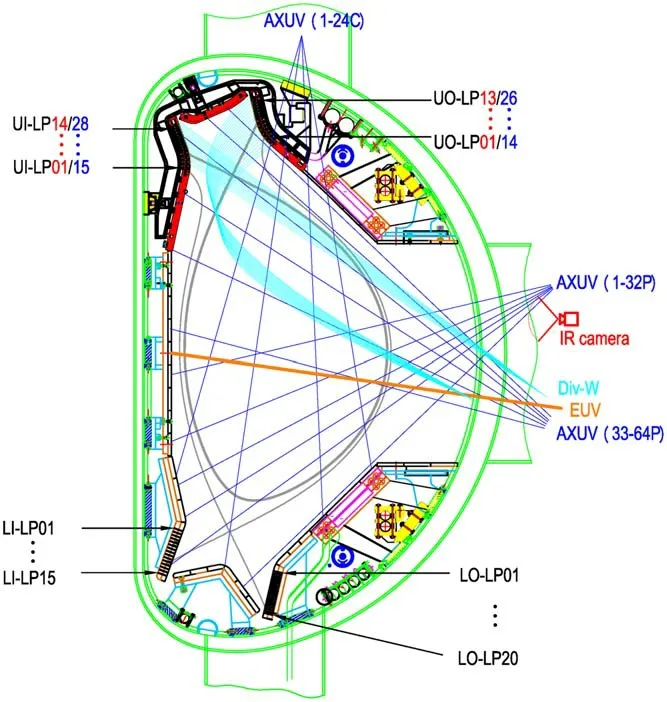
Figure 1.Layout of the boundary and divertor diagnostics,showing a typical USN shape in EAST.UI(O)—upper inner(outer)divertor target,LP—Langmuir probe,CH—channel of divertor LP,AXUV—absolute extreme ultraviolet detector arrays,EUV—extreme ultraviolet spectrometers,and Div-W–the multi-channel visible spectroscopic diagnostic system.
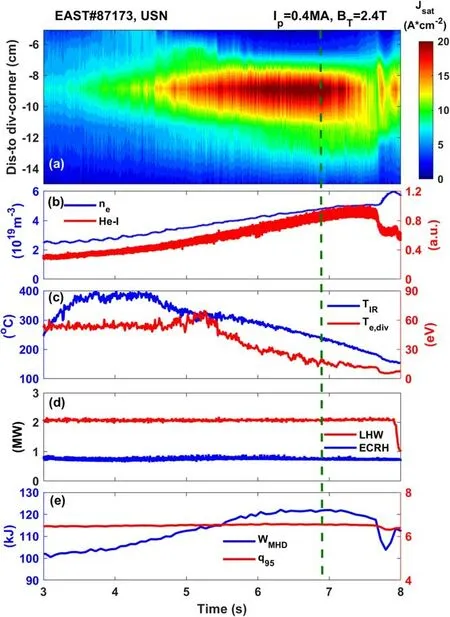
Figure 2.(a)Contour of Jsat at the UO divertor targets for a USN L-mode discharge in He plasma with favorable BT.The lineaveraged density(ne)and the He I emission are shown in panel(b),(c)the peak surface temperature(TIR)of the target and the electron temperature(Te,div)near the strike point,(d)the auxiliary heating power including LHW and ECRH,(e)the temporal evolution of the plasma stored energy(WMHD)and the edge safety factor(q95).The green dashed line corresponds to the rollover of Jsat,indicating the onset of detachment.
Figure 3 shows the evolutions of peakJsatand electron temperature at the UI and UO divertor targets,measured by the divertor LPs,as a function of the Greenwald density fraction.The data are obtained from three He discharges with different SOL power(PSOL)levels,together with a D discharge(#85094)closely matched to the He discharge(#87165)as a reference.More detailed information on the plasma parameters can be found in table 1.Note thatPSOLrepresents the power entering the SOL and is defined as

wherePOhmandPauxare the ohmic power and the absorbed auxiliary heating power,respectively.Pradis the total radiated power in the core plasma measured by the AXUV system in EAST,and dW/dtis the rate of change in the plasma stored energy.Similar to D plasmas,detachment at the inner divertor occurs at much lower densities than that at the outer divertor.Te,divat the inner target in He plasmas appears to be relatively low at all densities for all the power levels,as shown in figure 3(c).Figures 3(b)and(d)show the evolutions ofJsatandTe,divon the UO divertor target with increasing density for the different SOL powers in He and D plasmas.The onset of the detached divertor operation is indicated by the rollover ofJsatat the target as the plasma density increases,which is associated with a significant reduction inTe,div,i.e.~10 eV or below.As can be seen in figure 3 and table 1,the density threshold for the onset of detachment is sensitive to the level of the SOL power and increases with the input power.The density threshold of divertor detachment at the UI target is significantly lower than that at the UO divertor.
Figure 4 shows a direct comparison between D and He plasmas with favorableBT.The magnetic equilibria were kept as uniform and stable as possible.In particular,the position of the strike point on the UO target is well matched during the density ramp-up.The discharges presented here have plasma currentIp=0.4 MA,toroidal fieldBT=2.4 T,and total heating powerPtotal~1.1 MW,withneincreasing from~2.5×10¹⁹to~4.2×10¹⁹m-3.The edge plasma density(nedge,ρ~0.9at ρ~0.9)shown in figure 4(c)was kept nearly consistent during the density ramp-up phase.Figures 4(d)and(f)show that the electron temperature(at ρ~0.8)and the plasma stored energy(WMHD)in the He plasma have a marginally higher level than that in the D plasma,which is a general phenomenon,as observed in previous He plasma experiments in EAST.It is often found that there is a slight increase in radiation power(Prad)for He plasmas,as shown in figure 4(e).From figure 4(b)and table 1,with similar heating power,the SOL power in the He plasma(PSOL~0.75 MW)is lower than that in the D plasma(PSOL~0.9 MW).However,the divertor detachment(#87165,ne/nG~0.58,nedge,ρ~0.9~1.6×1019m-3)occurs at a marginally higher density in the He plasmas,relative to the D reference case(#85094,ne/nG~0.52,nedge,ρ~0.9~1.5×1019m-3).It is not yet clear why the density at the detachment onset at the outer divertor in He discharge is slightly different from that in the D plasma.The underlying reason responsible for the difference in the divertor detachment onset may be associated with the different atomic/molecular processes.Comparisons with SOLPS simulations for matched EAST helium discharges are underway to further clarify this.
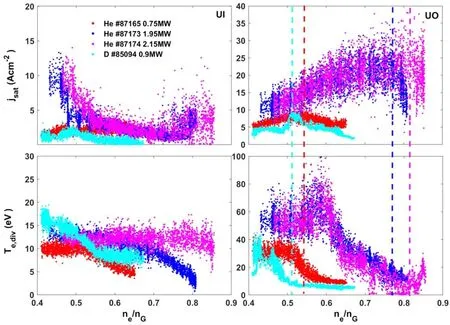
Figure 3.The evolutions of the peak ion saturation current density,Jsat((a),(b))and electron temperature,Te,div((c),(d))near the strike point on the UI(left)and UO(right)divertor targets with increasing density.The dashed lines indicate the onset of detachment at outer targets for the different shots.
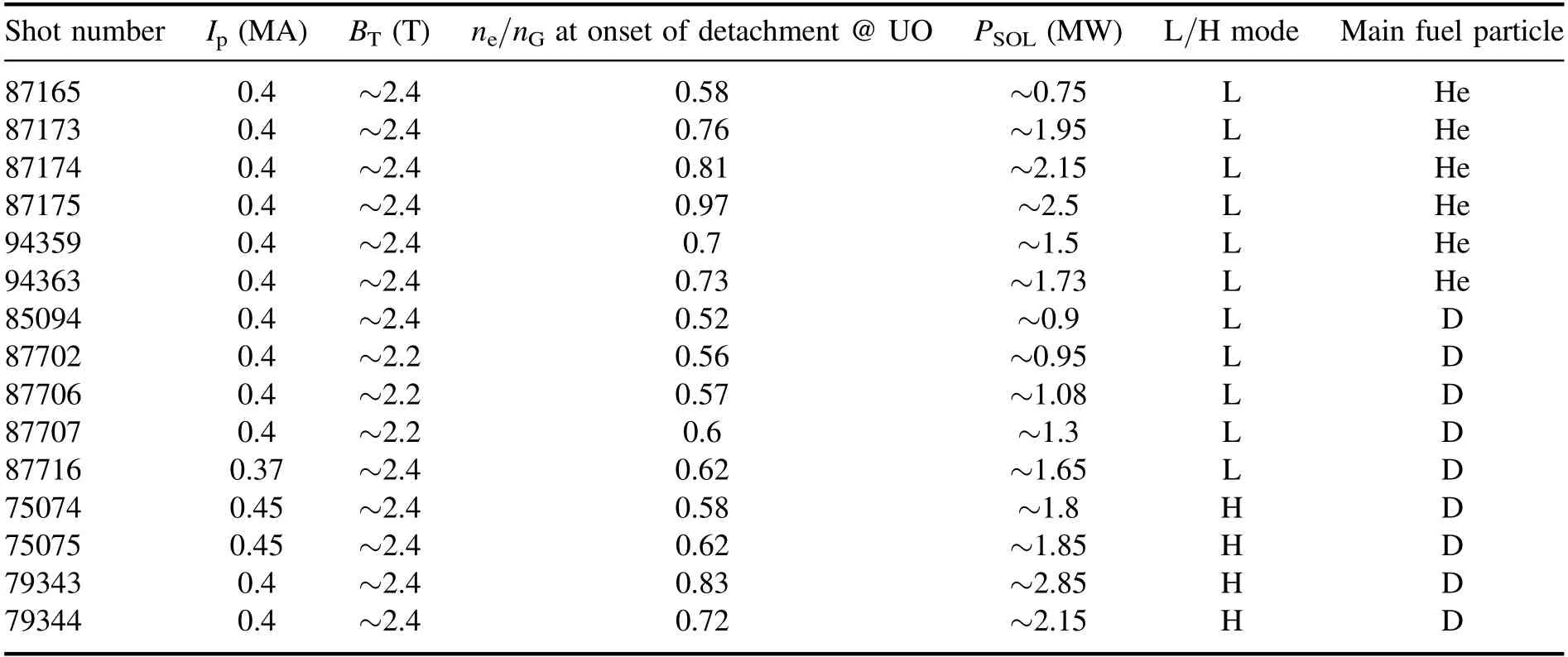
Table 1.Basic plasma parameters of the He and D discharges presented here.
Initial studies on the relationship between the detachment threshold density and SOL power have also been done in D and He plasmas.Figure 5 shows the statistical results of the divertor detachment threshold in the upper outer divertor versus the power entering the SOL(PSOL)for EAST USN discharges with favorableBTdirection.Detailed information on the statistics can be found in table 1.The plasma current and the toroidal field of the statistic discharges are around 0.4 MA and 2.2–2.4 T,respectively.As shown in figure 5,the detachment threshold of normalized density in D plasmas ranges between 0.5 and 0.65 for L-mode,and between 0.6 and 0.85 for H-mode,increasing with power in both cases.The detachment density threshold in He plasmas also increases with power,but is slightly higher than that in D plasmas for L-mode,i.e.at relatively lowPSOL.Note that the detachment density threshold in He plasmas continuously increases until much higherPSOL,but still in L-mode.Therefore,it is very difficult to achieve H-mode detachment simply by density ramp-up,due to the higher power threshold of L–H transition for He discharges.
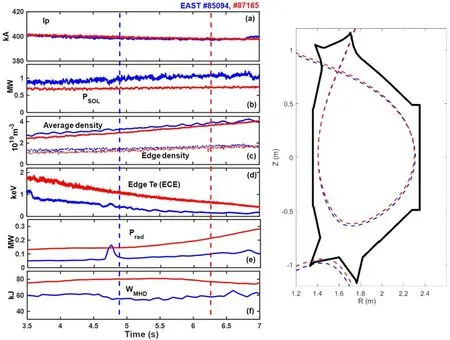
Figure 4.Left:comparison of the main parameters between D(#85094)and He(#87165)plasmas in USN L-mode discharges.The panels from top to bottom represent(a)plasma current Ip,(b)power entering the SOL(PSOL),(c)line-averaged density ne and edge density at ρ~0.9,(d)edge electron temperature at the low-field-side mid-plane at ρ~0.8,(e)total radiation power Prad,(f)plasma stored energy WMHD.Right:equilibrium configuration for favorable BT at t~4.9 s for #85094 and t~6.3 s for #87165.
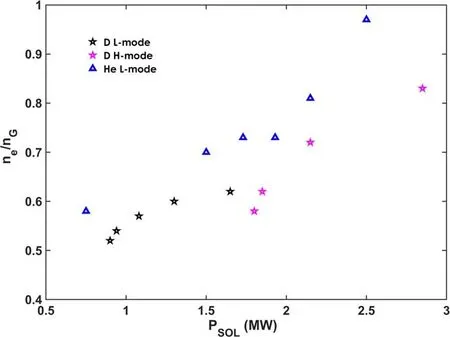
Figure 5.The ratio of detachment threshold density to Greenwald density for UO divertor detachment in D L-mode and H-mode,as well as He L-mode discharges in EAST for favorable BT.PSOL is the plasma transport power crossing the separatrix.
3.2.Detachment with impurity injection in helium discharges
For future fusion devices with hot core confinement and long pulses,strong divertor detachment is required to mitigate excessive particle and heat fluxes at the divertor target.Detachment can be achieved in L-and H-mode discharges by ramping up the plasma density.However,it requires a high Greenwald density fraction(i.e.a relatively high plasma density)to achieve cold,highly detached divertor conditions[29]in the case of high heating power(see figures 3 and 5).Such high upstream density may not be compatible with high core confinement scenarios[30].As found in EAST and other tokamaks,the H-mode threshold power in the He plasma is higher than that in D plasma;thus,the density threshold to maintain the detachment is higher in He H-mode plasmas.It is also found that divertor detachment in most present tokamaks significantly reduces the plasma confinement at high densities[31].Thus,it is difficult to maintain divertor detachment in He plasmas by simply helium fueling in highpower steady-state H-mode discharges.Therefore,one effective solution is to seed impurities to achieve divertor detachment at relatively lower densities.Argon(Ar)and neon(Ne)are possible impurity seeding candidates to induce strong radiation in the divertor and edge plasma regions for promoting detachment.
Divertor detachment in He plasmas with Ne seeding was performed during the 2019 EAST experimental campaign.Figure 6 shows the time evolution of the main parameters for a typical He L-mode discharge with Ne seeding(#94382)under the USN magnetic configuration.It was achieved at plasma currentIp=0.5 MA and toroidal magnetic fieldBT~2.4 T with favorableBT.The total heating power was approximately 4.8 MW including LHCD of 4.0 MW and ECRH of 0.8 MW,with the plasma stored energyWMHD~145 kJ and edge safety factorq95~5.4.Pure neon was injected into the plasma from the gas valve in the UO divertor SOL region with a pulse width of 75 ms and an interval of 125 ms between~5.1 and 6.4 s,as shown in figure 6(a).The line-averaged electron density(ne)increased from 4.0×10¹⁹m-3(ne/nG~0.51)before neon seeding to~5.0×10¹⁹m-3(ne/nG~0.64)after seeding,as shown in figure 6(b).With Ne gas puffing,the Ne radiation measured by the EUV spectrometer keeps increasing.Meanwhile,the total radiated power in the bulk plasma calculated by AXUV also significantly increases,i.e.from~0.6 MW at 5.4 s to~1.2 MW at 6.3 s.As shown in figure 6(c),it was also found that the radiated power did not increase immediately after Ne seeding until 5.4 s.A possible reason is that there is around 100–200 ms delay from the valve opening to the gas entering into the vacuum[32].As clearly shown in figures 6(a)and(f),Jsatin the UO divertor is significantly decreased when the neon gas is injected from the UO divertor,and is further reduced when the divertor plasma enters the detachment phase,withTe,divbeing reduced below 10 eV.The evolution of the peak surface temperature(TIR)at the UO divertor target shows a similar trend to that of the divertor electron temperature.Therefore,it should be beneficial to reduce the density threshold of detachment in He operation,consistent with the result in the D plasma.Note that the plasma stored energy is slightly degraded from~145 to~130 kJ upon detachment.

Figure 6.The time evolutions of main parameters for a typical He L-mode discharge with Ne seeding.(a)The contour of Jsat on the UO divertor target,where the red lines correspond to the strike point(SP)position calculated from the EFIT equilibrium reconstruction and the Ne seeding waveform from the valve at the UO divertor target,respectively.(b)The line-averaged density ne and the He I emission.(c)The line emission of Ne impurity and the total radiation power(Prad,total).(d)The auxiliary heating power including LHW and ECRH.(e)The plasma stored energy WMHD and edge safety factor q95.(f)The peak temperature(TIR)at the surface of the UO divertor target and Te,div near the strike point measured by IR thermography diagnostic and divertor LPs.The black dashed line corresponds to the beginning of the decrease in Jsat and Te.
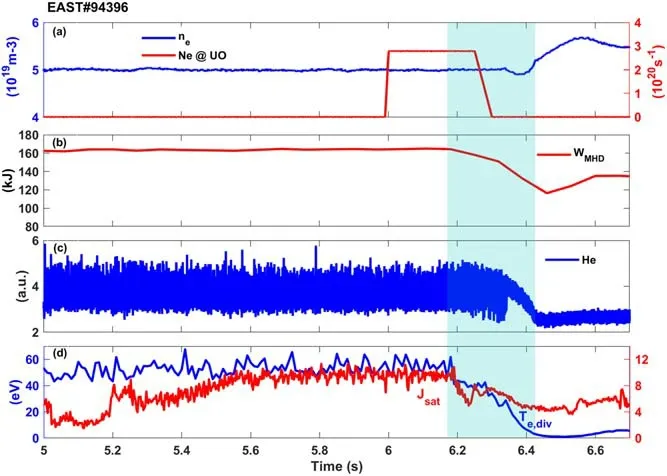
Figure 7.The time traces of a helium H-mode discharge in EAST(shot #94396).The line-averaged electron density(ne)and Ne seeding rate are shown in panel(a).The traces shown in panels(b)and(c)are plasma stored energy(WMHD)and He line emission,respectively.The bottom panel(d)shows Jsat and the Te,div near the strike point at the UO divertor target.
In addition,the experiment in H-mode plasmas was also studied by utilizing a small amount of pure Ne puffing from the UO target in EAST.This was performed atIp=0.45 MA andBT=2.4 T with favorableBTunder the USN magnetic configuration,withne~5.0×10¹⁹m-3,Ptotal~6.0 MW,WMHD~165 kJ,andq95~6.0.As shown in figure 7,JsatandTe,divdecreased significantly with Ne seeding.Meanwhile,the plasma stored energy,WMHD,was also reduced by about 30%.Due to the high threshold power in helium plasma and relatively open divertor geometry,too much core radiation due to the injection of Ne may adversely influence the core plasma performance and even result in H–L transition or disruptions.Therefore,accurate feedback control of impurity seeding rates is essential to maintain stable detachment for long-pulse high-performance operation in EAST and ITER.
4.Summary
Divertor detachment in helium plasmas has been demonstrated on EAST for the first time with pure RF heating and an ITER-like tungsten divertor.JsatandTe,divon the outer divertor target show a downward trend with the density ramping up in He plasmas,while the inner divertor plasma detaches at very low density,similar to the observations in deuterium plasmas.The density threshold for divertor detachment access in He L-mode plasmas is slightly higher than that in D L-mode plasmas for a given input power,and increases with the heating power.However,a much higher density is needed to achieve detachment in He H-mode due to the much higher power threshold for L–H transition in He than in D plasmas.The divertor detachment experiments with Ne seeding were also performed in L- and H-mode discharges with USN divertor configuration in EAST,and showed great prospects for reducing the density threshold of detachment in He operation.However,impurity seeding tends to contaminate core plasma and degrade confinement under strongly detached divertor conditions.These results will inform further investigations for the first phase of ITER operation in helium.
Acknowledgments
The authors would like to acknowledge the support and contributions of the EAST team.This work was supported by the National Key Research and Development Program of China(Nos.2017YFA0301300,2017YFE0402500 and 2019YFE03030000),National Natural Science Foundation of China(Nos.11905255,12005004,12022511,U1867222 and U19A20113),the Institute of Energy,Hefei Comprehensive National Science Center(No.GXXT-2020-004),AHNSF(No.2008085QA38),the CASHIPS Director’s Fund(No.BJPY2019B01)and the Key Research Program of Frontier Sciences of CAS(No.ZDBS-LY-SLH010).
ORCID iDs
 Plasma Science and Technology2022年7期
- Plasma Science and Technology的其它文章
- Special issue on selected papers from CEPC 2021
- Highly efficient γ-ray generation by 10 PWclass lasers irradiating heavy-ion plasmas
- Surface properties of Al-doped ZnO thin film before and after CF4/Ar plasma etching
- Photoexcited carrier dynamics in a GaAs photoconductive switch under nJ excitation
- Molecular mechanism study of Astragalus adsurgens Pall synergistically induced by plasma and plasma-activated water
- Microwave method based on curve fitting method for high-precision collision frequency diagnosis