
Role of joint aspiration before re-implantation in patients with a cement spacer in place
2022-07-30 08:11:36SandraHuguetMartBernausLucmezEvaCuchAlexSorianoLluFontVizcarra
World Journal of Orthopedics
2022年6期
INTRODUCTION
Periprosthetic joint infection (PJI) remains a challenging complication for all orthopedic surgeons.Despite the increase of a one-stage revision strategy,two-stage revision surgery remains the gold standard procedure for chronic PJI.Two-stage procedures using antibiotic-loaded cement spacers have reported eradication rates of over 73%[1-4].To determine the optimal time to perform the second stage of the revision surgery,many parameters and diagnostic methods had been analyzed.Synovial fluid culture after a joint aspiration seems to be a reasonable test to evaluate the presence of microorganisms in the joint[5-7].However,the effectiveness of this diagnostic test is unclear.Despite the lack of validation,synovial aspiration is a common practice before prosthesis reimplantation.
The purpose of our study was to evaluate the role of joint aspiration and synovial fluid culturing before re-implantation in patients with a cement spacer in place.
MATERIALS AND METHODS
A retrospective observational study was conducted.We analyzed all patients that underwent a twostage revision surgery at our institution between 2010 and 2017 (inclusive).
The following variables were recorded for all patients: demographic parameters,results of first stage cultures,cultures of the synovial fluid between stages,results of second stage cultures,and the need for new procedures after the second stage.
When the consistency of the samples did not allow homogenization,they were covered with thioglycolate broth and plated on agar plates (not in thioglycolate broth) after overnight incubation at 35 °C.Gram stains were performed from synovial fluid samples and then inoculated into a BacT/ALERT bottle (bioMérieux Marcy-l’étoile,France) incubated for 7 d.
All patients to whom arthrocentesis before the second stage of the surgery was not performed or the intraoperative cultures for the two stages of the surgery were not correctly analyzed were excluded from this study.
Treatment protocol
Our arthroplasty two-stage exchange protocol consisted of a first surgery where the prosthesis was explanted as well as all the cement and forage implants.A radical debridement was performed,and 5-7 samples were taken and analyzed by the microbiology laboratory.A cement spacer loaded with antibiotics (vancomycin and gentamicin),usually preformed (Vancogenx-Space,Tecres),was then placed.After surgery,an empirical intravenous antibiotic treatment (teicoplanin,rifampin,and amikacin) was started and continued until definitive results for the microbiological cultures were obtained.Once the causative microorganisms were isolated,antibiotic therapy was tailored to its sensitivity.This antibiotic treatment was then continued for 6 to 8 wk.After which,antibiotics were stopped for 2 wk (antibiotic holidays),and an arthrocentesis was performed.Blood tests were performed to quantify acute phase reactants,such as C-reactive protein.If the patient remained afebrile,without local clinical signs of infection,and with normalized serum C-reactive protein levels,we assumed that the infection was controlled and proceeded to the second stage.During the second-stage surgery,the cement spacer was removed and submitted to the microbiology laboratory for sonication.Another thorough debridement and sampling were performed before implantation of the definitive prosthesis.After the second stage surgery,patients received antibiotic therapy based on the sensitivity of the infecting organisms for 6 mo for total knee arthroplasty or 3 mo for total hip arthroplasty.
Joint aspiration protocol
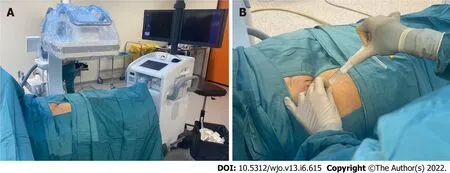
The knee is a superficial joint where after adequate skin disinfection and with proper sterility measures we performed an arthrocentesis at the outpatient clinic.Synovial fluid obtained was sent for microbiological study.On the other hand,hip arthrocentesis was performed at the operating room with the assistance of sedation by the anesthesiologist and fluoroscopic aid to localize the correct space for joint puncture (Figure 1).Sterility measures and microbiological studies were the same as for the knee joint.
Her excitement was contagious1. We knew the restaurant was posh because we could only understand parts of the menu. See? I told you there would be a place for me to wear my new spring outfit, she coyly reminded me.
Microbiological protocol
An antibiotic-free interval before joint aspiration (antibiotic holiday) and the time until the culture result is available (a minimum of 2 wk) extends the duration between the first and second stage of the two-stage revision surgery.However,active antibiotic treatment can result in false negatives.In all the cases of our series,the cultures of the first stage,second stage,and synovial fluid obtained from joint aspiration were performed in patients without active antibiotic treatment.Despite this condition,we did not have any positive cultures.To reduce the time between stages,some authors such as Mühlhofer[10] and Boelch[11] recommend performing reimplantation surgery without antibiotic holiday.
There is a story from many years ago of a primary school teacher. Her name was Mrs. Thompson. And as she stood in front ofher 5th grade class on the very first day of school, she told the children a lie. Like most teachers, she looked her students and said that she loved them all the same.
It is important to emphasize the differences between the knee and hip joint aspiration procedures.Knee joint aspiration is a much easier procedure as it is a more accessible joint and does not require guidance by fluoroscopy or ultrasound techniques.In some centers,when no fluid is obtained after joint aspiration,sterile saline is injected into the joint and then aspirated to obtain fluid to analyze.Injection of saline fluid into a joint that did not yield any synovial fluid (dry tap) was not recommended during the 2018 International Consensus Meeting on musculoskeletal infection.
Results interpretation
The results of intraoperative cultures during first-stage surgery and synovial fluid were recorded and compared with cultures obtained during re-implantation surgery.According to culture results during the second stage,patients were classified as persistent infection when second stage cultures were positive for the same microorganism that was isolated during the first stage even if only one single culture was positive.Reinfection was considered when two or more of the second stage cultures were positive for the same microorganism but differ from the ones isolated during the first stage.The presence of only one positive culture from intraoperative samples for a low virulent microorganism not isolated in the first stage was considered as a contaminant.
Having travelled from land to land in this fashion without finding anything to rivet10 his attention, it occurred to him to take the form of an eagle, and in this shape he flew across many countries and arrived at length in a new and lovely spot, where the air seemed filled with the scent11 of jessamine and orange flowers with which the ground was thickly planted
RESULTS
The results obtained in the study showed low sensitivity of joint aspiration for detecting infection persistence when performed prior to the second stage in a two-stage replacement.
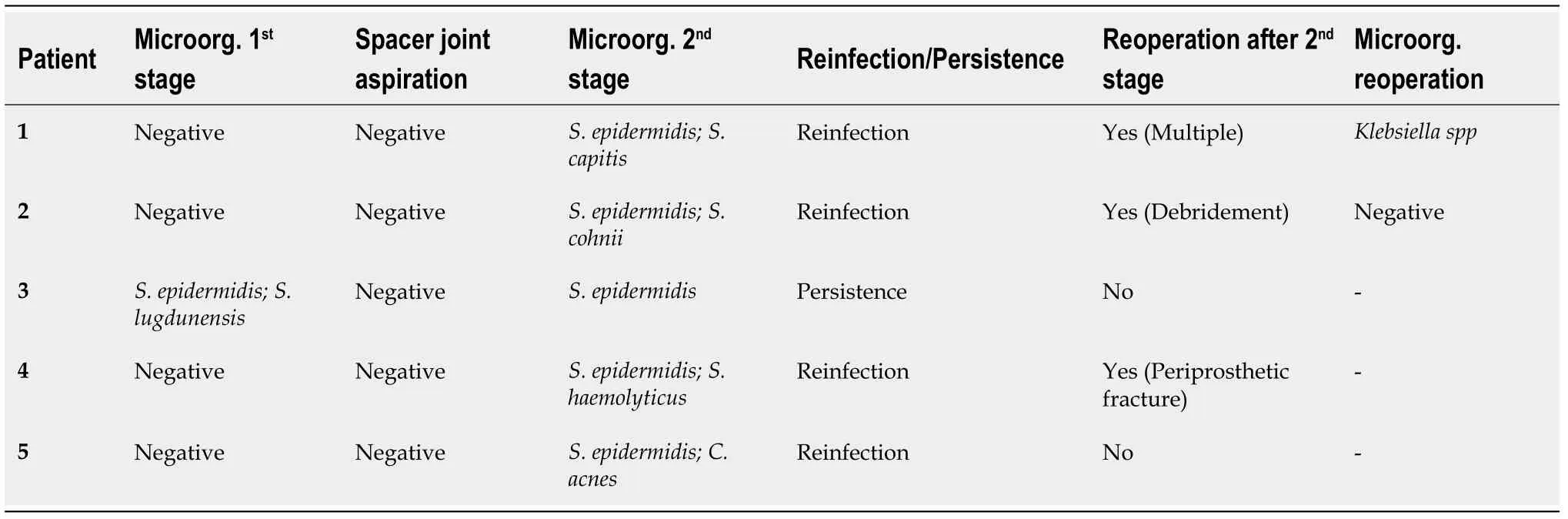
The mean age of patients was 70.4 years (range: 40-85 years).Twenty-four of them were females (61%),and sixteen were males (31%).In 39 patients,the synovial fluid culture was negative.In the remaining 2 cases,both knee spacers,no analysis was possible due to dry tap.Five patients had two or more positive intraoperative cultures during re-implantation surgery (Table 1).Only 1 patient,number 3,had a persistent infection.In this patient,the synovial fluid culture before the second-stage surgery failed to identify the infection.The other 4 cases had a reinfection,and in all of them the synovial fluid was negative.Three of these five patients (60%) required further surgeries after the second stage,and it was due to an infection in two cases (40%) (patients 1 and 2).
Mont[18] and Aalirezaie[19] considered joint aspiration and synovial fluid culturing a useful tool.However,we found similarities in our results with other authors and agreed to not perform mandatory synovial fluid aspiration before the second stage[11-13,15].
That night as I lay down to sleep, I gently placed my hand on my chest and I left it there until I dozed11 off. I knew I wasn t alone. We were all in bed together, metaphorically12() speaking, my breast, my chest, Ramona s gift and me.
Thirty-six patients (87.8%) had negative cultures or one positive culture from a minimum of five intraoperative samples (considered contamination) during the second stage of the revision surgery.Of these patients,17 (47.22%) needed new interventions after the second stage,and 12 of them (70.59%) were due to septic causes.
For a while they just hung there to each other laughing and crying and saying things without meaning. She d say a few words like, It was the bus station I meant and he d kiss her speechless and tell her the many things he had done to find her. What apparently13 had happeded three years before was that May had come by bus, not by train, and in her telegram she meant bus station, not railroad station. She had waited at the bus station for days and had spent all her money trying to find Harry. Finally she got a job typing.
DISCUSSION
PJI is a challenging complication following orthopedic surgery.Two-stage revision surgery was first described by Insall[8],and it is considered the gold standard treatment for chronic PJI.The precise time to perform the second stage of the revision surgery remains uncertain.A combination of serum markers and synovial aspiration results is considered the best test for determining the presence of PJI persistence[5-7,9].
Although the majority of studies confirm low sensitivity for joint aspiration fluid culture before reimplantation surgery[10-14] (some as low as our data of 0%),other studies like Preininger[15] and Newman[16] reported higher rates (21% and 30%,respectively) with a maximum sensitivity of 83% in the study by Meermans[17].All studies agree on its high specificity,above 90%[10-17].
At first I was grieved to see Lolotte cry, resumed the Princess, but I soon found that grieving was very troublesome, so I thought it better to be calm, and very soon afterwards I saw the Fairy Mirlifiche arrive, mounted upon her great unicorn110
Following the sampling protocol at our hospital,we took between 5 and 7 intraoperative samples.Each one was taken using a clean scalpel and clamp to avoid cross-contamination.Tissue samples were introduced in sterile plastic containers and sent to the microbiological laboratory without culture media.Once received in the laboratory,the tissue samples were homogenized in thioglycolate broth before plating in the following culture media (bioMérieux Marcy-l’étoile,France): (1) 5% blood sheep agar: 7 d at 37 °C in 5% COatmosphere; (2) Chocolate agar: 7 d at 37 °C in 5% COatmosphere; (3) McConkey agar: 2 d in a normal atmosphere; (4) Sabouraud agar: 5 d at 37 °C in a normal atmosphere; (5) Anaerobic agar: 7 d in an anaerobic atmosphere; and (6) Thioglycolate broth: systematic spread after 5 d of incubation in a normal atmosphere,in 5% sheep blood agar,chocolate agar,and anaerobic agar with the incubation times previously described.
There are some explanations for not having obtained any positive result in the synovial fluid culture in our patients.In the first place,the small sample size and the low sensitivity of the joint aspiration could explain our results.Second,the low bacterial load in the synovial fluid at the time of the joint aspiration.Third,the presence of local antibiotics due to elution of the antibiotic present in the cement spacer[20].
Even the summer when Dad got laid off from the mill, and Mama had to serve dried beans several times a week, not a single dime10 was taken from the jar
The main limitations of our study are its retrospective nature and the limited number of cases.There are few articles published in the literature concerning the value of synovial aspiration before reimplantation surgery with a cement spacer in place.These papers present heterogeneous data and an inconsistent antibiotic-free interval,making them difficult to compare.
CONCLUSION
Although synovial fluid culture may provide useful information regarding the infection status of the joint,we found no evidence to support mandatory joint aspiration before re-implantation in patients with a cement spacer in place.
We climbed into the van in absolute ecstasy3. He said, I ll take you places you never even thought of going. But tell me something. Why do you people want to do this? I told him my story and that I wanted to show gratitude4 for all that I had by giving something back.
ARTICLE HIGHLIGHTS
Research background
There are few studies in the literature based on the usefulness of joint aspiration with a cement spacer in place.The importance of this type of study lies in finding useful methods for determining the appropriate timing of the second stage of revision surgery.
Research motivation
The main problem in this type of research is its heterogeneity,as the duration of antibiotic treatment,the presence of antibiotic holiday,the use or not of a physiological saline solution when a dry aspiration is obtained,etc vary according to each institution’s protocol.
Research objectives
The objective of this study was to evaluate the role of culturing synovial fluid obtained by joint aspiration before re-implantation in patients who underwent a two-stage septic revision.
Research methods
This is a retrospective study,and the research method was to observe the results obtained in the joint aspiration performed before re-implantation in the knee/hip septic replacements in our center between 2010 and 2017.
Research results
A total of 50 patients diagnosed with PJI treated with a two-stage arthroplasty revision surgery were analyzed; nine patients were excluded because joint aspiration was not performed or the sample of synovial fluid was not correctly processed.The remaining 41 patients (20 hip and 21 knee joints) were included in the final analysis.
Research conclusions
The results obtained in our study lead us to not recommend the use of joint aspiration prior to the second stage of revision surgery due to its low sensitivity.
Research perspectives
Future research should focus on obtaining reliable markers to indicate the optimal time to perform the second stage of a two-stage septic revision.
Mrs. Conroy watched the bus disappear down the road. She looked around and tried to figure out what part of the city she was in. Suddenly the sun seemed awfully5 bright.
Huguet S wrote this manuscript; Huguet S,Bernaus M,Gómez L,Cuchí E,Soriano A,and Font-Vizcarra L commented on previous versions of the manuscript; All authors read and approved the final manuscript.
: The study was reviewed and approved by the Mútua Terrassa Institutional Review Board.
No written consent was needed for this article.No identifying information is included in this article.
No conflict of interest.
No additional data are available.
My parents split up when I was two years old and, while I had monthly contact with my dad, my bitter stepmother and my father s old-fashioned stiff upper lip meant we never became close. In fact, I used to dread8 the visits to see him and count the hours until I could go home again.
This article is an open-access article that was selected by an in-house editor and fully peer-reviewed by external reviewers.It is distributed in accordance with the Creative Commons Attribution NonCommercial (CC BYNC 4.0) license,which permits others to distribute,remix,adapt,build upon this work non-commercially,and license their derivative works on different terms,provided the original work is properly cited and the use is noncommercial.See: https://creativecommons.org/Licenses/by-nc/4.0/
Spain
Sandra Huguet 0000-0001-8540-3834; Martí Bernaus 0000-0001-9458-6337; Lucía Gómez 0000-0003-2074-6734; Eva Cuchí 0000-0002-0472-8467; Alex Soriano 0000-0003-2490-0271; Lluís Font-Vizcarra 0000-0002-8776-8009.
Wang JL
He would have continued gazing much longer at this remarkable23 curiosity had not the voice desired him to turn round and look at the crystal coffin24 which stood opposite
Filipodia
Wang JL
登錄APP查看全文
 World Journal of Orthopedics
2022年6期
World Journal of Orthopedics
2022年6期
- World Journal of Orthopedics的其它文章
- Hip prosthetic loosening and periprosthetic osteolysis:A commentary
- Evaluation of artificial intelligence models for osteoarthritis of the knee using deep learning algorithms for orthopedic radiographs
- Reducing bacterial adhesion to titanium surfaces using low intensity alternating electrical pulses
- Content of blood cell components,inflammatory cytokines and growth factors in autologous platelet-rich plasma obtained by various methods
- Topical use of tranexamic acid:Are there concerns for cytotoxicity?
- Management of hip fracture in COVID-19 infected patients