
BOUNDEDNESS AND EXPONENTIAL STABILIZATION IN A PARABOLIC-ELLIPTIC KELLER–SEGEL MODEL WITH SIGNAL-DEPENDENT MOTILITIES FOR LOCAL SENSING CHEMOTAXIS*
2022-06-25 02:11:36JieJIANG江杰
Jie JIANG (江杰)
Innovation Academy for Precision Measurement Science and Technology,CAS,Wuhan 430071,China
E-mail:jiang@apm.ac.cn;jiang@wipm.ac.cn
Abstract In this paper we consider the initial Neumann boundary value problem for a degenerate Keller–Segel model which features a signal-dependent non-increasing motility function.The main obstacle of analysis comes from the possible degeneracy when the signal concentration becomes unbounded.In the current work,we are interested in the boundedness and exponential stability of the classical solution in higher dimensions.With the aid of a Lyapunov functional and a delicate Alikakos–Moser type iteration,we are able to establish a time-independent upper bound of the concentration provided that the motility function decreases algebraically.Then we further prove the uniform-in-time boundedness of the solution by constructing an estimation involving a weighted energy.Finally,thanks to the Lyapunov functional again,we prove the exponential stabilization toward the spatially homogeneous steady states.Our boundedness result improves those in[1]and the exponential stabilization is obtained for the first time.
Key words Classical solution;boundedness;exponential stabilization;degeneracy;Keller–Segel models
1 Introduction
Chemotaxis is a biased movement of cells due to a chemical gradient,and it plays a significant role in diverse biological phenomena.In the 1970s,Keller and Segel proposed in their seminal work[2]the following model for chemotaxis:

Here,uandvdenote the density of cells and the concentration of signals,respectively.The signal-dependent cell diffusion rateγand chemo-sensitivityχare linked via

where the parameterσ≥0 is a constant proportional to the distance between the signal receptors in the cells.In the caseσ>0,a cell determines its moving direction due to a gradient sensing mechanism by calculating the difference of concentrations at different spots,while in the caseσ=0,the distance between receptors is zero and thus chemotactic movement occurs because of an undirected effect on the activity due to the presence of a chemical signal sensed by a single receptor (local sensing).One notices that in the latter case,the first equation of (1.1) has the concise form

whereγstands for a signal-dependent motility.More recently,in[3,4],by adding a logistic source term on the right hand side of (1.3),this model was also applied to describe the process of pattern formations via the so-called“self-trapping”mechanism,where the cellular motilityγ(·) was assumed to be suppressed by the concentration of signals.In other words,γ(·) is a signal-dependent decreasing function,i.e.,γ′(v)<0.We remark thatγ′(v)<0 indicates that cells are attracted by a high concentration of signals.
In this paper,we are interested in the boundedness and stability of classical solutions to the following initial boundary value problem for the parabolic-elliptic simplification of the original Keller–Segel model with signal-dependent motility for local sensing chemotaxis (i.e.,ε=σ=0 in (1.1)–(1.2)):

In view of the asymptotically vanishing property ofγ,an apparent difficulty in analysis lies in the possible degeneracy whenvbecomes unbounded.Theoretical analysis for the above Keller–Segel model with signal-dependent motility has attracted a lot of interest in recent years;see e.g.[1,5–18],and see[19,20]for some recent works on the gradient sensing model (1.1).A common strategy used in most literature is to derive theboundedness ofuwith somep>by an energy method.Then theboundedness ofvfollows via an application of standard elliptic/parabolic regularity theory to the equation forv.However,this method seems only to work under restrictive conditions,such as specific choices ofγ[1,8,15],or with the presence of logistic source terms[5–7].Recently,a new comparison approach was proposed in[11–14].By introducing an auxiliary elliptic problem that enjoys a comparison principle,the explicit point-wise upper bound estimates ofvwere established directly for generic motility functions satisfying (A0) in any spatial dimensions.In fact,it was proved thatv(x,t) grows at most exponentially in time and hence degeneracy cannot happen in finite time.In addition,a delicate Alikakos–Moser type iteration was further developed in[13]to deduce the uniformin-time boundedness ofvdirectly in higher dimensions without the help of any integrability ofu.
Previous studies on (1.4) strongly indicate that the dynamics of solutions are closely related to the decay rate ofγ.Whenn=2,it was proved in[11]that a classical solution always exists globally with any large initial datum and a genericγsatisfying (A0).Furthermore,ifγadditionally satisfies that

then for any large initial datum,the global classical solution is uniformly-in-time bounded[13].Note that assumption (1.7) allowsγto take any decreasing form within a finite region and moreover that any motility function decreases more slowly than a standard exponentially decreasing function at high concentrations can guarantee the boundedness;for example,γ(s)=e-sβwith anyβ∈(0,1).Ifγdecays even faster so that there isχ>0 such that

then the solution of (1.4) is uniformly-in-time bounded provided thatIn particular,ifγ(s)=e-χs,a critical-mass phenomenon was observed in[11,12,15]such that with any sub-critical mass,the classical solution is uniformly-in-time bounded.Moreover,it was pointed out that no finite-time blowup occurs and that the global solution may blow up at time infinity with certain super-critical mass[10–12].
For higher dimensionsn≥3,the boundedness was studied in several works provided thatγsatisfies some algebraically decreasing assumptions[1,13,19].In particular,ifγ(s)=s-kwith somek>0,one notices that a variant form of (1.4) reads as

The above two systems share the same set of equilibria.In addition,they have similar scaling structures.Supposing that (u,v) is a solution of (1.10),one checks thatuλ(t,x)=λu(t,x) andvλ(t,x)=λv(t,x) is also a solution with anyλ>0,while for (1.9),the scaling is given byuλ(t,x)=λu(λ-kt,x) andvλ(t,x)=λv(λ-kt,x).Such a scaling invariance indicates that existence results are usually independent of the size of initial datum.
There is very limited theoretical research on both (1.9) and (1.10).Roughly speaking,the dynamics of solutions seem to be determined by the size ofk.For the logarithmic Keller–Segel system (1.10) there are several studies on the admissible range ofkfor global existence/boundedness,and on the other hand,blowup solutions were constructed only in the radial symmetric casen≥3 andk>[21],though the threshold number is still unclear.In comparison,the existence of blowup solutions remains unknown for the fully parabolic version of (1.10).In[22],it was proved that a classical solution exists globally provided thatFor the radially symmetric case,the existence of weak solutions fork<∞,n=2 andwas shown in[23].More recently,the asymptotic stabilization toward the constant equilibria was obtained in[24]forn≥2 withk<under the smallness of the size of|Ω|.We refer the reader to[25–27]for a complete description of topics related to the logarithmic Keller-Segel model.
For the degenerate system (1.9),the boundedness of global solutions with anywas first shown in[1],and later in[13,19]via different methods.Moreover,the existence of a global (but likely growing up) classical solution was obtained in[13]within a larger rangeWe also mention that,recently,in[32],some doubly nonlinear diffusion operators involving porous medium type degeneracies were considered in similar frameworks,which indicates that the simultaneous density-determined enhancement of diffusion and crossdiffusion can foster boundedness in a system of this form.It would be interesting to consider whether the comparison method developed in[12]and the idea in the present contribution can be generalized to that case.
In the present work,we aim to improve the uniform-in-time boundedness results for (1.4) in higher dimensions.The key observation of this contribution is that under an assumption

system (1.4) possesses a Lyapunov functional (see also[1]).Then we can perform an Alikakos–Moser iteration to derive a time-independent upper bound ofvunder weakened conditions compared with[1,13,19].Also,with the aid of the Lyapunov functional,exponential stabilization of the global solution toward the spatially homogeneous steady statesis obtained for the first time.A direct consequence of our result to the specific caseγ(s)=s-kis that the boundedness of solutions can be improved to anyk≤1 whenn=4,5,orwhenn≥6.Furthermore,the solution will converge toexponentially as time tends to infinity.
In order to formulate our result in a more general framework,we introduce the following condition:

Note that (A2) allowsγto take other algebraically decreasing functions.For example,ifwith any givenk0>0,we may takek=k0+εwith anyε>0 in (A2).
Now we are in a position to state the main results of the current work.
Theorem 1.1Assume thatn≥3.Suppose thatγsatisfies (A0),(A1) and

Then,for any initial datum satisfying (1.5),problem (1.4) possesses a unique global classical solution that is uniformly-in-time bounded.
Moreover,there existα>0 andC>0 depending onu0,γ,nand Ω such that,for allt≥1,

Remark 1.2Thanks to the strictly positive time-independent lower boundv*ofvfor (x,t)∈Ω×[0,∞) given in Lemma 2.2 in the next section,assumptions (A1) and (A3) can be weaken so as to hold for alls≥v*.Thus,our existence and boundedness results also hold true ifγ(s) has singularities ats=0;for exampleγ(s)=s-kwithk>0.In such cases,we can simply replaceγ(s) by a new motility function~γ(s) which satisfies (A0) and coincides withγ(s) for
In particular,for the typical caseγ(v)=v-k,we have
Theorem 1.3Suppose thatγ(v)=v-kandn≥4.Then for any initial datum satisfying (1.5),problem (1.4) has a unique global classical solution which is uniformly-in-time bounded provided that 0<k≤1 whenn=4,5,or 0<kwhenn≥6.Moreover,there existα>0 andC>0 depending onu0,k,nand Ω such that,for allt≥1,

Remark 1.4Combined with the results in[1,13,19],uniform-in-time boundedness for the caseγ(s)=s-kis now available if

The exponential decay (1.15) also holds whenn≤3 if 0<k≤1.We remark that the convergence of (u,v) toward the constant solution was found in[1]whenγ(s)=s-k,supposing thatk∈∩(0,1],however,no convergence rate was given.
Now,let us sketch the main idea of our proof.First,we would like to recall the following identity,which unveils the key mechanism of our system:

Here Δ denotes the usual Neumann Laplacian operator.The above key identity was first observed in[11,12],and along with a new comparison approach,gives rise to a point-wise upper bound ofvwith generic functions satisfying (A0).Furthermore,one notices that a substitution of the second equation of (1.4) gives a variant form of this key identity:

Thanks to the comparison principle of elliptic equations and the decreasing property ofγ,one has that

withv*being the strictly positive lower bound forvgiven by Lemma 2.2 below.Then under the assumption (A2),based on a delicate Alikakos–Moser type iteration,we can show that the uniform-in-time upper bound ofvis obtainable if we have time-independent estimates forwith anybeforehand.
On the other hand,system (1.4) possesses a Lyapunov functional (see also[1]) such that

Next,in order to prove the boundedness of solutions,it suffices to establish theboundedness ofuwith somesince higher-order estimates can then be proven by standard iterations and a bootstrap argument.Recalling thatvis now bounded from above,γ(v) is bounded from below by a strictly positive time-independent constant due to its decreasing property.With the aid of the key identity again,we construct an estimation involving a weighted energyRΩupγq(v),which,with a proper choice ofp>n2andq>0,will finally imply the boundedness.
Last,the Lyapunov functionalR also plays a crucial role in the study of exponential stabilization.Sincewe haveΩvtdx=0 for allt>0,and hence the energy-dissipation relation (1.18) can be rewritten as

With the boundedness ofvin hand,one can deduce from the above by Poincaré’s inequality thatdecay exponentially.Then,by a bootstrapping strategy,the exponential stabilization of (u,v) can be further acquired inL∞×W1,∞.
We remark that if the second equation of (1.4) is of parabolic type,it is still unknown whether the system possesses a Lyapunov functional like (1.18).Thus,at the present stage,we cannot improve the results in[13]for the fully parabolic case using the same idea.
The rest of the paper is organized as follows:in Section 2,we provide some preliminary results and recall some useful lemmas.In Section 3 we first construct a Lyapunov functional which satisfies a certain dissipation property.Then,using a delicate Alikakos–Moser iteration,we derive the uniform-in-time upper bounds ofv.In Section 4,we first establish the boundedness of the weighted energy which gives rise to the boundedness of the global classical solutions.Then using the Lyapunov functional again we prove the exponential stabilization toward the constant steady states.
2 Preliminaries
In this section we recall some useful lemmas.First,the local existence and uniqueness of classical solutions to system (1.4) can be established by the standard fixed point argument and regularity theory for elliptic/parabolic equations.A similar proof can be found in[1,Lemma 3.1].
Theorem 2.1Let Ω be a smooth bounded domain of Rn.Suppose thatγ(·) satisfies (A0) andu0satisfies (1.5).Then there existsTmax∈(0,∞]such that problem (1.4) permits a unique non-negative classical solution (u,v)Moreover,the following mass conservation holds:

A strictly positive uniform-in-time lower bound forv=(I-Δ)-1[u](x,t) is given in[1,Lemma 2.2];see also[31,Lemma 3.3].
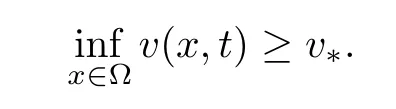
Lemma 2.2Suppose that (u,v) is the classical solution of (1.4) up to the maximal time of existenceTmax∈(0,∞].Then,there exists a strictly positive constantv*=v*(n,Ω,‖u0‖L1(Ω)) such that,for allt∈(0,Tmax),it holds that
Next,we recall a key identity and an explicit point-wise upper bound estimate forv[11,Lemma 3.1].
Lemma 2.3Assume thatn≥1 and suppose thatγsatisfies (A0).For any 0<t<Tmax,it holds that

Last,we recall the followingLp-Lqestimates for the Neumann heat semigroup on bounded domains (see e.g.,[28,29]):
Lemma 2.4Suppose that{etΔ}t≥0is the Neumann heat semigroup in Ω,and thatμ1>0 denotes the first nonzero eigenvalue of-Δ in Ω under Neumann boundary conditions.Then there existk1>0 andk2>0 which only depend on Ω such that the following properties hold:

3 Time-Independent Upper Bounds of v
In this part,we aim to establish the uniform-in-time upper bound forvin higher dimensions whenγdecreases algebraically at large concentrations.The proof consists of several steps.To begin with,we introduce a Lyapunov functional.
Lemma 3.1For any 0≤t<Tmax,it holds that

In particular,under the assumption (A1),there isC>0 depending only onu0such that

ProofMultiplying the first equation of (1.4) byv,integrating over Ω and substituting the second equation of (1.4) yields that

Then the uniform-in-time estimate (3.2) follows by integration of the above identity with respect to time.Finally,since-Δv0+v0=u0in Ω and?νv0=0 on?Ω,we infer,by Young’s inequality,that

This completes the proof. □
Remark 3.2In view of the time-independent lower bound 0<v*≤v(x,t),one can slightly weaken assumption (A1) as follows:

On the other hand,a direct calculation indicates that the above assumption yields that

and henceγfulfills (A2) with anyk>1.In particular,ifγ(s)=s-k,assumption (A1) is satisfied whenk≤1.
With the above result,we can proceed to derive the uniform-in-time upper bounds ofvbased on a delicate Alikakos–Moser iteration[30].First,we demonstrate
Lemma 3.3Assume thatn≥3.Suppose thatγsatisfies (A0) and (A2) with somek>0.Then there existλ1>0 andλ2>0 independent of time such that,for anyp>1+k,

ProofFirst,under our assumption,we may infer that there existb>0 andsb>v*such that,for alls≥sb,

and on the other hand,sinceγ(·) is non-increasing,

for all 0≤s<sb.Therefore,for alls≥0,it holds that

Now,multiplying the key identity (2.1) byvp-1with somep>1+k,we obtain that

Sinceγ(v)≤γ(v*),we deduce,by the comparison principle of elliptic equations,that

from which we deduce thatZ

whereC2>0 may depend on the initial datum,n,Ω andγ,but is independent ofpand time.Next,recalling thatv-Δv=u,we observe that with someλ1,λ2>0 independent ofpand time.The proof is completed by addingto both sides of the above inequality. □
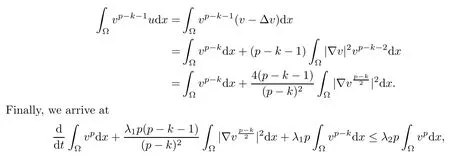
Lemma 3.4Assume thatn≥3.Suppose thatγsatisfies (A0) and (A2) with somebe a generic constant.There existsC0>0 depending only on the initial datum,Ω,k,λ1,λ2andnsuch that,for anysatisfying

ProofFirst,one notices thatq*>1+kand,provided thatn≥3 and 0<k<.Let

and on the other hand,solvingα<1 yields thatMoreover,sinceas well,one checks thatThen an application of Hlder’s inequality yields that

Recall the Sobolev embedding inequality

whereλ*>0 depends only onnand Ω.In view of the fact thatinvoking Young’s inequality,we infer that


It follows from the above and from (3.12) that
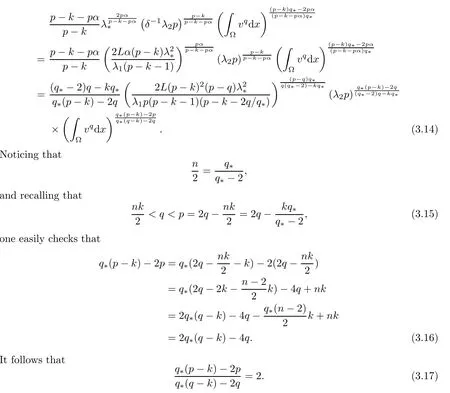
Moreover,we note by (3.16) again that


Thus,we obtain that

In addition,by substituting (3.15),we infer that

and similarly,by (3.19),

Moreover,sincep>q*>1+k,we deduce that

Now,based on the above calculations,we obtain that

Hence,one can find thatC0>0 is a constant depending only on the initial datum,Ω,k,λ1,λ2,λ*andnsuch that


Therefore,by the above and by (3.13),we have that

Combining Lemma 3.3 and recalling thatL>1,we finally arrive at the following inequality:

This completes the proof. □
Proposition 3.5Assume thatn≥3.Suppose thatγsatisfies (A0),(A1) and (A2) with someThen there isv*>0 depending only on the initial datum,γ,nand Ω such that

ProofFor allr∈N we define


Note that Mris finite for allrin view of (2.2). Now,lettingwe infer from the above that

which implies that

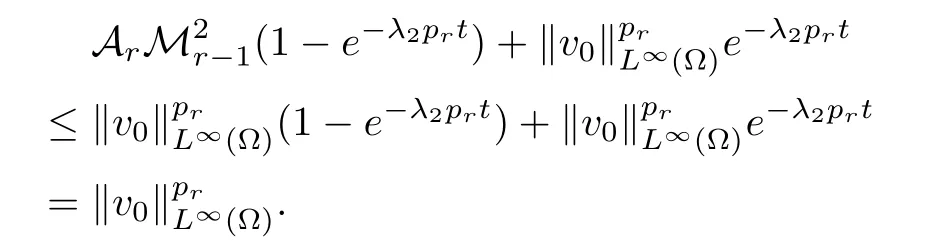
As a result,we obtain that,for allr∈N,

Sincepr≥q*for allr≥1,one can chooseL>1 sufficiently large depending only on the initial datum,Ω,nandksuch that Ar>1 for allr≥1.Moreover,adjustingC0by a proper larger number,we have that

with somea>0 depending only on the initial datum,Ω,kandn.In addition,sinceγsatisfies (A0) and (A1),due to Lemma 3.1 and the Sobolev embeddingwe may find some large constantK0>1 that dominatesdxfor all time (note that ‖v0‖L∞(Ω)≤‖u0‖L∞(Ω),by the definition ofv0).
Iteratively,we deduce that
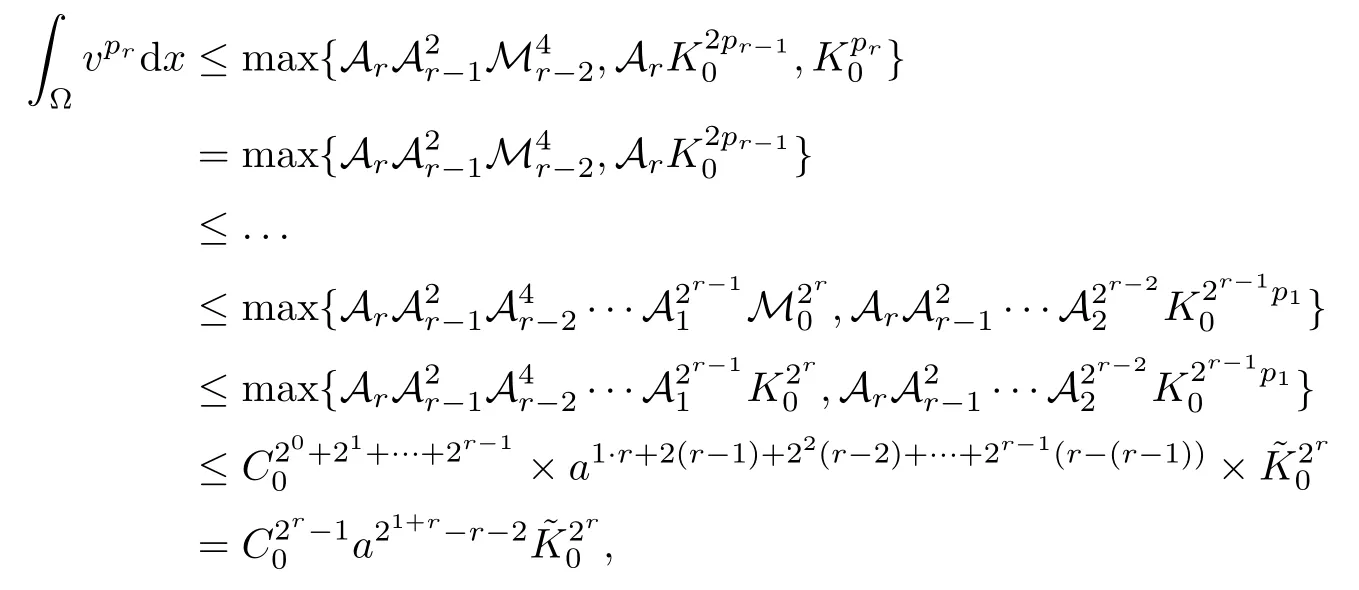

which concludes the proof. □
Corollary 3.6Ifγ(v)=v-k,thenvhas a uniform-in-time upper bound provided thatk≤1 whenn=4,5,orwhenn≥6.
Next,we recall the following lemma,established in[13]:
Lemma 3.7A function satisfying (A0),(A1) and

with somel>1 must fulfill assumption (A2) with any.
Lemma 3.8Assume thatn≥4.Suppose thatγ(·) satisfies (A0),(A1) and (A3).Thenvhas a uniform-in-time upper bound in.
ProofNote thatThusγsatisfies (A2) with somek<and,due to Proposition 3.5,vhas a uniform-in-time upper bound such thatv≤v*on□
4 Proof of Theorem 1.1
4.1 Uniform-in-time boundedness
This part is devoted to the proof of Theorem 1.1.With the time-independent upper bound ofvin hand,it suffices to establish an estimation involving a weighted energyfor some 1+p>andq>0.Higher-order estimates can be then proven via a standard bootstrapping argument.To begin with,we provide
Lemma 4.1For any 0≤t<Tmaxandp,q>0,it holds that

ProofFor anyp,q>0,by direct computations,we infer by the key identity that

Then a substitution ofv-Δv=uto the last term on the right hand side of (4.2) yields that

By integration by parts and the first equation of (1.4),we infer that

Last,by integration by parts again,it holds that


Collecting the above equalities completes the proof. □
Lemma 4.2Assume thatγ(·) satisfies (A0),(A1) and (A3).For any,there exist time-independent constantsandδ0=δ0(p,q)∈(0,1) such that

for allλ>0.We observe thatf(λ) attains its maximum valueThus,for anyit holds that

In addition,we can further find a time-independent constantδ0=δ0(p,λ0)∈(0,1) such that

for any 1+p∈(1,).On the other hand,according to Lemma 2.2 and Lemma 3.8,there exist the following time-independent lower and upper bounds forv:

for any 1+p∈(1,).As a result,assertion (4.6) holds withq=λ0pandδ0chosen above.□
Lemma 4.3Assume thatn≥3 and thatγ(·) satisfies (A0),(A1) and (A3).Then there existp>-1 andC>0 independent of time such that

ProofInvoking Young’s inequality,it holds that

with any 1+p∈(1,) andqandδ0chosen in Lemma 4.2.
Then it follows from (4.1) and Lemma 4.2 that

Sincev*≤v≤v*,there existC3and>0 depending onp,δ0,γand the initial datum only such that,for any

Recall the Gagliardo-Nirenberg inequality


with anyε>0 and someindependent of time.Thus,by choosing proper smallε>0,we infer from (4.9) that,for any

withC6andC7>0 independent of time.Then,in view of the fact that ‖u(·,t)‖L1(Ω)=‖u0‖L1(Ω),together with the uniform-in-time lower and upper boundedness ofγq(v),one can deduce iteratively from (4.11) that,for any
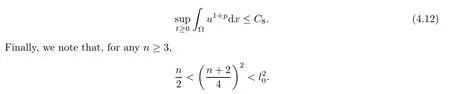
Thus we can always findp>0 satisfying 1+p>such that (4.12) holds.This completes the proof. □
Proof of Theorem 1.1Boundedness:Once we obtain Lemma 4.3 with 1+p>,we can to proceed to deduce the uniform-in-time boundedness of the solutions in the same manner as was done in[1,Lemma 4.3].We omit the details here. □
Corollary 4.4Assume thatγ(v)=v-kand thatn≥4.Then there exists a unique globally bounded classical solution,provided thatk≤1 whenn=4,5,orwhenn≥6.
4.2 Exponential stabilization toward constant steady states
In this part,we derive the exponential stabilization of the global solutions relying on a slightly modified version of the Lyapunov functional (3.1).
Lemma 4.5There exist constantsα>0 andC>0 depending onu0,γ,nand Ω such that

ProofObserving thatfor allt≥0,it follows that,and hence,

Therefore,we deduce from (3.1) that

Sincev≤v*andγis non-increasing,we have that

which,together with Poincaré’s inequality,yields that

Hereμ1>0 denotes the first positive eigenvalue of the Neumann Lapaplacian operator,and we also use the fact thatμ1‖?v‖2≤‖Δv‖2if?νv=0 on?Ω.
Thus,we infer from (4.14) that

which by standard ODI analysis yields that,for allt≥0,

wherev0=(I-Δ)-1[u0].
Next,from the first equation of (1.4),we have that

Since nowuandvare both uniformly-in-time bounded,there is a time-independent constantC9>0 such that

Applying Poincaré’s inequality,one can find a constant 0<α1<andC10>0 depending only on initial datum,γ,nand Ω such that

In view of (4.16),solving the above differential inequality yields that

withC11>0 depending on initial datum,n,γand Ω only.
Next,for anyp>2,we multiply (4.17) byto get that

Similarly,there are time-independent constantsC12=C12(p)>0 andα2<α1such that

Observing that

we arrive at

which yields that

Last,note that from the second equation of (1.4),

Choosing somep0>nin (4.20),one may deduce,by elliptic regularity and Sobolev embeddings,that

Next,we assert
Lemma 4.6There are positive constantsC=C(n,Ω,γ,u0) andθ∈(0,1) such that

ProofSince ‖u‖L∞(Ω)and ‖v‖W1,∞(Ω)are now uniform-in-time bounded,one infers from the key identity (2.1) that


and from the second equation of (1.4),

On the other hand,in the same manner as in[1,Lemma 5.1],there exists a time-independent constantC19>0 such that

with someθ2∈(0,1).
Then we recall the following variant form of the key identity:

Sinceγ(v(x,t)) is uniformly bounded from above and below,γ(v(x,t))Δ is a uniform elliptic operator.Also,in view of our assumption (A0),as well as the regularizing effect of the operator (I-Δ)-1,bothvγ(v) and (I-Δ)-1[uγ(v)]are now bounded inThus we can further deduce,by a standard version of Schauder’s theory for parabolic equations,that with someθ3∈(0,1),

In turn,we may finally deduce from the equation foru,by Schauder’s theory,that

With the above preparations,we are now ready to prove the exponential decay of ‖u-Denoting,by the semigroup theory,we infer from (4.17) that,for anyt>τ0≥1,

As a result,we deduce by Lemma 2.4 that


where we use the fact that

sincesv(t,x)+(1-s)u0is uniformly bounded from above and below on[0,+∞)×Ω for alls∈[0,1].
As a result,recalling Lemma 4.5 and Lemma 2.4,we may infer that

with anyα′<min{γ0μ1,α}.Here,we use the fact that,for anyβ≥κ>0,

with anyκ′<κ.Here,C24>0 depends only onκandκ′.On the other hand,for 0<β<κ,

with anyβ′<βandC25>0 depending onβ,β′.
Proof of Theorem 1.1Convergence:By Lemma 4.5 and (4.25),we conclude that

with someα′>0 andC26>0 depending onu0,γ,nand Ω. □
 Acta Mathematica Scientia(English Series)2022年3期
- Acta Mathematica Scientia(English Series)的其它文章
- A ROBUST COLOR EDGE DETECTION ALGORITHM BASED ON THE QUATERNION HARDY FILTER*
- CONTINUOUS SELECTIONS OF THE SET-VALUED METRIC GENERALIZED INVERSE IN 2-STRICTLY CONVEX BANACH SPACES*
- EXISTENCE RESULTS FOR SINGULAR FRACTIONAL p-KIRCHHOFF PROBLEMS*
- BOUNDS FOR MULTILINEAR OPERATORS UNDER AN INTEGRAL TYPE CONDITION ON MORREY SPACES*
- LEARNING RATES OF KERNEL-BASED ROBUST CLASSIFICATION*
- A COMPACTNESS THEOREM FOR STABLE FLAT SL (2,C) CONNECTIONS ON 3-FOLDS*