
巧用修辭,續(xù)寫美文
2023-02-21 05:51:12王思
瘋狂英語·新讀寫 2023年1期
關(guān)鍵詞:語言
【名師導(dǎo)學(xué)】
讀后續(xù)寫要求語言風(fēng)格與原文的語言風(fēng)格保持一致。因此,在寫作時(shí),我們要充分利用所學(xué)的知識(shí)來模仿原文的語言風(fēng)格,使續(xù)寫部分與原文的總體表達(dá)形式和語言風(fēng)格一致。
很多時(shí)候,我們續(xù)寫出來的句子缺乏亮點(diǎn),因而,我們可以在寫作中恰當(dāng)?shù)厥褂眯揶o手法,給語言增色。修辭是一門有著獨(dú)特魅力的藝術(shù),它能化平淡為新奇,化呆板為鮮活,化枯燥為生動(dòng)。在寫作中巧妙運(yùn)用貼切的修辭手法,能增強(qiáng)語言的表現(xiàn)力、說服力和感染力。
那么,在實(shí)際的寫作中,我們該如何圍繞主題意義,順承原文語言風(fēng)格,運(yùn)用恰當(dāng)?shù)恼Z言來構(gòu)建語篇呢?我們又該如何運(yùn)用恰當(dāng)?shù)男揶o手法為文章增色呢?下面就以一篇讀后續(xù)寫為例來探討這一問題。
【案例導(dǎo)引】
閱讀下面短文,根據(jù)所給情節(jié)進(jìn)行續(xù)寫,使之構(gòu)成一個(gè)完整的故事。
That cold January night,I was growing sick of my life in San Francisco.There I was walking home at one in the morning after a practice at the theater,feeling unbearably cold and unutterably exhausted.With opening night only a week away,I was still learning my lines.Hard as I tried,I was having trouble dealing with my part-time job at the bank and my acting at night at the same time.
As I walked,I thought seriously about giving up both acting and living in San Francisco.City life had become too much for me.The burden on my back seemed to be crushing me to the earth.As I walked down the empty streets under tall buildings,I felt very small and cold.Very few people were still out except a few sad-looking homeless people under blankets.I began running,both to keep warm and to keep away from any possible robbers.
About a block away from my apartment,I heard a sound behind me.“Am I being followed by someone?”I thought with fear.With my heart popping wildly like a deer,I turned quickly,half expecting to see someone with a knife or a gun.The street was empty.All I saw was a shining streetlight,which was telling the struggling stories of people in San Francisco.Still,the noise had made me nervous,so I started to run faster.Eventually,I reached the apartment building,took out the key,unlocked the door,and rushed into the room.When I reached into my pocket to take out the wallet,I suddenly realized what the noise had been.It had been my wallet falling on the sidewalk.Suddenly I wasn't cold or tired anymore.All the money I had was in the wallet,without which I would have to starve for the rest of the month.
注意:續(xù)寫詞數(shù)應(yīng)為150左右。
Paragraph 1:
I ran out of the door and back to where I'd heard the noise.______________________
__________________________________________________________________________
__________________________________________________________________________
__________________________________________________________________________
__________________________________________________________________________
__________________________________________________________________________
Paragraph 2:
Just as I was about to give up the search,I heard a garbage truck pull up to the sidewalk next to me.________________________
__________________________________________________________________________
__________________________________________________________________________
__________________________________________________________________________
__________________________________________________________________________
__________________________________________________________________________
一、原文的語篇要素

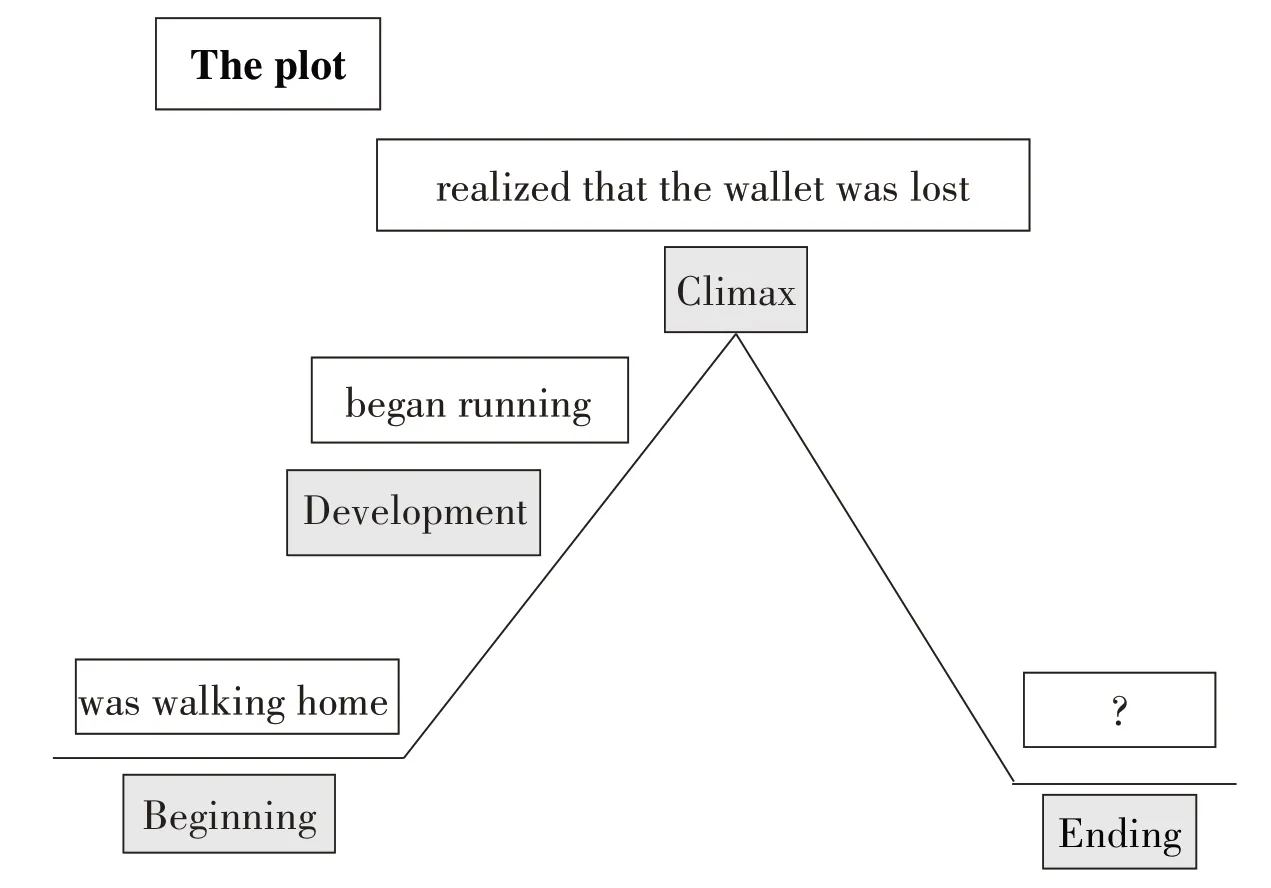
二、原文的情節(jié)脈絡(luò)發(fā)展
三、原文用到的修辭手法
“我”厭煩了在舊金山的生活,對(duì)生活與工作(包括排練)感到失望和無奈,最終考慮離開。然而,在尋找錢包時(shí)發(fā)生的事情使“我”感受到了人間真情,于是“我”最終放棄了離開這個(gè)城市的想法。原文運(yùn)用了押韻、夸張、比喻、擬人和排比等修辭手法來描述環(huán)境,抒發(fā)情感,渲染氣氛,加強(qiáng)語勢,增強(qiáng)表達(dá)的效果。
(一)押韻
中國古代的詩詞歌賦中,某些句子末尾的字韻母相同或相近,這使作品聲韻和諧,具有節(jié)奏和聲調(diào)美,讀起來朗朗上口,給人一種獨(dú)特的和諧優(yōu)美之感。漢語如此,英語也是如此。
例如,原文第一段中的“There I was walking home...feeling unbearably cold and unutterably exhausted.”,其中的unbearably 和unutterably 兩個(gè)詞尾韻相同,用它們來分別修飾cold 和exhausted,這不僅讀起來朗朗上口,還能充分表達(dá)出“我”當(dāng)時(shí)瀕臨崩潰、想要放棄的狀態(tài),給讀者留下深刻的印象。
(二)夸張
夸張是一種運(yùn)用豐富的想象力,在客觀現(xiàn)實(shí)的基礎(chǔ)上有目的地放大或縮小事物的形象特征,以增強(qiáng)表達(dá)效果的修辭手法。夸張是用言過其實(shí)的方法,突出事物的本質(zhì),或加強(qiáng)主人公的某種感情,強(qiáng)調(diào)語氣,烘托氣氛,激發(fā)讀者豐富的想象,使讀者產(chǎn)生強(qiáng)烈的共鳴。
在原文第二段中,“我”想放棄演戲甚至城市生活,覺得城市生活的壓力快把自己壓垮了。在這里,文章采用的表達(dá)為“The burden on my back seemed to be crushing me to the earth.”,此句中的burden 主要來自心理壓力。這句話巧妙地運(yùn)用了夸張的手法,強(qiáng)調(diào)了壓力之大,激發(fā)讀者的想象,使讀者產(chǎn)生了共鳴,讓讀者更能感受“我”想要逃離這個(gè)地方的強(qiáng)烈欲望。
(三)比喻
比喻是一種常用的修辭手法,用跟甲事物有相似之點(diǎn)的乙事物來描寫或說明甲事物。換言之,比喻就是打比方,就是根據(jù)聯(lián)想,抓住不同事物的相似之處,用淺顯、具體、生動(dòng)的事物來代替抽象、難以理解的事物。在寫作時(shí),使用比喻可使事物形象具體,以此激發(fā)讀者的想象,富有很強(qiáng)的感染力。寫作中,比喻主要是明喻和暗喻。
在原文第三段中,“我”在跑回公寓的路上突然聽到一個(gè)聲音,以為是被人跟蹤,感到很害怕。“With my heart popping wildly like a deer,...gun.”這句話運(yùn)用了比喻的修辭手法,把心怦怦跳比喻成小鹿亂撞,生動(dòng)地寫出了主人公當(dāng)時(shí)的緊張與心有余悸。
(四)擬人
擬人的修辭方法,就是把事物人格化,將本來不具備人的動(dòng)作和感情的事物變得具備人的動(dòng)作和感情。適當(dāng)?shù)夭捎脭M人化手法,能增強(qiáng)語言表達(dá)的感染力和生動(dòng)性,使被描寫的對(duì)象栩栩如生,活靈活現(xiàn),可以增強(qiáng)文章的感染力和吸引力。
在原文第三段中,“我”轉(zhuǎn)身看到身后的街道空空如也,一個(gè)人也沒有,只看到閃爍的街燈,它就像是在訴說著人們在這里苦苦掙扎的故事。“All I saw was a shining streetlight,which was telling the struggling stories of people in San Francisco.”這句話用了擬人的修辭手法,借用閃爍的街燈來訴說在這里生活的艱難,既生動(dòng)又極具感染力。
(五)排比
排比是把結(jié)構(gòu)相似、意思密切相關(guān)、語氣一致的詞語或句子成串排列的一種修辭方法,將意義相關(guān)或相近、結(jié)構(gòu)相同或相似和語氣相同的詞組或句子并排,達(dá)到一種加強(qiáng)語勢的效果。排比的行文有節(jié)奏感,朗朗上口,有極強(qiáng)的說服力,能增強(qiáng)文章的表達(dá)效果和氣勢,深化主題。
原文第三段也巧妙地運(yùn)用了排比的修辭手法。“Eventually,I reached the apartment building,took out the key,unlocked the door,and rushed into the room.”中 的reached、took out、unlocked 和rushed into 四個(gè)并列的謂語動(dòng)詞,展現(xiàn)了一系列的動(dòng)作,強(qiáng)化了當(dāng)時(shí)那種緊張害怕的氛圍,增強(qiáng)了表達(dá)效果。
以上是原文中使用到的修辭手法,那么,在續(xù)寫的時(shí)候,我們該如何巧用修辭才能讓續(xù)寫部分既達(dá)到與原文語言風(fēng)格一致,又給續(xù)寫的段落增加亮點(diǎn)呢?
四、續(xù)寫故事中修辭手法的運(yùn)用
(一)夸張
根據(jù)情節(jié)的發(fā)展和續(xù)寫第一段的段首句可知,主人公跑回去找他的錢包了。錢包對(duì)他來說非常重要,在還沒找到錢包之前,他應(yīng)該是既緊張又擔(dān)心,所以在續(xù)寫的時(shí)候可以巧用夸張的修辭手法來表達(dá)他焦急的心情,如“I was so anxious,as if my heart had leaped into my throat.”。這句話描述了主人公的擔(dān)心,其中的as if my heart had leaped into my throat形象地表達(dá)了主人公焦急、緊張的心情。
素材積累
1.That horror movie made my hair stand on end.那部恐怖電影嚇得我頭發(fā)都豎起來了。
2.After seeing the horror film,she really had her heart in her mouth.看完那部恐怖電影,她被嚇得心都提到嗓子眼了。
3.His bright smile lit up the room.他燦爛的笑容照亮了房間。
4.I almost laughed my head off.我都快笑死了。
5.He was bent out of shape.他非常生氣。
6.She cried her eyes out.她痛哭流涕。
(二)擬人
根據(jù)續(xù)寫第一段的段首句和續(xù)寫第二段的段首句,我們可以推知主人公返回去找錢包,但并沒有找到。而錢包的丟失,相當(dāng)于壓垮他的最后一根稻草。所以,在續(xù)寫第一段的時(shí)候可以運(yùn)用句子“A sense of despair hit me,and the darkness of the night was swallowing me.”來描寫主人公的絕望。其中的hit和swallow本來是表示人的動(dòng)作,但這里的擬人修辭手法更生動(dòng)形象地表現(xiàn)了主人公的絕望和無助。
素材積累
1.When the host announced that she won the prize,a wide excitement took hold of her.當(dāng)主持人宣布她獲獎(jiǎng)的時(shí)候,她興奮不已。
2.Upon hearing the bad news,she felt seized by a burst of sadness and couldn't help crying bitterly.一聽到這個(gè)壞消息,她感到很悲傷,忍不住痛哭起來。
3.When I was bathed in the sunlight,it felt like the amber-like sunshine was kissing every inch of my skin.當(dāng)我沐浴在陽光下的時(shí)候,感覺就像是琥珀色的陽光親吻著我全身的肌膚。
4.The wind stood up and gave a shout.大風(fēng)凜冽,發(fā)出怒吼。
5.Fireflies patrol the grass with small lanterns.螢火蟲提著小燈籠在草叢中巡邏。
6.The frogs are giving a concert—mixed chorus.青蛙們在舉辦音樂會(huì)——混聲大合唱。
(三)排比
根據(jù)續(xù)寫第二段的段首句可知,主人公并沒有找到錢包。而丟了錢包,意味著主人公的吃穿住行都成問題。這里,文章可以巧用排比句來體現(xiàn)這一點(diǎn),比如“How could I afford the meals the next day? How could I pay the rent of the house next month?How could I take public transportation to work?”。三個(gè)以how 開頭的問句組成一組排比句,大大增強(qiáng)了文章的表達(dá)效果和氣勢,體現(xiàn)了主人公當(dāng)時(shí)絕望的處境。
根據(jù)續(xù)寫第二段的段首句的提示和情節(jié)的發(fā)展可知,本段應(yīng)該是講述清潔工撿到了主人公的錢包并歸還給他。主人公在找回錢包的同時(shí),也感受到了這個(gè)城市的一點(diǎn)溫暖。這里,文章可以運(yùn)用句子“I had got back my wallet.I also had got back some enjoyment of city life.”來表達(dá)。這兩個(gè)句子結(jié)構(gòu)相同,意義相近,既增強(qiáng)了文章的表達(dá)效果,又深化了文章的主題——弘揚(yáng)真善美,傳遞正能量。
素材積累
1.As one of the modern college students,I get online every day to acquire the information I need,to download the music and movies I like,and to chat with the friends I miss.作為現(xiàn)代大學(xué)生,我每天上網(wǎng)獲取所需信息,下載喜歡的音樂和電影并跟想念的朋友聊天。
2.Where others see failure,they see hopes.Where others see a lack,they see a surplus.Where others see a door is closed,they see an open window.在別人看到失敗的地方,他們看到了希望。在別人看到不足的地方,他們看到了盈余。在別人看到一扇緊閉的門的地方,他們卻看到了一扇敞開的窗。
3.I reached the gate,hesitated and rang the bell.我抵達(dá)門口,猶豫,然后按響門鈴。
4.Some books are to be tasted,others to be swallowed and some few to be chewed and digested.一些書可以淺嘗輒止,一些書可以狼吞虎咽,而有些書則需要細(xì)嚼慢咽,好好消化。
(四)押韻
原文體現(xiàn)了錢包對(duì)主人公的重要性。本來就對(duì)舊金山的城市生活感到厭倦,現(xiàn)在錢包又丟了,主人公該是多么絕望和無助。這里,文章可以巧用押韻來增強(qiáng)這種情感的表達(dá),比如“The moment I thought about these,I froze there,feeling hopeless and helpless.”,其中的hopeless和helpless兩個(gè)詞尾韻相同,這不僅使句子讀起來朗朗上口,還能充分表達(dá)出主人公當(dāng)時(shí)的心情。
素材積累
1.I believe my brief words will relieve her grief.我相信我簡短的話會(huì)減輕她的悲痛。
2.I feed the food to the bleeding man in the flood.我把食品喂給洪水中那個(gè)流血的人。
3.Confused and depressed,Jane held her yellow blouse with her trembling hands.簡感到非常迷惑和沮喪,用顫抖的手抓著她的黃襯衫。
4.There were a few books here and there,but apart from those,the room was quite bare.房間里散放著幾本書,但除此之外幾乎沒有什么東西。
(五)比喻
根據(jù)續(xù)寫第二段的段首句“Just as I was about to give up the search,I heard a garbage truck pull up to the sidewalk next to me.”可推知,這里是故事的轉(zhuǎn)折點(diǎn)。高考寫作要體現(xiàn)正確的世界觀、人生觀和價(jià)值觀,要弘揚(yáng)真善美,傳遞正能量。本文中,垃圾車的出現(xiàn)并非偶然,我們由此可以推知,應(yīng)該是清潔工撿到了主人公的錢包并將錢包歸還給他,這讓主人公感受到了溫暖,覺得這個(gè)城市并沒有那么糟糕。文章可采用句子“Feeling a warm current coursing through my body,I had my eyes blurred.”來表達(dá)。這里將感動(dòng)比喻成暖流,生動(dòng)地寫出了這份溫暖。
素材積累
1.This weather is terrible.I am sweating like a pig.天氣很悶熱。我汗流浹背。
2.Soon the tiny flakes of snow floated softly down,like flocks of little white birds.不久,小小的雪花靜悄悄地飄落下來,就像一群白色的小鳥。
3.I feel like I am floating in an ocean of sadness.我感覺自己像漂浮在悲傷的海洋中。
4.Clusters of stars decorated the vast sky like sparkling jewels.繁星像閃閃發(fā)光的珠寶一樣裝飾了浩瀚的天空。
5.The beautiful park was a scented carpet of color.美麗的公園就像一塊芬芳的彩色地毯。
6.Her hair was a flowing golden river streaming down her shoulders.她的頭發(fā)像一條流淌在她肩上的金色河流。
【參考范文】
Paragraph 1:
I ran out of the door and back to where I'd heard the noise.Inch by inch,I searched the sidewalk.I was so anxious,as if my heart had leaped into my throat.After fifteen minutes,my wallet was still nowhere to be found.A sense of despair hit me,and the darkness of the night was swallowing me.How could I afford the meals the next day? How could I pay the rent of the house next month?How could I take public transportation to work?The moment I thought about these,I froze there,feeling hopeless and helpless.
Paragraph 2:
Just as I was about to give up the search,I heard a garbage truck pull up to the sidewalk next to me.The door opened,and out jumped a small red-haired man with an amused look in his eyes.“Is this what you're looking for?”he asked,holding up a small square shape.It was my wallet! Feeling a warm current coursing through my body,I had my eyes blurred.I got back my wallet.I also got back some enjoyment of city life.I realized that the city couldn't be a bad place as long as people were willing to help each other.
【模擬導(dǎo)練】
閱讀下面短文,根據(jù)所給情節(jié)進(jìn)行續(xù)寫,使之構(gòu)成一個(gè)完整的故事。
My pupil Robby
Robby was 11 years old when his mother,a single mom,dropped him off for his first piano lesson.“I prefer that students begin at an earlier age,”I explained to Robby.But Robby said that it had always been his mother's dream to hear him play the piano.So I took him as a student.
Robby began his piano lessons and from the beginning I thought it was a hopeless endeavor.As much as Robby tried,he lacked the sense of tone and basic rhythm needed to excel in.But he dutifully reviewed his scales and some elementary pieces that I required all my students to learn.At the end of each weekly lesson he'd always say,“My mom's going to hear me play someday.”He had given his last ounce of strength to learn and practice,but it seemed hopeless.He just did not have any inborn ability.His mother always dropped him off before the class,waited in her aged car during the class and picked him up when the class was over,but she never stopped in.
Then one day,Robby stopped coming to our lessons.I thought about calling him,but I assumed that because of his lack of ability,he had decided to pursue something else.I also was glad that he stopped coming.He was a bad advertisement for my teaching!
Several weeks later,I mailed to the students' homes a flyer on the upcoming recital.To my surprise,Robby called and asked me if he could be in the recital.I told him that the recital was for current pupils and because he had dropped out,he really did not qualify.He said that his mom had been sick and unable to take him to piano lessons,but he was still practicing.“Miss Hondorf...I've just got to play!”he insisted.
I don't know what led me to allow him to play in the recital.Maybe it was his persistence,or maybe it was something inside of me saying that it would be alright.
注意:續(xù)寫詞數(shù)應(yīng)為150左右。
Paragraph 1:
When the night for the musical performance came,the high school gymnasium was packed with parents,friends and relatives.________________
__________________________________________________________________________
__________________________________________________________________________
__________________________________________________________________________
__________________________________________________________________________
__________________________________________________________________________
__________________________________________________________________________
Paragraph 2:
Overcome and in tears,I ran up on stage and put my arms around Robby in joy.___________
__________________________________________________________________________
__________________________________________________________________________
__________________________________________________________________________
__________________________________________________________________________
__________________________________________________________________________
__________________________________________________________________________
【評(píng)價(jià)導(dǎo)思】
1.文章使用了哪些修辭手法?
__________________________________________________________________________
__________________________________________________________________________
2.你續(xù)寫的段落與原文的語言風(fēng)格是否一致?
__________________________________________________________________________
__________________________________________________________________________
3.你在續(xù)寫時(shí)使用了哪些修辭手法?你覺得在寫作中還有哪些修辭手法比較常用?
__________________________________________________________________________
__________________________________________________________________________
猜你喜歡
中華詩詞(2023年8期)2023-02-06 08:51:28
文苑(2020年4期)2020-05-30 12:35:30
小學(xué)生作文(中高年級(jí)適用)(2018年3期)2018-04-18 01:24:47
瘋狂英語·新策略(2017年8期)2017-05-31 08:13:46
華北電力大學(xué)學(xué)報(bào)(社會(huì)科學(xué)版)(2016年4期)2016-12-01 03:59:30
新聞傳播(2016年10期)2016-09-26 12:15:04
玉溪師范學(xué)院學(xué)報(bào)(2015年1期)2015-08-22 02:51:58
少兒科學(xué)周刊·少年版(2015年4期)2015-07-07 21:11:17
語文知識(shí)(2014年10期)2014-02-28 22:00:56
中學(xué)生英語高中綜合天地(2009年10期)2009-12-29 00:00:00
