
Hypercritical Accretion for Black Hole High Spin in Cygnus X-1
2022-05-24 14:21:32YingQinXinwenShuShuangxiYiandYuanZhuWang
Ying Qin ,Xinwen Shu ,Shuangxi Yi ,and Yuan-Zhu Wang
1 Department of Physics,Anhui Normal University,Wuhu 241000,China;yingqin2013@hotmail.com
2 Guangxi Key Laboratory for Relativistic Astrophysics,Nanning 530004,China
3 School of Physics and Physical Engineering,Qufu Normal University,Qufu 273165,China
4 Key Laboratory of Dark Matter and Space Astronomy,Purple Mountain Observatory,Chinese Academy of Sciences,Nanjing 210033,China
Abstract Recent observations of AdLIGO and Virgo have shown that the spin measurements in binary black hole (BH)systems are typically small,which is consistent with the predictions by the classical isolated binary evolution channel.In this standard formation channel,the progenitor of the first-born BH is assumed to have efficient angular momentum transport.The BH spins in high-mass X-ray binaries(HMXBs),however,have consistently been found to be extremely high.In order to explain the high BH spins,the inefficient angular momentum transport inside the BH progenitor is required.This requirement,however,is incompatible with the current understanding of conventional efficient angular momentum transport mechanism.We find that this tension can be highly alleviated as long as the hypercritical accretion is allowed.We show that,for a case study of Cygnus X-1,the hypercritical accretion cannot only be a good solution for the inconsistent assumption upon the angular momentum transport within massive stars,but match its other properties reported recently.
Key words:gravitational waves–stars:black holes–X-rays:binaries
1.Introduction
The recently revised measurements of the distance to Cygnus X-1 (Miller-Jones et al.2021) have shown that the masses of the black hole (BH) and its companion star are now significantly more massive than previous measurements,i.e.,To date the BH mass of Cygnus X-1 has exceeded the previously highest measured one in the X-ray binary for the extragalactic system M33 X-7.We note that the BH dimensionless spin recently reported is extremely high,a* >0.9985 (Miller-Jones et al.2021),which is consistent with the previous measurement,namely a*>0.983 (Orosz et al.2011;Cantiello et al.2014;Gou et al.2014;Reynolds 2021;Zhao et al.2021).In addition,it has been found that the surface helium-to-hydrogen ratio is about more than a factor of two relative to the solar composition (Shimanskii et al.2012).Therefore,the observations of BH spin measurement and high surface abundance of its companion star has put a challenge for stellar models of massive binary evolution.
For low-mass X-ray binaries,the BH spins span the entire range from zero to maximally spinning,which can be explained through the Eddington-limited accretion onto the BH after its birth(Fragos &McClintock 2015).The BH spins,however,in the three high-mass X-ray binaries(HMXBs)(Cygnus X-1,M33 X-7 and LMC X-1),have been found continuously to be spinning close to maximum.Such high spins cannot be explained when considering the limited lifetime of BH companion and the Eddington-limited accretion in the isolated binary evolutionary scenario.
Valsecchi et al.(2010) proposed a so-called Case-A mass transfer channel (Kippenhahn &Weigert 1967) that is applicable to the formation of M33 X-7.In this channel,the two stars evolve initially in a close binary system,and the BH progenitor star,while still in its main sequence,initiates mass transfer onto its companion.Qin et al.(2019b) systematically investigated this channel and found out that,in order to explain the three HMXBs,the inefficient angular momentum transport mechanism is required to form a fast spinning BH.
To date,LIGO/Virgo have detected gravitational waves from~76 binary BH (BBH) mergers (The LIGO Scientific Collaboration et al.2021).One of the most intriguing results is that the effective inspiral spins are typically low.This has been well explained in the classical isolated binary evolution channel(Qin et al.2018;Bavera et al.2020;Belczynski et al.2020),in which the immediate progenitor of the BBH is a close binary system composed of a BH and a helium star.In this classical channel,the second-born BH can be efficiently spun up by tides (Qin et al.2018) from its companion and the first-born BH is assumed to have a negligible spin.This assumption requires that for a massive star the stellar core and its envelope have a strong coupling (i.e.,efficient angular momentum transport inside stars),and thus the first-born BH would have a negligible spin as its progenitor evolves initially with very weak tides in a wide binary system and loses its envelope to its companion via stellar winds and/or mass transfer.Therefore,the current spin measurements of LIGO/Virgo are in favor of the efficient angular momentum transport mechanism.Such an assumed mechanism,however,has a significant challenge when it is applied to the BH HMXBs.
It is still unclear whether the angular momentum transport inside massive stars is efficient or not.The Tayler–Spruit dynamo (TS dynamo;Spruit 1999,2002),produced by differential rotation in the radiative layers,is considered as one of potential mechanisms responsible for the efficient transport of angular momentum between the stellar core and its radiative envelope.Stellar models with TS dynamo cannot only reproduce the flat rotation profile of the Sun(Eggenberger et al.2005),but the observations for final rotation of neutron stars and white dwarfs (Heger et al.2005;Suijs et al.2008).However,it has been recently found that models with TS dynamo still cannot explain the slow rotation rates of cores in red giants (Eggenberger et al.2012;Cantiello et al.2014).More recently,a revised TS dynamo (Fuller et al.2019) was proposed to better match lower core rotation rates for subgiants,which is in a better agreement with asteroseismic measurements than predicted by the original TS dynamo.But it was further confirmed that this revised TS dynamo still faces a challenge to reproduce the observed core rotation rates of red giant stars (Eggenberger et al.2019).To date,a theoretical debate on the existence of the dynamo has been ongoing(Zahn et al.2007).
In the scenario of the classical binary evolution channel,the immediate progenitor of the BBH is a close binary system composed of a BH and a helium star.The first-born BH,formed from the more massive star,has been found with a negligible spin (Qin et al.2018).This result is exclusively dependent upon the well-accepted assumption of the TS dynamo for its progenitor.When considering the limited lifetime of HMXBs,breaking the Eddington accretion limit becomes a promising solution to explain the measured high BH spins.Early on,the case study of one HMXB(Moreno Méndez et al.2008) showed that the hypercritical accretion had happened in M33 X-7.Inayoshi et al.(2016) argued that the BH accretion rate larger than 5000 times the Eddington limit is still stable.Recently it was reported (Cherepashchuk et al.2020) that SS433 is likely a BH X-ray binary,and that the inferred accretion rate is~10-4M⊙yr-1.The hypercritical accretions onto supermassive BHs in two-dimensional radiation hydrodynamical simulations have been performed (van Son et al.2020).Woosley &Heger (2021) pointed out that a BH accretion at a rate higher than the Eddington limit is well known and that it can also be another source of uncertainty affecting the theoretical estimates for the boundaries of pairinstability mass gap.Recent population studies (Takeo et al.2020) have shown that the pair-instability mass gap might be polluted via either stable super-Eddington accretion or super-Eddington accretion in the Common Envelope phase.
The motivation of this work comes from the inconsistent BH spin measurements in two types of BH binaries (i.e.,binary BHs and HMXBs).Such an inconsistency has put different constraints on the efficiency of the angular momentum transport inside massive stars in the context of the classical isolated binary evolution channel (Qin et al.2021).Additionally,the measured surface helium abundance of BH companion star is enhanced by more than a factor of two when compared with the solar composition.Combing the two together has put a significant challenge on the stellar models of massive binary evolution.Therefore,in this work under the assumption of nonspinning BHs at birth due to an efficient angular momentum transport inside massive stars,we study an alternative approach to forming fast-spinning BHs in HMXBs.In this study,we employ the the stellar structure code Modules for Experiments in Stellar Astrophysics MESA (Paxton et al.2011,2013,2015,2018,2019) to investigate whether or not the hypercritical accretion can explain the currently reported high BH spin measurement and high surface helium abundance of BH companion of Cygnus X-1.The paper is organized as follows.In Section 2,we briefly introduce the hypercritical accretion of the BH.We then present in Section 3 the methods in this study.In Section 4,we show the result of the case study for Cygnus X-1 with the hypercritical accretion.Finally the discussion and conclusions are given in Section 5.
2.Hypercritical Accretion of a black hole
In this section we first present the accretion process onto a BH at the Eddington limit,and then briefly introduce the hypercritical accretion.The Eddington accretion rate is the maximum rate at which the outward force from the radiation pressure balances the inward gravitational pull.Considering a BH as the accreting object,its corresponding maximum accretion rate is defined as

where κ is the opacity and it is assumed to be mainly due to pure electron scattering,i.e.,κ=0.2(1+X)cm2g-1,X is the hydrogen mass fraction,and η the radiation efficiency.Forη is approximately expressed (Bardeen 1970) as
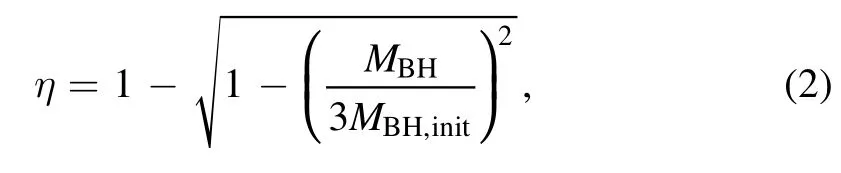
where MBH,initis the initial mass of the BH before accretion.Under the assumption of the Eddington limit,the material in excess of the Eddington accretion rate is lost by carrying the specific orbital angular momentum of the BH.For an initially non-spinning BH,its mass and spin increase through accretion(Bardeen 1970) according to
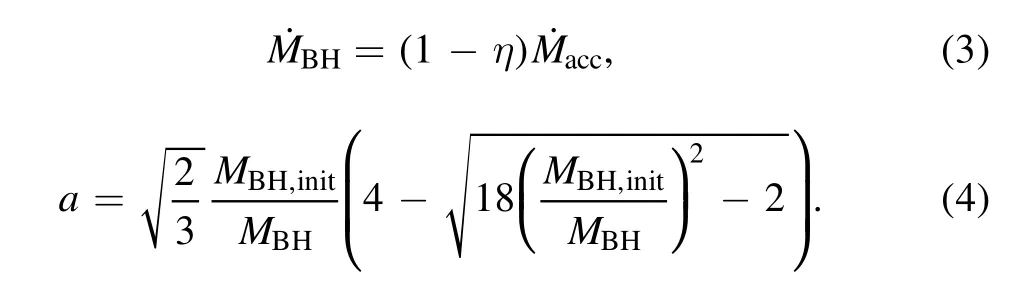
In our evolutionary sequences,none of the BH increases its mass by a factor of
In case of the hypercritical accretion,the general point proposed (Brown &Weingartner 1994) is that if the mass transfer rates exceed the Eddington limit,the excess accretion energy can be removed by means of neutrino pairs rather than photons.This thus allows the matter to be smoothly accreted onto the BH.
The hypercritical accretion can reach a rate foror even higher (Brown &Weingartner 1994).The case study(Moreno Méndez et al.2008) indicated that the hypercritical accretion had happened to the M33 X-7 system in which the BH was spun up through the hypercritical accretion after its birth.In the investigation of a binary system consisted of MBH=12 M⊙orbiting its companion star with mass M2=25 M⊙at an orbital period of 6.8 days,it was found (Podsiadlowski et al.2003) that the companion star initiated overflowing its Roche lobe at the end of main-sequence phase and the corresponding mass transfer rate could reach a peak of~4×10⁻³M⊙yr-1on the thermal timescale of the envelope.
In this work,we employ the detailed binary evolution code MESA to investigate the evolution of a HMXB-like that could resemble Cygnus X-1.In this investigation,we allow for the hypercritical accretion,and assume the conservative mass transfer in the binary system.
3.Methods
We use release 15,140 of the MESA stellar evolution code to perform all of the detailed binary evolution calculations in this work.We adopt a metallicity of Z=Z⊙,where Z⊙=0.0142(Asplund et al.2009).We model the convection energy transport using the standard mixing-length theory (B?hm-Vitense 1958)with a mixing-length parameter of α=1.93.We adopt the Ledoux criterion for the boundary of the convective zones and choose the step core overshooting with the parameter αov=0.1.We also adopt the convective premixing scheme as introduced in Paxton et al.(2019)and include the thermohaline mixing with the parameter αth=1.0.For superadiabatic convection in radiation-dominated regions,we employ the MLT++to help numerical convergence (Paxton et al.2013).
For stellar winds,we use the‘‘Dutch’’scheme for both RGB and AGB phase,as well as the cool and hot wind.We adopt the default RGB_to_AGB_to_wind_switch=1d-4,a scaling factor Dutch_scaling_factor=1.0,as well as cool_wind_full_on_T=0.8d4 and hot_wind_full_on_T=1.2d4.
We model the angular momentum transport and rotational mixing diffusive processes (Heger &Langer 2000),including the effects of Eddington-Sweet circulations,the Goldreich-Schubert-Fricke instability,as well as secular and dynamical shear mixing.We adopt diffusive element mixing from these processes with an efficiency parameter of fc=1/30(Chaboyer&Zahn 1992;Heger &Langer 2000).For an efficient angular momentum transport mechanism,we use the Spruit-Tayler dynamo (Spruit 1999,2002).Mass transfer is modeled following the Kolb scheme (Kolb &Ritter 1990) and the implicit mass transfer method (Paxton et al.2015) is adopted.The timescale for orbital synchronisation is calculated following (Hurley et al.2002) for massive stars with radiative envelopes.
4.Case Study of Cygnus X-1
4.1.Updated Properties of Cygnus X-1
Cygnus X-1 is a binary consisting of a massive supergiant O-type star orbiting a BH with a 5.6 days orbital period.Recently the inferred BH and its companion masses of Cygnus X-1 with revised measurements of its distance have been reported to be more massive than previous measurements.The reported parameters with their median value and 68%confidence interval boundaries of this system (Miller-Jones et al.2021),are shown in Table 1.
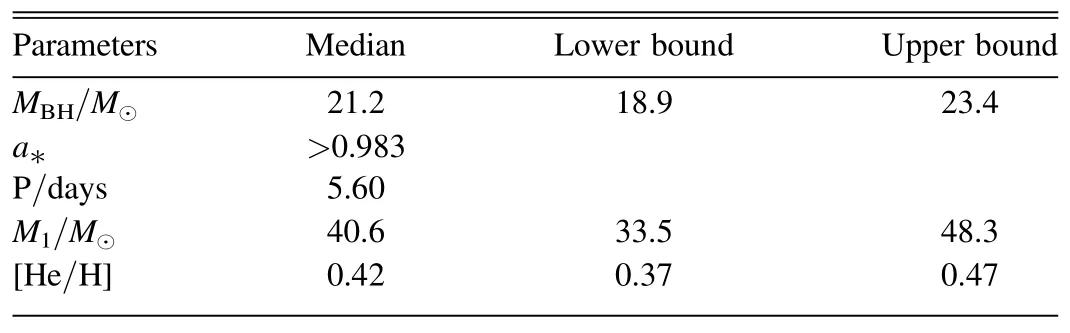
Table 1 Main Properties of Cygnus X-1
4.2.Application of the Hypercritical Accretion to Cygnus X-1
Our result of the binary calculation that may resemble the formation history of Cygnus X-1 is shown in Figure 1.We evolved a binary consisting of a BH with the mass MBH=12 M⊙as a point mass and the companion star with its mass M2=56 M⊙at zero-age main sequence,at an initial orbital period Porb=13 days.
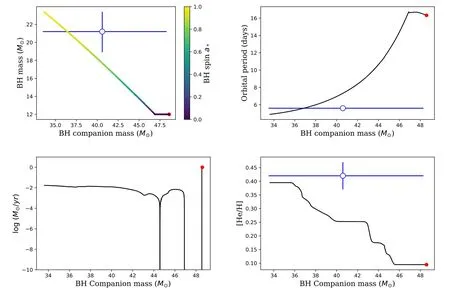
Figure 1.Key binary parameters as a function of the BH companion mass.Top left panel:the BH spin a*as a function of the BH mass and its companion star mass since the beginning of mass transfer(marked by a red point).The orbital period(top right panel),the mass transfer rate(bottom left panel),the ratio of the helium to hydrogen at the surface of the BH companion star (bottom right panel),as a function of the BH companion mass.The median values with corresponding 68%confidence for observed properties are denoted in blue.
In this numerical calculation,the BH had an assumption of zero spin at its birth.This is not only well accepted by currently conventional understanding for efficient angular momentum transport inside massive stars,but consistent with measured low BH spins from the gravitational-wave observations(Abbott et al.2021).We assume that the material from the BH companion’s winds captured by the BH is negligible when compared with the mass transfer through the Roche lobe overflow via the first Lagrangian point(L1).In the top left panel in Figure 1,we show the evolution of the binary after the onset of the mass transfer.It is shown that the BH gradually increases its spin magnitude as it accretes material from its companion star.The non-spinning BH accretes nearly half of its initial mass (~6 M⊙) to reach a high spin close to maximum.The recently updated measurements(Miller-Jones et al.2021)of the BH mass,as well as its spin a* and companion mass,are marked in blue(at 68%credibility).The currently reported BH spin is very extreme,i.e.,a*>0.983,and it is still consistent with previous measurements(Orosz et al.2011;Cantiello et al.2014;Reynolds 2021).Our finding shows that such high BH spin can be explained by the hypercritical accretion investigated here.We note that the current measurements of the masses for the BH and its companion have very larger uncertainties.
As the BH spin can be well explained by the hypercritical accretion,we then continue to show other parameters in our calculation.The top right panel in Figure 1 presents the evolution of the orbital period as a function of the BH companion mass.The binary orbital period first increases as the BH companion loses mass through the stellar winds.It then reaches the peak as the companion star expands to reach its Roche lobe.The mass transfer via the first L1from the BH companion (more massive) to the BH (less massive) shortens the orbital separation and thus the orbital period.In the bottom left panel,we present the mass transfer rate as a function of the BH companion mass.The gap shown after the first mass transfer phase is due to the quick shrink of the companion star.We note that the mass transfer is stable at a rate~10-2M⊙yr-1.Such a high value requires that the hypercritical accretion in this binary evolution is allowed.
Furthermore,it was reported(Shimanskii et al.2012)that the abundance ratio of the surface helium-to-hydrogen is about twice the solar composition.This indicates the BH companion has been stripped its outer hydrogen layer at a certain level.The bottom right in Figure 1 clearly shows that this abnormality is reasonable due to its larger uncertainty of the measurements.Based on our investigation,such an enhanced helium abundance is because that the BH companion star was exposed its inner layers through mass transfer and/or stellar winds.
5.Discussion and Conclusions
HMXBs are mostly considered as wind-fed binary systems(Shao&Li 2020),in which the BH is the accreting part of the strong stellar winds of its companion.SS 433,known as a Galactic X-ray binary,is found that mass is lost from the system at a rate of~10-4M⊙yr-1,indicating that the compact object in SS433 is accreting mass from its companion at highly supercritical rate (Fabrika 2004,also see for a recent update(Cherepashchuk et al.2020).Analyzing the hard X-ray INTEGRAL observations of SS 433 provided reliable constraints on the binary mass ratio ?0.6,which suggests that the compact object is probably a BH.Assuming a BH as the compact object,the formation channel for SS 433 has been recently explored(Han&Li 2020).Additionally,the finding of the outflows (Waisberg et al.2019) for SS 433 indicates that the mass transfer onto the BH is nonconservative.However,as a case study for Cygnus X-1,we assumed that the mass transfer is conservative.Note that the hypercritical rate here is significantly higher (~two orders of magnitude) when compared with the above mass outflow rate.Although this assumption is extreme,it will not significantly influence the final results since some fraction of the material can be significantly accreted by the BH in a supercritical accretion disk(Fabrika 2004).Therefore,our simplified assumption here is secure to test the efficiency for spinning up the accreting BH.
Recent population study shows the birthrate of Galactic BH binaries is a few 10-5–10-4yr-1(Shao &Li 2019).As only one such high-mass X-ray source in our Galaxy,the formation rate of Cygnus X-1 is~10-3yr-1,which is challenging when considering our current understanding for massive binary evolutions.M33 X-7 and LMC X-1,known as other two BH HMXBs with high spin measurements,have been considered to share similar formation path.Early on,it was found (Moreno Méndez 2011) that,regardless of the formation channels for M33 X-7 and LMC X-1,the observed BH spins had to be obtained through the hypercritical accretion.Additionally,recent studies show that a BH can accrete materials from its companion via the stable mass transfer (van den Heuvel et al.2017;Shao &Li 2021),but the hypercritical accretion is still required to efficiently spin up the BH when considering the limited lifetime of the companion star.
It has been suggested that the two types of BH binaries(BBHs and BH-HMXBs) likely have distinct formation paths(Qin et al.2019a;Fishbach&Kalogera 2021;Reynolds 2021).This work is motivated by the inconsistent finding for the BH spin measurements in the two types of BH binaries.For BBHs measured from LIGO/Virgo(Abbott et al.2021),the currently obtained low BH spins are in favor of the efficient angular momentum transport inside massive stars.On the other hand,in order to explain the high spin measurements for BHs in HMXBs,the angular momentum transport has to be inefficient(Qin et al.2019b,2021).Given the classical isolated formation channel for the two BH binaries,this inconsistency has put a challenge on the angular momentum transport mechanism inside massive stars.This contradictory,however,can be alleviated as long as the hypercritical accretion is allowed for some cases,for instance Cygnus X-1,M33 X-7 and LMC X-1.
Given the non-spinning BHs at birth,we then assumed in this work that the HMXB might have experienced the hypercritical accretion.Therefore,we employ the detailed binary evolution code MESA to study the origin of the BH high spin for the HMXBs,specifically for the case of Cygnus X-1.We find that the binary evolution sequence shown in Figure 1 could resemble the Cygnus X-1 given its large uncertainties.In addition,the reported high ratio of the helium to hydrogen at the surface of the BH companion star can also be well explained.Given the very expensive computational cost,our study here is only the first step to investigate an alternative formation pathway,i.e.,hypercritical accretion,for the case study of Cygnus X-1.As a follow-up work,we next plan to perform a more detailed investigation of the systematic parameter study for the three HMXBs (Cygnus X-1,M33 X-7 and LMC X-1).
Acknowledgments
The authors would like to thank Xiang-Dong Li for helpful discussions at the beginning of this project.Ying Qin acknowledges the support from the Doctoral research start-up funding of Anhui Normal University and the funding from Key Laboratory for Relativistic Astrophysics in Guangxi University.This work was supported by the National Natural Science Foundation of China (Grant Nos.12192220,12192221 and U2038106) and by the Natural Science Foundation of Universities in Anhui Province (Grant No.KJ2021A0106).
登錄APP查看全文
 Research in Astronomy and Astrophysics
2022年3期
Research in Astronomy and Astrophysics
2022年3期
- Research in Astronomy and Astrophysics的其它文章
- Estimation of HII Bubble Size Distribution from 21cm Power Spectrum with Artificial Neural Networks
- Influence of Megaregolith on the Thermal Evolution of Mercury’s SilicateShell
- Common Envelope to Explosion Delay time Distribution (CEEDTD) of Type Ia Supernovae
- V0644 Ser:An Active Ultrashort Period Contact Binary Star
- Physical Properties of 29 sdB+dM Eclipsing Binaries in Zwicky Transient Facility
- New Massive Contact Twin Binary in a Radio-quiet HII Region Associated with the M17 Complex