
Guangyangba Airport Heritage Site: An Airspace Gateway of Wartime Chongqing, A Public Cultural Space of Today廣陽壩機場遺址抗戰時的重慶空中門戶,如今的公共文化空間
2022-04-23 22:27:04楊艷
重慶與世界 2022年4期
楊艷
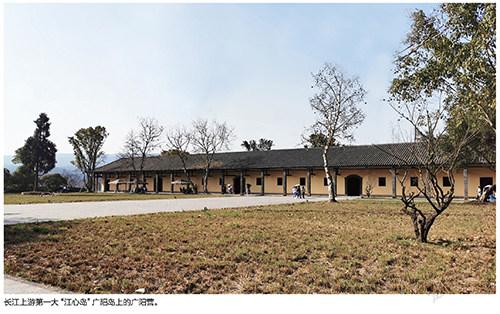
In early April, the grass is tall and the birds are flying high. On Guangyang Island, hills, rivers, forests, fields, lakes, and grass form a delightful contrast, and the Guangyang Island International Convention Center and other projects are under construction in full swing...... Everything is taking on a new and thriving look. In 2018, Chongqing officially announces Guangyang Island as the “Pilot Zone for Eco-civilization Innovation on the Yangtze River”, focusing on presenting the results of eco-civilization pilot projects and creating an ideal destination for leisure and sightseeing.
In addition to the natural landscape, Guangyang Island is also home to the most complete and the largest area of wartime airfield heritage sites in China, with the most diverse and the largest number of relics, including the U.S. Army hotel, oil depot, bunkers, barracks, wartime inscriptions, and other sites worth visiting.
Guangyang Island was formerly known as Guangde Yu (Islet) and Guangyang Zhou (offshore bank) and is commonly known as Guangyang Ba (Dam) among the locals. In history, the first plane of Chongqing took off on February 11, 1930 from the Guangyangba Airport on Guangyang Island in Xiakou Town, Nan’an District.
Guangyangba Airport was the first airport in the main urban area of Chongqing. In August 1929, Liu Xiang, then the Sichuan Military Logistics Supervisor and commander of the 21st Army of the National Revolutionary Army, decided to build an airport in Guangyang Dam. During the War of Resistance against Japanese Aggression, the Chinese Air Force set up the First Route Command in Chongqing, which was responsible for air defense operations in the wartime capital of Chongqing. Among them, the Chinese air force defending Chongqing was mainly stationed at the three major airports in Guangyangba, Baishiyi, and Liangshan (now Liangping, Chongqing). Guangyangba Airport was the wartime gateway guarding Chongqing's airspace safety as it was located in the middle of the Yangtze River, where the terrain was relatively flat and wide. And with Tongluo Mountain and Mingyue Mountain as natural barriers, it could be defended when attacked and also conduct proactive attacks.
In 1937, when the War of Resistance against Japanese Aggression broke out, to strengthen the air defense of Chongqing, the National Government drafted 12,000 workers to expand the Guangyangba Airport. With primitive tools, people cut all the rolling hills at the eastern end of Guangyang Island into flat land, and at the same time expanded the barracks, mechanic depot, U.S. Army hotel, command headquarters, bunkers, and other building facilities.
Guangyangba Airport became one of the important military airfields in the Great Rear Area and played an important role in the war. During the air battles in Chongqing, a group of prominent pilots, represented by Zheng Shaoyu, an underground CPC member and the top commander of the Chinese Air Force in charge of the air battles against Japan, fought bloodily at Guangyangba Airport and truly built a solid air defense barrier in Chongqing.
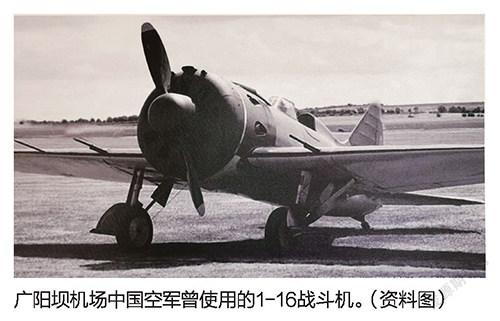
In early 1939, the 27th Squadron of the 5th Brigade of the Chinese Air Force was stationed at Guangyangba Airport, and later the 4th Brigade of the Chinese Air Force, a renowned and prominent Brigade, was stationed to take charge of the air defense missions in Chongqing and fought heroically during the Japanese air raids many times. Many of the pilots in this group were overseas Chinese nationals from South Asia. In addition, there were also Soviet and American volunteer air units aiding China stationed on the island.
Now, 92 years have passed. Strolling down the long corridors inside the rebuilt Guangyang Camp, one can enjoy the green and vibrant grasslands in front of the buildings. The sun shines on the renovated walls, a peaceful and quiet place.
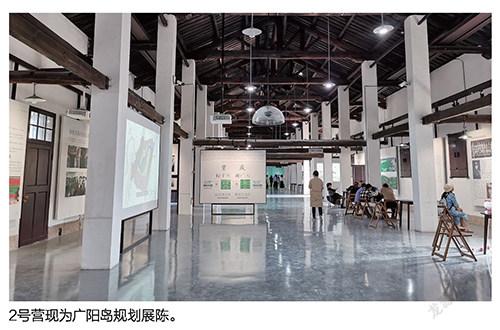
Guangyang Camp was once the barracks of Guangyangba Airport. Barrack 1 and 2 are the two largest barracks in the entire Guangyangba Airport heritage site, which are in situ conservation and restoration buildings and have become an exhibition hall. It is made up of a hip-and-gable roof with small green tiles, brick column bearing, rooms divided by rammed earth walls, wooden doors and windows, and outer corridors around the main body of the building. The architecture style is square and rigorous, simple but dignified.
Entering indoors, photos of the barracks in the past are exhibited on the walls, recreating the historical events of this “Island of Heroes”. Camp No. 3 is a combination of six independent single rooms, with a delicate and exquisite fa?ade in the style of the Bayu folk house. Camp No. 4 contains two courtyards connected by an internal corridor, which is square and symmetrical, with an elegant ancient style.
After 1949, Guangyangba Airport was taken over by the Eastern Sichuan Military Region. As an Allied power that fought bravely in the Anti-Japanese Aggression War, Guangyangba Airport later served as the location of the Aviation Club of the Chongqing Sports Commission, which nurtured aerospace talents for Chongqing. After the club was abolished, it was turned into a training base for the Chongqing Sports Commission, and part of the land was reclaimed as a farm with the approval of the municipal government.
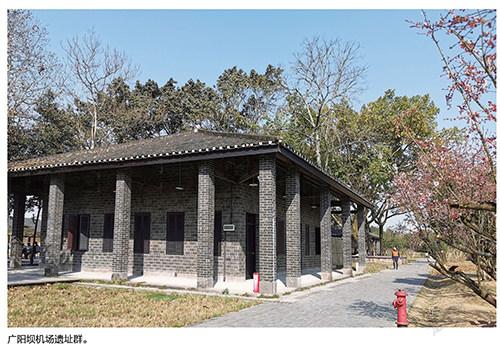
There are currently 28 existing airfield heritage sites on Guangyang Island, including 8 bunkers, 8 soldiers’ barracks, 2 U.S. Army hotels, 6 oil depots, 2 air defense shelters, 1 power generation house, and 1 reinforced concrete bridge connecting Guangyang Island with land. The structure of the site group is complete, well preserved, and as one of the few complete wartime military facilities in Chongqing, it bears great significance to the study of wartime history.
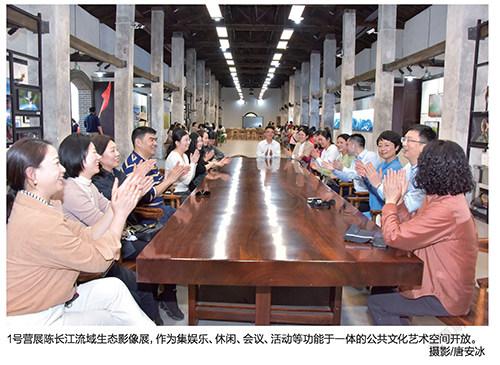
History roots deeply and continues to grow on this ecological island, and culture presents treasures that shine in the embrace of breathtaking sceneries. At present, with elaborate planning and effective conservation, Guangyang Camp is cleverly utilized as a destination for Guangyangba’s historical and cultural attractions, as well as an ecological island for leisure and experiences. It provides functions including entertainment, leisure, convention, and other activities, providing a cultural and artistic space for the public. In recent years, national expert seminars on the construction of ecological facilities and the Great River Civilization Museum, as well as various thematic studies such as the “Bayu Nature” science popularization initiative have been held in Guangyang Camp. Guangyang Island is truly taking up the responsibilities of new historical missions and drawing a beautiful picture for the future with renewed vitality.
暮春四月,草長鶯飛。廣陽島上,山、水、林、田、湖、草相映成趣,廣陽島國際會議中心等項目正如火如荼建設……呈現出一派欣欣向榮的景象。2018年,重慶市正式規劃廣陽島為“長江生態文明創新試驗區”,集中展示生態文明試驗成果,為大家提供一個生態休閑觀光好去處。
除了自然景觀,廣陽島上還有國內保存最完整、遺跡種類和數量最多、面積最大的抗戰機場遺址,包括美軍招待所、油庫、碉堡、士兵營房、抗戰題刻等值得參觀。
廣陽島古稱廣德嶼、廣陽洲,民間通稱廣陽壩。1930年2月11日,重慶歷史上第一架飛機正式起飛,起飛地點正是位于南岸區峽口鎮廣陽島上的廣陽壩機場。
廣陽壩機場是重慶主城最早修建的機場。1929年8月,時任四川軍務善后督辦兼國民革命軍第21軍軍長劉湘,決定在廣陽壩修建機場。抗戰時期,中國空軍在重慶設立第一路司令部,負責戰時首都重慶的防空作戰任務。其中,保衛重慶的中國空軍主要駐防廣陽壩、白市驛和梁山(今重慶梁平)三大機場。廣陽壩機場因所處江面中央,地形相對平坦寬闊,有銅鑼山、明月山作為天然屏障,進可攻、退可守,成為抗戰時期保衛重慶空中安全的門戶。
1937年,抗日戰爭全面爆發,為了加強重慶的防空力量,國民政府征工12000人,擴建廣陽壩機場。人們用最原始的工具,將廣陽島東端的連綿山丘全部削成平地,同時擴建的還有軍營、機修庫、美軍招待所、指揮部、碉堡等建筑設施。
廣陽壩機場成為大后方重要的軍事機場之一,在抗戰中發揮了重要作用。以重慶空戰期間,中國空軍在空中負責對日作戰的最高指揮官—地下黨員鄭少愚為代表的一批優秀飛行員,曾在廣陽壩機場浴血奮戰,構筑起重慶堅固的空中防線。
1939年初,中國空軍第五大隊第27中隊進駐廣陽壩機場,后中國空軍王牌驅逐機大隊第四大隊進駐,負責重慶的防空作戰任務,多次迎擊日機空襲。這支隊伍中,不少飛行員是來自南洋的華僑。此外,島內還有蘇聯和美國的援華志愿航空隊。
如今,九十多年過去了。漫步在重建的廣陽營長長的走廊,屋前綠草茵茵,生機勃發。陽光照在翻新的墻面上,一片祥和寧靜。
廣陽營曾是廣陽壩機場的營房。1、2號營房是整個廣陽壩機場抗戰遺址群中最大的兩座營房,為原址保護修繕建筑,已成為科普性質的展館。歇山式小青瓦屋頂,磚柱承重,夯土墻分割開間,木質門窗,環建筑主體四周設置貫通式外廊。整體望去,方正嚴謹,樸實厚重。
往室內走,墻壁上張貼著營房的歷史照片,再現了當年這座“英雄之島”的歷史事跡。3號營由6個獨立單間組合而成,為巴渝民居山墻風格立面,小巧精致。4號營包含兩個院落,雙院落之間由內部廊道連接,方正對稱,古風典雅。
1949年后,廣陽壩機場由川東軍區接管。廣陽壩機場在經歷抗戰的浴血同盟之后,曾作為重慶市體育運動委員會航空俱樂部所在地,為重慶培育航空航天人才。俱樂部撤銷后,轉為市體委訓練基地,其中部分土地經市政府批準開墾為農場。
據統計,廣陽島上現存機場遺址共28處,其中碉堡8個、士兵營房8棟、美軍招待所2個、油庫6個、防空洞2個、發電房1個,通往廣陽島的鋼筋混凝土橋梁1座。遺址群結構完整,保存較好,是重慶市為數不多的較完整的抗戰軍事設施,對研究抗戰歷史具有重大意義。
歷史文脈在生態島上生根延續,文化瑰寶在綠水青山里熠熠生輝。目前,廣陽營在保護的基礎上被巧妙利用為“廣陽壩歷史文化風景眼、生態島休閑文化體驗地”,集娛樂、休閑、會議、活動等功能于一體,為大眾提供了一處公共文化藝術空間。近年來,生態設施建設全國專家研討會、大河文明館全國專家研討會等會議,“自然巴渝”科普行動等各類主題學習都在廣陽營舉行。這里正擔負起新的歷史使命,以蓬勃朝氣繪制出日新月異的美麗圖景。
猜你喜歡
環球人文地理(2022年8期)2022-09-21 03:49:42
保健醫苑(2021年7期)2021-08-13 08:48:02
學生天地(2020年36期)2020-06-09 03:12:30
小學科學(學生版)(2020年5期)2020-05-25 07:11:32
小學科學(學生版)(2020年4期)2020-05-21 07:30:46
小學科學(學生版)(2020年3期)2020-03-25 13:31:22
意林·全彩Color(2019年11期)2019-12-30 06:08:38
重慶行政(公共人物)(2018年5期)2018-11-06 07:42:18
重慶文理學院學報(社會科學版)(2017年5期)2017-10-23 01:30:02
今日重慶(2017年5期)2017-07-05 12:52:25
