
Some Observations and Thoughts about Reconfigurable Intelligent Surface Application for 5G Evolution and 6G
2022-04-19 01:12:44HOUXiaolinLIXiangWANGXinCHENLanSUYAMASatoshi
ZTE Communications 2022年1期
HOU Xiaolin ,LI Xiang ,WANG Xin ,CHEN Lan ,SUYAMA Satoshi
(1.DOCOMO Beijing Communications Laboratories Co.,Ltd.,Beijing 100190,China;2.NTT DOCOMO,INC.,Tokyo 239-8536,Japan)
Abstract: Reconfigurable intelligent surface (RIS) is one of the hottest research topics for 5G evolution and 6G.It is expected that RIS can improve the system capacity and coverage with low cost and power consumption.This paper first discusses typical applications of RIS for 5G evolution and 6G,including RIS-aided smart channels and RIS-aided mega multiple-input multiple-output (MIMO).Then,several observa?tions from RIS trials and system-level simulations are presented,especially those on the deployment strategy and the potential performance gain of RIS for coverage enhancement.The near-field effect and a two-step dynamic RIS beamforming method are also discussed.Finally,we summarize the challenges and opportunities of the RIS technology for 5G evolution and 6G,including hardware design,system and channel modeling,algorithm design and optimization,and standardization.We also suggest a step-by-step commercialization strategy as a conclusion.
Keywords:5G evolution;6G;beamforming;coverage;RIS
1 Introduction
By 2020,the 5G mobile communication system has been commercialized in many countries,including Ko?rea,China,Japan,the U.S.,etc.6G research and de?velopment activities have been initiated and are heat?ing up worldwide.Many companies and research institutions have issued 6G white papers.It is expected that 6G standard?ization will be launched around 2025 and 6G commercializa?tion will be achieved around 2030.Now it is still in an early stage of 6G research and development.Discussions are mainly related to use cases,requirements,and technology trends.For 6G,some new disruptive services and applica?tions are foreseen with the fast development of technologies such as terahertz (THz),reconfigurable intelligent surface(RIS),satellite communications,artificial intelligence (AI)/deep learning (DL),etc.The most appealing 6G use cases in?clude holographic-type communication,digital twin,tactile In?ternet,full coverage,ubiquitous intelligence,etc.
To realize the promising 6G use cases,NTT DOCOMO has proposed six extreme requirements,as shown in Fig.1,for 6G radio access technologies[1].These extreme requirements con?sist of extremely high data rates and high capacity,extremely coverage extension,extremely low power consumption and cost reduction,extremely low latency,extremely high-reliable communication,and extremely massive connectivity and sens?ing.Note that these extreme requirements are driven not only by further extensions but also by new combinations of 5G use cases,including enhanced mobile broadband (eMBB),ultrareliable and low latency communication (URLLC),and mas?sive machine type communication(mMTC).
RIS is one of the hottest research topics on candidate tech?nologies for 5G evolution and 6G.In recent years,RIS has emerged as a prominent technology in mobile communications and has attracted worldwide attention from both academia and industry.Intensive research has been conducted covering both theoretical and implementation aspects,e.g.,hardware design and prototyping,system modeling and optimization,perfor?mance analysis and trials,as well as standardization activi?ties[2-6].The development of the RIS technology is originated from advances of meta material combined with the antenna and array theory,and is inclined towards flexibility,configu?rability,and intelligence.In principle,RIS can reradiate the incident electromagnetic wave as desired to some extent.This is achieved by pre-or reconfiguring the electromagnetic char?acteristics of RIS elements.The reconfigurability can be real?ized in different ways,including motors,microelectromechanical systems (MEMS),PIN-or varactor-diodes,and functional materials such as liquid crystal and graphene.This enables the potential application of RIS in various fields,e.g.,radar,communications,sensing,etc.Especially,5G evo?lution and 6G could benefit from properties of RIS like low cost and power consumption,superior performance gain,and great flexibility in deployment.Hence,RIS is considered as a promising candidate technology to improve the system capac?ity and coverage with low cost and power consumption in the 5G evolution and 6G era.
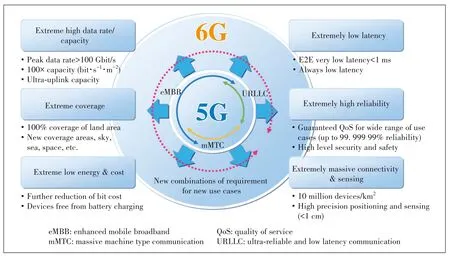
▲Figure 1.Extreme requirements of 6G
The rest of this paper is organized as follows.Section 2 de?scribes typical RIS applications for 5G evolution and 6G.In Section 3,several observations from trials and simulations are introduced,including the near-field effect and a two-step dy?namic RIS beamforming method.Section 4 discusses the chal?lenges and opportunities of RIS from four aspects,respec?tively.Finally,we conclude this paper in Section 5 with a stepby-step commercialization suggestion.
2 Typical RIS Applications for 5G Evolu?tion&6G
As for the 6G requirements,two RIS applications show great potential in future mobile communication sys?tems,i.e.,the RIS-aided smart chan?nel and RIS-aided mega MIMO,as shown in Fig.2.
2.1 Application 1:RIS-Aided Smart Channel
Extreme coverage is expected for 6G,i.e.,a high data rate connection shall be provided everywhere.In practical cellular systems,especially in an urban scenario,fading and in?terferences in the radio environ?ment make this difficult to achieve.Conventionally,additional base sta?tions (BSs) shall be deployed and optimized to resolve this.Alterna?tively,relaying techniques may also be considered for some cases such as range extension in rural areas or an outdoor-to-indoor(O2I)scenario.
For coverage extension,RIS can be deployed in the wireless environ?ment between BSs and user equip?ment (UE) to achieve a RIS-aided smart channel,as illustrated in Fig.2(a).In this case,the RIS is respon?sible for redirecting the incident signals,under the control of the BS,towards the indented user devices.As compared with the conventional relaying technique,RIS,as a new network topology technique,has the following advan?tages.Firstly,RIS operates in the full-duplex mode without significant self-interference.In contrast to this,conventional half-duplex relays suffer from a loss in spectral efficiency,while full-duplex relays require either well-isolated transmit and receive antennas or additional self-interference cancella?tion functionality.Secondly,RIS forwards negligible additive noise to the receiver,which,on the contrary,is a major perfor?mance limiting factor for conventional radio-frequency(RF)re?peaters.Thirdly,thanks to the simple structure and low cost of RIS,the electrical size of a RIS panel can be much larger than that of a conventional relay,resulting in a very narrow RIS beam.Therefore,a RIS could better help focus the scattered energy on the intended UE while causing little interference to other pieces of UE.Finally,as the RIS technology develops,more dynamic and intelligent RIS can also be expected and exploited for applications such as inter-cell interference sup?pression and multi-layer enhancement in strong line-of-sight(LoS)scenarios.

▲Figure 2.Typical RIS applications for 5G evolution&6G
2.2 Application 2:RIS-Aided Mega MIMO
The peak data rate of 6G is expected to be over 100 Gbit/s.To achieve this,it is necessary to exploit the spectrum resource in a higher frequency band like the sub-THz band.However,current transceiver architecture and the RF technology may not be well suited for such high frequencies and large band?width systems.Challenges such as the efficiency of power amplifiers,the resolution and bandwidth of analog-digital/digital-analog converters,the difficulties in realizing highfrequency phase shifters,and the much higher requirement on the die size will all influence the performance and the power-and cost-efficiency of future high frequency and large bandwidth systems.
To meet these challenges,implementing RIS on the BS-side is considered as an economical alternative to the massive MIMO architecture.This application is referred to as RISaided mega MIMO,as illustrated in Fig.2(b).Specifically,modulated signals are fed onto a RIS either through a wired feed network or via space feeding,and the RIS shall beamform signals towards intended user devices.The RIS beam is ex?pected to be highly directional due to the large electrical size of RIS.This helps compensate for the severe path loss of high frequency band radio channels and improves the received sig?nal strength.In contrast to RIS-aided mega MIMO,expending a massive MIMO BS to the same array size is much more ex?pensive.Furthermore,hybrid beamforming can also be ad?opted for RIS-aided mega MIMO to support multi-layer trans?mission and to achieve an even higher data rate.To this end,multiple feeders shall be used to feed pre-coded data streams to the RIS,which shall generate multiple narrow beams with low side lope for interference suppression.
In the above case,the role of RIS can be regarded as a beamformer.Besides,RIS can also be utilized for direct signal modulation.For instance,unmodulated carrier signals can be fed onto the RIS,and the information to be transmitted shall be modulated through a designated change of RIS state in the time domain[7].This innovative technique largely simplifies the RF hardware in the transmitter and is suitable for low-cost and energy-limited devices.However,further investigation is needed to improve the limited data rate.
3 Observations from Trials and Simulations
In this section,we will introduce several observations from DOCOMO RIS trials and system-level computer simulations,especially the deployment strategy and potential performance gain for coverage enhancement.
3.1 RIS Trials
DOCOMO conducted several trials to test metamaterial sur?faces from 2018 to 2021,including the first demonstration of a metamaterial reflector at 28 GHz for outdoor coverage expan?sion in 2018,the first trial of transparent dynamic metasurface capable of dynamically switching between full penetration,partial reflection,and full reflection modes in 2020,and a demonstration of metasurface lens to improve outdoor-indoor coverage with focal point control in 2021.
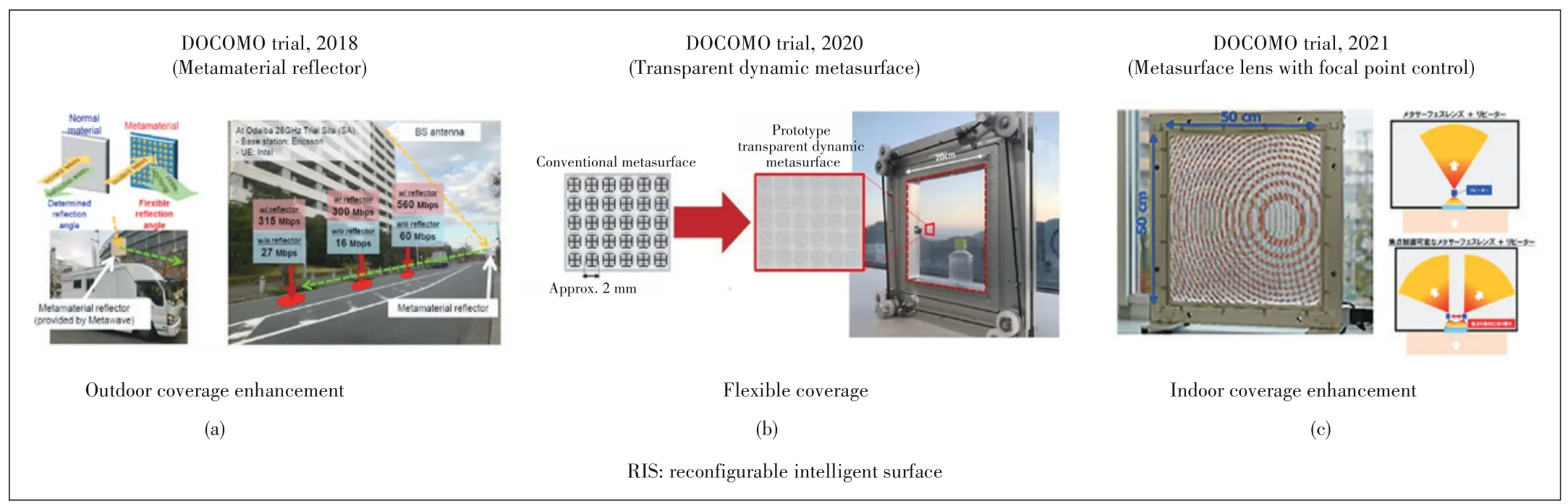
▲Figure 3.DOCOMO RIS trials[8–10]
In 2018,DOCOMO conducted a field trial about a proto?type of a metamaterial reflector working on a 28 GHz millimeter-wave (mmWave) band[8].During the trial,the BS was mounted on the roof of a building which made the street under the building a blind spot of coverage,as shown in Fig.3(a).To cover this area,a metamaterial reflector was deployed and adjusted to reflect the beam to this area.After the meta?material reflector was deployed,more than 15 dB signal-tonoise-ratio (SNR) enhancement and more than 500 Mbit/s throughput enhancement were observed,which demonstrated the effectiveness of the metamaterial reflector for coverage en?hancement.In 2020,DOCOMO conducted trials with a trans?parent dynamic metasurface,as shown in Fig.3(b)[9].The transparent dynamic metasurface consists of two transparent base boards,on one of which a pre-designed pattern of meta?material is printed.The operation mode of the transparent dy?namic metasurface can be controlled by adjusting the distance of the two boards.One of three modes,i.e.,full penetration,full reflection,and hybrid mode,can be configured.In the full penetration mode,the penetration loss of the metasurface is only about 1 dB,and more than 10 dB penetration loss is ob?served in the full reflection mode.Since the metasurface is transparent,it can be mounted on windows without impacts on the environment and can be used to control the signal/interfer?ence for a dedicated area.An enhanced version of the trans?parent dynamic metasurface was tested in 2021,which could focus the mmWave to a focal point[10].On the focal point,the metasurface can improve the SNR by about 24 dB compared with normal glasses.The indoor coverage of mmWave can be enhanced if a repeater is deployed on the focal point of the metasurface as shown in Fig.3(c).The O2I mmWave coverage can be enhanced with this solution,which provides a reliable link between outdoor mmWave BS and indoor UE.
3.2 Computer Simulations
Through a series of experiments,the coverage enhancement ability,dynamic control technology,near-field focusing tech?nology,and typical scene application of RIS have been pre?liminarily verified.In order to test the effectiveness of largescale deployment of RIS and compare the performance of dif?ferent RIS functions,e.g.,beamforming schemes,it is neces?sary to further explore the RIS deployment strategy with the help of simulation,such as the number,location,size and function of deploying RIS in cellular systems,so as to meet the performance requirements of real scenarios.To this end,we conducted several computer simulations,and the results will be presented in the following.
A system-level simulation (SLS) that performed in a multicell scenario for 28 GHz will be introduced first.The scenario,as shown in Fig.4(a),consists of 57 explicitly modeled hexago?nal cells following the Dense Urban-eMBB case in Ref]11].For simplicity,the user devices are assumed to have isotropic antennas and the fast fading channel component is not mod?eled.A RIS reflector is deployed in each cell at the cell corner facing the corresponding BS.An ideal case where both the BSRIS link and the RIS-UE link are LoS is considered.Espe?cially,the height of RIS reflectors is set to 10 m,and the UMi-Street Canyon path loss model is adopted for RIS-UE chan?nels.Two different RIS sizes are considered in this simulation,i.e.,a 1×1 m2and a 2×2 m2RIS.The RIS elements are as?sumed to have half-wavelength spacing.The RIS beamforming gain is modeled as the combined gain of a receiving beam to?wards the attached BS and a transmitting beam towards the serving UE.Furthermore,taking the large RIS size and the ex?tended near field into account,the transmitting beam of RIS is assumed to focus on the UE to attain the maximum gain.The performance in terms of geometry is shown in Fig.4(b).As compared with the baseline case without RIS,the observed performance gain of RIS is ca.3 dB and 12 dB for 1×1 m2and 2×2 m2RIS,respectively.Moreover,for the 1×1 m2RIS case,ca.56% UE chooses to be served by the RIS link,while this number increases to 94% for the 2×2 m2RIS case.These re?sults clearly demonstrate the potential gain of deploying RIS in mmWave systems.However,it shall also be noticed that,even under the idealized assumptions,the size of the required RIS for attaining a notable gain is remarkably large.
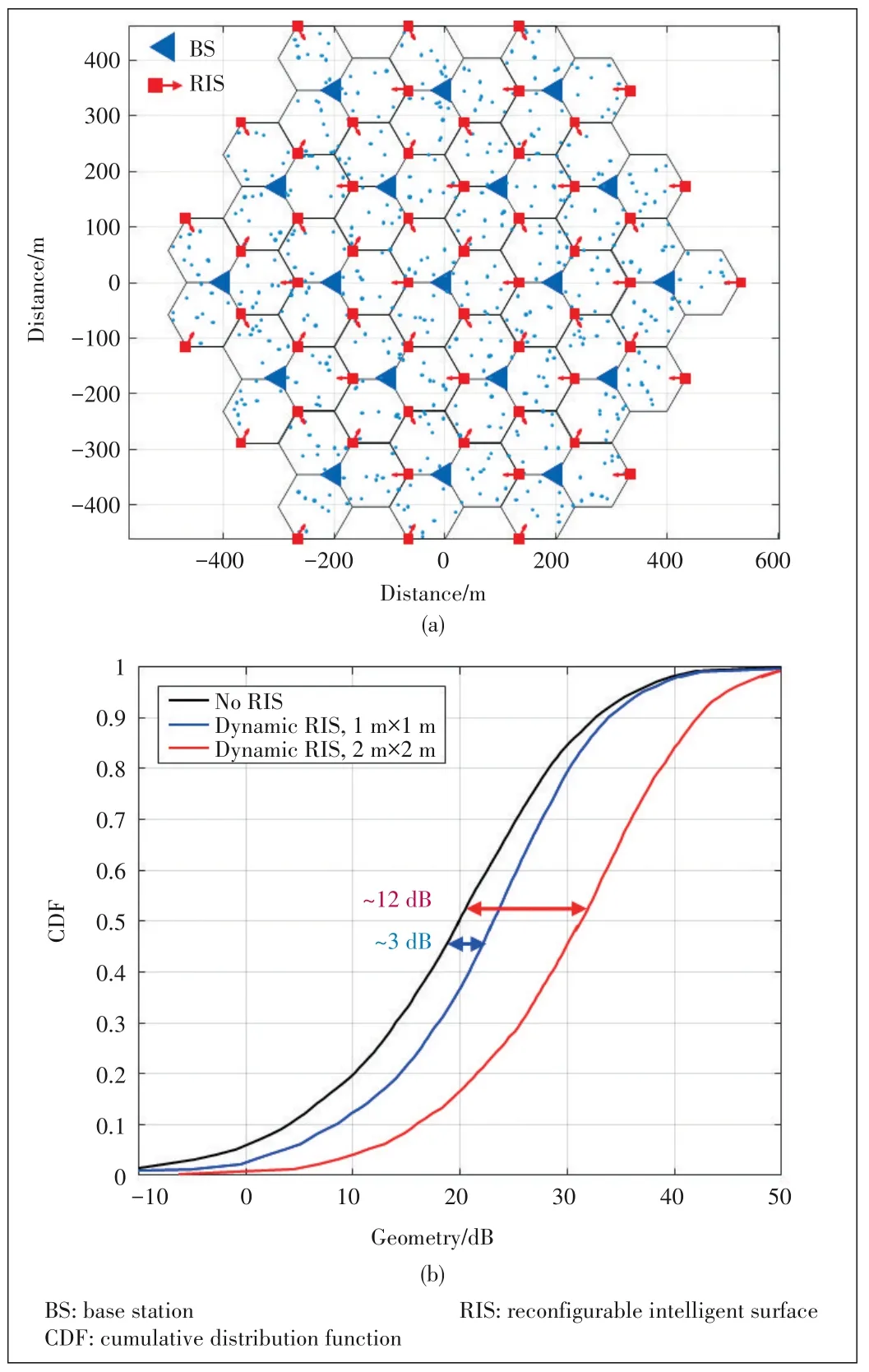
▲Figure 4.System-level simulation (SLS) for RIS:(a) the scenario and(b)the geometry
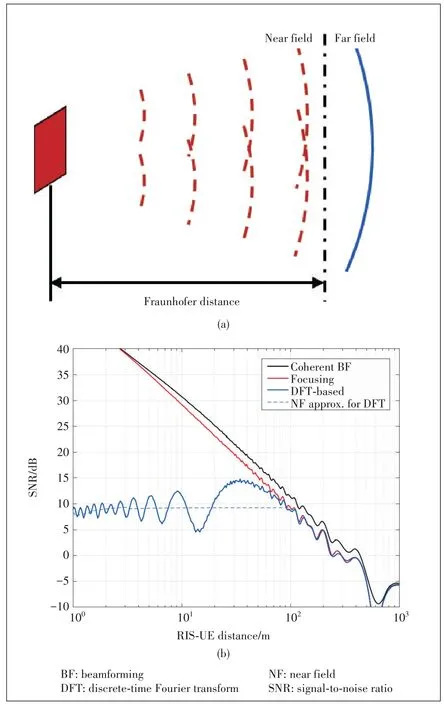
▲Figure 5.Near-field effect
For a large-scale RIS,its radiative near field can be as far as hundreds of meters,as illustrated in Fig.5(a).For instance,a 1×1 m2RIS operating at 30 GHz has a near field up to 400 m according to its Fraunhofer distance.In other words,in a typical cellular scenario,almost all user devices to be served by the RIS are located in its near field.However,conventional beamforming is designed for the far field of the antenna array and suffers from a noticeable performance loss in the near field due to diffraction.Given 400 MHz bandwidth at a 30 GHz band and 1×1 m2RIS deployed 150 m away from the BS,this effect is shown in Fig.5(b),where the receiving SNR at UE is plot?ted as a function of the distance between the RIS and the UE.A two-ray model with plane earth reflection is assumed for the RIS-UE channel.In Fig.5(b),the black,red,and blue solid curves represent the performance of coherent,focused,and collimated (DFT-based) beamforming,respectively.The blue dotted curve represents the approxi?mated average performance of colli?mated beamforming in the near field of RIS.It can be noticed that in this simple scenario,focused beamforming achieves near-optimal performance.However,the perfor?mance of collimated beamforming oscillates around a constant value for UE within 100 m.This damped oscillating behavior follows the well-known Fresnel diffraction.The above results reveal both potential possibilities and challenges for RIS beamforming design.On the one hand,large-scale RIS can provide sufficient gain to combat the path loss of the two hops via beamforming.On the other hand,a new distance-dependent beamforming scheme is necessary to exploit the full potential of RIS,especially in the near field.
To accommodate the near-field effect,we are designing a RIS beamforming scheme with a tradeoff between complexity and performance.The principle of the RIS beamforming scheme is to divide a large RIS into multiple smaller subarrays,whose size shall be dynamically chosen according to the RIS-UE distance.The scheme includes two beamforming steps,as shown in Fig.6.In the first step,let a collimated/DFT-based beam be selected for all RIS sub-arrays based on the UE direction.Then,in the second step,each sub-beam of the RIS sub-arrays is steered by an individual angle so that the sub-beams are focused on the UE.Preliminary simulation shows that this two-step dynamic RIS beamforming method can improve the received SNR at the near field UE by about 10-20 dB compared with the traditional collimated/DFTbased beamforming method.
4 Challenges and Opportunities of RIS
Though the performance of RIS has been demonstrated by simulations and verified by prototyping and trials,a lot of chal?lenges still need to be addressed before this technology can be implemented in practical systems.These challenges can be,roughly speaking,viewed from four aspects,i.e.,hardware,modeling,algorithm,and standardization.
4.1 Hardware
For the time being,different RIS prototypes vary in the ma?terial,element design and arrangement,tuning method,and operating frequency.As for the performance,both the gain to the in-band signal and the attenuation to the out-band signal are of particular importance.For the in-band signal,a uniform gain over large bandwidth is more favorable in terms of im?proving the system capacity.For the out-band signal,deeper attenuation and sharper edge shall better help interference suppression in practical systems.Besides,the accuracy and speed of tuning the RIS element also largely influence the per?formance and application.In terms of the cost,both manufac?turing and maintaining costs shall be considered,which de?pend on the material,processing,package,durability,power consumption,etc.Finally,an outlook design that fits the appli?cation and the environment is always preferred.
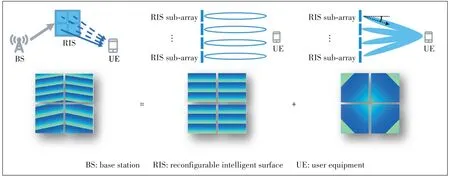
▲Figure 6.Two-step RIS beamforming method
4.2 Modeling
To study the performance of RIS in a more realistic sce?nario,sufficiently accurate modeling with acceptable complex?ity for both the RIS element and the RIS channel is needed.For the RIS element,both the spatial and the spectral charac?teristics shall be modeled.Furthermore,depending on the hardware implementation,imperfections such as amplitudephase coupling,mutual coupling,and angle-dependent re?sponse need to be taken into consideration.For the modeling of RIS channel,intensive work has been conducted.However,a unified and reliable RIS channel model is still missing.Is?sues such as the modeling methodology,the near field channel model,and modeling for specific scenarios are still open.
4.3 Algorithm
Concerning the schemes and algorithms for RIS-aided trans?mission,the following topics are closely related to the applica?tion of this technology.Firstly,due to the passiveness and the large size of typical RIS,the channel estimation is rather chal?lenging.Therefore,a practical RIS channel estimation mecha?nism with acceptable signaling overhead is needed.Secondly,adaptive RIS beamforming is crucial for achieving the promised gain.Besides the performance,other aspects such as the com?plexity,the CSI requirement,and the robustness shall be con?sidered.Thirdly,the cooperation between multiple BSs and RIS,as well as the scheduling of both RIS and UE,is an inter?esting topic related to the future RIS-aided wireless systems.
4.4 Standardization
3GPP officially identified 5G-Advanced as the name of 5G evolution standard,marking the opening of the post 5G era.Some preliminary RIS use cases which are transparent to UE can be considered now for the 5G-Advanced standardization stage.Some companies have already proposed to study RIS during the discussion about 3GPP Release 18 study and work items.There are also proposals on studying smart repeater for Release 18 during the discussion,which has tight connections with the RIS use cases.However,many challenges are still to be addressed to specify RIS for current NR systems.Current RIS prototypes have different physical dimensions,scales,and materials of different RF characteristics.It is a great chal?lenge to model and accommodate such variations in the speci?fications.We may need a set of RF requirements and a flex?ible baseband specification to support all these kinds of RIS devices.A unified model and evaluation methodology should be discussed for RIS.Although RIS can be viewed as a kind of smart repeaters and could inherit many features that would be specified for smart repeaters.There will still be differences which should be addressed in the future after the smart re?peater is specified.For example,the beam control of RIS is more complex than the smart repeater.There are a lot of differ?ences in terms of beam number,beamwidth,timing,and power control between RIS and smart repeater,which have not been included in the current working scope of smart repeaters.In our view,a comprehensive study should be done before specifying RIS for 5G-Advanced.A set of RF models should be investigated and formulated in order to clearly describe the characteristic of RIS,based on which we can further study its potential performance gain and specification impacts.
5 Conclusions
In this paper,we mainly discuss some observations and thoughts about RIS applications for 5G evolution and 6G.As an emerging technology,RIS has promising advantages of high integration,low cost and low power consumption,but its com?mercial maturity still needs time.At present,we should seize the time window of 5G evolution and 6G to realize the prelimi?nary commercial application of RIS.In terms of 5G evolution and 6G time scales,the most attractive RIS applications in?clude blind-spots coverage,indoor coverage enhancement,MIMO transmitter enhancement,etc.Meanwhile,RIS is ex?pected to become the infrastructural platform for integrated communication,sensing,and AI,and to realize the intelligent channel of independent perception of the environment and real-time parameter optimization.Therefore,we suggest that the RIS application can take a step-by-step strategy and gradu?ally expand its application scope.The successful application of RIS in 5G evolution,6G,and future mobile systems calls for tight collaboration between academia and industry.
- ZTE Communications的其它文章
- Metric Learning for Semantic?Based Clothes Retrieval
- Dual?Polarized RIS?Based STBC Transmission with Polarization Coupling Analysis
- RIS:Spatial?Wideband Effect Analysis and Off?Grid Channel Estimation
- Markovian Cascaded Channel Estimation for RIS Aided Massive MIMO Using 1?Bit ADCs and Oversampling
- Resource Allocation for Two?Tier RIS?Assisted Heterogeneous NOMA Networks
- IRS?Enabled Spectrum Sharing:Interference Modeling,Channel Estimation and Robust Passive Beamforming