
Editorial:Special Topic on Reconfigurable Intelligent Surface (RIS)
2022-04-19 01:12:42YUANYifei,JINShi,MarcoDiRENZO
ZTE Communications 2022年1期
Guest Editors>>>

YUAN Yifeireceived his Bachelor &Master degrees from Tsinghua University,China,and Ph.D.degree from Carnegie Mellon University,USA.He was with Alcatel-Lucent from 2000 to 2008,working on 3G/4G key tech?nologies.From 2008 to 2020,he was with ZTE Corpora?tion as a technical director and the Chief Engineer,re?sponsible for standard research on LTE-Advanced and 5G.Since January 2020,he has been with China Mobile Research Institute as the Chief Expert,responsible for ad?vanced research of 6G air interface.His research interests include MIMO,channel coding,non-orthogonal multiple access (NOMA),Internet of Things(IoT),and resource scheduling.He has extensive publications,including seven books on LTE-Advanced relay,LTE-Advanced key technologies &sys?tem performance,narrow-band (NB) IoT,5G new radio (NR) channel coding,5G ultra-dense networks (UDN),5G non-orthogonal multiple access,and 5G random access enhancements,respectively.He has over 50 granted US pat?ents.He is the rapporteur of NOMA study item in 3GPP.He is the recipient of the Best Paper Award by IEEE Communications Society Asia-Pacific Board for a paper on NOMA inIEEE Communications Magazine.He serves as the editor ofIEEE Communications LettersandChina Communications,and the Editor in Chief ofHans Wireless Communications.

JIN Shireceived the Ph.D.degree in information and com?munications engineering from Southeast University,China in 2007.From June 2007 to October 2009,he was a re?search fellow with the Adastral Park Research Campus,Uni?versity College London,U.K.He is currently with the fac?ulty of the National Mobile Communications Research Labo?ratory,Southeast University.His research interests include space time wireless communications,random matrix theory,and information theory.He serves as the associate editor ofIEEE Transactions on Communications,IEEE Transactions on Wireless Commu?nications,IEEE Communications Letters,andIET Communications.Dr.JIN and his co-authors were awarded the 2011 IEEE Communications Society Stephen O.Rice Prize Paper Award in the field of communication theory and the 2010 Young Author Best Paper Award by the IEEE Signal Processing Society.

Marco Di RENZOreceived the Laurea (cum laude) and Ph.D.degrees in electrical engineering from the Univer?sity of L’Aquila,Italy in 2003 and 2007,respectively,and the Habilitation à Diriger des Recherches (Doctor of Sci?ence) degree from University Paris-Sud (now Paris-Saclay University),France in 2013.Since 2010,he has been with the French National Center for Scientific Research(CNRS),where he is a CNRS Research Director (Profes?sor) with the Laboratory of Signals and Systems (L2S) of Paris-Saclay University—CNRS and CentraleSupelec,France.In Paris-Saclay University,he serves as the coordinator of the Communications and Networks Research Area of the Laboratory of Excellence DigiCosme,and as a member of the Admission and Evaluation Committee of the Ph.D.School on Informa?tion and Communication Technologies.He is the Editor-in-Chief ofIEEE Communications Lettersand a distinguished speaker of the IEEE Vehicular Technology Society.In 2017-2020,he was a distinguished lecturer of the IEEE Vehicular Technology Society and IEEE Communications Society.He has received several research distinctions,which include the SEE-IEEE Alain Glavieux Award,the IEEE Jack Neubauer Memorial Best Systems Paper Award,the Royal Academy of Engineering Distinguished Visiting Fellowship,the Nokia Foundation Visiting Professorship,the Fulbright Fellowship,and the 2021 EURASIP Journal on Wireless Communications and Networking Best Paper Award.He is a Fellow of the IEEE,a Fellow of the UK Institution of Engineering and Technology (IET),a Fellow of the Asia-Pacific Artificial Intelligence Association (AAIA),an ordinary member of the European Acad?emy of Sciences and Arts (EASA),and an ordinary member of the Academy of Europe(AE).Also,he is a highly cited researcher.
Over the past two years,reconfigurable intelligent sur?face (RIS),as a promising emerging technology for Be?yond 5G (B5G) and 6G mobile communications sys?tems,has attracted enormous interest from both aca?demia and industry worldwide.In IMT-2030 (6G) Promotion Group of China,the RIS task force was created in June 2020.In IEEE,an emerging technology initiative (ETI) of RIS was formed in July 2020.In ETSI,an industry specifications group(ISG) was kicked off in September 2021.In 2022,RIS Technol?ogy Alliance (RISTA) will be established.Initial field trials of RIS have been conducted by several companies and universities.
A RIS panel is made up with many surface-laid elements,where each element can be controlled to change the phase/am?plitude of incident electromagnetic waves.Benefiting from the rapid development of meta-material device manufacturing,RIS panels with hundreds of programable meta-surface elements now become feasible,so that RIS can significantly improve,rather than adapt to,radio environments.By properly cooperat?ing with base station antennas,RIS can extend the network cov?erage and increase the system throughput.RIS is primarily a passive device requiring little or a very small amount of power.Hence its operation is more energy-efficient than deploying tra?ditional small cell base stations or relays which usually contain active radio devices such as power amplifiers.However,RIS is a relatively new technology that still faces a lot of challenges and issues for wireless and device researchers/engineers to solve.
In this special topic,we assembled eight papers with a rea?sonable divide between theoretical research and practical engi?neering:five of them are coming from academia and three from the industry.They span over the general trends of RIS re?search and development,RIS devices,signal processing and control aspects of RIS systems,and prototype RIS transmitter and receiver system.In terms of research fields,certain bal?ance is also considered to ensure diversity.Apart from the two general papers,four papers are in the field of wireless commu?nications,e.g.,signal processing and physical layer controls.Two papers are primarily about hardware and electromagnetic physics,e.g.,circuit device and test systems.
The two papers“Recent Progress in Research and Develop?ment of Reconfigurable Intelligent Surface”and“Some Obser?vations and Thoughts about Reconfigurable Intelligent Surface Application for 5G Evolution and 6G”come from wireless op?erators,China Mobile and NTT DOCOMO,respectively.They provide big pictures of recent R&D of RIS at both academia and the industry.The former paper has a more comprehensive coverage,including the fundamental performance bounds,channel estimation,joint optimization algorithms,propagation channel modeling,realistic issues,control mechanisms,field trials and related activities in standardization development or?ganizations (SDOs)of RIS.The latter paper emphasizes a little bit on demo trial and system-level computer simulations car?ried out by NTT DOCOMO for 28 GHz millimeter wave band.For large-scale RIS panels,near field effect is analyzed and a two-step beamforming method is proposed.
The paper“Recent Developments of Transmissive Reconfigu?rable Intelligent Surfaces:A Review”is contributed by profes?sors from Tsinghua University.It reviews design approaches for RIS devices:Rx-Tx structure and frequency selective surface(FSS)structure;representative designs with different phase reso?lutions are illustrated,such as single-polarized 1-bit,dualpolarized 1-bit,2-bit and continuous 360° phase shifts.The op?erating mechanisms,schematics and transmission performances of those RIS elements are discussed in details.
Four papers in this special topic are devoted in signal pro?cessing and control aspects of RIS,reflecting the importance of control algorithms in fulfilling the performance potential of RIS.The paper“IRS-Enabled Spectrum Sharing:Interference Modeling,Channel Estimation and Robust Passive Beamform?ing”from Macau University pays special attention to the inter?ference modeling in multi-user and multi-RIS panel scenarios.By decoupling the cascaded RIS channels,a novel channel es?timation framework is proposed that includes off-line estima?tion and on-line estimation,with certain tradeoff consideration between spectral efficiency and energy efficiency of the sys?tems.Also,in this paper,RIS beamforming is optimized in a more realistic setting,e.g.,imperfect channel estimation and non-ideal or finite bits for phase shifts.The paper“Resource Allocation for Two-Tier RIS-Assisted Heterogeneous NOMA Networks”comes from Zhejiang University and considers het?erogeneous networks that consist of macro base stations,small cell base stations and RIS units.In such setting,cross-tier in?terference becomes a limiting factor to the overall system per?formance.The problem is formulated as the joint optimizationof transmit power of small cell base stations and phase-shift ma?trix of RIS,with the aim to maximize the sum rates of all small cells.Non-orthogonal multiple access (NOMA) is employed here to further enhance the system throughput albeit with in?creased complexity.An efficient sub-optimal algorithm is pro?posed which is based on alternating iterations to convert the original non-convex problem to a convex approximation.Simu?lations show that the proposed scheme can reduce the transmit power of small cell base stations by 40% compared to the case without RIS.The paper“Markovian Cascaded Channel Estima?tion for RIS Aided Massive MIMO Using 1-Bit ADCs and Oversampling”from University of Electronic Science and Technology of China extends the technique of uplink receiverend oversampling with low-bit width to the scenario of cas?caded user-to-RIS and RIS-to-base station where both base sta?tion and RIS are equipped with a large number of antenna ele?ments.Bussgang decomposition is applied to handle the coarse quantization,while a Markov chain model is developed for the oversampling filter.The cascaded channels are estimated by the proposed approximate message-passing (AMP) based algo?rithm.It is shown from the simulation that the proposed 1-bit system with oversampling can deliver the comparable mean square error performance to the 2-bit systems,while requiring significantly less processing power at the receiver.The paper“RIS:Spatial-Wideband Effect Analysis and Off-Grid Channel Estimation”comes from ZTE Corporation,with a focus on the impact of spatial wideband effect on RIS operation.Such im?pact can be quite significant in millimeter wave deployment whose system bandwidth is typically~400 MHz.The paper considers sparse channel parameters such as angles and gains,which can be estimated using compressed-sensing algorithm to achieve super resolution.The effectiveness of the algorithm is verified by the simulation results.This paper also discusses several challenges of RIS,for instance,channel modeling,nearfield effect,multi-user transmission,and standardization.
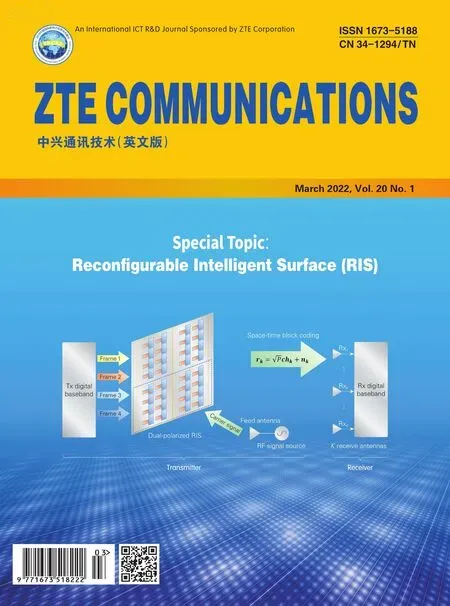
The paper“Dual-Polarized RIS-Based STBC Transmission with Polarization Coupling Analysis”describes the recent work by researchers from Southeast University,China.Instead of us?ing RIS as a passive relay,RIS in this paper is employed in the transmitter to replace some of radio-frequency processing mod?ules in traditional base stations.A dual-polarized RIS transmit?ter is proposed,which can achieve 4-transmit space-time block coding(STBC)with proper partitions of RIS elements with differ?ent polarizations.The polarization coupling is thoroughly ana?lyzed by a suitable model.A prototype system of RIS-based STBC is built using the fabricated dual-polarized phase adjust?able RIS unit cells.Theoretical performance analysis and experi?mental results match closely,indicating the effectiveness of the model in characterizing the polarization coupling in RIS.
We would like to thank all the authors for their valuable con?tributions and all the reviewers for their timely and construc?tive comments on the submitted manuscripts.We hope that this special issue would be informative and useful for readers.
- ZTE Communications的其它文章
- Metric Learning for Semantic?Based Clothes Retrieval
- Dual?Polarized RIS?Based STBC Transmission with Polarization Coupling Analysis
- RIS:Spatial?Wideband Effect Analysis and Off?Grid Channel Estimation
- Markovian Cascaded Channel Estimation for RIS Aided Massive MIMO Using 1?Bit ADCs and Oversampling
- Resource Allocation for Two?Tier RIS?Assisted Heterogeneous NOMA Networks
- IRS?Enabled Spectrum Sharing:Interference Modeling,Channel Estimation and Robust Passive Beamforming