
lmmune checkpoint inhibitor-associated ophthalmic adverse events: current understanding of its mechanisms,diagnosis, and management
2022-04-19 06:58:14YuWenZhouQianXuYanWangRuoLanXiaJiYanLiuXueLeiMa
關鍵詞:生產
INTRODUCTION
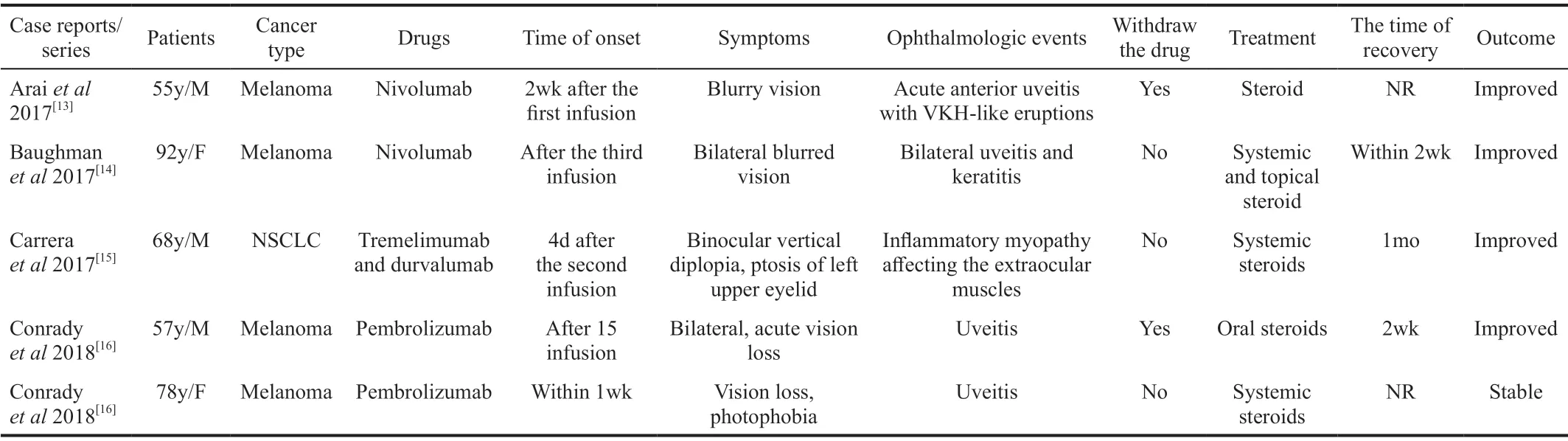
Immune checkpoint inhibitors (ICIs) that target cytotoxic T-lymphocyte antigen 4 (CTLA-4) and programmed cell death protein 1 receptor/ligand (PD-1/PD-L1) pathways have shown robust evidence of antitumor activity in patients with cancer. These medications include pembrolizumab,ipilimumab, nivolumab, atezolizumab, avelumab, and durvalumaband have been authorized by the Food and Drug Administration (FDA) for numerous cancer therapies. With the progressive implementation of ICIs in clinical practice,however, a key challenge has emerged: the uncontrolled collateral effects of ICIs on the immune system, which can result immune-related adverse events (irAEs) that can affect all organ systems. IrAEs comprise common adverse events,such as dermatological, gastrointestinal, hematological,pulmonary, and rheumatic toxicities, nephritis, and endocrinopathy. They also include rare adverse events (arising in <1% of patients), such as neurological, ocular, and cardiac toxicities, which can largely be controlled by glucocorticoid therapy. Among these toxicities, ophthalmic irAEs,including dry eye, uveitis, ocular myasthenia gravis, uveal effusion, retinal detachment, and conjunctivitis (Figure 1) occur infrequently and are not comprehensively recognized. The current understanding of ophthalmic irAEs is mainly derived from case reports and case series (Table 1). In this review,to strengthen the understanding of ICI-associated ophthalmic toxicity and enhance the quality of life of patients, we elaborate on the incidences, manifestations, diagnoses, potential mechanisms, treatments, and management of ophthalmic irAEs based on the current knowledge and relevant literature.
黨組織的思想政治工作是黨在長期的工作實踐中總結出來的重要經驗,是發揮黨員先鋒模范作用,促進企業健康發展等工作的生命線。企業思想政治工作的思路是指企業思想政治工作的指導思想和戰略方針。科學發展觀是發展中國特色社會主義必須堅持和貫徹的重大戰略思想,也是做好新形勢下思想政治工作的重要指導思想。近年來,中心黨總支通過加強黨的理論知識學習與組織建設,進一步夯實黨建工作基礎,明確黨員責任,團隊凝聚力得到了增強,員工創造力得到了激發。在廣大黨員群眾的支持下,先后榮獲了“上海市工人先鋒號”、“上海市電力公司先進基層黨組織”等榮譽稱號。
POTENTIAL MECHANISM OF OPHTHALMIC TOXICITY
The mechanism of ICI-associated ophthalmic events has yet to be fully understood. The eyes have special mechanismsto limit the invasion of inflammation and infectious agents,thus protecting visual functionAnatomical mechanisms,such as the presence of the blood-retinal barrier and absence of efferent lymphatic vessels, protect the eyes from infection,whereas immune mechanisms, such as the upregulation of the Fas ligand and tumor growth factor-beta (TGF-β), can prevent inflammation by converting T cells into regulatory T cells and causing immune cell death.
Blockade of these regulatory T cells may trigger adverse reactions, and reprogramming of the cell death pathway may lead to ocular adverse events due to ICI therapy. To further downregulate the inflammatory T-cell activity, retinal pigment epithelial cells express both PD-L1 and CD86, which can interact with PD-l and CTLA-4, respectively. High levels of PD-L1 were also found to express in various ocular tissues and may play crucial roles in preventing autoimmunity. In addition, PD-1 and PD-L2 were expressed on tumor cells of ocular adnexal invasive squamous cell carcinomas to varying degrees; as a consequence, these tumor cells can potentially respond to ICI therapy.
IMMUNE CHECKPOINT INHIBITOR-ASSOCIATED OPHTHALMIC ADVERSE EVENTS
Ocular irAEs can occur at any time during treatment, and even after the cessation of ICIs. However, most (approximately 70%) irAEs typically occur within two months after the initiation of therapy. A minority of irAEs occurs after 48wk,and these irAEs can involve various parts of the eye and orbit. We reviewed published cases of adverse ophthalmic reactions and found that the time to onset of ophthalmic irAEs was earlier when combined with ICIs (either with other ICIs or other conventional therapies; Figure 2). Apart from the variability of the time to onset, there is variability in the ocular symptoms: the most common clinical manifestation of ICIrelated ophthalmic toxicity is dry eyes (3%-24%), uveitis(1%), and myasthenia gravis involved with the eyes (frequency undefined). Other less common ophthalmic adverse events include uveal effusion, retinal detachment, conjunctivitis,ocular myositis, vasculitis, keratitis, episcleritis, vitritis,choroidopathy, and a broad spectrum of neuro-ophthalmic toxicities (Figure 1). Information on various types of ocular adverse events are summarized in Table 2. Most of these adverse reactions can be effectively controlled by periocular,topical, or systemic corticosteroids.
以我國某一農村為例,對農村人畜飲水安全的影響因素進行分析,該地區主要是利用雨水與泉水進行供水,主要水源來自該縣的一水庫,飲水問題基本得到解決,其水質受人為因素、環境因素、地理位置等影響極易出現污染,水質不能滿足國家對生活飲水的安全標準規定,且因使用受污染的水導致許多村民都出現了骨質疏松、糞便呈血、牙齒變黃等癥狀,嚴重威脅著村民的身體安全。通過調查發現,該地區的農村人畜飲水安全影響因素主要體現在以下幾方面。
通過總結分析,發現單元教學課具有以下特色:1.注重創設問題情境,從生活實際或數學內部提出問題,體現學習新知識的必要性。2.注重抽取分式概念的基本要素,讓學生經歷分式概念的建構過程,有利于培養學生的數學抽象概括能力。……
登錄APP查看全文
猜你喜歡
江蘇安全生產(2022年9期)2022-11-02 07:01:24
中國化肥信息(2022年7期)2022-08-31 01:28:54
山東冶金(2022年2期)2022-08-08 01:50:42
小學科學(學生版)(2020年10期)2020-10-28 07:52:12
中國化肥信息(2020年7期)2020-03-19 01:54:02
中國軍轉民(2017年6期)2018-01-31 02:22:28
消費導刊(2017年24期)2018-01-31 01:29:23
中國制筆(2017年2期)2017-07-18 10:53:09
現代企業(2015年4期)2015-02-28 18:48:06
汽車零部件(2014年11期)2014-09-18 11:57:16
 International Journal of Ophthalmology
2022年4期
International Journal of Ophthalmology
2022年4期
- International Journal of Ophthalmology的其它文章
- Comment on: Real-world outcomes of two-year Conbercept therapy for diabetic macular edema
- Efficacy of intravitreal conbercept combined with panretinal photocoagulation for severe nonproliferative diabetic retinopathy without macular edema
- Efficacy of conbercept after switching from bevacizumab/ranibizumab in eyes of macular edema secondary to central retinal vein occlusion
- lntraoperative complication rates in cataract surgery performed by resident trainees and staff surgeons in a tertiary eyecare center in Hungary
- Comparing surgical efficiencies between phacoemulsification systems: a single surgeon retrospective study of 2000 eyes
- Factors associated with corneal astigmatism change after ptosis surgery