
Artificial intelligence improves accuracy, efficiency, and reliability of a handheld infrared eccentric autorefractor for adult refractometry
2022-04-19 06:57:56YiTingCaoDanYangCheYiLeiPanYunLiLuChongYangWangXiaoLiZhangYunFeiYangKeKeZhaoJiBoZhou
關鍵詞:安全性
INTRODUCTION
Ametropia is now a serious public health concern worldwide. Globally, it was estimated that there were 312 million cases of myopia in 2015. Nearly 5 billion people will be affected by 2050. A higher incidence of myopia means more pathological myopia patients. Refractive error has become one of the leading causes of visual impairment and preventable blindness among children and young adults.
Based on the above, regular and large-scale vision screening should be implemented as soon as possible. Accurate, affordable,and portable measuring equipment is needed to screen large populations. Retinoscopy, table-mounted autorefractors (TAR),and handheld automatic refractors are often used for vision screening. Retinoscopy, which estimates refractive power by measuring the divergence of reflected light, requires experienced and skilled optometrists. TAR is widely used and technological innovations have improved their precision.However, measuring visual acuity in subjects who are older or very young, or in those that have a disability may be more challenging; consequently, portable handheld autorefractors are also frequently used to measure visual acuity.
285 Aspirin interrupts bile duct carcinoma in rats induced by thioacetamide
根據車輛在會車過程中的響應曲線可知,在幾項安全性指標中,輪軌垂向力與輪重減載率在會車過程中有較大的安全余量;而輪軸橫向力和脫軌系數在450 km/h工況下會在短暫的時間中超過安全限值。這是由于會車氣動流場對車體的橫向作用力較大,主要影響與輪軌橫向力有關的安全性指標。通過觀察輪軸橫向力和脫軌系數超過安全限值的峰值點可知,運行安全性指標的危險點一般出現在交會列車前部鼻端通過觀測點的時刻,故應在高速列車的鼻端設計中設法降低會車時的初始壓力波幅度,以提高動車組在高速會車時的運行安全性。
This research investigated whether AI improved the clinical utility of hICA by comparing the values of diopter measurement and time control, and provides insight that could aid the development of accurate and efficient autorefractors.
SUBJECTS AND METHODS
The study adhered to the tenets of the Declaration of Helsinki. The study protocol was approved by the Ethics Committee of Shanghai Ninth People's Hospital,affiliated with Shanghai Jiao Tong University School of Medicine (Shanghai, China; SH9H-2020-T22-2). The study objectives and procedures were explained to all subjects in advance, and written informed consent was obtained.
Subjects with small pupils (bilateral pupil diameter<2 mm in indoor light) and ocular diseases were excluded from the study. In total, 70 healthy adult volunteers participated.Subjects with a visual acuity <20/20 with correction in one eye were not eligible to participate. Data on age, date of birth, sex,spectacle use, and ophthalmological findings were collected.
Three instruments were tested in this study,namely an automatic refractor (AR-1; Nidek, Gamagori, Japan)and two automatic vision screeners: the VS100 Spot Vision Screener (Welch Allyn, Skaneateles Falls, NY, USA) and the V100 Vision Screener (MediWorks, Shanghai, China).The appropriate rights to reproduce or mentioned of the V100 Vision Screener has been obtained from Shanghai MediWorks Precision Instruments Company Limited. All three instruments were calibrated before testing.
The AI binocular measurement method described here is based on deep learning.
The U-net segmentation network described by Ronnebergerin 2015 is widely used for medical image segmentation. U-net were used to segment the pupil area from red/green/blue (RGB) images.The image resolution was 320×240, and probability maps were generated by convolution, skip connection, and deconvolution operations. The pupil area was considered to correspond to the probability map that exceeded the probability threshold(Figure 1). The U-net neural network enhances information,decreases the loss thereof, and greatly improves the accuracy of medical images. As shown in Figure 2, the network framework includes an encoder, decoder, and skip connection.The encoder extracts image features, such as shallow layers and fine granular structures. The decoder restores the features,including shallow- and deep-channel features, and converts image information from low to high resolution. The decoding module can express deep- and coarse-grained features. Next,the ROI is located using probability maps. The skip connection links the encoder and the decoder, reduces information loss during the feature extraction process, and ensures accurate positioning and segmentation.
A total of 20 000 human eye images were collected and separated into a training set and a verification set (ratio of 4:1). Data augmentation was applied, including rotation, translation,scaling, grey-level stretching, and randomisation. Then the images were normalised by subtraction and accommodating variation. The “loss cross-entropy function” was dichotomous,with “0” representing the background and “1” representing the pupil. The “U-net training weight” was used as the initial weight before fine-tuning the training dataset. Stochastic gradient-descent with an optimised iteration method was applied for 60 rounds. The initial learning rate of 0.01 decreased 10-fold after 20 rounds, and then again after 40 rounds. Finally,the training weight with the minimum difference between the training and verification set data loss was selected for network reasoning. The U-net network inference procedure generated probability maps with thresholds. Areas with a probability >0.8 were designated as pupillary regions; the remaining areas were considered background. Next, a binary mask for the pupillary region was obtained and used to extract the pupillary ROI from the original image. Then the infrared eccentricity algorithm was used to obtain diopter values.


當然,更重要的是,我們要從文化素養和道德建設的層面,深刻反思中華民族優秀文化傳統所出現的嚴重斷層,華夏千年禮儀之邦,如今竟至斯文掃地,四處丟丑,乃至遭人蔑視。說到底,如今整個社會道德水準亟待提高,造成這種現狀的原因很復雜,全社會都有責任。二十年前,我曾與著名社會學家金耀基教授進行過一次有關中華文化的對話,他的一句名言令我至今難忘:“二十世紀初的中國人曾經看不起中華文化,然而一路掃蕩下來,到了二十世紀末,中國人已經看不見中華文化了!”這是多么痛徹而嚴酷的現實啊!
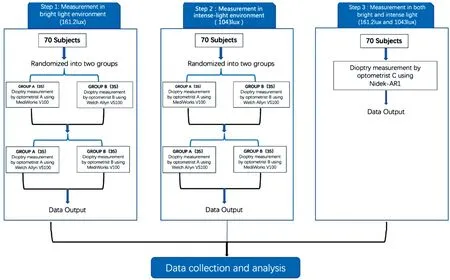
In the first and second steps, two professional optometrists simultaneously obtained the measurements for each subject;each optometrist used a different vision screener. Then the optometrists swapped the vision screeners before the next round of measurements. Therefore, all subjects were evaluated using both vision screeners, and by both optometrists, under bright and intense light conditions. Measurements that took more than 20s were considered failures. The Welch Allyn VS100 and MediWorks V100 devices were positioned approximately 1 m from the face of each participant to obtain the measurements.
To evaluate the efficiency of each vision screener, measurement times were recorded for each subject by two timekeepers with two stopwatches of the same type (from the point at which the binocular image appeared on the screen until the results were outputted).
甘薯黑痣病菌的生物學特性研究…………………………………………… 趙永強,徐 振,楊冬靜,孫厚俊,謝逸萍,張成玲(89)
Parameters for Refractive Error Measurements Measurements recorded using the TAR were used as the reference standard. The diopter of spherical power (DS)and cylindrical power (DC) were decomposed into vertical/horizontal component (J0=-(DC/2)×cos(2A), A means axis)and oblique component [J45=-(DC/2)×sin(2A)] of refractive,and spherical equivalent (SE; the DS plus half of the negative DC) were used to evaluate the accuracy of both of the handheld infrared eccentric autorefractors used in this study.
RESULTS
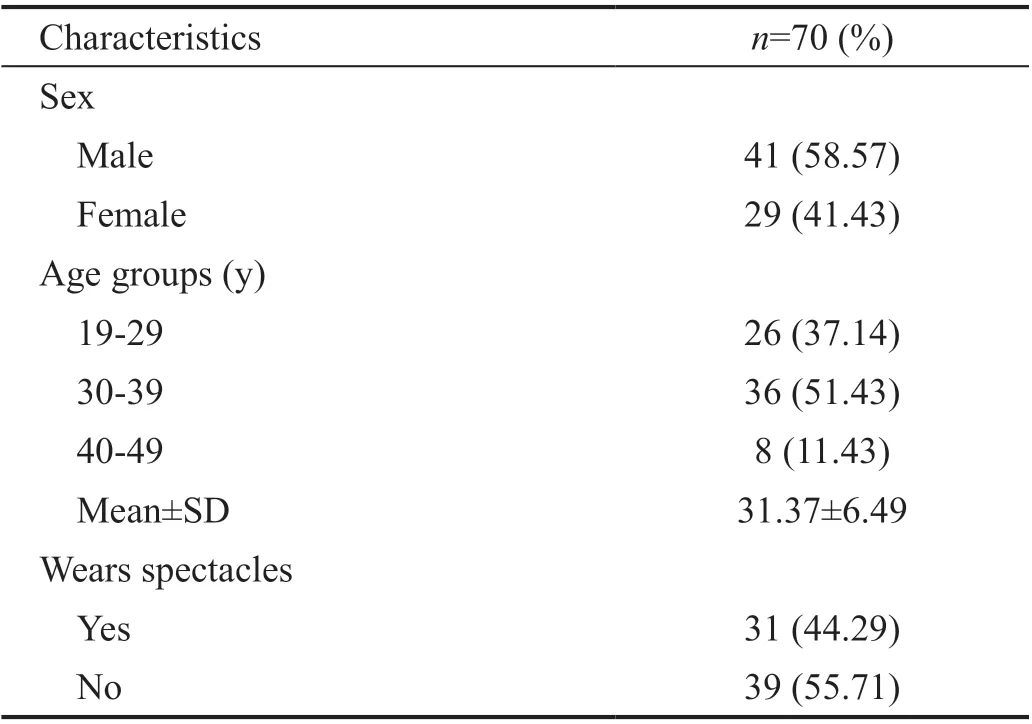
In total, 140 eyes of 70 participants were assessed. The sociodemographic characteristics of the participants are shown in Table 1.
Statistical Analysis The data collected during the project were processed using Excel software (Microsoft Corp.,Redmond, WA, USA). Next, the data were reviewed for errors and analysed using SPSS software (ver. 24.0; IBM Corp.,Armonk, NY, USA). The normality of the distribution of the optometry data was assessed using the Shapiro-Wilk test. For qualitative data, frequencies and proportions were calculated.Descriptive statistics were generated for the quantitative data,as medians and interquartile ranges (IQRs), because these data were not normally distributed. To avoid analytical difficulties associated with the interdependence of observations between eyes from the same individual, a generalised equation was used to compare the SE, DS, and DC measurements, and the times thereof, among the different groups. The intraclass correlation coefficient (ICC) and Spearman's rank correlation coefficient were used to evaluate correlations among the measurements recorded by the three instruments. Bland-Altman were used to analyze the precision of the equipment by the agreement.The tests were two-sided, and a-value <0.05 was considered statistically significant.
Handheld automatic refractors are convenient to use, and many studies have compared their accuracy and efficiency with traditional clinical optometry methods. Results have shown that measurements of astigmatism, myopia, and anisometropia recorded using these handheld autorefractors are consistent with those recorded using cycloplegic retinoscopy.However, these refractors are associated with small errors and may be affected by external factors. The measurement of refractive error using a handheld infrared eccentric autorefractor(hICA) is based on light tracing, which may be affected by changes in light intensity, humidity, movement caused by hand-shake, focusing blur, or eye deformation. Deep learning,as a neoteric form of artificial intelligence (AI), could improve the stability and robustness of these procedures by enhancing the representativeness of data in the form of text, images, or sound. In this study, AI was applied to increase the accuracy of hICA measurements obtained during vision screening.
In a brightly lit environment (161.2 lx), the median (IQR) SE values measured using the MediWorks V100, Welch Allyn VS100, and Nidek AR-1 instruments were -1.250 (2.47) D, -1.187 (2.973) D,and -1.678 (3.094) D, respectively. There were no significant differences in the estimated marginal mean SE, DS, and DC values (J0 and J45) obtained using the Welch Allyn VS100 and Nidek AR-1 (>0.05). The estimated marginal mean SE, DS,and DC (J0, J45) values obtained using the three instruments are presented in Table 2.
Of the two hICAs, the instrument equipped with AI (MediWorks V100) showed the better detection rate(100%70% in an intense-light environment).
In total, 98 eyes of 49/70 (70%) participants were successfully evaluated using the Welch Allyn VS100. Therefore, the SE measurements of these 49 subjects were analysed. In an intense-light environment(1043 lx), the medians (IQR) SE values measured using the MediWorks V100, Welch Allyn VS100, and Nidek AR-1 instruments were -1.303 (2.89) D, -1.522 (3.164) D, and-2.030 (3.124) D, respectively. Similar to the results obtained in the brightly lit environment, the DC values significantly differed between MediWorks V100 and Nidek AR-1 (<0.05).There were statistically significant differences in the SE and DS values obtained using the Welch Allyn VS100 and Nidek AR-1 instruments (<0.05). The estimated marginal mean SE,DS, J0 and J45 values obtained using the three instruments are presented in Table 3.
In an intense-light environment (1043 lx), the ICC for the SE between the MediWorks V100 and Nidek AR-1 instruments was 0.956 (<0.001), and that between the Welch Allyn VS100 and Nidek AR-1 instruments was 0.973 (<0.001). The ICC and Bland-Altman analyses indicated a high degree of consistency and repeatability for the SE and DS measurements obtained using the two vision screeners and the TAR.
Light intensity had a significant effect on the dioptric measurements recorded using both handheld screeners (<0.05), whereas it had little effect on the TAR measurements (>0.05; Table 3).
從表1看出,冬季分蘗數以鄭麥1860的最高,為44.2萬穗/畝,其次是輪選166,為37.8萬穗/畝,泰禾麥2號的最低,僅為27.1萬穗/畝;
登錄APP查看全文
猜你喜歡
現代儀器與醫療(2022年2期)2022-08-11 09:51:40
汽車工程師(2021年12期)2022-01-18 06:02:43
建材發展導向(2021年14期)2021-08-23 00:57:04
建材發展導向(2021年23期)2021-03-08 01:05:44
裝備制造技術(2020年4期)2020-12-25 05:25:56
科技傳播(2019年22期)2020-01-14 03:05:32
活力(2019年17期)2019-11-26 00:42:18
基層中醫藥(2018年6期)2018-08-29 01:20:20
上海農業學報(2017年3期)2017-04-10 12:39:18
信息安全與通信保密(2016年3期)2016-08-23 01:23:46
 International Journal of Ophthalmology
2022年4期
International Journal of Ophthalmology
2022年4期
- International Journal of Ophthalmology的其它文章
- Comment on: Real-world outcomes of two-year Conbercept therapy for diabetic macular edema
- Efficacy of intravitreal conbercept combined with panretinal photocoagulation for severe nonproliferative diabetic retinopathy without macular edema
- Efficacy of conbercept after switching from bevacizumab/ranibizumab in eyes of macular edema secondary to central retinal vein occlusion
- lntraoperative complication rates in cataract surgery performed by resident trainees and staff surgeons in a tertiary eyecare center in Hungary
- Comparing surgical efficiencies between phacoemulsification systems: a single surgeon retrospective study of 2000 eyes
- Factors associated with corneal astigmatism change after ptosis surgery