
One-year outcomes and predictable factors for microhook ab interno trabeculotomy
2022-04-19 06:58:04DaikiSakaiMasashiFujiharaSatoshiYokotaMakotoNakamuraYasuoKurimoto
關鍵詞:優化
INTRODUCTION
Trabeculotomy is an established surgical procedure for patients with glaucoma. The supposed mechanism of intraocular pressure (IOP) reduction is through relieving the resistance of aqueous humor (AH) flow by the cleavage of trabecular meshwork (TM) and the inner wall of the Schlemm's canal (SC). Trabeculotomy expectedly achieves a mild reduction in IOP, compared to trabeculectomy,which is the gold standard surgical treatment for glaucoma.Nonetheless, the former is associated with a low frequency of vision-threatening complications such as hypotony and blebrelated infection, which can be attributed to its blebless profile.Conventional trabeculotomy uses theapproach.However, the currently trending procedure of minimally invasive glaucoma surgery (MIGS) uses theapproach, sparing the conjunctiva and sclera. The mainstream procedure for MIGS is the trabecular bypass procedure, which is classified into the following groups: 1) removal of the TM and inner wall of the SC (trabeculectomy and 2) cleavage of the TM and inner wall of the SC [trabeculotomy (μLOT)]. While the former category utilizes the trabectomeand Kahook Dual Blade, the latter involves gonioscopy-assisted transluminal trabeculotomy (GATT)and microhook μLOT. μLOT is a novel surgical procedure developed in Japan as an option for MIGS. A short surgical time (<10min) and low surgical cost requiring no expensive devices are the strengths of μLOT. Moreover, based on safety profile, μLOT is permitted in wide variety of cases.Thus, it is considered a promising treatment option for patients with glaucoma requiring surgical intervention. Despite the increasing popularity of μLOT, few reports describe its surgical outcomes. For optimal indications, information that predicts outcomes is required. The purpose of this study is to investigate the one-year outcomes in consecutive cases and factors that influence the results of μLOT.
SUBJECTS AND METHODS
This retrospective, single-center, observational study was performed according to the Declaration of Helsinki.It was approved by the Institutional Review Board of the Kobe City Medical Center General Hospital (Kobe, Japan). We applied the opt-out methods to obtain informed consent for this observational study involving the use of medical records.Patients who did not give their consent were excluded.
We enrolled consecutive patients who underwent μLOT at the Kobe City Eye Hospital between February 2018 and July 2019. Both μLOT alone and combined with cataract surgery were included. Indications for μLOT were the followings: 1) open angle glaucoma patients who had early to moderate glaucomatous damage; 2) requiring a reduction in IOP or in reliance on glaucoma medications while avoiding filtering surgery. There was no strict protocol and the decision to operate was at the discretion of each surgeon. If both eyes underwent μLOT during the recruitment period, only the first one was selected. We included all types of open angle glaucoma, regardless of the history of glaucoma surgery.Patients with a follow-up of less than 1mo were excluded.
圖13結果顯示,優化后的刀片1上的扭矩為1.22 N·m;刀片2上的扭矩為1.4 N·m;刀片3上的扭矩為1.45 N·m。可見,采用方案3(異形刀片)進行優化后,刀片上的扭矩均比原方案小,達到了節能的效果,但是相比優化方案2(彎曲刀片),方案3中的3片刀片上的扭矩變化平穩,均未出現波動情況。
Previous studies have reported that the μLOT is effective for various types of glaucoma including POAG, EXG, uveitic glaucoma, steroid-induced glaucoma, developmental glaucoma,and secondary glaucoma following vitrectomy.However, limited studies compared the effectiveness of μLOT among different types of glaucoma. According to Rahmatnejad, the success rates of GATT were not significantly different between POAG and SOAG eyes (including EXG eyes). While, Aktasreported that patients with POAG who underwent GATT had a higher percentage of IOP reduction compared with those with SOAG (including EXG) at 18mo postoperatively. Tanitoreported that steroid-induced glaucoma and developmental glaucoma might be good candidates for μLOT by performing multiple regression analysis. Our study added that POAG, which had a one-year surgical success rate of 80.0%, might be a good candidate for μLOT. There were no significant differences in the mean postoperative IOP and the number of glaucoma eye drops between the POAG and SOAG eyes that did not require additional surgery. This result suggests there are some populations of SOAG eyes which could achieve IOP reduction equivalent to that of POAG eyes. Additionally, our result showed that uveitic glaucoma had poor one-year surgical success rate, although the sample size was too small. Future studies involving large number of each type of SOAG patients are required to evaluate the effectiveness of μLOT for SOAG.Regardingtrabelulectomy, some studies have reported a higher success rate or greater IOP-lowering effect of trabectome surgery in EXG eyes compared to that in POAG eyes, which were not consistent with our results. While μLOT comprises the cleavage of the TM and inner walls of the SC, trabectome surgery includes the ablation and removal of the strip of the TM and the inner wall of the SC. Tingdescribed that the effect of trabectome surgery on washing out the exfoliation materials may lead to favorable results in EXG eyes. The difference in the surgical procedure may reflect as discrepancies between the surgical results of trabectome surgery and μLOT. Tojorecently reported trabectome surgery had significantly better surgical results compared with μLOT for glaucoma patients including various types of glaucoma. Comparisons of surgical outcomes for specific type of glaucoma are expected to determine the optimal indications oftrabeculotomy, because the best candidate for these two surgeries might be a different type of glaucoma. To identify the good candidate for μLOT is useful for clinicians because μLOT has the benefit in terms of surgical costs.
2)在恒溫熱風干燥和分階段控溫熱風干燥兩種方法下,辣椒干燥后的品質相差不大,但是在分階段控制溫度條件下,辣椒達到安全含水率的總干燥時間普遍較短,即其干燥速率較快、干燥能耗較低。試驗所得最優的干燥辣椒的工藝是:分階段控制溫度熱風干燥,初始溫度為45℃,150min后迅速升溫至60℃,風速為1.2m/s,辣椒達到安全含水率的總干燥時間為420min。
We performed the μLOT as previously reported. The Swan-Jacob Autoclavable Gonioprism or Ocular Hill Surgical Gonioprism (Ocular Instruments,Bellevue, WA, USA) were used to observe the anterior chamber (AC) angle opposite to the corneal port. We inserted the Tanitotrabeculotomy micro-hook (Inami,Tokyo, Japan) into the AC through the corneal port. The tip of the micro-hook was inserted into the SC and circumferentially moved to incise the TM and the inner wall of the SC. Surgeons could select any of the straight-type (M-2215S) or angledtype (M-2215R, M-2215L) microhooks. The position, number of corneal port incisions, and subsequent incision range of the TM were at the discretion of each surgeon. Although the incision range of the original method from Tanitowas approximately 240 degree, the incision range of 120 degree was recently reported in some studies; both methods were included in our cases.
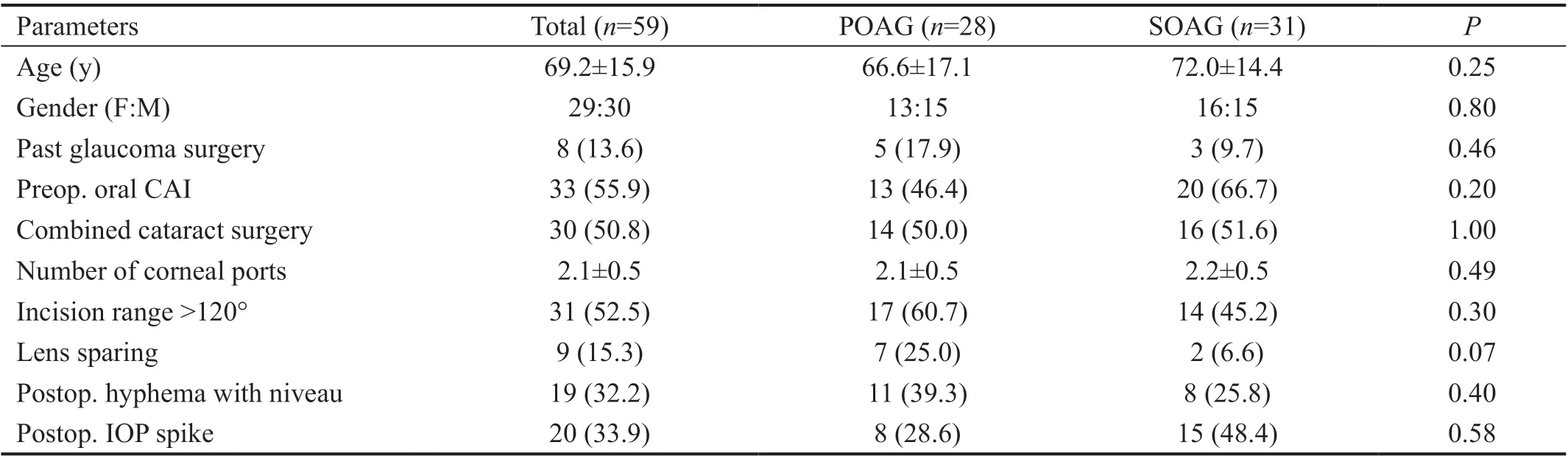
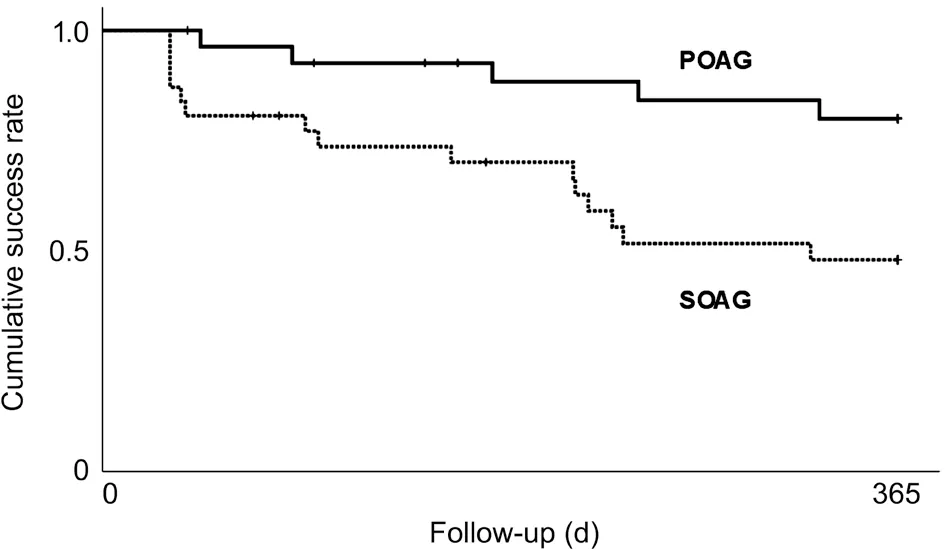
There was no substantial difference in the clinical characteristics and perioperative factors between the POAG and SOAG eyes(Table 1). The one-year cumulative rate of surgical success was significantly higher in POAG eyes than that in SOAG eyes (80.0%48.0%,=0.011, log-rank test; Figure 2). EXG,uveitic glaucoma, steroid-induced glaucoma had one-year cumulative surgical success rate of 63.5%, 16.7%, and 53.3%,respectively. After μLOT, the mean IOP and the number of glaucoma eye drops significantly decreased at 1wk, 3 and 12mo postoperatively in both POAG and SOAG eyes (all<0.01), and there was no significant difference between the POAG and SOAG eyes in IOP and the number of glaucoma eye drops at any point (Tables 2 and 3).


RESULTS
We performed multivariate analyses to detect the factors associated with failure, and the presence of a postoperative IOP spike was revealed as an independent risk factor. Postoperative IOP elevation or IOP spike is a common complication of trabeculotomy, which is often ascribed to a micro-apparent hyphema or postoperative inflammation. TM reportedly has the greatest resistance throughout the outflow of AH. AH initially exits the eye through the TM into the SC. It enters the collector channel opened along the external wall of the SC in the distal outflow. It then moves through the intrascleral plexus, eventually leading to the aqueous and episcleral veins where the AH joins the systemic circulation. Following μLOT,postoperative IOP elevation is presumed to be a consequence of an impaired distal outflow. Thus, pre-existing obstruction or constriction of the distal outflow pathway prevents the eyes from having enough drainage capacity to withstand the surgerymediated additional stress. Postoperative IOP elevation may occur in these eyes even with mild postoperative hyphema or inflammation. Thus, the presence of postoperative IOP spike is presumed to indicate poor drainage capacity of the eyes.Rahmatnejadinvestigated the factors influencing the surgical results of GATT and revealed a significantly higher rate of postoperative IOP spike (defined as IOP>30 mm Hg) in the surgical failure groups than in the surgical success groups.μLOT and GATT are classified in the same category of μLOT.Therefore, the results of our study and those of Rahmatnejadmay have similar underlying mechanisms. We speculate that postoperative IOP spike is not only a common complication of μLOT, but also a factor associated with surgical failure.
We conducted repeated measures analysis of variance (ANOVA) and paired-test with Bonferroni correction to compare the pre- and postoperative values. We divided the eyes into two diagnostic categories based on the type of glaucoma: primary open angle glaucoma (POAG) and secondary open angle glaucoma (SOAG) including exfoliation glaucoma (EXG). We performed unpaired-test or Fisher's exact test to compare the values between the two diagnostic categories (POAG and SOAG). Kaplan-Meier survival curves with log-rank tests were used to assess the cumulative rate of surgical success. We truncated all patients at 365d postsurgery, with a follow-up greater than 1y, because the majority of censoring occurred after one-year of follow-up visit.Associations between the surgical failure and collected factors were assessed using a multivariate Cox proportional-hazards regression model. We included all statistically significant variables on univariate analyses in the multivariate analyses.value <0.05 was considered statistically significant. All statistical analyses were performed using SPSS for Windows software package, version 25 (SPSS Inc., Chicago, IL, USA).
近3年來,在新入科的CSSD護士培訓中,通過實行PDCA循環管理法,使新入科護士的專業技能和知識得到明顯提高,全部都按標準按時按質完成培訓。
對Kinect采集到的20個三維關節點坐標進行行為特征提取時選擇的特征量應滿足平移不變性及縮放不變性,角度特征很好的滿足了以上兩個條件。為了方便計算角度將20個關節點分別用“A”-“O”進行標記,對應關系見圖2,其中A(Head),T(HandLeft),P(HandRight),L(FootLeft),H(FootRight)5個關節點由于會發生抖動現象[6],所以并未使用。
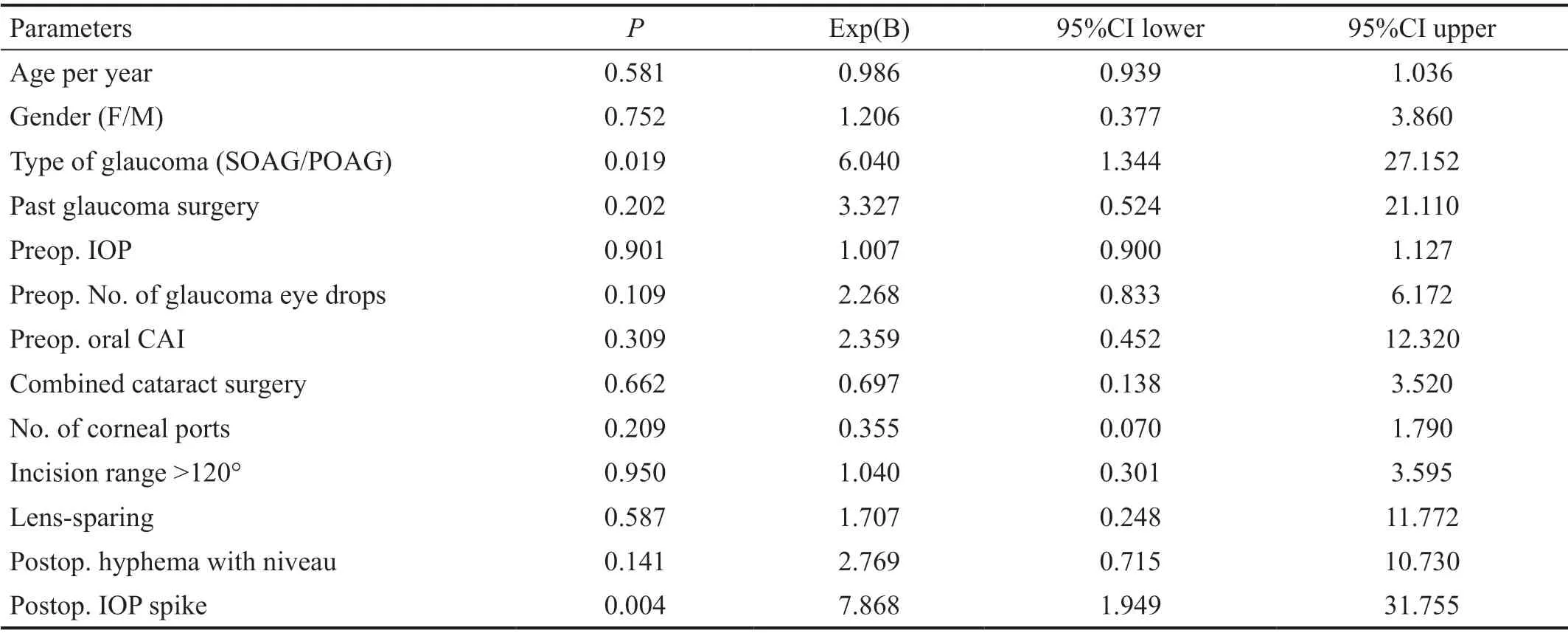
The results of univariate analyses revealed SOAG (=0.019) and postoperative IOP spike (=0.004) as potential factors (Table 4). Both of SOAG[=0.017, adjusted hazard ratio (aHR): 3.468, 95%CI: 1.246-9.654] and postoperative IOP spike (<0.001, aHR: 5.382,95%CI: 2.113-13.707) were independent factors associated with surgical failure in multivariate analyses (Table 5).

There were only two cases of postoperative complications requiring interventions, and both were hyphema(washout at 2 and 7d postoperatively). Vitreous hemorrhage occurred in three eyes post-surgery. However, it improved spontaneously without causing any visual impairment. There were 20 cases of postoperative IOP spike, which were treated by resuming glaucoma eye drops (=10) or oral CAI (=5)or both (=4). Patients did not receive routine antiglaucoma medications to prevent postoperative IOP spike, although two cases with relatively advanced visual field defect received preventive oral CAI. Seventeen eyes needed additional glaucoma surgery during the follow-up period. The indication of additional surgery was uncontrollable IOP elevation resistant to maximum medical antiglaucoma therapy (=16)and progression of visual field defect despite good IOP control(=1). While 12 eyes underwent standard trabeculectomy, 5 underwent additional μLOT.
DISCUSSION
Our study presents the one-year surgical outcomes and some factors associated with surgical outcomes of μLOT in consecutive cases of open angle glaucoma. The IOP and number of glaucoma eye drops had significantly decreased from baseline at the one-year follow-up visit. The mean postoperative IOP of 16.1±4.4 mm Hg was comparable to that previously reported by Moriof 17.8±6.3 mm Hg. Although there were some cases with postoperative complications which caused transient visual impairment, all of them improved spontaneously or were treatable with minor interventions.Regarding the types of glaucoma, POAG eyes achieved better one-year outcomes compared to SOAG eyes. Additionally,our results of multivariate analyses revealed SOAG eyes and postoperative IOP spike as the factors associated with surgical failure of μLOT.
We collected data on IOP and the number of glaucoma eye drops at the preoperative visit and each postoperative follow-up visit. Postoperative follow-up interval of each case was decided by each surgeon (5mo was the longest), and the postoperative data were collected at one week postoperatively, one month postoperatively, and monthly after that (if available). Furthermore, we collected the following clinical characteristics and perioperative factors for analyses:age, sex, type of glaucoma, history of glaucoma surgery,preoperative use of oral carbonic anhydrase inhibitor (CAI),combined cataract surgery, postoperative lens status, number of corneal ports for trabeculotomy, intraoperative incision range of TM, presence of postoperative hyphema with niveau, and IOP spike. We defined an IOP spike as an IOP exceeding 25 mm Hg at any follow-up IOP measurements within 2wk post-surgery.
The IOP and the number of glaucoma eye drops at each postoperative follow-up visit were the primary outcome measures. Surgical failure was defined as failure to meet the following target criteria of surgical success on two consecutive visits: 1) IOP≤21 mm Hg or 2) IOP≤ the preoperative IOP with a reduced number of glaucoma eye drops. The need for additional glaucoma surgery was also defined as failure. We recorded the first consecutive visit as the time of failure in all cases. Considering the postoperative IOP fluctuations after trabeculotomy, the surgical failure judgment was delayed up to 30d post-surgery. However, the cases requiring additional glaucoma surgery within 30d post-surgery were defined as failure on the day of second surgery (one patient). If the patients underwent additional glaucoma surgery, we excluded all follow-up measurements of the IOP and the number of glaucoma eye drops after the second surgery. The secondary outcome measures were the factors associated with surgical failure and postoperative adverse events.
反復使用的竹簽存在許多的衛生隱患,服務人員不注意衛生操作規范、沒有衛生的儲存條件,就可能讓各種細菌存活,而大腸桿菌、沙門氏菌等不是開水一燙就能夠燙死的,帶有細菌的竹簽會對食客身體健康造成嚴重威脅。
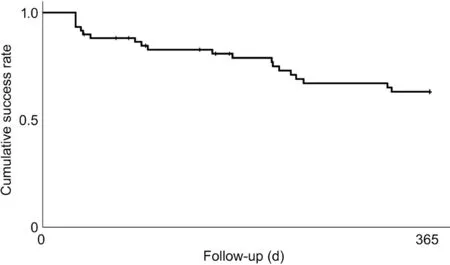
A total of 59 eyes of 59 patients were included in the study.The mean age was 69.2±15.9y, and the patients comprised 29 women. Twenty-eight eyes were POAG and 31 eyes were SOAG. Out of the 31 SOAG eyes, 18 eyes were EXG and the remaining 13 were other secondary glaucoma [uveitic (=6),steroid-induced (=5), after pars plana vitrectomy (=1),traumatic (=1)]. Four eyes had a history of trabeculotomy, 1 eye had a history of trabeculectomy, and 3 eyes had a history of selective laser trabeculoplasty. Table 1 summarizes the clinical characteristics and collected perioperative factors.There was a significant difference between the IOP measurements (<0.01, repeated measures ANOVA), and the mean IOP significantly decreased from 25.3±7.2 mm Hg preoperatively to 19.5±8.1 1wk postoperatively (<0.01), to 17.8±6.3 mm Hg 3mo postoperatively (<0.01), and to 16.1±4.4 mm Hg 12mo postoperatively (<0.01; Table 2). There was also a significant difference between measurements of the mean number of glaucoma eye drops (<0.01, repeated measures ANOVA),and the mean number of glaucoma eye drops significantly decreased from 3.9±1.1 preoperatively to 1.2±1.7 1wk postoperatively (<0.01), to 2.8±1.7 3mo postoperatively(<0.01), and to 2.1±1.8 12mo postoperatively (<0.01;Table 3). The overall cumulative surgical success rate at 12mo post-surgery was 63.1%. Figure 1 outlines the Kaplan-Meier survival curve for all cases.
Limitations of our study include its retrospective nature,limited sample size, multiple surgeons, mixture of standalone and cataract-combined surgery, and a short follow-up time.Additionally, there was no strict protocol to standardize the indications of interventions. We presumed our surgical success rate to be relatively inferior to those of previous reports. This can be attributed to the inclusion of consecutive patients,regardless of the type of glaucoma or past surgical history.Future prospective studies with the protocol of surgical indications and procedures involving a larger sample size with longer follow-up time are needed.
In conclusion, μLOT is a good treatment option for POAG eyes. However, the postoperative course should be carefully followed in cases with postoperative IOP spike.
RAPD標記技術是出現最早的分子標記技術之一,其操作簡便、成本較低及不需要DNA的序列材料等特點是其他標記技術無法比擬的[7]。……
登錄APP查看全文
猜你喜歡
房地產導刊(2022年5期)2022-06-01 06:20:14
能源工程(2022年1期)2022-03-29 01:06:28
建材發展導向(2021年12期)2021-07-22 08:06:48
建材發展導向(2021年7期)2021-07-16 07:07:52
中學生數理化(高中版.高二數學)(2021年12期)2021-04-26 07:43:48
中學生數理化(高中版.高考數學)(2021年12期)2021-03-08 01:28:50
今日農業(2020年16期)2020-12-14 15:04:59
消費導刊(2018年8期)2018-05-25 13:20:08
家庭影院技術(2018年4期)2018-05-09 07:07:41
電子制作(2017年20期)2017-04-26 06:57:45
 International Journal of Ophthalmology
2022年4期
International Journal of Ophthalmology
2022年4期
- International Journal of Ophthalmology的其它文章
- Comment on: Real-world outcomes of two-year Conbercept therapy for diabetic macular edema
- Efficacy of intravitreal conbercept combined with panretinal photocoagulation for severe nonproliferative diabetic retinopathy without macular edema
- Efficacy of conbercept after switching from bevacizumab/ranibizumab in eyes of macular edema secondary to central retinal vein occlusion
- lntraoperative complication rates in cataract surgery performed by resident trainees and staff surgeons in a tertiary eyecare center in Hungary
- Comparing surgical efficiencies between phacoemulsification systems: a single surgeon retrospective study of 2000 eyes
- Factors associated with corneal astigmatism change after ptosis surgery