
Preoperative laser reduces silicone oil use in primary diabetic vitrectomy
2022-04-19 06:58:04WenBinZhengXiaoHuDingKunBeiLaiJiZhuLiYuQingWuYuanMaZiYeChenShiDaChenSaiNanXiaoBingQianLiuYingLinTaoLi
INTRODUCTION
Diabetic retinopathy (DR) is the leading ocular complication of diabetes which cause irreversible blindness in working-age adults worldwide
. Approximately 25% of vision loss in DR patients is a result of severe complications of advanced proliferative diabetic retinopathy(PDR)
. Due to the aging population and the increasing prevalence of diabetes, the number of people suffering visionthreatening PDR has significantly increased in recent years
.Pan-retinal photocoagulation (PRP), which prevents the disease progression and reduces the risk of severe visual impairment by 50%, has been the standard treatment of high-risk PDR for decades
. However, in our experience, several patients miss the best time for laser photocoagulation treatment for various reasons and progress to severe PDR-related complications that require vitrectomy surgery. It was reported that 5.6%of patients progress to severe PDR and require a vitrectomy despite having received adequate PRP
.
Vitrectomy has been established as the ultimate treatment of severe PDR-related complications and silicone oil has been used as an effective endotamponade agent that increases the success rate of complicated cases undergoing vitrectomy
.However, once silicone oil is used as intraocular tamponade agent, a subsequent surgery for removal is required. It also brings some disadvantages, such as the progression of nuclear cataracts, poor vision prognosis, increased economic burden and may lead to other postoperative complications
. Having a clearer understanding of the risk factors of silicone oil tamponade in vitrectomy for PDR-related complications might provide novel and more effective preventive strategies. Thus,it is critical to understand the predictive factors of silicone oil tamponade in vitrectomy for PDR-related complications.However, although clinically relevant, the related factors of using silicone oil as intraocular tamponade agent during diabetic vitrectomy still unknown.
Protocol of this cross-sectional, retrospective study was reviewed and approved by the Medical Ethics Committee at Zhongshan Ophthalmic Centre (ZOC) of Sun Yat-sen University (2021KYPJ094). As this was a retrospective study, patient informed consent was waived. The study adhered to the Helsinki Declaration (2008).
The mean patient age at surgery was 52.1±10.5y (range: 18-85y),79 patients (11.4%) were under 40y of age and 158 (20%) were at least 60 years old. Demographics and clinical characteristics of the patients were showed in Table 1.
SUBJECTS AND METHODS
60例自2015年1月—2017年1月收治的肝臟核磁共振檢查患者作為分析樣本,以護(hù)理路徑為前提,分為兩組。基礎(chǔ)組30例,患者男女比18:12,年齡23~80歲,平均(51.52±10.36)歲,文化程度:初中10例,高中9例,大專(zhuān)以上11例。分析組30例,患者男女比19:11,年齡24~80,平均(52.07±10.39)歲,文化程度:初中11例,高中10例,大專(zhuān)以上9例。對(duì)比組間數(shù)據(jù),不統(tǒng)計(jì)學(xué)價(jià)值。
(1)課程結(jié)束后,進(jìn)行考核。理論考核根據(jù)教學(xué)大綱統(tǒng)一命題,統(tǒng)一試卷,統(tǒng)一評(píng)分標(biāo)準(zhǔn);操作考核統(tǒng)一操作要求和評(píng)分標(biāo)準(zhǔn),考核成績(jī)采用百分制。
Preoperative anti-VEGF combined with PRP therapy was performed in 191 eyes (23.8%),preoperative anti-VEGF without prior PRP in 387 eyes(48.6%), preoperative PRP treatment alone in 62 eyes (7.8%)and 158 eyes (19.8%) received no adjuvant pretreatment. One hundred and forty-four out of the 798 eyes (18.1%) underwent at least three sessions of PRP.
很多時(shí)候,人們的一些過(guò)失行為會(huì)導(dǎo)致電力電纜的損壞。這是由于電纜在布置的過(guò)程中,有的工作人員由于粗心或者操作方法不當(dāng),導(dǎo)致其發(fā)生扭曲或者被折,造成了電纜線的損壞,隨著使用時(shí)間的增長(zhǎng),將會(huì)影響電網(wǎng)的正常運(yùn)行。
A standard three-port 23G or 25G parsplana vitrectomy (PPV) was peformed for non-clearing VH,traction retinal detachment (TRD), combined traction and rhegmatogenous retinal detachment (TRRD), or combined VH and RD with a wide-angle viewing system in all the patients.All surgeries were conducted by one of six experienced vitreoretinal specialists, each with more than five years of experience performing vitreoretinal surgery. Intravitreal anti-vascular endothelial growth factor (VEGF) drugs(ranibizumab, aflibercept or conbercept) were administrated 3-7d prior to surgery for active neovascularization (NV) or VH at the surgeon's discretion. The blood or opacified vitreous was cleared, vitreoretinal traction was released, and fibrovascular membrane were removed. Laser was applied for retinal breaks and PRP was used in patients who had not previously undergone laser photocoagulation or in patients in whom previous laser photocoagulation was insufficient. Combined phacomusification was performed as indicated. Whether the intraocular lens was implanted at the same time depends on the fundus status. Endotamponade was achieved using the balanced salt solution, air or silicone oil, mainly according to the status of the retina at the end of the surgery. However, the patient's general condition and visual acuity of the opposite eye were also taken into consideration as silicone oil filling indicators. Balanced salt solution was used as endotamponade in case of no retinal tears was observed. Air endotamponade was used in case of within two retinal tears in a superior location. Silicone oil (5000 mPa.s; RT SIL-OL 5000; Zeiss,Berlin, Germany) was used in case of inferior retinal tears,large and more than two retinal tears, or fibrovascular membrane that could not be cleaned completely. Silicone oil removal was performed at least three months postoperative.Cataract surgery was performed when the lens opacity affects the observation of the fundus.
The medical and surgical data of the patients were retrospectively collected
the electronic medical record system. The preoperative data included patient demographics, duration of symptoms, best-corrected visual acuity, fasting blood glucose, serum cholesterol, triglycerides,serum creatinine, blood urea nitrogen, history of hypertension,use of anti-VEGF agents prior to vitrectomy, and previous treatments for DR (including local laser, PRP and vitrectomy).The operative and postoperative data collected for this study included intraocular tamponade used at the end of the surgery and recurrence of VH or RD that required subsequent surgeries.
The
statistical analyses were performed with SPSS version 25 (IBM, North Castle, NY, USA).
<0.05 was considered statistical significant. Variables were calculated using basic descriptive statistics, normally distributed continuous variables were presented as mean±standard deviation; nonnormally distributed continuous variables were presented as the median. Categorical variables were presented as number and percentage. A binary Logistic regression test was performed to identify risk factors associated with the use of silicone oil tamponade at the end of vitrectomy.
RESULTS
The aim of the present study was to identify the predictive factors for silicone oil tamponade during primary diabetic vitrectomy. In addition, the clinical characteristics of patients who underwent PPV for PDR-related complications, preoperative treatments and duration of symptoms, were also assessed.
The main indication for primary diabetic vitrectomy surgery was non-clearing VH, followed by VH combined with RD, RD affecting macular, RD threatening macular, and active fibrovascular proliferation (Table 2).
The preoperative corrected Snellen visual acuity of most patients undergoing surgery was <0.05,while 58 eyes (7.3%) had visual acuity >0.3 before surgery (Table 3).
“天脊化肥專(zhuān)營(yíng)店”是天脊集團(tuán)市場(chǎng)深耕終端發(fā)力的“橋頭堡”。天脊集團(tuán)以基層網(wǎng)絡(luò)建設(shè)為重要抓手,把“給政策”扭轉(zhuǎn)到“教技能”上來(lái),積極推進(jìn)重點(diǎn)門(mén)店向天脊化肥專(zhuān)營(yíng)店發(fā)展升級(jí)。今年驗(yàn)收通過(guò)200家,在三年內(nèi)至少建成1000家以上天脊化肥專(zhuān)營(yíng)店,讓其成為農(nóng)民豐收交流、科學(xué)種田案例示范、增產(chǎn)增效成果分享、農(nóng)民致富親身體驗(yàn)的“新時(shí)代天脊助力鄉(xiāng)村振興喜悅舞臺(tái)”。
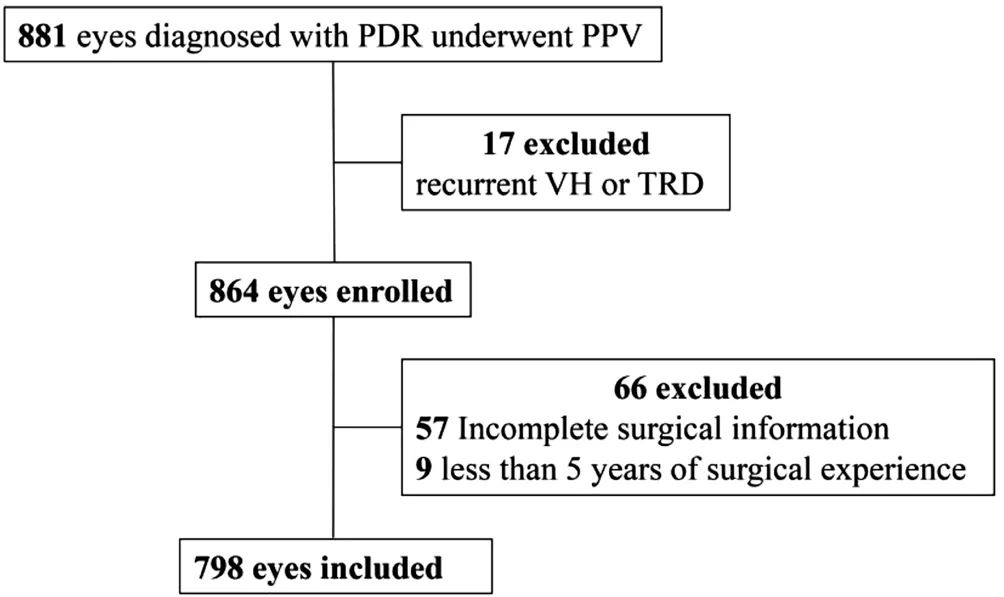
Medical and surgical records of all vitrectomy surgeries at the fundus surgery centre of ZOC from 1 January 2018 to 31 December 2018 were identified and reviewed in the electronic medical record system. A total of 881 consecutive cases of vitrectomy were identified.Patients who underwent primary vitrectomy for PDR-related complications were enrolled. Patients undergoing a secondary vitrectomy for recurrent vitreous haemorrhage (VH) or recurrent retinal detachment (RD), patients with incomplete medical or surgical records, and vitrectomies performed by surgeons with less than five years of experience were excluded from this analysis. The final analysis included 690 consecutive patients (798 eyes; Figure 1).
Nevertheless, Antoszyk
reported that anti-VEGF alone was not inferior to vitrectomy with PRP in the treatment of VH from PDR in the primary outcome of visual acuity over 6mo following initial treatment; however, vitrectomy surgery, which involves the removal of pathological vitreous and clearance of hemorrhage and scarring tissues relieving vitreoretinal traction,remains the cornerstone of treatment for late complications of PDR, even in patients with a history of optimal laser photocoagulation and other medical therapies
. The current surgical concept and techniques used in vitrectomies have dramatically advanced since the surgery reported by Diabetic Retinopathy Vitrectomy Study (DRVS)
, characterizing by the increased use of smaller gauge vitrectomy systems,application of wide-angle viewing system, injection of silicone oil to aid retinal reattachment in complicated cases, and widespread use of anti-VEGF adjuvant therapy for severe PDR-related complications
.
由表1可知,白泥的主要成分是SiO2和Al2O3,其含量分別高達(dá)68.46%和12.98%,二者通過(guò)堿液浸出獲得可溶性硅源和鋁源,能夠替代傳統(tǒng)分子篩合成過(guò)程中需要的化工原料。
相關(guān)研究表明,當(dāng)?shù)叵滤畡?dòng)力條件改變時(shí),原來(lái)被堵塞的洞隙及其相連的下部排水通道復(fù)活,重新成為地下水集中活動(dòng)的地段;……
登錄APP查看全文
猜你喜歡
當(dāng)代陜西(2022年5期)2022-04-19 12:10:18
新世紀(jì)智能(數(shù)學(xué)備考)(2021年9期)2021-11-24 01:14:28
湘潮(上半月)(2021年4期)2021-07-20 08:05:28
汕頭大學(xué)學(xué)報(bào)(自然科學(xué)版)(2020年4期)2020-12-14 07:05:00
文苑(2020年4期)2020-05-30 12:35:30
小學(xué)生作文(中高年級(jí)適用)(2018年3期)2018-04-18 01:24:47
瘋狂英語(yǔ)·新策略(2017年8期)2017-05-31 08:13:46
學(xué)習(xí)月刊(2015年21期)2015-07-11 01:51:44
少兒科學(xué)周刊·少年版(2015年4期)2015-07-07 21:11:17
語(yǔ)文知識(shí)(2014年10期)2014-02-28 22:00:56
 International Journal of Ophthalmology
2022年4期
International Journal of Ophthalmology
2022年4期
- International Journal of Ophthalmology的其它文章
- Comment on: Real-world outcomes of two-year Conbercept therapy for diabetic macular edema
- Efficacy of intravitreal conbercept combined with panretinal photocoagulation for severe nonproliferative diabetic retinopathy without macular edema
- Efficacy of conbercept after switching from bevacizumab/ranibizumab in eyes of macular edema secondary to central retinal vein occlusion
- lntraoperative complication rates in cataract surgery performed by resident trainees and staff surgeons in a tertiary eyecare center in Hungary
- Comparing surgical efficiencies between phacoemulsification systems: a single surgeon retrospective study of 2000 eyes
- Factors associated with corneal astigmatism change after ptosis surgery