
CCPG1 involved in corneal Aspergillus fumigatus infection
2022-04-19 06:57:56LiMeiWangXiaoMengChenHaiJingYanShuYanXiaoYanSunDaWeiZhangHuaYangDanLiLuChengYeChe
INTRODUCTION
Corneal diseases, especially infectious corneal diseases,are one of the leading causes of blindness worldwide
.Its importance in the prevention and treatment of eye diseases is second only to cataracts
. Fungal keratitis (FK), as a kind of blinding keratopathy, has been paid more attention globally
.In developing countries and tropical and subtropical regions,FK usually occurs after vegetative trauma
. In developed countries, improper wearing of contact lenses is the main reason for FK
. Due to the lack of effective drugs and surgical treatments, the cure of FK is still challenging.
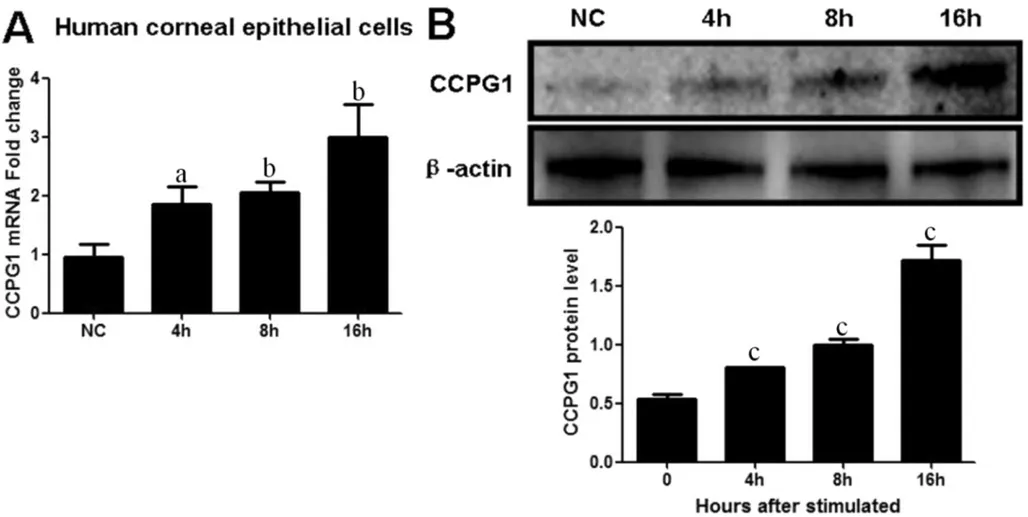
after 4h infection, the protein expression of CCPG1 increased significantly with time (Figure 1B). The above results show that CCPG1 participated in the antifungal immune response of HCECs.
Bernales
and Schuck
found that in yeast, the endoplasmic reticulum provided a membrane for autophagosomes and was also a target of autophagy. As a key intracellular organelle, the endoplasmic reticulum is responsible for overseeing the synthesis of transmembrane proteins and secreted proteins. The unfolded protein response (UPR) occurs when the endoplasmic reticulum is under stress. UPR is a response that resolves the defects of endoplasmic reticulum cavity protein inhibition through transcriptional activation.When a protein misfolds and accumulates in the endoplasmic reticulum, some signaling pathways are activated, and then a cascade reaction is triggered to inhibit translation
.
Use RNAiso plus reagent (Takara) to extract total RNA. PrimeScript RT kit (Takara) was used for reverse transcription of total RNA (2 μg). SYBR Green was used for real-time PCR.The sequences of all oligonucleotide primers used can be as follows: hβ-actinF-GCTCCTCCTGAGCGCAAG and R-CATCTGCTGGAAGGTGGACA, hCCPG1 F-GTCACACTTTTTCCCCTCCA and R-CTCAGTGGCC ATAAAGCACA.
The role of CCPG1 in UPR is still under further study. Smith and Wilkinson
, by inhibiting the expression of CCPG1,found that the expansion of endoplasmic reticulum (ER) and the destruction of cell distribution in mouse retinal acinar cells were aggravated; at the same time, molecular markers of ER stress also increased. That is to say, it is related to the loss of UPR-regulated ER phagocytosis above the maintenance of the ER.
This type of selective autophagy promotes the targeted elimination of specific organelles or cargo through the action of specific autophagy receptors. These substances are recruited and isolated into autophagosomes
.
This experiment predicts whether CCPG1 can participate in the current harmful FK, which can prevent excessive inflammation, protect the host from collateral damage and increase the treatment of FK.
MATERIALS AND METHODS
(
) strain 3.0772 was purchased from the China General Microbial Culture Collection Center (Beijing, China)and was cultured for 3-4d. Remove impurities, filter with sterile cotton gauze to obtain a pure conidia suspension, and adjust the concentration to 5×10
cfu/mL for retention.
對照組124例患者中,單獨用藥91例,占73.39%;二聯用藥8例,占6.45%;三聯用藥1例,占0.81%。干預組139例患者中,單獨用藥18例,占12.95%;無聯合用藥情況。預防性應用抗菌藥物的聯合用藥情況,見表3。
Human corneal epithelial cells(HCECs) and THP-1 macrophages were seeded into 6-well plates and 12-well plates, respectively, and then grown to 80%confluence in an incubator (37℃, 5% CO
). After stimulation with
conidia for 4, 8, and 16h later, the cells were collected and lysed, and then qRT-PCR and Western blot tests were performed.
disease, a common inflammatory bowel disease. This noncanonical autophagy pathway can prevent inflammation during the process of removing dead cells and protect autoimmunity and inflammatory bowel disease
.
Cell cycle progression 1 (CCPG1) is an endoplasmic reticulum protein induced by endoplasmic reticulum stress. Its expression is up-regulated under the induction of UPR. It can interact with GABARAP and LC3 family proteins
.
夾層加熱系統的投入減少機組啟動時間,降低上下缸溫差,改善機組啟動條件,有效避免因加熱膨脹不均可能發生的碰磨引起振動。鍋爐點火起壓后,爐側壓力為0.2~0.5 MPa,凝汽器建立真空后稍開聯箱進汽門,維持聯箱壓力0.1~0.3 MPa,對汽輪機汽缸夾層加熱供汽及聯箱暖管疏水;汽輪機沖轉到500 r/min投入汽缸夾層加熱,控制汽缸溫升率小于1.5 ℃/min,使汽缸內外加熱均勻;高壓外缸下半外壁金屬溫度達到320 ℃時停用夾層加熱系統。
The HCECs and THP-1 were collected and placed in RIPA buffer (Solarbio, China): PMSF (Solarbio,China): phosphatase inhibitor cocktail I (MedChemExpress,USA) at a ratio of 98:1:1 and lysed on ice. A BCA kit (Solarbio,China) was used to determine the protein concentration.
Then used 8%-16% SDS-PAGE gel (GenScript, China)for total protein electrophoresis, and transfferd to PVDF membrane. The PVDF membrane was blocked in blocking buffer (Beyotime, China) at 37℃ for 2h, and with antiinterleukin-1β (IL-1β) primary antibody incubated (R&D,USA) or anti-β-actin primary antibody (CST, USA) or anti-CCPG1 primary antibody (Santa Cruz Biotechnology, USA)overnight at 4℃. The membrane was then incubated with HRP-labeled secondary antibody. Western ECL blotting substrate (Bio-Rad, USA) was added to the PVDF membrane to develop blots. Digital images were analyzed using a Vilber Solo 4S chemiluminescence imaging system.
The slides with THP-1 cells were soaked in phosphate buffer saline (PBS) for 3 times,and fixed with 4% paraformaldehyde. Then the slides were permeated with 0.5% Triton X-100 (prepared in PBS) for 20min at room temperature, and immersed in PBS 3 times.Next, normal goat serum was added to the slides, blocking for 30min at 37℃; then the slides were incubated overnight with the following antibodies: anti-CCPG1 (Santa Cruz Biotechnology, USA), anti-CLEC1 (Novus, USA).
Honest()(?)??X?x.Computes(X,{RB}K)∧Send(X,x)∧Contains(x,{RB}K)∧After(Send(X,x),Receive(B,{,
According to STRING Interaction Network Preview(Figure 4A), we predicted that C-type lectin-like receptor-1(CLEC-1) and CCPG1 might be interacting proteins.Immunofluorescence results showed that CCPG1 and CLEC1 proteins were distributed in macrophages, and there was obvious intracytoplasmic co-localization (Figure 4B).
The statistical significance of each score and qRT-PCR was determined by
-test. The data are expressed as mean±standard deviation (SD) and analyzed by GraphPad 5.0 software. When
<0.05, the data is considered significant.
RESULTS
After stimulation by
, the mRNA expression of CCPG1 increased indistinctively in THP-1 pretreated with dectin-1 neutralizing antibody (Figure 3A). But compared with the control group, there was no statistical difference.
Recent studies have shown that autophagy plays an immunomodulatory role in innate and adaptive immune responses by selectively targeting signal transduction molecules. Autophagy is a highly conserved cellular process in eukaryotes. Its function of maintaining cell homeostasis is achieved by supporting cell survival and regulating inflammation. Autophagy can degrade unnecessary or functionally abnormal intracellular components, such as abnormal proteins, old organelles
and pathogens
, and has been extensively studied in various immune cells including T cells
, B cells
, and macrophages
. More and more evidences show that autophagy plays an important role in the host's defense against microbial infections and inflammation.For example, it can inhibit the activation of inflammasomes in macrophages
, and may eliminate active inflammasomes through p62 ubiquitination
.
Similarly,
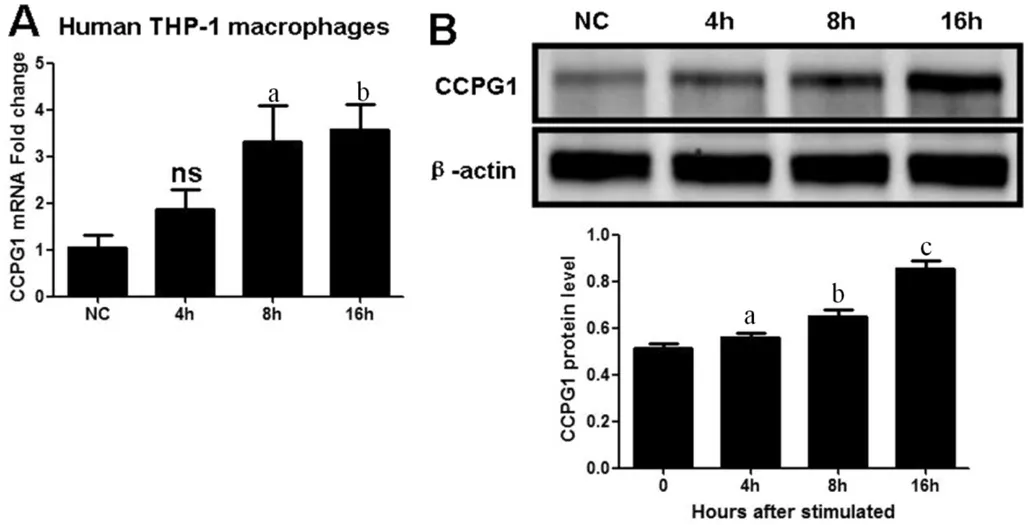
stimulated THP-1 to establish cell models. The mRNA expression of CCPG1 did not change significantly after 4h, and increased significantly after 8 and 16h (Figure 2A). Through the Western blot experiment, differently, we observed that the protein level of CCPG1 began to increase after 4h stimulation, and increased significantly after 8 and 16h (Figure 2B). Accordingly, CCPG1 also participated in the THP-1 antifungal immune response.
stimulated HCECs to establish fungal infection cell models. qRT-PCR results showed that the mRNA expression of CCPG1 increased after 4h, and the CCPG1 mRNA levels increased significantly with time (Figure 1A). Western blot experiments showed that
The protein expression level of IL-1β was significantly decreased compared with the control group. However,treatment with dectin-1 neutralizing antibody did not affect the protein expression of CCPG1 (Figure 3B). Although all regulate the immune response by participating in noncanonical autophages, there was no necessary connection between dectin-1 and CCPG1.
Fluorescent secondary antibody (ProteinTech) was added in the dark for 1h, and then the slides were soaked with PBST 3 times. Next, DAPI solution (Solarbio, China) was added dropwise and incubated for 5min in the dark, and then the specimens were stained with nuclei and immersed in PBST 3 times. Finally, a fluorescence micrograph was taken by Zeiss Axiovert microscope.
DISCUSSION
Autophagy was originally described as a process of selfdecomposition, but now it is known that it plays a key role in the face of many aspects such as bacteria, viruses and parasitic pathogens
. Recent mechanism studies have shown that autophagy played an immunomodulatory role in innate and adaptive immune responses by selectively supplementing signal molecules
. In the past decade, another form of autophagy had emerged, called LC3- (microtubule-associated protein 1A/1b light chain 3-)-associated phagocytosis (LAP)or non-canonical autophagy. LAP is a unique pathway that participates in cell surface receptor signaling by recruiting the LC3-phosphatidylethanolamine (PE) binding system during phagocytosis
.
精神分裂癥屬于精神疾病的一種,其發病率在6.55%左右,陰性癥狀、陽性癥狀以及認知功能障礙為患者主要臨床癥狀,早期患者主要有發呆、不理睬人及反應不靈敏等臨床表現,隨著病情逐漸發展,患者可出現妄想、幻覺等嚴重表現。本文主要選取了74例急性期精神分裂癥患者為研究對象,分別給予氨磺必利與奧氮平治療,對比兩種方法的臨床療效,現報告如下。
LAP has recently become a major anti-inflammatory pathway,playing an important role in intracellular and physiological
.Jostins
found that LAP was associated with Crohn's
THP-1 macrophages were pretreated with dectin-1 neutralizing antibody (R&D) and IgG neutralizing antibody (R&D) for 2h.After 16h of stimulation with
conidia, the cells were collected for qRT-PCR and Western blot.
權箏今天在小花園跟何東分手后就打電話找發小兒丁香。丁香一聽出了這么大的事兒,馬上請假來見她。丁香是精神病醫生,倆人分析結果,何東是恐婚,給他點時間讓他不恐。
拮抗真菌種類較多,主要為木霉屬,其次是酵母菌,另外也發現擔子菌、炭角菌、擬莖點霉屬和擬盤多毛孢屬等對果蔬病原菌有拮抗作用[5]。顏霞等[7]從菊科植物假橐吾中分離得到86株內生真菌,分為10個屬,交鏈孢霉屬和絲核菌屬占優勢 (分別為41.9%和16.3%),其中31株內生真菌分別對細菌、植物病原菌有顯著的抑制作用。……
登錄APP查看全文
 International Journal of Ophthalmology
2022年4期
International Journal of Ophthalmology
2022年4期
- International Journal of Ophthalmology的其它文章
- Comment on: Real-world outcomes of two-year Conbercept therapy for diabetic macular edema
- Efficacy of intravitreal conbercept combined with panretinal photocoagulation for severe nonproliferative diabetic retinopathy without macular edema
- Efficacy of conbercept after switching from bevacizumab/ranibizumab in eyes of macular edema secondary to central retinal vein occlusion
- lntraoperative complication rates in cataract surgery performed by resident trainees and staff surgeons in a tertiary eyecare center in Hungary
- Comparing surgical efficiencies between phacoemulsification systems: a single surgeon retrospective study of 2000 eyes
- Factors associated with corneal astigmatism change after ptosis surgery