
能源材料新時代
2022-04-12 02:58:20曾海波黃富強
無機材料學報 2022年2期
曾海波, 黃富強
能源材料新時代
曾海波1, 黃富強2,3,4
(1. 南京理工大學 材料科學與工程學院, 新型顯示材料與器件工信部重點實驗室, 南京 210094;2. 中國科學院 上海硅酸鹽研究所, 高性能陶瓷和超微結構國家重點實驗室, 上海 200050;3. 中國科學院大學 材料科學與光電技術學院, 北京 100049;4. 北京大學 化學與分子工程學院, 稀土材料化學及應用國家重點實驗室, 北京 100871)
人類發展的歷史, 也是能源變革的歷史, 人類社會的每一次技術革命無不伴隨著對能源認識、開發和利用的創新與進步。當下, 我國已經成為全球排名第一的能源生產和消費大國, 并且兩個總量還在不斷攀升。能源技術是解決對傳統化石能源過度依賴及環境污染等問題, 構建合理的社會能源結構, 推進可持續發展, 實現“雙碳”減排的關鍵手段。2020年, 我國以太陽能、風能為代表的可再生能源增長達到全世界的三分之一, 發展迅速。這其中, 能源材料是能源工業和能源技術體系中涉及的特殊材料, 在實現清潔能源的轉化和利用, 發展新能源技術, 以及支撐整個能源系統中扮演著核心角色。
近年來, 能源材料在諸多領域取得了廣泛而持續的發展, 包括二次電池、燃料電池、太陽能電池、超級電容器、光電催化、含能材料等。比如, 以高鎳三元材料(NCM)為代表的新型鋰離子電池正極材料, 正引領著新一代汽車動力電池技術的發展, 以支持更快的充電速度、更久的服役壽命和更長的行駛里程[1-4]。不斷提升的儲能需求也催生了一系列新型電池技術, 如鋰硫[5]、鋰空氣[6]電池體系, 以及固態電池[7]技術等, 多種技術并行發展。它們在能量密度、經濟性、安全性等方面各具優勢, 但也存在如鋰硫電池中多硫化鋰造成的穿梭效應, 鋰空氣電池中放電產物易堵塞基底的孔道以及固態電池中電解質的電導率不佳等諸多問題, 其技術完善和產業化推動強烈依賴于電極和電解質材料的創新設計和結構優化。同時, 為了提高非化石能源占一次能源的消費比, 太陽能電池作為新能源技術的翹楚, 被寄予厚望。其中, 以鈣鈦礦為代表的第三代太陽能電池技術已獲得與單晶硅相媲美的光電轉換效率[8], 讓人們對光伏產業的未來充滿了期待, 然而其對溫、濕、光、氧的敏感性和不穩定性[9], 以及在材料制備過程中難以回避污染環境的含Pb原料, 種種問題仍需從材料的底層設計中尋求解決之道。此外, 以Pt、Pd等貴金屬為代表的傳統催化劑材料不斷優化, 以及開發的新型非貴金屬、非金屬催化劑, 正逐步提高燃料電池的能量轉換效率, 降低其技術成本, 并已取得了一定程度的商業化應用[10-11]。同時, 涉及如CO2還原、固氮等過程的光、電催化新材料與新技術, 也為可再生能源的存儲及利用形式提供新的出口, 為2030年完成碳達峰、2060年實現碳中和提供技術支撐[12-13]。
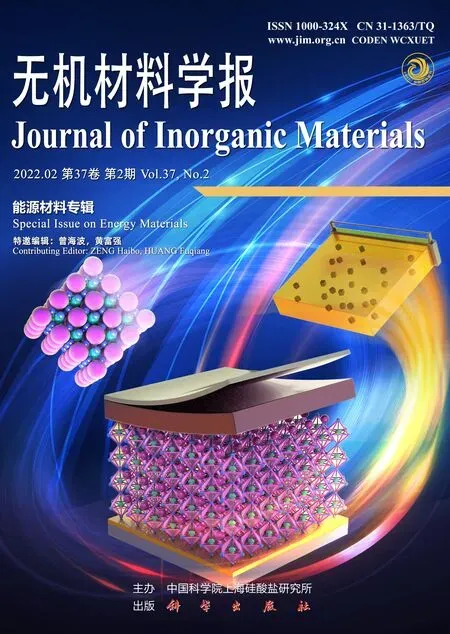
在可持續發展的時代大背景以及競爭激烈的國際前沿科技大環境下, 我國在能源材料的理化機理探索、功能發現、精準設計制備以及先進器件組裝等方面做出了許多開創性的工作。為集中展示我國學者在相關領域的研究成果, 推動學術交流, 激發社會各界對能源材料的興趣, 南京理工大學聯合中國科學院上海硅酸鹽研究所、華中科技大學等單位組織出版“能源材料專輯”, 專輯收錄了能源材料相關的最新研究論文和綜述文章, 涉及鈣鈦礦太陽能電池、半透明太陽能電池、鋰離子電池、鎂電池、鋰硫電池、熱電、二氧化碳裂解等。期望該專輯能夠拋磚引玉, 為促進我國能源材料的科學研究和學科發展提供有益參考。
Energy Materials in New Era
ZENG Haibo1, HUANG Fuqiang2,3,4
(1. MIIT Key Laboratory of Advanced Display Materials and Devices, School of Materials Science and Engineering, Nanjing University of Science and Technology, Nanjing 210094, China; 2. State Key Laboratory of High Performance Ceramics and Superfine Microstructure, Shanghai Institute of Ceramics, Chinese Academy of Sciences, Shanghai 200050, China; 3. Center of Materials Science and Optoelectronics Engineering, University of Chinese Academy of Sciences, Beijing 100049, China; 4. State Key Laboratory of Rare Earth Materials Chemistry and Applications, College of Chemistry and Molecular Engineering, Peking University, Beijing 100871, China)
In the long river of human history, every technological revolution is accompanied by transition of cognition, development and utilization of energy. At present, China has become the No. 1 in the world in both production and consumption of energy, which continue rising in the expected future. Developing energy technology is still a key way to solve the problems of excessive dependence on traditional fossil energy and environmental pollution, construct a reasonable social structure, promote the sustainable development of human society, and achieve the goals of carbon emission peaking and carbon neutrality. In 2020, renewable energy in China such as photovoltaics and wind power evolved marvelously which occupied 1/3 of global total volume. In this regard, energy materials are indispensable components, which play the core role in realizing conversion and utilization of clean energy, developing new energy technologies, and supporting the entire energy system.
In recent years, energy materials have achieved extensive and sustainable development in many fields, including secondary batteries, fuel cells, solar cells, supercapacitors, photoelectric catalysis, and energy-containing materials. For example, high nickel ternary materials as cathode material in the lithium-ion battery are leading the future of a new generation of automotive power battery technology towards faster charging speed, longer service life and longer mileage[1-4]. The ever increasing demand for energy storage has also spawned simultaneously a series of new battery technologies, such as lithium-sulfur[5], lithium-air[6]and solid-state batteries[7]. They have advantages in energy density, economy and safety, but technical defects (, shuttle effect in Li-S battery attributed to polysulfides, blockage of matrix pores in Li-air battery attributed to discharging product, unsatisfactory electrical conductivity of electrolyte in solid-state battery) are frustrating. Technological improvement and industrialization are strongly dependent on the innovative design and structural optimization of electrode and electrolyte materials. To promote the share of renewable energy in primary source, photovoltaics, the representative of new energy, has received great expectation. In addition, halogen perovskite-based third-generation solar cell technology has achieved a solar energy conversion efficiency comparable to that of silicon single crystal, showing a prosperous photovoltaic industry in the future[8]. However, its sensitivity to temperature, humidity, light, and oxygen[9], and inevitable Pb-containing raw material in preparation still need to find a solution in the underlying materials design. Moreover, as continuously optimizing the traditional catalyst materials, like Pt and Pd, as well as the non-precious and non-metallic catalysts, the energy conversion efficiency of fuel cells has been gradually improved with reduction of their technical costs, meeting a certain degree of commercial application[10-11]. Besides, photocatalytic and electrocatalytic technologies for CO2reduction and nitrogen fixation also provide a new way for the storage and utilization of renewable energy, technically supporting the carbon emission peak in 2030 and carbon neutrality in 2060[12-13].
In the context of the era of sustainable development and the fiercely competitive international scientific and technological frontier research environment, in the energy materials research, including the exploration of physical and chemical properties, function discovery, precise design and preparation of nanomaterials, and advanced device assembly, China has made many important breakthroughs. In order to focus on displaying the research results of Chinese scholars in this field, to promote academic exchanges among peers, and to stimulate interest in energy materials from all walks of life, Nanjing University of Science and Technology, Shanghai Institute of Ceramics, Huazhong University of Science and Technology,hereby organize the “Special Issue on Energy Materials”, containing the latest research articles and reviews related to energy materials involving perovskite photovoltaics, semitransparent solar cell, Li-ion battery, Mg battery, Li-S battery, thermoelectrics, CO2splitting,. It is hoped that this special issue can offer useful references for the scientific research and disciplinary development of energy materials in China.
[1] SUN Y K, CHEN Z H, NOH Y J,. Nanostructured high-energy cathode materials for advanced lithium batteries., 2012, 11: 942–947.
[2] BAI X, BAN L, ZHUANG W. Research progress on coating and doping modification of nickel rich ternary cathode materials., 2020, 35(9): 972–986.
[3] LIU Y, BAI H, ZHAO Q,. Storage aging mechanism of LiNi0.8Co0.15Al0.05O2/graphite Li-ion batteries at high state of charge.., 2021, 36(2): 175–180.
[4] SCHIPPER F, DIXIT M, KOVACHEVA D,. Stabilizing nickel-rich layered cathode materials by a high-charge cation doping strategy: zirconium-doped LiNi0.6Co0.2Mn0.2O2., 2016, 4: 16073–16084.
[5] YUAN K, YUAN L X, CHEN J,. Methods and cost estimation for the synthesis of nanosized lithium sulfide.,2021,2:2000059.
[6] JUNG H G, HASSOUN J, PARK J B,. An improved high- performance lithium-air battery., 2012, 4: 579–585.
[7] KATO Y, HORI S, SAITO T,. High-power all-solid-state batteries using sulfide superionic conductors., 2016, 1:16030.
[8] Best Research-Cell Efficiency Chart. [2021-10-20] https://www. nrel.gov/pv/cell- efficiency.html, 2021.
[9] YANG D D, LI X M, MENG C F,. Research progress on the stability of CsPbX3nanocrystals., 2020, 35(10): 1088–1098.
[10] LIN G X, JU Q J, JIN Y,. Suppressing dissolution of Pt-based electrocatalysts through the electronic metal-support interaction., 2021, 11: 2101050.
[11] FAN C, JIANG X, CHEN J,. Low-load Pt nanoclusters anchored on graphene hollow spheres for efficient hydrogen evolution.,2021,2:2000017.
[12] WANG Z H, HU X, LIU Z Z,. Recent developments in polymeric carbon nitride-derived photocatalysts and electrocat-alysts for nitrogen fixation., 2019, 9: 10260–10278.
[13] VOIRY D, CHHOWALLA M, GOGOTSI Y,. Best practices for reporting electrocatalytic performance of nanomaterials., 2018, 12(10): 9635–9638.

曾海波, 國家杰出青年基金獲得者, 國家萬人計劃領軍人才, 美國光學會/英國皇家化學會會士, 科睿唯安全球高被引科學家, 愛思維爾全球2%頂尖科學家, 現任南京理工大學材料學院院長。長期從事半導體光電材料與器件的教學和研究工作, 包括發光材料與成像顯示技術, 吸波材料與隱身技術, 二維半導體與集成電路技術, 先后主持國家重點研發計劃項目課題、國家自然科學基金重點項目、國防科技創新特區“火花課題”重點項目。獲授權發明專利45項, 以第一或通訊作者發表、、等期刊論文235篇, ESI高被引論文45篇, SCI引用40,000余次, H因子101。E-mail: zeng.haibo@njust.edu.cn
黃富強, 博士, 中國科學院上海硅酸鹽研究所研究員, 北京大學教授, 中國化學會能源化學專業委員會主任, 國家杰出青年科學基金獲得者。長期從事無機固體化學與新能源材料及器件研究, 擔任國家重點研發計劃、科技委重點項目及863首席科學家, 發表、等學術論文600余篇, 申請發明專利150余項, 以第一完成人獲國家自然科學二等獎(2017年)、上海市自然科學一等獎(2016、2019年)。E-mail: huangfq@mail.sic.ac.cn

南京理工大學是隸屬于工業和信息化部的全國重點大學, 坐落在鐘靈毓秀、虎踞龍蟠的古都南京, 辦學環境宜人, 基礎設施一流。學校由創建于1953年的新中國軍工科技最高學府——中國人民解放軍軍事工程學院(簡稱“哈軍工”)分建而成。近年來, 學校立足南京、面向江蘇, 不斷延伸和擴展辦學面, 形成了“一校三區”的發展布局, 是國家首批“211工程”重點建設院校和“985工程優勢學科創新平臺”項目重點建設高校, 2017年入選國家“雙一流”建設高校。
南京理工大學被譽為“兵器科學與技術的搖籃”, 科技優勢突出, 標志性成果不斷涌現。始終堅持面向國家重大戰略, 瞄準科技前沿, 在先進發射、光電信息、導航制導、先進材料等科技領域處于國內領先水平。2019年10月, 由我校擔任總師單位研制的武器裝備亮相中華人民共和國成立70周年閱兵式, 接受了黨和全國人民的檢閱。學校大力推進產學研合作, 發揮國家級技術轉移中心和校外研究院的作用, 推動重大科技成果的轉化應用, 服務國家和地方經濟社會發展, 民用爆破、特種超細粉體制備、智能熔敷焊、滾動功能部件測試等技術, 填補了相關領域的空白, 創造了顯著的經濟效益和社會效益。
近年, 為響應國家能源結構調整戰略, 推進可持續發展, 保障能源安全, 南京理工大學在國際上也逐漸發展成既有鮮明特色的研究領域, 如含能材料、航天燃料和生物質燃料, 也有民用的高能量密度、高安全性的儲能材料和器件, 熱電、光電、光熱等重要的新型能源轉化系統的科研院校。在含能材料領域, 2017年研制出世界上首個全氮陰離子鹽, 為我國占領全氮類超高能量密度材料的制高點打下了關鍵基礎, 現代含能材料也正朝著高能量密度、高可靠性和安全性的方向快速發展。在光電器件領域率先開發了全無機鈣鈦礦量子點室溫合成方法及其QLED發光器件, 被同行在等期刊數十次評價為“首次(first)”、“發起了(initiated)”、“開啟了(opened)”。在能源存儲領域設計了一種具有層狀和尖晶石共生異質結構的LiMnO2陰極, 為抑制錳基正極材料中的姜–泰勒畸變提供了嶄新途徑, 推動了可持續性、規模化儲能器件的商業化發展。
1000-324X(2022)02-0113-04
10.15541/jim20211002
- 無機材料學報的其它文章
- Thermodynamic and First-principles Assessments of Materials for Solar-driven CO2 Splitting Using Two-step Thermochemical Cycles
- 半透明太陽能電池的熱力學極限效率研究
- 金屬氰胺化合物的結構、合成及電化學儲能應用
- 醋酸鉛添加劑在印刷鈣鈦礦太陽能電池中的應用
- 鈉離子電池Na3Zr2Si2PO12陶瓷電解質的噴霧干燥法制備及性能優化
- Amorphous LiSiON Thin Film Electrolyte for All-solid-state Thin Film Lithium Battery