植物天然產物的葡萄糖醛酸苷生物合成的研究進展
2022-03-21 02:16:10陳秉松王昭昕楊雨帆顏曉暉
中草藥 2022年6期
陳秉松,周 迎,王昭昕,楊雨帆,邱 峰,顏曉暉*
植物天然產物的葡萄糖醛酸苷生物合成的研究進展
陳秉松1, 2,周 迎3,王昭昕2,楊雨帆2,邱 峰1*,顏曉暉2*
1. 天津中醫藥大學中藥學院,天津 301617 2. 天津中醫藥大學 組分中藥國家重點實驗室,天津 301617 3. 天津中醫藥大學國際學院,天津 301617
葡萄糖醛酸化是一類重要的由葡萄糖醛酸轉移酶(UDP-glucuronosyltransferase,UGT)催化的Ⅱ相代謝反應,負責多種體內內源性和外源性物質的清除。葡萄糖醛酸化影響內源或外源性物質在組織中的分布水平,對藥物的藥效和不良反應有巨大的影響。UGTs廣泛分布于機體的各種組織中,不同亞型之間存在組織差異性和底物特異性。葡萄糖醛酸苷的制備為植物天然產物的藥理活性、藥動學性質、藥物間相互作用等研究提供了基礎。綜述了植物天然產物酚類、香豆素類、木脂素類、生物堿類、萜類等葡萄糖醛酸苷生物合成的研究進展,為這類化合物的制備和藥理活性研究提供參考。
植物天然產物;葡萄糖醛酸苷;葡萄糖醛酸轉移酶;生物合成;多酚類;香豆素類;木脂素類;生物堿類;萜類
葡萄糖醛酸化是生物體內通過葡萄糖醛酸轉移酶(UDP-glucuronosyltransferase,UGT)催化進行的II相代謝反應,在這類反應中,UGT催化葡萄糖醛酸從尿苷二磷酸葡萄糖醛酸(uridine 5′-diphosphoglucuronic acid,UDPGA)轉移到內源性物質(如膽紅素、類固醇激素和脂溶性維生素等)和外源性物質(藥物、食物、環境毒物等)上生成相應的葡萄糖醛酸苷產物[1]。葡萄糖醛酸化通常導致產物水溶性增強,活性降低,可加快底物分子通過腎臟、膽汁或腸道清除。據統計,葡萄糖醛酸化代謝約占所有藥物Ⅱ相代謝的35%[2]。因此,葡萄糖醛酸化在維系內源性物質平衡和體內外源性物質的清除中發揮關鍵調控作用,影響藥物在組織中的分布和水平,對藥物的藥效和不良反應有巨大的影響,UGT也是機體發育[3-4]和疾病發生[5-7]的重要指標。在葡萄糖醛酸化反應過程中,UGT催化底物分子的親核基團進攻葡萄糖醛酸,發生雙分子親核取代反應反應,葡萄糖醛酸中C1位羥基的構象發生翻轉,生成β--葡萄糖醛酸苷和尿苷二磷酸,通常按照底物中親核基團的不同,把葡萄糖醛酸化反應分為-、-、-和-葡萄糖醛酸化[8](圖1)。大多數底物分子結合葡萄糖醛酸基團后水溶性增加,藥理活性降低,清除率增加,但是一些葡萄糖醛酸代謝產物與底物相比具有更強的活性[9]。如阿片類藥物嗎啡在UGT2B7的催化下可產生嗎啡6--葡萄糖醛酸苷(morphine-6-glucuronide,M6G)和嗎啡3--葡萄糖醛酸苷(morphine-3-glucuronide,M3G),研究發現M6G的麻醉效果是嗎啡的100倍,M3G具有明顯的中樞興奮作用[10]。化合物methyl 1-(3,4-dimethoxyphenyl)-3-(3-ethylvaleryl)-4-hydroxy-6,7,8-trimethoxy-2-naphthoate(S-8921)是一種腸道頂端鈉依賴性膽汁轉運蛋白(apical sodium-dependent bile acid transporter,ASBT)抑制劑,體外抑制實驗表明其葡萄糖醛酸化代謝物S-8921G對人ASBT的抑制作用比原型藥物強6000倍[11]。
UGT廣泛分布在機體的各種組織器官如肝、腎、腸、胃、皮膚、胸腺、腦中,不同UGT的表達具有不同的組織特異性,對于內源性和外源性物質也具有不同的底物選擇性和位點選擇性,導致了體內葡萄糖醛酸化反應的高度復雜性(圖2)。目前研究較為廣泛的、以UDPGA為糖基供體的人源UGT可分為3個家族(UGT1A、UGT2A和UGT2B),包括19個亞型(UGT1A1、UGT1A3、UGT1A4、UGT1A5、UGT1A6、UGT1A7、UGT1A8、UGT1A9、UGT1A10、UGT2A1、UGT2A2、UGT2A3、UGT2B4、UGT2B7、UGT2B10、UGT2B11、UGT2B15、UGT2B17和UGT2B28)[9]。參與藥物代謝的主要是UGT1A和UGT2B 2個家族,對這2個家族酶的表達和底物特異性研究也最多。近年來隨著對UGT在內源和外源物質代謝、生長發育和疾病發生方面的深入研究,特別是因UGT基因多態性,相同藥物在不同的人群中會產生不同的有效性和毒性[12],藥物研發人員越來越重視藥物葡萄糖醛酸化產物的藥理活性、成藥性和安全性等問題。伍明江等[13]采用超高效液相色譜與四級桿飛行時間質譜聯用(UPLC-Q-TOF/MS)技術,從口服桑葉黃酮提取物的大鼠血漿、尿液、糞便、膽汁中分析鑒定了包括葡萄糖醛酸化代謝產物在內的41個代謝產物。Zhao等[14]通過收集給藥大鼠的尿液,分離獲得4--β--葡萄糖醛酸化根皮素和6-甲氧基-2--β--葡萄糖醛酸化根皮素,但從生物樣品中直接提取生物體內的代謝產物,所需生物樣品量大,成本高,不利于后續的藥理活性研究。雖然可以通過Koenigs-Knorr反應利用鹵代糖作為葡萄糖醛酸的供體來化學合成葡萄糖醛酸衍生物,但這一反應需要經過多個保護和脫保護步驟,合成效率普遍不高[15-16]。相比之下,利用UGT制備葡萄糖醛酸化產物具有反應條件溫和、選擇性好、合成步驟少、產物后處理容易等優勢,越來越受到青睞。本文對植物天然產物葡萄糖醛酸化的催化酶、作用位點、化合物結構及近年來利用UGT制備植物天然產物的葡萄糖醛酸化衍生物的研究進展進行綜述。
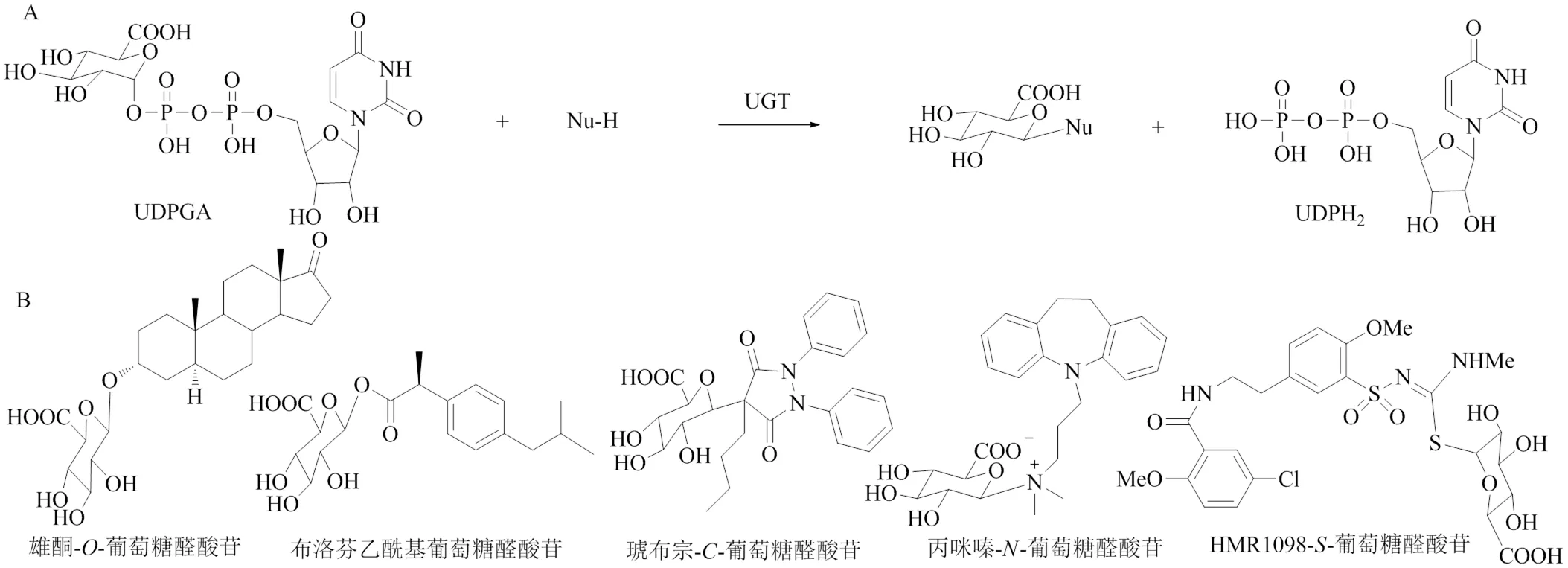
圖1 UGT介導的葡萄糖醛酸化反應(A)及不同類型的葡萄糖醛酸化產物(B)

圖2 葡萄糖醛酸轉移酶進化樹分析、組織分布和代表性底物
1 葡萄糖醛酸化代謝研究的體外模型
當前常用的研究葡萄糖醛酸化代謝的體外模型主要有原代肝細胞、微粒體和重組UGT等[17]。原代肝細胞是與人體肝臟最接近的模型,但其代謝活性在培養過程中會明顯減弱,不同批次代謝活性差異大,且因為肝細胞來源短缺、操作復雜,難以廣泛應用。微粒體是細胞內膜系統(主要為內質網)的膜結構破碎后形成的囊泡,一般通過組織勻漿、差速離心法制備,制備的微粒體包含了大量的UGT。因為肝臟、腎臟和腸道是動物代謝外源物質的主要組織,所以肝微粒體、腎微粒體和腸微粒體是最常用的微粒體模型。相對于原代肝細胞,微粒體具有易制備、易操作等優點,但其需要消耗動物資源,而且種屬及個體差異會導致批次間的穩定性差,難以實現葡萄糖醛酸化代謝物的規模化制備。重組UGT酶是利用DNA重組技術將編碼UGT的基因轉入哺乳動物細胞(COS、V79和HEK293)、昆蟲細胞(Sf9)中,實現其高效、專一表達。目前UGT1A1、UGT1A3、UGT1A4、UGT1A6、UGT1A7、UGT1A8、UGT1A9、UGT1A10、UGT2B4、UGT2B7、UGT2B15、UGT2B10、UGT2B17等人源UGT已經實現了以哺乳動物細胞為宿主的商業化重組表達[8]。利用重組UGT,可以研究不同酶的底物特異性,制備目標化合物的葡萄糖醛酸化衍生物,比較原型藥物和衍生物在吸收、分布、代謝、外排等方面的性質差異。重組UGT也為研究基因多態性與藥物代謝差異性提供了模型[18]。
2 利用體外模型制備植物天然產物的葡萄糖醛酸苷
2.1 酚類化合物的葡萄糖醛酸苷
2.1.1 類黃酮化合物的葡萄糖醛酸苷 類黃酮化合物具有抗氧化、抗炎、抗病毒等多種活性,在植物中主要以糖苷、酯等結合物形式存在,不易被機體吸收。類黃酮攝入后通常先被腸道中的酶及微生物水解成游離形式的苷元,被吸收后在UGT的作用下生成葡萄糖醛酸化衍生物,經由膽汁、糞便、尿液等途徑排出體外,呈現明顯的首關效應。類黃酮化合物的葡萄糖醛酸化反應主要由UGT1A家族中的6種酶UGT1A1、UGT1A3、UGT1A7、UGT1A8、UGT1A9、UGT1A10催化,UGT2B7和UGT2B15也可參與部分類黃酮化合物的代謝[1]。這些UGT酶在各個組織中的表達水平不同,對于不同類黃酮底物的選擇性也有較大差異,導致體內類黃酮化合物的代謝具有組織特異性。如山柰酚(kaempferol)在大鼠體內存在山柰酚-7-葡萄糖醛酸苷(K-7-G)和山柰酚-3-葡萄糖醛酸苷(K-3-G)2種代謝產物,在小腸中更多生成K-3-G,而用大鼠肝微粒體催化山柰酚,主要的代謝產物是K-7-G[19]。此外,UGT針對不同類黃酮化合物中酚羥基的葡萄糖醛酸化也存在位點選擇性。以木犀草素(luteolin)為例,人源重組UGT代謝研究表明其葡萄糖醛酸化代謝主要由UGT1A9、UGT1A6和UGT1A1催化,其中UGT1A9的代謝能力最強,介導其C7-OH和C3′-OH的葡萄糖醛酸化反應,UGT1A6介導C7-OH的葡萄糖醛酸結合,而UGT1A1可催化木犀草素C3′--葡萄糖醛酸苷中C7-OH與葡萄糖醛酸的結合,生成C7-OH和C3′-OH的雙葡萄糖醛酸化產物[20]。由于類黃酮化合物的生物活性主要取決于羥基,特別是游離羥基的數目和位置,因此不同UGT對于這類化合物在體內的活性有重要影響。
2.1.2 白藜蘆醇及其類似物的葡萄糖醛酸苷 白藜蘆醇(resveratrol)及其類似物包括白皮杉醇(piceatannol)、氧化白藜蘆醇(oxyresveratrol)、二芳基乙烯(combretastatin)、紫檀茋(pterostilbene)等,具有抗腫瘤、抗氧化和抗心血管疾病等多種活性,但口服后被肝細胞和腸上皮細胞中的UGT1A1、UGT1A3、UGT1A6、UGT1A7、UGT1A8、UGT1A9、UGT1A10以及磺基轉移酶代謝,經由膽汁、尿液等途徑清除,導致進入血液循環的白藜蘆醇類化合物的原型濃度極低,其生物利用度幾乎為零[21]。姜黃素(curcumin)可用于治療腫瘤、糖尿病、炎癥、神經退行性疾病、代謝綜合征等,但因極低的口服生物利用度和在生理條件下降解快等缺點,限制了姜黃素的臨床開發[22]。UGT1A1、UGT1A8和UGT1A10是主要的姜黃素及去甲氧基姜黃素的酚羥基葡萄糖醛酸化酶,而雙去甲氧基姜黃素不易被葡萄糖醛酸化;UGT1A9可以同時催化姜黃素酚羥基和碳鏈上醇羥基的葡萄糖醛酸化[23]。大麻酚(cannabinol)是從大麻中分離的一種活性物質,可與免疫細胞表面抑制性G蛋白偶聯受體CB1和CB2結合,大麻酚與CB2受體的結合與激活能力更強,因此可以發揮CB2受體治療神經病理性疼痛的作用,而不產生CB1受體相關的中樞性不良反應,因此受到了廣泛的關注[24]。四氫大麻酚(tetrahydrocannabinol,THC)是從大麻中分離的另一種活性物質,與大麻酚相比,它在C6a-C10a和C7-C8間的雙鍵被還原,因此C環失去芳香性;利用重組UGT對大麻酚和THC進行體外催化發現THC只有在被轉化成大麻酚后才能被UGT1A9葡萄糖醛酸化,提示C環可能與UGT1A9中的芳香氨基酸通過π-π重疊效應參與酶與底物的識別。除了UGT1A9之外,UGT1A7、UGT1A8、UGT1A10也能催化大麻酚的葡萄糖醛酸化[25]。THC的Ⅰ相代謝產物THC-OH和THC-COOH能分別被UGT1A9、UGT1A10和UGT1A1、UGT1A3催化生成葡萄糖醛酸苷,說明Ⅰ相代謝引入的游離羥基、羧基能影響化合物經由葡萄糖醛酸化途徑代謝的能力[25]。辣椒素(capsaicin)是辣椒產生辛辣感的主要成分,具有很好的鎮痛和抗炎作用,常用于治療關節炎、牛皮癬和外周神經炎等,此外辣椒素還能抑制腫瘤細胞增殖、轉移及誘導腫瘤細胞凋亡。通過對不同UGT亞型與辣椒素的共孵育發現UGT1A1、UGT1A8、UGT1A9、UGT2B7、UGT2B15和UGT2B17均參與辣椒素的葡萄糖醛酸化,而UGT1A1和UGT2B7是主要的亞型酶[26]。表1總結了部分已進行表征的植物來源的酚類化合物的葡萄糖醛酸化位點和相關UGTs,葡萄糖醛酸化酚類化合物的化學結構見圖3。
2.2 香豆素類化合物的葡萄糖醛酸苷
香豆素類化合物主要存在于茄科、傘形科、菊科、豆科等植物中,也是許多中藥材如白芷、蛇床子、補骨脂、秦皮、前胡、獨活等的重要藥效成分。除了具有抗炎、抗病毒、抗氧化等活性外,近年來發現許多香豆素類化合物可通過調控細胞周期、誘導細胞凋亡等機制抑制腫瘤細胞的增殖。大部分香豆素類化合物在C7位上連有酚羥基,其他位點如C6、C8位因為電負性較高,也容易產生含氧取代基或異戊烯基等。葡萄糖醛酸化代謝是香豆素類化合物在體內代謝的主要途徑,C7位上的羥基是發生葡萄糖醛酸化的主要位點。UGT1A9是主要催化香豆素類化合物葡萄糖結合反應的酶,此外UGT1A6、UGT1A1、UGT1A10等也能催化部分這類化合物的葡萄糖醛酸化,而UGT2B家族中各種同工酶均未表現出對香豆素類化合物的催化活性。傘形酮(umbelliferone)和4-甲基傘形酮(4-methylumbelliferone)常被用作非特異性底物來考察各種UGT同工酶的活性[56]。
除了簡單結構的香豆素類化合物外,UGT1A家族的亞型酶也參與如補骨脂定(psoralidin)和蟛蜞菊內酯(wedelolactone)等較為復雜的香豆素類化合物的代謝。補骨脂定經過肝微粒體代謝產生2個代謝物補骨脂定-9--葡萄糖醛酸苷(psoralidin-9--glucuronide,9--G)和補骨脂定-3--葡萄糖醛酸苷(psoralidin-3--glucuronide,3--G),UGT1A1、UGT1A7、UGT1A8和UGT1A9負責參與這一代謝過程,而3--G的生成只由UGT1A9介導,因此補骨脂定可作為檢測UGT1A9活性的特異性底物[57]。蟛蜞菊內酯中有3個酚羥基,但其C5位羥基是主要的葡萄糖醛酸化位點,這一反應主要由UGT1A9和UGT1A1介導[58]。香豆素類化合物的葡萄糖醛酸化位點和相關UGTs見表2,葡萄糖醛酸化香豆素類化合物的化學結構見圖4。
表1 酚類化合物的葡萄糖醛酸化位點和相關UGTs
Table 1 Glucuronidation sites of phenols and related UGTs
編號化合物名稱UGTs葡萄糖醛酸化位點文獻 1木犀草素(luteolin)1A1, 1A6, 1A9C7-OH, C3′-OH20 2白楊素(chrysin)1A6C7-OH27 3芹菜(apigenin)1A3, 1A9, 1A6, 2B7C5-OH, C7-OH, C4′-OH28 4千層紙素A(oroxylin A)1A9, 1A10C7-OH29 5黃芩素(baicalein)1A8, 1A9C7-OH30 6漢黃芩素(wogonin)1A3, 1A9, 1A8C7-OH31 7野黃芩素(scutellarein)1A9, 1A8, 1A10C7-OH32 8香葉木素(diosmetin)1A1, 1A6, 1A8, 1A9, 1A10C7-OH, C3′-OH33 9金圣草黃素(chrysoeriol)1A1, 1A3, 1A6, 1A8, 1A9, 1A10C7-OH, C4′-OH33 10刺槐素(acacetin)1A8, 1A9, 1A10C5-OH, C7-OH34 11異鼠李素(isorhamnetin)1A3, 1A9C3-OH, C5-OH, C7-OH35 12山柰酚(kaempferol)1A3, 1A9C3-OH, C7-OH19 13槲皮素(quercetin)1A3, 1A9C3-OH, C7-OH, C3′-OH, C4′-OH36 14漆黃素(fisetin)1A1, 1A3, 1A7, 1A8, 1A9C4′-OH37 15橙皮素(hesperetin)1A1, 1A3, 1A7, 1A8, 1A9C7-OH, C3′-OH38 16大豆苷元(daidzein)1A1, 1A3, 1A8, 1A9C7-OH, C4′-OH39 17染料木素(genistein)1A8, 1A9, 1A10C7-OH, C4′-OH40 18大豆黃素(glycitein)1A1, 1A8, 1A9C7-OH41 19芒柄花黃素(formononetin)1A1, 1A8, 1A9C7-OH42 20鷹嘴豆芽素A(biochanin A)1A1, 1A8, 1A9C7-OH43 21櫻黃素(prunetin)1A1, 1A8, 1A9C5-OH, C4′-OH, C8-C44 22毛蕊異黃酮(calycosin)1A1, 1A9C7-OH, C3′-OH45 23甘草黃酮(glabridin)1A1, 1A3, 1A8, 1A10, 2B7, 2B15C2-OH, C4-OH46 24兒茶[(+)-catechin]1A9C5-OH, C7-OH47 25表沒食子兒茶[(?)-epigallocatechin]1A1, 1A8, 1A9C7-OH, C3′-OH48 26表沒食子兒茶素沒食子酸酯[(?)-epigallocatechin gallate]1A1, 1A3, 1A8, 1A9C7-OH, C3′-OH, C3′′-OH, C4′′-OH48 27水飛薊賓(silybin)1A3, 1A9C20-OH, C7-OH35 28異新狼毒素A(iso-neochamaejasmin A)1A1, 1A3, 1A9C7-OH, C7′′-OH, C4′-OH, C4′′-OH49 29反式白藜蘆醇(trans-resveratrol)1A1, 1A7, 1A9, 1A10C3-OH, C4′-OH50 30白皮杉醇(piceatannol)1A1, 1A8, 1A10C3-OH, C3′-OH, C4′-OH51 31氧化白藜蘆醇(oxyresveratrol)1A1, 1A3, 1A6, 1A7, 1A10, 2B7C2′-OH52 32順式白藜蘆醇(cis-resveratrol)1A1, 1A6, 1A9, 1A10C3-OH, C4′-OH50 33combretastatin A41A9C3′-OH53 34姜黃素(curcumin)1A1, 1A8, 1A10C4-OH23 35沒食子酸甲酯(methyl gallate)1A1, 1A9C3-OH, C4-OH54 36大麻酚(cannabinol)1A8, 1A10C1-OH25 37辣椒素(capsaicin)1A1, 2B7, 1A3, 1A7, 1A8, 1A9, 2B7, 2B15 C4′-OH26 382,6-二羥蒽醌(anthraflavic acid)1A1, 1A3, 1A9, 1A10, 2B17C2-OH55 39大黃素(emodin)1A1, 1A8, 1A10C3-OH55 40蘆薈大黃素(aloe-emodin)1A7, 1A9C1-OH, C8-OH55 41丹蒽醌(danthron)1A1, 1A9, 2B7C1-OH55

圖3 葡萄糖醛酸化酚類化合物的化學結構
表2 香豆素類化合物的葡萄糖醛酸化位點和相關UGTs
Table 2 Glucuronidation sites of coumarins and related UGTs
編號化合物名稱UGTs葡萄糖醛酸化位點文獻 42秦皮素(fraxetin)1A1, 1A3, 1A6, 1A7, 1A9, 1A10C7-OH, C8-OH59 43秦皮乙素(esculetin)1A6, 1A9C7-OH60 44異秦皮啶(isofraxidin)1A1, 1A7, 1A8, 1A9, 1A10C7-OH61 45瑞香素(daphnetin)1A6, 1A9C7-OH, C8-OH59 46東莨菪素(scopoletin)1A9C7-OH62 474-甲基傘形酮(4-methylumbelliferone)1A1, 1A3, 1A6, 1A7, 1A8, 1A9, 1A10, 2B7, 2B15, 2B17C7-OH63 48歐前胡素酚(osthenol)1A3, 1A9C7-OH64 49補骨脂定(psoralidin)1A9, 1A1, 1A7, 1A8C3-OH, C9-OH57 50蟛蜞菊內酯(wedelolactone)1A1, 1A9C5-OH58

圖4 葡萄糖醛酸化香豆素類化合物的化學結構
2.3 木脂素類化合物的葡萄糖醛酸苷
木脂素類化合物具有多種重要的生物活性,如抗病毒、抗菌、抗氧化、抗癌、抗焦慮、抗糖尿病并發癥等,大部分植物木脂素類化合物在腸道菌群的作用下發生去甲基化、去羥基化、還原和水解等反應,同時也被體內的細胞色素P450和UGT等酶代謝,生成具有不同藥理活性的代謝產物[65]。
芝麻素(sesamin)具有清除自由基、保肝、抗癌等藥理作用,受到了廣泛關注,其在體內的代謝主要經由肝臟中的細胞色素P450轉化為單兒茶酚芝麻素,然后由UGT進行葡萄糖醛酸化,單兒茶酚芝麻素及其葡萄糖醛酸化代謝物可通過抑制巨噬細胞介導的解偶聯來抑制β干擾素/誘導型一氧化氮合成酶信號,發揮抗炎作用[66]。單兒茶酚芝麻素的葡萄糖醛酸化具有物種差異性,在人微粒體中孵育只有單一產物3--葡萄糖醛酸化單兒茶酚芝麻素生成,而在大鼠微粒體孵育體系中,單兒茶酚芝麻素可以在C3-OH或C4-OH發生葡萄糖醛酸化。重組人UGT孵育實驗顯示,UGT2B7在單兒茶酚芝麻素葡萄糖醛酸化中發揮重要作用[67]。
厚樸酚(magnolol)是傳統中藥厚樸的主要活性成分,具有抗氧化、抗微生物、抗腫瘤等多種藥理作用[68],也是一種常用的食品添加劑。UGT1A1、UGT1A3、UGT1A7、UGT1A8、UGT1A9和UGT2B7能夠催化厚樸酚的葡萄糖醛酸結合代謝,其中UGT2B7在催化過程中起最主要的作用[69]。肉豆蔻木酚素(macelignan)是一種從肉豆蔻中分離出的木脂素類化合物,對神經退行性疾病具有潛在治療作用。利用商業化重組人UGT孵育肉豆蔻木酚素,發現多數重組UGT均能催化肉豆蔻木酚素的葡萄糖醛酸化,其中UGT1A1和UGT2B7活性最高[70]。狼毒乙素(ebracteolata compound B)是月腺大戟和狼毒大戟中主要的活性物質,具有顯著的抗結核桿菌活性,是上市藥物結核靈片中的藥效物質。通過使用選擇性化學抑制和重組人UGT來鑒定催化狼毒乙素葡萄糖醛酸化的UGT,發現UGT1A6和UGT1A9對狼毒乙素具有較好的催化活性,其中UGT1A6的親和力更強。雖然狼毒乙素結構中存在C2-OH、C4-OH 2個潛在的葡萄糖醛酸化結合位點,但僅分離鑒定出4--葡萄糖醛酸化狼毒乙素,說明UGT對狼毒乙素的催化具有立體選擇性[71]。張涵慶等[72]在月腺大戟的根中曾分離得到該葡萄糖醛酸苷,說明在植物中也存在相應的UGT。部分已表征的木脂素類化合物的葡萄糖醛酸化位點和相關UGTs見表3,葡萄糖醛酸化木脂素類化合物的化學結構見圖5。
2.4 生物堿類化合物的葡萄糖醛酸苷
大多含有親核性氮原子的生物堿,包括初級芳香胺、羥胺、酰胺和芳香-雜環化合物等,均可以發生-葡萄糖醛酸化代謝;在服用一些生物堿藥物后,可在尿液中檢測到大量的-葡萄糖醛酸化代謝產物,表明葡萄糖醛酸化代謝是生物堿在人體中重要的代謝和清除途徑[8]。
表3 木脂素類化合物的葡萄糖醛酸化位點和相關UGTs
Table 3 Glucuronidation sites of lignans and related UGTs
編號化合物名稱UGTs葡萄糖醛酸化位點文獻 51單兒茶酚芝麻素(sesamin monocatechol)2B7C3-OH67 52厚樸酚(magnolol)2B7, 1A1, 1A3, 1A7, 1A8, 1A9C2-OH69 53肉豆蔻木酚素(macelignan)1A1, 1A3, 1A7, 1A8, 1A9, 1A10, 2B4, 2B7, 2B15, 2B17C1-OH70 54狼毒乙素(ebracteolata compound B)1A6, 1A9C4-OH71
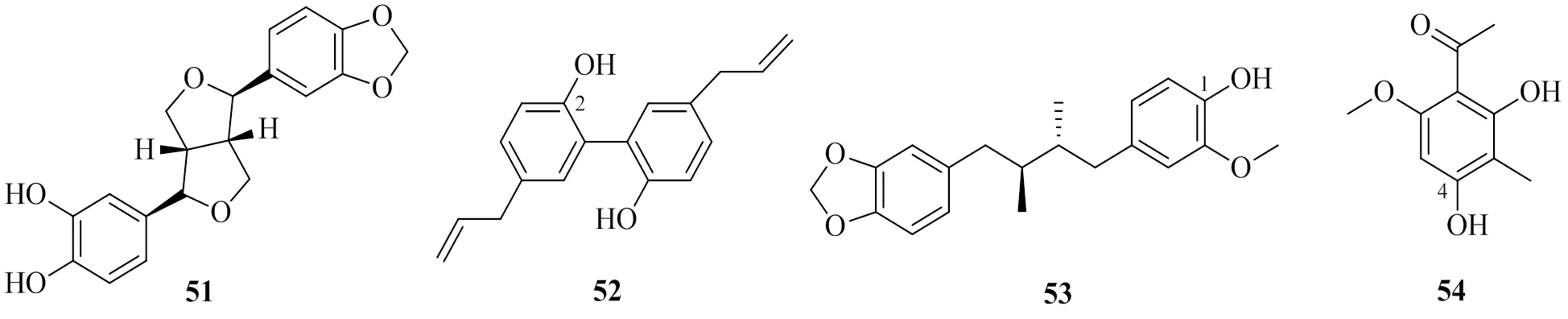
圖5 葡萄糖醛酸化木脂素類化合物的化學結構
小檗堿(berberine)是從黃連中分離得到的一種生物堿,作為黃連的重要藥效物質,因其良好的抗炎、調脂、抗腫瘤、抗糖尿病等作用而受到廣泛關注。小檗紅堿(berberrubine)是小檗堿的代謝產物之一,藥動學研究顯示小檗紅堿比小檗堿具有更好的腸道吸收和生物利用度;葡萄糖醛酸化小檗紅堿(berberrubine-9--β--glucuronide,BRBG)是小檗紅堿的主要代謝產物,口服給藥后小檗紅堿被迅速代謝為BRBG。雖然小檗紅堿和BRBG都具有良好的降血糖效果,但因為BRBG在體內的暴露量遠高于小檗紅堿,因此BRBG可能在小檗紅堿降血糖過程中發揮更為重要的作用[73-74]。藥根堿(jatrorrhizine)也是一種小檗堿的體內代謝產物,采用化學抑制劑法及重組人CYP和UGT酶鑒定藥根堿代謝酶,發現CYP1A2、UGT1A1、UGT1A3、UGT1A7、UGT1A8、UGT1A9和UGT1A10可參與人肝微粒體中藥根堿的代謝[75]。Shi等[76]給大鼠iv藥根堿后發現其血漿中的代謝產物多為去甲基化和葡萄糖醛酸化產物,大鼠肝微粒體代謝研究顯示UGT1A1和UGT1A3催化藥根堿葡萄糖醛酸化生成藥根堿-3-葡萄糖醛酸苷(jatrorrhizine-3--glucuronide)。大鼠iv小檗堿后,部分藥物被代謝為去甲基小檗堿,隨后UGT1A1催化其C2-OH、C3-OH的葡萄糖醛酸化[74,77]。
嗎啡(morphine)經葡萄糖醛酸化代謝形成M3G和M6G;M3G是嗎啡的主要代謝產物(占嗎啡總量的45%~55%),但無鎮痛活性。M6G有極佳的鎮痛活性,經由鞘內注射的麻醉作用比原型嗎啡強600倍,且無嗎啡原型藥物具有的惡心、嘔吐和呼吸抑制等不良反應[78]。研究表明M6G可通過與有機陰離子轉運蛋白2和葡萄糖轉運蛋白-1相結合從而透過血腦屏障,還可以形成電子中性兩性離子二聚體,通過被動擴散透過血腦屏障,在腦組織中發揮作用[79]。尼古丁(nicotine)被認為是煙草中的主要成癮劑,在體內被代謝成可替寧(cotinine),Kuehl等[80]通過異源表達蛋白體外代謝研究,發現UGT1A3、UGT1A4和UGT1A9均能催化尼古丁的-葡萄糖醛酸化,但可替寧的-葡萄糖醛酸化僅能由UGT1A4催化。生物堿類化合物的葡萄糖醛酸化位點和相關UGTs見表4,葡萄糖醛酸化生物堿類化合物的化學結構見圖6。
2.5 萜類化合物的葡萄糖醛酸苷
萜類廣泛存在于自然界中,是構成某些植物的香精、樹脂、色素等的主要成分,根據化合物分子中異戊二烯單位的數量,可分為半萜、單萜、倍半萜、二萜、二倍半萜、三萜、四萜等。
薄荷醇(menthol)是從薄荷中提取的一種飽和環萜醇,具有抗炎鎮痛、清涼止癢、抗真菌、胃腸道保護等多種藥理活性[85]。薄荷醇是一種手性脂肪醇,以-或-薄荷醇的形式存在,研究顯示UGT酶對2種薄荷醇異構體的葡萄糖醛酸化轉化具有立體選擇性,UGT2A1和UGT2B7對-薄荷醇的催化活性最高,UGT2B7和UGT2B17對-薄荷醇的催化活性最高。相比于UGT2A1和UGT2B17,UGT2B7催化- 和-薄荷醇均具有最小的米氏常數(m)且數值接近,說明UGT2B7對2種薄荷醇異構體同時表現出最高的催化活性且活性相似,而UGT1A7僅檢測到對-薄荷醇具有催化活性[86]。香芹酚(carvacrol)是唇形科植物精油中的主要成分之一,廣泛應用于食品、香料、醫藥等行業,其在肝臟和腸道中的葡萄糖醛酸化主要由UGT1A9和UGT1A7催化[87]。鏈狀倍半萜化合物金合歡醇(又稱法尼醇,farnesol)存在于許多芳香植物中具有較好的抗癌活性。微粒體孵育和化學抑制實驗顯示,金合歡醇在人肝微粒體中被UGT1A1催化形成葡萄糖醛酸化金合歡醇,而在腸微粒體中的葡萄糖醛酸化主要由UGT2B7催化,同時人肝微粒體也可將金合歡醇代謝為羥基金合歡醇,并進一步代謝為其葡萄糖醛酸化衍生物[88]。
表4 生物堿類化合物的葡萄糖醛酸化位點和相關UGTs
Table 4 Glucuronidation sites of alkaloids and related UGTs
編號化合物名稱UGTs葡萄糖醛酸化位點文獻 55小檗紅堿(berberrubine)1A1, 2B1C9-OH74 56藥根堿(jatrorrhizine)1A1, 1A3, 1A7, 1A8, 1A9, 1A10C3-OH75 57去亞甲基小檗堿(demethyleneberberine)1A1C2-OH, C3-OH74 58嗎啡(morphine)2B7, 1A1C3-OH, C6-OH79 59尼古丁(nicotine)1A3, 1A4, 1A9N80 60可替寧(cotinine)1A4N80 61千里光堿(senecionine)1A4N81 62倒千里光堿(retrorsine)1A4N81 63荷葉堿(nuciferine)1A4N82 64士的寧(strychnine)1A4, 2B10N83 65馬錢子堿(brucine)1A4, 2B10N84

圖6 葡萄糖醛酸化生物堿類化合物的化學結構
天然甜味劑甜菊糖苷是一類從菊科植物甜葉菊中提取的四環二萜類糖苷,它們以甜菊醇(steviol)為苷元,口服后甜菊糖苷在結腸中被擬桿菌產生的β-葡萄糖苷酶催化水解成甜菊醇[89]。在甜菊醇的體內代謝產物中,僅檢測到C19位羧基的葡萄糖醛酸化產物[90],表明UGT只能介導甜菊醇的C19位羧基的葡萄糖醛酸化。雙氫青蒿素(dihydroartemisinin,DHA)是青蒿素衍生物青蒿琥酯(artesunate)的活性代謝物,與青蒿素相比水溶性更高,活性更強,同時還具有抗瘧、抗炎、抗腫瘤、抗肺纖維化等作用[91]。在人尿液樣品和人肝微粒體催化體系中均檢測出葡萄糖醛酸化雙氫青蒿素(α-DHA-β-glucuronide),UGT1A9和UGT2B7是這一過程中主要的代謝酶[92]。polyandric acid A(PAA)是從澳大利亞藥用植物Merr. & L. M. Perry中分離獲得的活性成分,在人肝微粒體催化體系中,PAA首先發生酯鍵水解,生成hydrolysed polyandric acid A(PAAH),再通過UGT2B7和UGT1A1進行葡萄糖醛酸化反應。PAAH具有C2-OH、C17-OH、C18-COOH 3個可進行葡萄糖醛酸化的位點,其與人肝微粒體、重組UGT1A1或UGT2B7孵育可檢測出3種單葡萄糖醛酸化代謝物,顯示該催化反應缺乏區域選擇性[93]。
20()-原人參二醇(protopanaxadiol,PPD)是人參皂苷的代表苷元之一,具有廣泛的藥理活性。在人肝微粒體和大鼠肝微粒體中孵育的PPD葡萄糖醛酸化代謝產物,均為PPD-3-β--葡萄糖醛酸酯,未發現在C12-OH和C20-OH位點的葡萄糖醛酸化代謝產物,表明UGT酶對PPD有較好的立體選擇性。化學抑制和重組人UGT亞型分析表明,在人肝微粒體中,PPD的葡萄糖醛酸化反應主要由UGT1A4催化,UGT1A3雖然也可以催化這一反應,但活性較弱[94]。
熊果酸(ursolic acid)是一種天然的五環三萜類羧酸化合物,是一些傳統中藥如山楂、女貞、梔子等的主要藥理活性成分。將熊果酸與人肝微粒體、腸微粒體分別孵育,均發現同種單葡萄糖醛酸化產物生成。在輕度堿性水解作用下,葡萄糖醛酸化代謝產物的峰幾乎沒有降低,推測葡萄糖醛酸化在羥基而不是在羧酸部分發生。與不同亞型的UGTs共孵育,鑒定發現UGT1A3和UGT1A4對熊果酸葡萄糖醛酸化反應顯示出最顯著的催化活性。鵝去氧膽酸(chenodeoxycholic acid,UGT1A3抑制劑)和合歡素(hecogenin,UGT1A4抑制劑)聯用時,肝微粒體催化的熊果酸葡萄糖醛酸化產物產量明顯降低[59]。萜類化合物的葡萄糖醛酸化位點和相關UGTs見表5,葡萄糖醛酸化萜類化合物的化學結構見圖7。
表5 萜類化合物的葡萄糖醛酸化作用位點和相關UGTs
Table 5 Glucuronidation sites of terpenoids and related UGTs
編號化合物名稱UGTs葡萄糖醛酸化位點文獻 66D-薄荷醇(D-menthol)2A1, 2B7C1-OH86 67L-薄荷醇(L-menthol)2B7, 2B17C1-OH86 68香芹酚(carvacrol)1A7, 1A9C1-OH87 69金合歡醇(farnesol)2B4, 2B7, 1A1, 1A9C1-OH88 70甜菊醇(steviol)2B7C19-COOH90 71雙氫青蒿素(dihydroartemisinin)1A9, 2B7C10-OH92 72hydrolysed polyandric acid A 1A1, 2B7C2-OH, C17-OH, C18-COOH93 7320(S)-原人參二醇[20(S)-protopanaxadiol]1A4, 1A3C3-OH94 74熊果酸(ursolic acid)1A3, 1A4C3-OH59
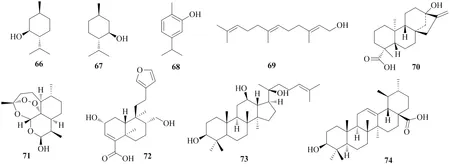
圖7 葡萄糖醛酸化萜類化合物的化學結構
3 利用微生物制備植物天然產物的葡萄糖醛酸苷
部分天然產物的葡萄糖醛酸化代謝產物比原型藥物具有更好的藥理活性、穩定性或水溶性,利用化學合成方法制備葡萄糖醛酸苷因技術、成本等因素限制,難以實現工業化生產。在大腸桿菌、釀酒酵母等宿主中高效、專一表達動物或植物來源的UGT,并利用宿主內源或外源的UDP-葡萄糖6-脫氫酶(UDP-glucose 6-dehydrogenase,UGDH)提供UDPGA,可以構建中藥活性成分的葡萄糖醛酸化工程菌。利用葡萄糖為碳源,以目標活性成分為底物,可以規模化制備其葡萄糖醛酸化衍生物,為研究目標化合物的吸收、代謝和藥效物質奠定基礎。
Pandey等[95]在大腸桿菌BL21(DE3)中過表達UDP-葡萄糖醛酸生物合成基因(、、、),并異源表達來源于葡萄的VvGT5蛋白和阿拉伯婆婆納的UGT88D8蛋白,分別催化芹菜素和槲皮素的葡萄糖醛酸化,制備芹菜素-7--葡萄糖醛酸(apigenin 7--glucuronide)和槲皮素-3--葡萄糖醛酸(quercetin 3--glucuronide)。Kim等[96]敲除了大腸桿菌BL21(DE3)中代謝UDP-葡萄糖醛酸的基因,以增加UDPGA的供應,使木犀草素-7--葡萄糖醛酸的產量從14 mg/L上升到30 mg/L;進一步過表達大腸桿菌基因后,木犀草素的葡萄糖醛酸苷的產量進一步上升至300 mg/L。Ikushiro等[97]在釀酒酵母和裂殖酵母的基因組中,整合了人源的編碼UGT1以及鼠源的編碼UGDH的基因,構建其共表達體系;通過靜息酵母細胞進行全細胞催化,獲得了4-甲基傘形酮、雙氯芬酸、萘普生、洛索洛芬等具有酚羥基或羧酸基團化合物的葡萄糖醛酸化產物。人參皂苷Rh1(ginsenoside Rh1)具有較強的藥理活性,包括細胞毒性作用、抗炎作用、神經保護作用和抗過敏作用,但其水溶性較低[98-99];糖基的結合可以增加母體化合物的穩定性和水溶性,而通過化學合成方法制備人參皂苷的葡萄糖醛酸化衍生物難以進行[100]。Luo等[101]在大腸桿菌BL21(DE3)中分別異源表達枯草芽孢桿菌來源的編碼UGT酶的、和基因,其中表達和的工程菌株可催化人參皂苷Rh1生成3--β--吡喃葡萄糖基-6--β--吡喃葡萄糖基-20()-原托那沙三醇。Yue等[102]在大腸桿菌BL21(DE3)中表達了來源于紫蘇的UGT88D7,通過全細胞催化獲得了包括白楊素、香葉木素、山柰酚、漆黃素、桑色素、二氫槲皮素、橙皮素、鷹嘴豆芽素A在內的多種植物天然產物的葡萄糖醛酸苷。Marvalin等[103]利用鏈霉菌sp. M52104轉化柚皮素、槲皮素、反式白藜蘆醇等酚類植物天然產物,獲得了他們的葡萄糖醛酸苷產物。利用微生物轉化制備的植物天然產物的葡萄糖醛酸苷的相關信息見表6,化合物75~78的化學結構見圖8。
表6 利用微生物轉化制備的植物天然產物的葡萄糖醛酸苷
Table 6 Biosynthesis of glucuronidated plant natural products using microbial biotransformation
編號化合物名稱表達宿主UGT葡萄糖醛酸化位點文獻 1木犀草素(luteolin)大腸桿菌BL21(DE3)UGT1A1, UGT1A7, UGT1A9C3-OH, C7-OH 20 2白楊素(chrysin)大腸桿菌BL21(DE3)UGT88D7(紫蘇)C7-OH102 3芹菜素(apigenin)大腸桿菌BL21(DE3)UGT88D8(葡萄)C7-OH 99 8香葉木素(diosmetin)大腸桿菌BL21(DE3)UGT88D7C7-OH102 12山柰酚(kaempferol)大腸桿菌BL21(DE3)UGT88D7C7-OH102 13槲皮素(quercetin)大腸桿菌BL21(DE3)VvGT5(阿拉伯婆婆納)C3-OH 99 13槲皮素(quercetin)鏈霉菌Streptomyces sp. M52104未表征C3-OH, C7-OH, C3′-OH, C4′-OH103 14漆黃素(fisetin)大腸桿菌BL21(DE3)UGT88D7C7-OH102 15橙皮素(hesperetin)大腸桿菌BL21(DE3)UGT88D7C7-OH102 20鷹嘴豆芽素A(biochanin A)大腸桿菌BL21(DE3)UGT88D7C7-OH102 29反式白藜蘆醇(trans-resveratrol)鏈霉菌未表征C3-OH, C4′-OH103 474-甲基傘形酮(4-methylumbelliferone)釀酒酵母AH22UGT1A1, UGT1A6C7-OH 97 75人參皂苷Rh1(ginsenoside Rh1)大腸桿菌BL21(DE3)yojK1, yjiC1(枯草芽孢桿菌)C3-OH101 76桑色素(morin)大腸桿菌BL21(DE3)UGT88D7C7-OH102 77二氫槲皮素(dihydroquercetin)大腸桿菌BL21(DE3)UGT88D7C7-OH102 78(2S)-柚皮[(2S)-naringenin]鏈霉菌未表征C7-OH, C4′-OH103

圖8 化合物75~78的化學結構
4 結語與展望
葡萄糖醛酸化代謝在藥物的體內代謝過程中發揮著不可或缺的作用,通過UGT的作用,細胞內源的葡萄糖醛酸被轉移到藥物分子上,顯著提高藥物分子的水溶性和極性,一方面加速藥物經由膽汁和尿液排出體外,降低了藥物分子的生物利用度,另一方面也降低了藥物對其靶標的親和性和藥理活性。此外,葡萄糖醛酸化反應在藥物-藥物相互作用中也發揮重要作用。研究葡萄糖醛酸化反應對藥物相互作用影響,不僅可以了解藥物的藥效和代謝特性,也對分析預測多種藥物相互作用導致的藥效改變、不良反應等有重要意義。中藥具有成分復雜、作用靶點多等特點,深入研究葡萄糖醛酸化反應對中藥藥效物質的轉化、代謝、清除及藥理活性的影響,特別是由于UGTs的基因多態性、表達水平差異、聯合用藥等因素對中藥活性成分發揮藥效的影響[102],對于中藥的個性化、精準化用藥有非常重要的意義。
雖然大部分藥物在葡萄糖醛酸化代謝后活性降低,但部分藥物的葡萄糖醛酸化代謝物,如M6G、表兒茶素-3--葡萄糖醛酸、橙皮素-7--葡萄糖醛酸、槲皮素-3--葡萄糖醛酸等具有比原型化合物更優的藥理活性[1]。開發有效制備植物天然產物的葡萄糖醛酸化代謝物的方法,規模化制備葡萄糖醛酸化代謝產物,是比較研究原型藥物和葡萄糖醛酸化代謝物的代謝性質和藥理活性、監測不同藥物的葡萄糖醛酸化代謝物之間的相互作用、開發基于植物天然產物的新藥的基礎。由于UGTs主要存在于真核細胞的內質網膜上,在體外表達,蛋白質正確折疊存在較大困難,大部分UGTs只能通過哺乳動物細胞、昆蟲細胞等進行表達,成本高、難以放大,不適合進行葡萄糖醛酸化產物的規模化制備。利用合成生物學技術,在大腸桿菌、釀酒酵母等底盤細胞中表達動物源或植物源的UGTs,可以利用葡萄糖等廉價碳源,對植物天然產物進行葡萄糖醛酸化轉化,為植物天然產物的藥效學研究和新藥開發奠定物質基礎。
利益沖突 所有作者均聲明不存在利益沖突
[1] 王梅玲, 夏楊柳, 楊夢麗, 等.-葡萄糖醛酸苷的生物合成研究進展 [J]. 中草藥, 2015, 46(7): 1065-1073.
[2] Evans W E, Relling M V. Pharmacogenomics: Translating functional genomics into rational therapeutics [J]., 1999, 286(5439): 487-491.
[3] Miners J O, Rowland A, Novak J J,. Evidence-based strategies for the characterisation of human drug and chemical glucuronidationand UDP-glucuronosyltransferase reaction phenotyping [J]., 2021, 218: 107689.
[4] 陳虹, 鐘丹妮, 高宗燕, 等. 膽紅素尿苷二磷酸葡萄糖醛酸轉移酶1A1基因突變與新生兒黃疸易感性的關系 [J]. 山東醫藥, 2017, 57(1): 22-25.
[5] Oda S, Fukami T, Yokoi T,. A comprehensive review of UDP-glucuronosyltransferase and esterases for drug development [J]., 2015, 30(1): 30-51.
[6] Meech R, Hu D G, McKinnon R A,. The UDP-glycosyltransferase (UGT) superfamily: New members, new functions, and novel paradigms [J]., 2019, 99(2): 1153-1222.
[7] Yang N, Sun R, Liao X,. UDP-glucuronosyltransferases (UGTs) and their related metabolic cross-talk with internal homeostasis: A systematic review of UGT isoforms for precision medicine [J]., 2017, 121: 169-183.
[8] Stachulski A V, Meng X L. Glucuronides from metabolites to medicines: A survey of thegeneration, chemical synthesis and properties of glucuronides [J]., 2013, 30(6): 806-848.
[9] Hu D G, Hulin J U A, Nair P C,. The UGTome: The expanding diversity of UDP glycosyltransferases and its impact on small molecule metabolism [J]., 2019, 204: 107414.
[10] Kilpatrick G J, Smith T W. Morphine-6-glucuronide: Actions and mechanisms [J]., 2005, 25(5): 521-544.
[11] Sakamoto S, Kusuhara H, Horie K,. Identification of the transporters involved in the hepatobiliary transport and intestinal efflux of methyl 1-(3,4-dimethoxyphenyl)-3-(3-ethylvaleryl)-4-hydroxy-6,7,8-trimethoxy-2-naphthoate (S-8921) glucuronide, a pharmacologically active metabolite of S-8921 [J]., 2008, 36(8): 1553-1561.
[12] Hu D G, Mackenzie P I, McKinnon R A,. Genetic polymorphisms of human UDP-glucuronosyltransferase (UGT) genes and cancer risk [J]., 2016, 48(1): 47-69.
[13] 伍明江, 吳曉磊, 張德芹, 等. UPLC-Q-TOF/MS鑒定大鼠口服桑葉黃酮后的體內物質 [J]. 中草藥, 2017, 48(14): 2832-2838.
[14] Zhao Y, Liu C P, Lai X P,. Immunomodulatory activities of phlorizin metabolites in lipopolysaccharide-stimulated RAW264.7 cells [J]., 2017, 91: 49-53.
[15] 朱向明, 俞飆, 惠永正. 葡萄糖醛酸苷的合成研究進展 [J]. 有機化學, 2000, 20(2): 146-154.
[16] Singh Y, Demchenko A V. Koenigs-knorr glycosylation reaction catalyzed by trimethylsilyl trifluoromethanesulfonate [J]., 2019, 25(6): 1461-1465.
[17] Burchell B, Coughtrie M W. UDP-glucuronosyltransferases [J]., 1989, 43(2): 261-289.
[18] Radominska-Pandya A, Bratton S, Little J M. A historical overview of the heterologous expression of mammalian UDP-glucuronosyltransferase isoforms over the past twenty years [J]., 2005, 6(2): 141-160.
[19] Zheng L, Zhu L, Zhao M,.exposure of kaempferol is driven by phase II metabolic enzymes and efflux transporters [J]., 2016, 18(5): 1289-1299.
[20] Wu L, Liu J, Han W,. Time-dependent metabolism of luteolin by human UDP-glucuronosyltransferases and its intestinal first-pass glucuronidation in mice [J]., 2015, 63(39): 8722-8733.
[21] Cottart C H, Nivet-Antoine V, Laguillier-Morizot C,. Resveratrol bioavailability and toxicity in humans [J]., 2010, 54(1): 7-16.
[22] 李玉倩, 李學軍. 姜黃素抗腫瘤作用基礎與臨床研究進展 [J]. 中國藥理學與毒理學雜志, 2020, 34(5): 321-335.
[23] Hoehle S I, Pfeiffer E, Metzler M. Glucuronidation of curcuminoids by human microsomal and recombinant UDP-glucuronosyltransferases [J]., 2007, 51(8): 932-938.
[24] Salo O M, Raitio K H, Savinainen J R,. Virtual screening of novel CB2 ligands using a comparative model of the human cannabinoid CB2 receptor [J]., 2005, 48(23): 7166-7171.
[25] Mazur A, Lichti C F, Prather P L,. Characterization of human hepatic and extrahepatic UDP-glucuronosyltransferase enzymes involved in the metabolism of classic cannabinoids [J]., 2009, 37(7): 1496-1504.
[26] Sun H, Wang H, Liu H,. Glucuronidation of capsaicin by liver microsomes and expressed UGT enzymes: Reaction kinetics, contribution of individual enzymes and marked species differences [J]., 2014, 10(10): 1325-1336.
[27] Walsky R L, Bauman J N, Bourcier K,. Optimized assays for human UDP-glucuronosyltransferase (UGT) activities: Altered alamethicin concentration and utility to screen for UGT inhibitors [J]., 2012, 40(5): 1051-1065.
[28] Li Q, Wang L, Dai P,. A combined strategy of mass fragmentation, post-column cobalt complexation and shift in ultraviolet absorption spectra to determine the uridine 5′-diphospho-glucuronosyltransferase metabolism profiling of flavones after oral administration of a flavone mixture in rats [J]., 2015, 1395: 116-128.
[29] Zhou Q, Zheng Z, Xia B,. Use of isoform-specific UGT metabolism to determine and describe rates and profiles of glucuronidation of wogonin and oroxylin A by human liver and intestinal microsomes [J]., 2010, 27(8): 1568-1583.
[30] Zhang L, Lin G, Zuo Z. Involvement of UDP-glucuronosyltransferases in the extensive liver and intestinal first-pass metabolism of flavonoid baicalein [J]., 2007, 24(1): 81-89.
[31] Hanioka N, Isobe T, Tanaka-Kagawa T,. Wogonin glucuronidation in liver and intestinal microsomes of humans, monkeys, dogs, rats, and mice [J]., 2020, 50(8): 906-912.
[32] Wang Y Z, Ao H, Qian Z M,. Intestinal transport of scutellarein and scutellarin and first-pass metabolism by UDP-glucuronosyltransferase-mediated glucuronidation of scutellarein and hydrolysis of scutellarin [J]., 2011, 41(7): 538-548.
[33] Zeng X, Shi J, Zhao M,. Regioselective glucuronidation of diosmetin and chrysoeriol by the interplay of glucuronidation and transport in UGT1A9-overexpressing HeLa cells [J]., 2016, 11(11): e0166239.
[34] Dai P, Luo F, Wang Y,. Species-and gender-dependent differences in the glucuronidation of a flavonoid glucoside and its aglycone determined using expressed UGT enzymes and microsomes [J]., 2015, 36(9): 622-635.
[35] Chen Y, Xie S, Chen S,. Glucuronidation of flavonoids by recombinant UGT1A3 and UGT1A9 [J]., 2008, 76(3): 416-425.
[36] Chen Y K, Chen S Q, Li X,. Quantitative regioselectivity of glucuronidation of quercetin by recombinant UDP-glucuronosyltransferases 1A9 and 1A3 using enzymatic kinetic parameters [J]., 2005, 35(10/11): 943-954.
[37] Wong Y C, Zhang L, Lin G,. Structure-activity relationships of the glucuronidation of flavonoids by human glucuronosyltransferases [J]., 2009, 5(11): 1399-1419.
[38] Brand W, Boersma M G, Bik H,. Phase II metabolism of hesperetin by individual UDP-glucuronosyltransferases and sulfotransferases and rat and human tissue samples [J]., 2010, 38(4): 617-625.
[39] Hanioka N, Ohkawara S, Isobe T,. Regioselective glucuronidation of daidzein in liver and intestinal microsomes of humans, monkeys, rats, and mice [J]., 2018, 92(9): 2809-2817.
[40] Pritchett L E, Atherton K M, Mutch E,. Glucuronidation of the soyabean isoflavones genistein and daidzein by human liver is related to levels of UGT1A1 and UGT1A9 activity and alters isoflavone response in the MCF-7 human breast cancer cell line [J]., 2008, 19(11): 739-745.
[41] Tang L, Singh R, Liu Z,. Structure and concentration changes affect characterization of UGT isoform-specific metabolism of isoflavones [J]., 2009, 6(5): 1466-1482.
[42] Shi J, Zheng L, Lin Z F,. Study of pharmacokinetic profiles and characteristics of active components and their metabolites in rat plasma following oral administration of the water extract ofusing UPLC-MS/MS [J]., 2015, 169: 183-194.
[43] Kosaka K, Sakai N, Endo Y,. Impact of intestinal glucuronidation on the pharmacokinetics of raloxifene [J]., 2011, 39(9): 1495-1502.
[44] Joseph T B, Wang S W, Liu X,. Disposition of flavonoids via enteric recycling: Enzyme stability affects characterization of prunetin glucuronidation across species, organs, and UGT isoforms [J]., 2007, 4(6): 883-894.
[45] Ruan J Q, Yan R. Regioselective glucuronidation of the isoflavone calycosin by human liver microsomes and recombinant human UDP-glucuronosyltransferases [J]., 2014, 220: 231-240.
[46] Guo B, Fang Z, Yang L,. Tissue and species differences in the glucuronidation of glabridin with UDP-glucuronosyltransferases [J]., 2015, 231: 90-97.
[47] Blount J W, Redan B W, Ferruzzi M G,. Synthesis and quantitative analysis of plasma-targeted metabolites of catechin and epicatechin [J]., 2015, 63(8): 2233-2240.
[48] Lu H, Meng X, Li C,. Glucuronides of tea catechins: Enzymology of biosynthesis and biological activities [J]., 2003, 31(4): 452-461.
[49] Yu L S, Pu J B, Zuo M J,. Hepatic glucuronidation of isoneochamaejasmin A from the traditional Chinese medicineL. root [J]., 2014, 42(4): 735-743.
[50] Aumont V, Krisa S, Battaglia E,. Regioselective and stereospecific glucuronidation of-and-resveratrol in human [J]., 2001, 393(2): 281-289.
[51] Miksits M, Maier-Salamon A, Vo T P,. Glucuronidation of piceatannol by human liver microsomes: Major role of UGT1A1, UGT1A8 and UGT1A10 [J]., 2010, 62(1): 47-54.
[52] Hu N, Mei M, Ruan J,. Regioselective glucuronidation of oxyresveratrol, a natural hydroxystilbene, by human liver and intestinal microsomes and recombinant UGTs [J]., 2014, 29(3): 229-236.
[53] Aprile S, del Grosso E, Grosa G. Identification of the human UDP-glucuronosyltransferases involved in the glucuronidation of combretastatin A-4 [J]., 2010, 38(7): 1141-1146.
[54] Jiamboonsri P, Pithayanukul P, Bavovada R,.glucuronidation of methyl gallate and pentagalloyl glucopyranose by liver microsomes [J]., 2016, 31(4): 292-303.
[55] Wu W, Hu N, Zhang Q,.glucuronidation of five rhubarb anthraquinones by intestinal and liver microsomes from humans and rats [J]., 2014, 219: 18-27.
[56] Lu H, Fang Z Z, Cao Y F,. Isoliquiritigenin showed strong inhibitory effects towards multiple UDP-glucuronosyltransferase (UGT) isoform-catalyzed 4-methylumbelliferone (4-MU) glucuronidation [J]., 2013, 84: 208-212.
[57] Sun H, Ma Z, Lu D,. Regio-and isoform-specific glucuronidation of psoralidin: Evaluation of 3--glucuronidation as a functional marker for UGT1A9 [J]., 2015, 104(7): 2369-2377.
[58] Li L, Huang X J, Peng J L,. Wedelolactone metabolism in rats through regioselective glucuronidation catalyzed by uridine diphosphate-glucuronosyltransferases 1As (UGT1As) [J]., 2016, 23(4): 340-349.
[59] Liang S C, Ge G B, Liu H X,. Identification and characterization of human UDP-glucuronosyltransferases responsible for theglucuronidation of daphnetin [J]., 2010, 38(6): 973-980.
[60] Zhu L, Lu L, Zeng S,. UDP-glucuronosyltransferases 1A6 and 1A9 are the major isozymes responsible for the 7--glucuronidation of esculetin and 4-methylesculetin in human liver microsomes [J]., 2015, 43(7): 977-983.
[61] Meng F, Li Y, He G,. Identification of human UDP-glucuronosyltransferase isoforms involved in the isofraxidin glucuronidation and assessment of the species differences of the reaction [J]., 2017, 117: 118-125.
[62] Fujiwara R, Yokoi T, Nakajima M. Structure and protein-protein interactions of human UDP-glucuronosyltransferases [J]., 2016, 7: 388.
[63] Uchaipichat V, MacKenzie P I, Guo X H,. Human udp-glucuronosyltransferases: Isoform selectivity and kinetics of 4-methylumbelliferone and 1-naphthol glucuronidation, effects of organic solvents, and inhibition by diclofenac and probenecid [J]., 2004, 32(4): 413-423.
[64] Cho P, Paudel S, Lee D,. Characterization of CYPs and UGTs involved in human liver microsomal metabolism of osthenol [J]., 2018, 10(3): 141.
[65] 陶凱奇, 王紅, 周宗寶, 等. 木脂素類化合物的結構及生物活性研究進展 [J]. 中南藥學, 2017, 15(1): 70-74.
[66] Abe-Kanoh N, Kunimoto Y, Takemoto D,. Sesamin catechol glucuronides exert anti-inflammatory effects by suppressing interferon β and inducible nitric oxide synthase expression through deconjugation in macrophage- like J774.1 cells [J]., 2019, 67(27): 7640-7649.
[67] Yasuda K, Ikushiro S, Kamakura M,. Sequential metabolism of sesamin by cytochrome P450 and UDP-glucuronosyltransferase in human liver [J].2011, 39(9): 1538-1545.
[68] 張勇, 唐方. 厚樸酚藥理作用的最新研究進展 [J]. 中國中藥雜志, 2012, 37(23): 3526-3530.
[69] Zhu L L, Ge G B, Zhang H B,. Characterization of hepatic and intestinal glucuronidation of magnolol: Application of the relative activity factor approach to decipher the contributions of multiple UDP-glucuronosyltransferase isoforms [J]., 2012, 40(3): 529-538.
[70] Liu H, Wu Z, Ma Z,. Glucuronidation of macelignan by human liver microsomes and expressed UGT enzymes: Identification of UGT1A1 and 2B7 as the main contributing enzymes [J]., 2014, 35(9): 513-524.
[71] Zhang X, Yao Y, Lou Y,. Metabolism of ebracteolata compound B studiedwith human liver microsomes, HepG2 cells, and recombinant human enzymes [J]., 2010, 38(12): 2157-2165.
[72] 張涵慶, 丁云梅. 月腺大戟根中有效成分乙素和丙素的結構研究 [J]. 植物資源與環境, 1992, 1(3): 6-9.
[73] Yang N, Sun R B, Chen X L,.assessment of the glucose-lowering effects of berberrubine-9--β--glucuronide, an active metabolite of berberrubine [J]., 2017, 38(3): 351-361.
[74] Liu Y, Hao H, Xie H,. Oxidative demethylenation and subsequent glucuronidation are the major metabolic pathways of berberine in rats [J]., 2009, 98(11): 4391-4401.
[75] Zhou H, Shi R, Ma B,. CYP450 1A2 and multiple UGT1A isoforms are responsible for jatrorrhizine metabolism in human liver microsomes [J]., 2013, 34(3): 176-185.
[76] Shi R, Zhou H, Ma B L,. Pharmacokinetics and metabolism of jatrorrhizine, a gastric prokinetic drug candidate [J]., 2012, 33(3): 135-145.
[77] Wang K, Feng X, Chai L,. The metabolism of berberine and its contribution to the pharmacological effects [J]., 2017, 49(2): 139-157.
[78] Klimas R, Mikus G. Morphine-6-glucuronide is responsible for the analgesic effect after morphine administration: A quantitative review of morphine, morphine-6-glucuronide, and morphine-3-glucuronide [J]., 2014, 113(6): 935-944.
[79] De Gregori S, De Gregori M, Ranzani G N,. Morphine metabolism, transport and brain disposition [J]., 2012, 27(1): 1-5.
[80] Kuehl G E, Murphy S E.-glucuronidation of nicotine and cotinine by human liver microsomes and heterologously expressed UDP-glucuronosyltransferases [J]., 2003, 31(11): 1361-1368.
[81] He Y Q, Liu Y, Zhang B F,. Identification of the UDP-glucuronosyltransferase isozyme involved in senecionine glucuronidation in human liver microsomes [J]., 2010, 38(4): 626-634.
[82] Lu Y L, He Y Q, Wang M,. Characterization of nuciferine metabolism by P450 enzymes and uridine diphosphate glucuronosyltransferases in liver microsomes from humans and animals [J]., 2010, 31(12): 1635-1642.
[83] Tian J X, Peng C, Xu L,.metabolism study of strychnos alkaloids using high-performance liquid chromatography combined with hybrid ion trap/time-of-flight mass spectrometry [J]., 2013, 27(6): 775-783.
[84] Chen X G, Lai Y Q, Cai Z W. Simultaneous analysis of strychnine and brucine and their major metabolites by liquid chromatography-electrospray ion trap mass spectrometry [J]., 2012, 36(3): 171-176.
[85] 陳晨, 劉兆國, 汪思亮, 等. 薄荷醇及其受體TRPM8與腫瘤關系研究進展 [J]. 中國藥理學通報, 2015, 31(3): 312-314.
[86] Kozlovich S, Chen G, Watson C J W,. Role of l- and d-menthol in the glucuronidation and detoxification of the major lung carcinogen, NNAL [J]., 2019, 47(12): 1388-1396.
[87] Dong R H, Fang Z Z, Zhu L L,. Identification of UDP-glucuronosyltransferase isoforms involved in hepatic and intestinal glucuronidation of phytochemical carvacrol [J]., 2012, 42(10): 1009-1016.
[88] Staines A G, Sindelar P, Coughtrie M W H,. Farnesol is glucuronidated in human liver, kidney and intestine, and is a novel substrate for UGT2B7 and UGT1A1 [J]., 2004, 384(3): 637-645.
[89] 陳俊名. 甜菊糖苷的體外代謝及生物活性研究 [D]. 無錫: 江南大學, 2019.
[90] Geuns J M, Buyse J, Vankeirsbilck A,. Identification of steviol glucuronide in human urine [J]., 2006, 54(7): 2794-2798.
[91] 王嵐, 李純, 董雨瑞, 等. 雙氫青蒿素抗肝癌作用機制研究進展 [J]. 現代中西醫結合雜志, 2020, 29(15): 1703-1706.
[92] Ilett K F, Ethell B T, Maggs J L,. Glucuronidation of dihydroartemisininand by human liver microsomes and expressed UDP-glucuronosyltransferases [J]., 2002, 30(9): 1005-1012.
[93] Bendikov M Y, Miners J O, Simpson B S,.metabolism of the anti-inflammatory clerodane diterpenoid polyandric acid A and its hydrolysis product by human liver microsomes and recombinant cytochrome P450 and UDP-glucuronosyltransferase enzymes [J]., 2017, 47(6): 461-469.
[94] Li J, He C, Fang L,. Identification of human UDP-glucuronosyltransferase 1A4 as the major isozyme responsible for the glucuronidation of 20()-protopanaxadiol in human liver microsomes [J]., 2016, 17(3): 205.
[95] Pandey R P, Jung H Y, Parajuli P,. A synthetic approach for biosynthesis of miquelianin and scutellarin A in[J]., 2019, 9(2): 215.
[96] Kim S Y, Lee H R, Park K S,. Metabolic engineering offor the biosynthesis of flavonoid--glucuronides and flavonoid--galactoside [J]., 2015, 99(5): 2233-2242.
[97] Ikushiro S, Nishikawa M, Masuyama Y,. Biosynthesis of drug glucuronide metabolites in the budding yeast saccharomyces cerevisiae [J]., 2016, 13(7): 2274-2282.
[98] Lee Y, Jin Y, Lim W,. A ginsenoside-Rh1, a component of ginseng saponin, activates estrogen receptor in human breast carcinoma MCF-7 cells [J]., 2003, 84(4): 463-468.
[99] Jung J S, Shin J A, Park E M,. Anti-inflammatory mechanism of ginsenoside Rh1in lipopolysaccharide-stimulated microglia: Critical role of the protein kinase A pathway and hemeoxygenase-1 expression [J]., 2010, 115(6): 1668-1680.
[100] Lairson L L, Henrissat B, Davies G J,. Glycosyltransferases: Structures, functions, and mechanisms [J]., 2008, 77: 521-555.
[101] Luo S L, Dang L Z, Zhang K Q,. Cloning and heterologous expression of UDP-glycosyltransferase genes fromand its application in the glycosylation of ginsenoside Rh1[J]., 2015, 60(1): 72-78.
[102] Yue T, Chen R, Chen D,. Enzymatic synthesis of bioactive-glucuronides using plant glucuronosyltransferases [J]., 2019, 67(22): 6275-6284.
[103] Marvalin C, Azerad R. Microbial glucuronidation of polyphenols [J]., 2011, 73(1/2/3/4): 43-52.
Research progress on biosynthesis of glucuronides of plant natural products
CHEN Bing-song1, 2, ZHOU Ying3, WANG Zhao-xin2, YANG Yu-fan2, QIU Feng1, YAN Xiao-hui2
1. School of Traditional Chinese Medicine, Tianjin University of Traditional Chinese Medicine, Tianjin 301617, China 2. State Key Laboratory of Component-based Traditional Chinese Medicine, Tianjin University of Traditional Chinese Medicine, Tianjin 301617, China 3. College of International Education, Tianjin University of Traditional Chinese Medicine, Tianjin 301617, China
Glucuronidation is an important phase Ⅱ metabolism catalyzed by UDP-glucuronosyltransferases (UGT), which is involved in the clearance of many endogenous and exogenous substances. Glucuronidation influences the tissue distribution of endogenous and exogenous compounds, and has a great impact on the efficacy, toxicity, and side effects of drugs. UGTs are widely distributed in various tissues of the body, featured by various tissue-abundance and substrate-specificity among different isoforms. Preparation of glucuronides for plant natural products provides foundation to evaluate their pharmacological activities, pharmacokinetic properties, and drug interactions. Research progress on biosynthesis of glucuronides of plant natural products such as polyphenols, coumarins, lignans, alkaloids, and terpenoids were summarized in this paper, in order to provide reference for their preparation and pharmacological studies.
plant natural products; glucuronides; UDP-glucuronosyltransferase; biosynthesis; polyphenols; coumarins; lignans; alkaloids; terpenoids
R282.1
A
0253 - 2670(2022)06 - 1875 - 16
10.7501/j.issn.0253-2670.2022.06.032
2021-05-25
國家重點研發計劃“合成生物學”重點專項(2020YFA0907900);天津中醫藥大學研究生科研創新項目(YJSKC-20191021)
陳秉松(1995—),男,碩士研究生,研究方向為合成生物學。E-mail: bingsongchen@163.com
顏曉暉(1979—),男,研究員,博士生導師,研究方向為天然產物的合成生物學。E-mail: yanxh@tjutcm.edu.cn
邱 峰(1967—),男,教授,博士生導師,研究方向為中藥及天然藥物藥效物質。E-mail: fengqiu20070118@163.com
[責任編輯 崔艷麗]