
Measuring Loschmidt echo via Floquet engineering in superconducting circuits
2022-03-12 07:44:06ShouKuanZhao趙壽寬ZiYongGe葛自勇ZhongChengXiang相忠誠GuangMingXue薛光明
Chinese Physics B 2022年3期
Shou-Kuan Zhao(趙壽寬) Zi-Yong Ge(葛自勇) Zhong-Cheng Xiang(相忠誠) Guang-Ming Xue(薛光明)
Hai-Sheng Yan(嚴海生)1,2, Zi-Ting Wang(王子婷)1,2, Zhan Wang(王戰)1,2, Hui-Kai Xu(徐暉凱)3, Fei-Fan Su(宿非凡)1,Zhao-Hua Yang(楊釗華)1,2, He Zhang(張賀)1,2, Yu-Ran Zhang(張煜然)4, Xue-Yi Guo(郭學儀)1,Kai Xu(許凱)1,5, Ye Tian(田野)1, Hai-Feng Yu(于海峰)3, Dong-Ning Zheng(鄭東寧)1,2,5,6,Heng Fan(范桁)1,2,5,6, and Shi-Ping Zhao(趙士平)1,2,5,6,?
1Beijing National Laboratory for Condensed Matter Physics,Institute of Physics,Chinese Academy of Sciences,Beijing 100190,China
2School of Physical Sciences,University of Chinese Academy of Sciences,Beijing 100190,China
3Beijing Academy of Quantum Information Sciences,Beijing 100193,China
4Theoretical Quantum Physics Laboratory,RIKEN Cluster for Pioneering Research,Wako-shi,Saitama 351-0198,Japan
5CAS Center for Excellence in Topological Quantum Computation,University of Chinese Academy of Sciences,Beijing 100190,China
6Songshan Lake Materials Laboratory,Dongguan 523808,China
Keywords: superconducting qubit,quantum simulation,Loschmidt echo,Floquet engineering
1. Introduction
The Loschmidt echo is a measure of the recovery of evolving quantum state when a time-reversal procedure is applied to the system,which can be used to quantify the sensitivity of quantum evolution to perturbations.[1]It is a well-known diagnostic of quantum chaos that captures the dynamical aspect in the time domain and has many applications. Suppose that an initial quantum state|ψ0〉evolves for timetunder a HamiltonianH1and another HamiltonianH2is applied betweentand 2tin order to recover|ψ0〉. In practical situations,it is not realistic to haveH2exactly equal to-H1,which would lead to a perfect recovery of|ψ0〉. The existing difference ΔH=H2+H1betweenH2and-H1then gives rise to an imperfect recovery of the initial state.
Due to its special properties,the Loschmidt echo has been employed to quantify decoherence[2,3]and entanglement[4]in many-body systems, and has also been used recently for coined discrete-time quantum walk study.[5]In the superconducting multiqubit systems,the detection of dynamical phase transitions[6]and the characterization of time reversibility for the out-of-time-order correlator(OTOC)measurement[7]have been reported. The OTOC is a recently proposed measure of quantum information spreading and scrambling in chaotic systems, which is shown to be directly linked to the Loschmidt echo in its thermal average.[8]
One of the key challenges for experimentally measuring the Loschmidt echo is the time reversal of quantum-state evolution. In this work, we use Floquet engineering for the first time to realize the reversal process and demonstrate the measurement of the Loschmidt echo in a superconducting 10-qubit chain. Floquet engineering, using time-periodic driving,is a powerful tool for the manipulation of quantum states and the control of their dynamic processes.[9]It has been applied in superconducting circuits for implementing qubit switch,[10]qubit-state stabilization,[11]high-fidelity quantum gates,[12,13]quantum state transfer,[14]and the model of topological magnon insulators.[15]Taking the advantage of its feasibility in tuning both the magnitude and phase of the coupling between the nearest-neighbor (NN) qubits, the measurement of OTOCs and operator spreading have been demonstrated in a recent experiment.[16]Here,using the Bell state as the initial state,we experimentally study the Loschmidt echo and discuss the imperfection of the recovery arising from the coupling between the next-nearest-neighbor(NNN)qubits and the on-site interaction in the specific superconducting multiqubit Hamiltonian which are not time reversible. Our results indicate that the Loschmidt echo is very sensitive for probing small perturbations in the quantum-state evolution process, as compared to,for instance,monitoring the qubit excited populations during a time forward and backward state evolution.frranges from 6.545 GHz to 6.729 GHz,while the maximum qubit frequencyfmvaries between 5.097 GHz and 5.895 GHz,andfiis the qubit frequency at the idle point.Uis the qubit on-site interaction. The energy relaxation timeT1and the dephasing timeT*2are measured at the idle point. The NN and NNN coupling strengthsgj,j+1andgj,j+2are measured at the working point of 4.35 GHz.FgandFeare the readout fidelities of the ground and first-excited states,respectively.

Fig.1. Optical micrograph of the superconducting processor containing 10 transmon qubits arranged into a chain. Each qubit has a microwave line for the XY control,a flux bias line for the Z control,and a readout resonator for measurement.
2. Device information
In Fig.1,we show the capacitively coupled chain-like 10-qubit device used in the present work. Each qubit has a microwave line forXYcontrol and a flux bias line forZcontrol,and is coupled to aλ/4 readout resonator that in turn couples to a transmission line for the measurement. The measurement setup and method have been described previously.[16]TheXYpulse,Zpulse,qubit-state readout,pulse sequence timing,and gate fidelity are carefully calibrated. The device parameters are listed in Table 1. The frequency of the readout resonator

Table 1. Basic device parameters. fr is the readout resonator frequency, fm is the qubit maximum frequency,and fi is the qubit idle frequency.U is the qubit anharmonicity. T1 and T*2 are the energy relaxation time and dephasing time of the qubit at idle point, Fg and Fe are the readout fidelities for the ground and first-excited states, gj,j+1 and gj,j+2 are the coupling strengths of the nearest-neighbor (NN) and the next-nearest-neighbor(NNN)qubits,and δ fΦ is the detuning for the experiment with|Φ〉as the initial states.
3. Experimental method
In the rotating frame with a common frequency, the system is governed by the 1D Bose-Hubbard model[17-19]


whereJ0(x)is the Bessel function of order zero.
The effective coupling strength between the NN qubits can thus be tuned by changingεjandν/2π. It follows the Bessel function which can be positive or negative leading to a time-reversible system ?Heff. In order to have a common coupling strength between each NN qubit pair, we fixν/2π= 120 MHz and only drive the odd qubits with the same amplitude|εj| =ε, so the coupling strength approximatesgjJ0(ε/ν). In addition, we stagger the phase of the applied flux withε1,ε5,ε9=εandε3,ε7=-εto partly reduce the unwanted NNN coupling. In this way,we are able to set identical coupling strength for each NN qubit pair with adjustable values from positive to negative.
The Loschmidt echo now can be writen as
After the initial-state preparation,all qubits are biased to the working point for the state evolution and time-periodic driving is applied to the odd-number qubits from 0 totand then fromtto 2twith a staggered phase. The driving amplitude isε=εa=213.6 MHz for the first period and isε=εb=400 MHz for the last period. Here we haveJ0(εa/ν)=-J0(εb/ν),corresponding togeffj,j+1≈±4 MHz forεaandεb,respectively, which results in a sign change of ?Heffand the corresponding reversal of the system evolution(note we haveν/2π=120 MHz always). At the end of the evolution, the qubits are brought back to their idle points for the tomographic measurement,as is illustrated in Fig.2(a).

Fig.2.(a)Pulse sequences for the 10-qubit Loschmidt echo experiment.The Bell state|Φ〉56 is first prepared for qubits 5 and 6 at their idle points with the rest of qubits remaining in the ground states. Subsequently all qubits are biased to the working point for the state evolution and time-periodic driving is applied to the odd-number qubits from 0 to t and then from t to 2t with different amplitude and phase. Finally,the qubits are brought back to their idle points for tomographic measurement and state readout. The orange, blue,and red pulses represent XY, Z, and readout drives, respectively. (b) Corresponding sequences for the single-photon walk and its reversed evolution experiment in the 9-qubit chain with the excitation on qubit 5.
4. Results and discussion
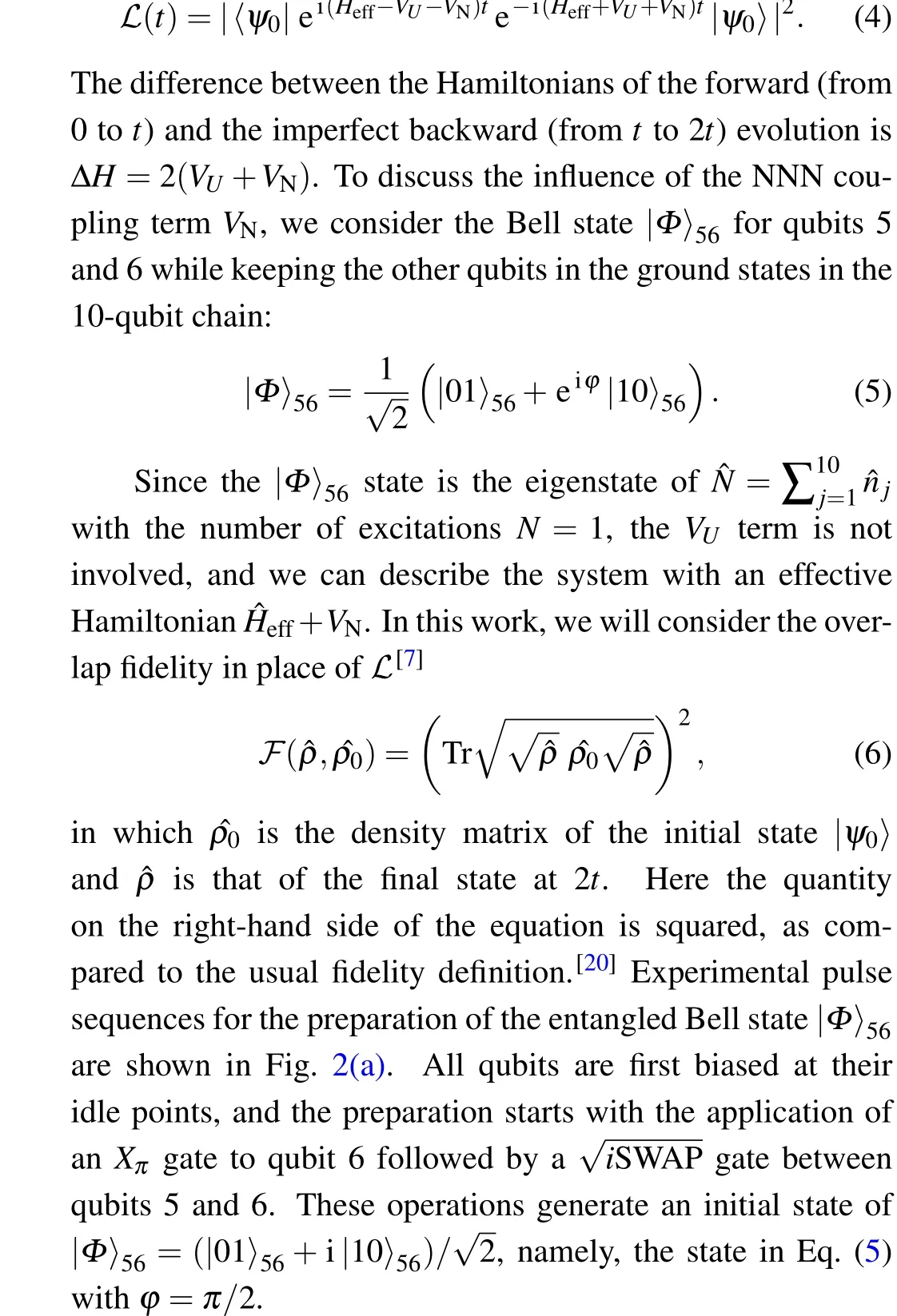
In the present experiment, we have set the maximum Loschmidt echo time ast=160 ns. Figure 3(a) shows the density matrix representation of the experimentally measured initial Bell state|Φ〉56prepared at timet=0. As can be seen in the figure,the state is close to ideal and the overlap fidelity with the ideal|Φ〉56state calculated with Eq.(6)is 0.97. Figure 3(b)shows the result of state tomography att=80 ns,measured with implemented qubit detuning to be discussed below.In this case,an obvious deviation from the ideal Bell state can be observed. In Fig. 4, we show our key results of the measured and calculated overlap fidelities versus the Loschmidt echo timetfor the initial Bell state|Φ〉56. The circles are for the experimental data measured using the techniques and procedures described above while the dashed line is from the theoretical calculation. We find that the fidelityFdecreases from 1 att=0 to about 0.6 att=160 ns. The clear decrease can be identified as resulting mainly from the coupling between the NNN qubits. Since we have used staggered phase of the applied flux, the NNN coupling strength between oddnumber qubits has a significant reduction. For instance,whenε/2π=213.6 MHz, we haveJ0(2ε/ν)=-0.388, while forε/2π=400 MHz,we haveJ0(2ε/ν)=0.282.[16]As a result,the NNN coupling strength for all qubits is below 0.5 MHz(see Table 1).

Fig.3. Density matrix representations of the experimentally measured Bell state|Φ〉56 for the time of(a)t=0 and(b)t=80 ns in the Loschmidt echo experiment with qubit detuning.

Fig. 4. Overlap fidelity defined in Eq. (6) versus Loschmidt echo time t for the initial state|Φ〉56. Thick solid and dashed lines represent the calculated results considering NNN couplings with and without qubit detuning,respectively. The squares and circles are the corresponding experimental data. The dash-dotted line is the numerical result without considering the NNN coupling.
These results indicate that the NNN coupling of small magnitude can lead to a significant decrease of the overlap fidelity. In order to see the influence further, we reduce the NNN coupling by introducing the qubit detuning quantified in the following way. In Fig.5(a),we show the numerical results of the qubit populations at the end of the experiment shown in Fig.2(a)with extended Loschmidt timet=250 ns and considering NN and NNN coupling strengths given in Table 1. The time step is taken to be 250/30 ns. We average the populations in the time period from 125 ns to 250 ns for each qubit. The value is then maximized by adjusting the frequency detuningδ fΦwithin a range of±2 MHz for all qubits simultaneously via the Nelder-Mead algorithm to obtain the optimized detuningδ fΦ. The final detuningδ fΦis listed in the last row of Table 1. Figure 5(b)shows the result calculated by taking the detuning into account. In this case, the population leakage from qubitsQ5andQ6to other qubits is largely suppressed.

Fig.5. Calculated population distribution versus Loschmidt echo time t for the initial state|Φ〉56. (a)Consider NN and NNN coupling strengths given in Table 1.(b)Further consider the optimized qubit frequency detuning δ fΦ in Table 1 to partially cancel the NNN coupling.
The squares and solid line in Fig. 4 are for the experimental and numerical results obtained by considering the qubit frequency detuning. We can see that the overlap fidelity has a significant increase compared to the data without considering the detuning, although it is still smaller than the result calculated without the NNN coupling, as shown in Fig. 4 with a dash-dotted line. The latter result without any NNN coupling only slightly deviates from unity with a fidelity above 0.97 at the end oft=160 ns, which is attributed to the approximation taken in the derivation of the effective Hamiltonian Eq.(2)under time-periodic driving. Apparently,qubit detuning partly reduces the remaining NNN coupling and also introduces small nonuniformity of the qubit working point during the quantum-state evolution.
We point out that the Loschmidt echo is extremely sensitive to small perturbations during the quantum-state evolution,as compared, for instance, to the qubit excited populations.In Fig. 6, we show the results of the single-photon quantum walk fromt= 0 to 125 ns, and its time-reversed evolution fromt=125 ns to 250 ns. The experiment is performed on a selected 9-qubit chain with the centralQ5excited to the|1〉state att=0. The measurement process is similar to those described above and is illustrated in Fig. 2(b). The squares in Fig. 6 are for the experimental data while the dashed and solid lines are for those calculated with and without considering the qubit NNN coupling, respectively. From the data ofQ5calculated with NNN coupling in the figure, we find the ratio of the qubit population att= 250 ns to its initial value att=0 ns to be 0.91, which is much higher than the corresponding Loschmidt echo fidelity of 0.66 att=125 ns(see the dashed line in Fig. 4). This is due to the fact that the qubit population only reflects the norm of its excited-state wave function, whereas the phases of the wave functions are also involved in the Loschmidt echo experiment in addition to their norms.

Fig.6.Qubit populations versus time for single-photon walk and its reversed time evolution starting at t=125 ns in the 9-qubit chain with the excitation on qubit 5. Symbols are the experimental results, dashed and solid lines are those calculated with and without considering the qubit NNN coupling,respectively.
Our experimental results described so far are obtained with the initial states having single-photon excitation, where the on-site interaction termVUin the Hamiltonian can be neglected. We find that the time reversed process appears quite satisfactory if one looks at the time forward and backward evolution from the viewpoint of the qubit populations. The NNN term does not seem to show an important role in this case. The situation will be different for the initial states with multiphoton excitations. In our previous studies of OTOC in a 10-qubit chain, the recovery of the initial states is found less satisfactory when the qubit populations are monitored.[16]
5. Summary
We have successfully performed the Loschmidt echo experiment in a superconducting 10-qubit system using Floquet engineering and discussed the imperfect recovery of the initial Bell state arising from the NNN coupling present in the qubit device. Our results demonstrated that the Loschmidt echo is very sensitive to small perturbations during quantum-state forward and backward evolution. Further calculations indicate that the change of the Bell state itself such as the phaseφin Eq. (5) will also have a strong influence on the overlap fidelity.These properties may be employed for the investigation of the multiqubit system concerning many-body decoherence and entanglement,etc.,especially when devices with reduced or vanishing NNN coupling between qubits are used.
Acknowledgments
This work was supported in part by the Key-Area Research and Development Program of Guang-Dong Province,China (Grant No. 2018B030326001) and the National Key R&D Program of China (Grant No. 2017YFA0304300).Y. R. Z. was supported by the Japan Society for the Promotion of Science(JSPS)(Postdoctoral Fellowship via Grant No. P19326, and KAKENHI via Grant No. JP19F19326).H. Y. acknowledges support from the Natural Science Foundation of Beijing, China (Grant No. Z190012) and the National Natural Science Foundation of of China (Grant No.11890704).H.F.acknowledges support from the National Natural Science Foundation of China (Grant No. T2121001),Strategic Priority Research Program of Chinese Academy of Sciences(Grant No.XDB28000000),and Beijing Natural Science Foundation,China(Grant No. Z200009).

- Chinese Physics B的其它文章
- Surface modulation of halide perovskite films for efficient and stable solar cells
- Graphene-based heterojunction for enhanced photodetectors
- Lithium ion batteries cathode material: V2O5
- A review on 3d transition metal dilute magnetic REIn3 intermetallic compounds
- Charge transfer modification of inverted planar perovskite solar cells by NiOx/Sr:NiOx bilayer hole transport layer
- A low-cost invasive microwave ablation antenna with a directional heating pattern