
Testing grounds
2022-02-25 13:44:32李洪方王懿
漢語世界(The World of Chinese) 2022年1期
李洪方 王懿




After 30 years in the making, is Yunnan’s coffee industry ready to stake its reputation in the international leagues?
云南的咖啡能像普洱茶一樣享譽天下嗎?
Text and photography by Dragos C. Cacio
Additional photographs from Li Hongfang (李洪方) and Wang Yi (王懿)
Ican smell the freshly ground beans that will go in my morning cup of coffee. Intertwined within it are recognizable aromas like nuts and chocolate, but some of the scents are new to me: Notes of honey, flowers, and berries swirl with the smell of books and wooden furnishings in this small coffee shop in Old Town Dali, the well-known tourist hub and hipster haven of China’s southwestern Yunnan province.
A barista approaches with my order in a round, transparent glass cup, much like a cup of tea. The coffee, too, is a pale, translucent red, looking more like black tea than the expected espresso. Abu, as the barista introduces herself, explains to me it’s a local brew from Baoshan city, the second most productive coffee-growing region in Yunnan. “The beans are very lightly roasted, which preserves this very strong floral scent and pale color,” she says.
It’s not this coffee snob’s idea of inky Italian espresso, but the local brew isn’t without its own pedigree. Coffee first came to Yunnan during the late 19th century, when a caffeine-loving French missionary, Father Alfred Lietard, also known as Tian Deneng (田德能), planted coffee trees outside of his church from a seedling he’d brought from France, and taught locals how to brew and make the drink. Today, in the village of Zhukula outside Dali, 24 century-old coffee trees still stand.
Coffee cultivation grew steadily after this early introduction, reaching 4,000 hectares in the province by the 1950s, before it was nearly wiped out by outbreaks of leaf rust. The local varieties of coffee plants, Typica and Bourbon, were especially susceptible to rust, and there was little demand within China for coffee. By 1970, barely 270 hectares were left, and coffee in Yunnan seemed destined to be chalked up as another agricultural failure from the era.
Farmers in the province mainly produced tea, corn, and sugarcane for poor returns, bringing them to the brink of poverty. In the 1980s, in an effort to help local farmers, a government program introduced two new rust-resistant varieties of coffee plants, the S.288 from India and Catimor from Portugal. In 1988, Nestle, which had identified parts of Yunnan as having ideal conditions to grow coffee, teamed up with the Yunnan government to plant the Catimor variety throughout the province, bringing production back to earlier levels.
Today, Yunnan produces 98 percent of coffee in China, averaging 100,000 metric tons annually, with Hainan and Fujian provinces making up the rest of China’s coffee production. Around 50 percent of Yunnan’s crop is sold outside of China, with exports generating 280 million US dollars in 2016. The famous tea-growing region of Pu’er in the southwest of the province accounts for 60 percent of Yunnan’s coffee production alone.
From bean to cup
As local farmers adapt their machinery and terrace-farming practices to the new crop, entrepreneurs from across the country are setting up as roasters in the province, centering on Dali with the artists, musicians, organic farmers, and other transplants that have traded the urban grind for the city of 700,000 souls in central Yunnan.
Wang Yi, the 39-year-old owner of Dali’s Truth Coffee, who introduces himself by the name of “Mr. Beans,” left his job as a civil engineer in Beijing in 2017 to join a friend who wanted to start a coffee business in Dali, saying he wanted a “change.”
“I knew nothing about coffee, so I took classes and learned with a coffee master in China,” Wang reminisces about the first time he came to Yunnan. As the drink gains in popularity in China, even a small operation like his can easily find customers for its “specialty coffee,” a term for coffee that is graded 80 points or above on a 100-point scale by an internationally certified taster.
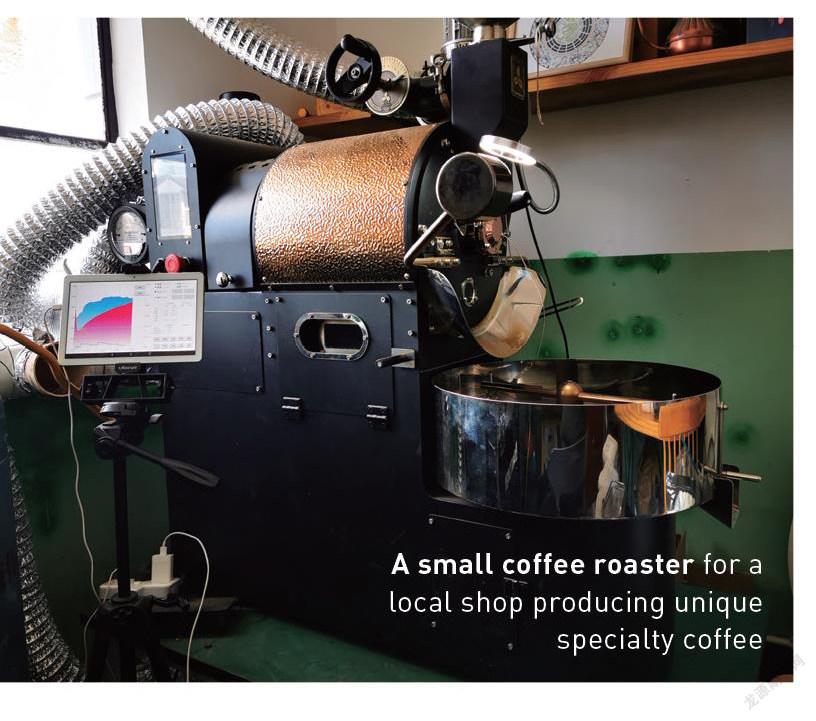
His roastery is in a small apartment across from his coffee shop, with two rooms: one for storage, and the other containing a roasting machine that he controls from a tablet. Today, he is religiously inspecting every single green bean that is about to be roasted. They are meant to be sent into competition. If they win, Wang hopes it will increase the reputation of his brew.
Coffee is treated here like precise clockwork. Each dose is weighed by Wang on a scale. Stacked on one side of the roaster are 12 trays of green beans he personally selected for use in upcoming coffee competitions. On the right side, there are the roasted beans. As I suspected, it’s a light roast—almost medium, but not quite there. You can smell the freshly roasted beans: flowery with clear notes of berries.
Back at the shop, the barista sets the temperature on the espresso machine and, stopwatch in hand, controls the ideal brewing time of an espresso—20 to 30 seconds. Armed with his notepad for tasting impressions, Wang dives into the first drink: 24 seconds of brewing is deemed too short for the perfect espresso; 25.6 seconds gives it the right level of boldness. Wang marks the bags of each batch accordingly, with the specific temperature and brewing time.
We go through eight espresso shots before Wang is satisfied with the result. Compared with the brews from Baoshan, these are a lot darker, but it’s still there—the floral aroma, the fruity taste, and, once the cup is empty, a strong smell of sweet caramel.
“The coffee business is not easy. There is a lot of competition, and though you might only want to offer top quality, most customers will choose the cheaper option because they don’t know the difference,” Wang laments. The retail price range for coffee in China varies between 40 and 300 yuan (6 to 47 US dollars) for 500 grams of coffee, which is comparable to other countries; but at the start of the last decade tea-drinkers still far outnumbered coffee-drinkers in China at a ratio of nine-to-one, though demand for coffee has nearly doubled since then.
I leave Wang with one question that has been boggling me: “What does Yunnan coffee taste like?” Initially confused by the question, I see the light in his eyes when he connects the dots. While Colombian and Ethiopian coffee have a taste and quality clearly recognized by coffee shops and consumers across the world, Yunnan coffee is yet to be defined. “I think many are wondering the same thing, but it’s not clear what Yunnan coffee exactly is yet,” Wang acknowledges.
From tea to coffee
Pu’er, a city of 2 million people in Yunnan’s far southwest, less than 200 kilometers from the Myanmar border, is best known for producing the tea that shares its name. Made with fermented leaves, which produce a distinctive “mushroomy” taste, Pu’er tea is one of the most expensive commodities in the world: A gram of Pu’er leaves can retail for over 1,000 yuan (157 US dollars) in today’s market.
Nestle was not the only major corporation that saw great opportunities in Yunnan’s coffee. While the company did not harvest or farm in the Pu’er region, it supported local farmers to grow better quality beans, which it would then purchase from them at a discount. In 2012, Starbucks established its first Asia-based Starbucks Farmer Support Center in Pu’er, with the objective of improving the overall quality of the region’s beans and coffee-growing practices. It claims to have trained thousands of farmers over the years in sustainable coffee practices.
Despite these investments, Yunnan coffee still struggles to develop a quality grade that is consistent enough for international standards. “Chinese coffee is still new in the world of coffee; 30 years is considered very young,” Li Hongfang, owner of Sinocafe, a farm and roaster in the Pu’er region, tells TWOC. Yunnan has yet to create a coffee strand that is acclimated to the local environment and yields consistent quality beans, which requires several generations. Meanwhile, the farmers are limited by outdated tools and practices, which are slow to change.
Li, originally from Guizhou, has lived in the Pu’er region for over 40 years and says he landed in the coffee business by chance. “I started working at Nestle as an interpreter in 1996, before I became a manager and then a farm manager.” After building his experience over multiple years, he decided to launch his own coffee business. “There’s a lack of Chinese coffee brands on the market in China, so I saw the opportunity.”
Like any new business venture, this came with its own series of challenges. Yunnan is home to almost 200,000 coffee-growing households and farmers, according to a 2013 report from the Dehong Tropical Agriculture Research Institute of Yunnan, leading to aggressive competition. “The biggest challenge I face right now, and most other farmers as well, is the rising cost of workers,” says Li.
Sinocafe sells green beans directly to Europe, Canada, and the US, in addition to supplying beans to Starbucks and Nestle in China. But Sinocafe’s total production always depends on demand in the market, which is unstable in China: It varies from 2,000 to 8,000 tons per year.
Like Colombian coffee, Yunnan coffee falls under the mid-range quality coffee type. But the resulting taste is different due to the more acidic soil and colder climate at high altitude, leading to a sweeter bean. The lack of reputation makes Yunnan coffee cheaper by default, which reduces the profit margin of local farmers when trying to sell at an international level.
Meanwhile, the strong preference for light-roasted coffee in China makes it challenging to market abroad. “[Though] there are few coffee purists in China that drink European style espresso or cappuccino,” Li recounts, “younger drinkers like a variety of flavors.” Pu’er coffee usually has a floral taste and is high in acidity due to high-altitude soil. The strong caramel smell is unique to Pu’er coffee, and is brought out by the light roast.
Chinese land policy poses another challenge. Because rural land is collectively held, Li asserts, this discourages farmers from investing on their land. “The government should make the farmers owners, like in the United States, where they pay taxes,” he says, believing this will also encourage innovation.
“[We need] everything to reduce the cost of labor and farm smart. But all of that requires investment,” he says. “Farmers need to change. We need to focus more on machinery and new agricultural strategies and new farmers—by new farmers, I mean young, highly educated people with knowledge.”
Despite its challenges, the coffee industry in Yunnan is slowly gaining ground, with Starbucks Reserve even paying tribute to it by serving Yunnan single origin coffee in its Chinese locations, which is an unmixed coffee coming from a single region or, sometimes, a single farm. In the meantime, young roasters like Wang are passionate about developing Yunnan coffee’s unique flavor and story. His beans have won multiple awards, including the International Golden Coffee Award, China’s AeroPress Championship, and most recently the Ingenuity Coffee competition in Guangzhou.
Precision continues to be his selling point. Every step of the roasting process “is calculated to always obtain the same result. Your coffee needs to be consistent, or it’s bad for the reputation,” says Wang. “But I like the roasting process. It’s very quiet and meditative. I like being alone and allowing myself to relax. That’s what I like the most about roasting coffee.”
As we both sit quietly in the room, guided by the faint sounds of the roaster and the smell of coffee surrounding us, I understand the kind of peace one can find here. Not wanting to disturb such a precious moment, we make plans to meet up later at his coffee shop to test the outcome, and maybe even taste China’s next prize-winning coffee roast.
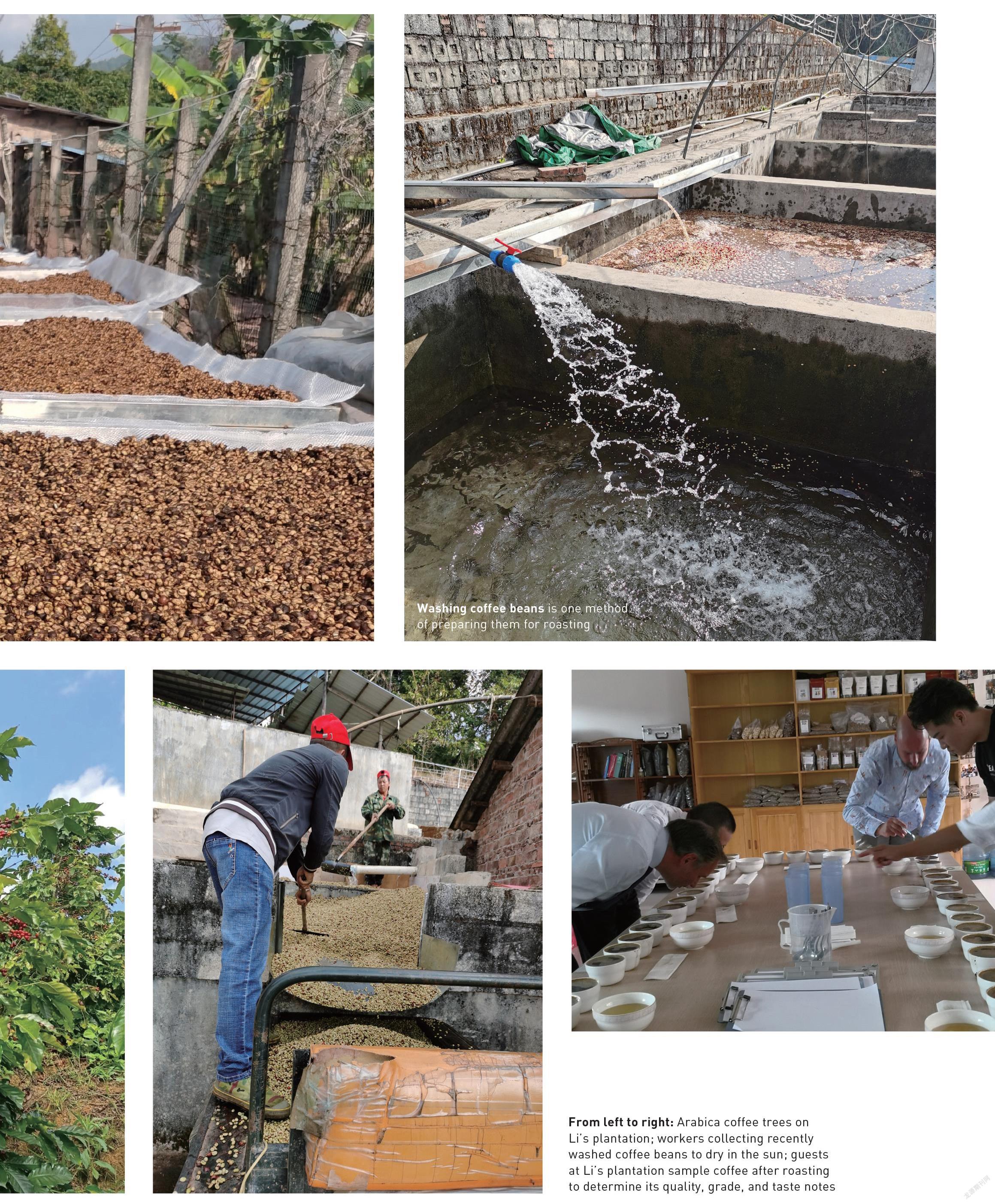
Coffee beans drying in the sun
Washing coffee beans is one method of preparing them for roasting
From left to right: Arabica coffee trees on Li’s plantation; workers collecting recently washed coffee beans to dry in the sun; guests at Li’s plantation sample coffee after roasting to determine its quality, grade, and taste notes
A small coffee roaster for a local shop producing unique specialty coffee
Baristas offer customized options based on the customer’s own taste
Front view of Wang’s Truth Cafe on a quiet evening in Old Town Dali, Yunnan
 漢語世界(The World of Chinese)2022年1期
- 漢語世界(The World of Chinese)的其它文章
- On the Character: 動
- No Excuses
- Rough Cut
- When China Goes on the Road
- A New Way of Seeing
- 學中文