
Ultrafast dynamics of cationic electronic states of vinyl bromide by strong-field ionization-photofragmentation
2022-02-24 08:59:26LongXingZhou周龍興YangLiu劉洋ShenHe賀屾DaShuaiGao高大帥XingChenShen沈星晨QiChen陳淇TaoYu于濤HangLv呂航andHaiFengXu徐海峰
Chinese Physics B 2022年2期
Long-Xing Zhou(周龍興) Yang Liu(劉洋) Shen He(賀屾) Da-Shuai Gao(高大帥)Xing-Chen Shen(沈星晨) Qi Chen(陳淇) Tao Yu(于濤) Hang Lv(呂航) and Hai-Feng Xu(徐海峰)
1Institute of Atomic and Molecular Physics,Jilin University,Changchun 130012,China
2Jilin Provincial Key Laboratory of Applied Atomic and Molecular Spectroscopy,Jilin University,Changchun 130012,China
Strong field ionization-photofragmentation (SFI-PF) with ultrafast pump–probe scheme is a powerful approach to study the dynamics of molecular cationic electronic states. Here we carry out a SFI-PF study on the cationic electronic states of vinyl bromide, C2H3Br. The yields of the parent C2H3Br+ and the formation of the fragment (Br+, C2and C2)ions have been measured at different pump–probe delay time. Analysis provides experimental evidence of A2A′–X2A′′ internal conversion of vinyl bromide cations which occurs in a time of about 220 fs,and the time of C2 formation induced by the dissociation of the A2A′ state around 300 fs. The study would add our knowledge of the behavior of electronic excited states of complex molecular cations.
Keywords: strong field ionization,ultrafast dynamics,vinyl bromide cation
1. Introduction
Strong field ionization (SFI) is the fundamental process of an atom or molecule when irradiated by a femtosecond strong laser field.[1,2]For polyatomic molecules,owing to their small energy difference between electronic states,an electron could be ionized from not only the highest occupied molecular orbital (HOMO) but also inner orbitals (HOMO-1, HOMO-2).[3,4]The multi-orbital contributions in SFI lead to the production of molecular cations that are populated in different electronic states(and vibrational states as well).Investigations on the dynamics of cationic electronic states induced by SFI have attracted intense research interest,which have paved the way to understanding the effects of molecular orbital and resonance in strong laser–molecule interactions, as well as the electronic state interaction and vibronic coupling in molecular cations.
Ultrafast time-resolved pump–probe methodology, pioneered by Zewail more than two decades ago,[5,6]has been widely applied to reveal the interaction of excited states of neutral molecules.[7–11]Comparing to neutral molecules, the information about electronic states of molecular cations is relatively limited, especially the ultrafast dynamics of the cationic states. On the other hand, the interaction and dynamics of molecular cationic electronic states play a pivotal role in many photochemical and photobiological processes. In recent years,SFI of molecules combining with the time-resolved pump–probe scheme has become a promising approach to reveal ultrafast dynamics of molecular cations,i.e., SFI to produce molecular cations followed by a delayed weak laser to produce photofragmentations (PF) as the probe. Studies are performed on SFI-PF of various polyatomic molecules, such as benzene and its derivatives,[12–15]large aromatic compounds,[16–18]halogenated alkanes,[19–21]cycloketone molecules[22,23]and so on, which have revealed coherent vibrational/electronic dynamics and dissociation of molecular cations.
Here, we carry out a SFI-PF study on the cationic electronic states of vinyl bromide (C2H3Br). Vinyl bromide is a typical molecule that presents multi-orbital effect in strong field ionization. The molecule has two distinct portions, Br and C2H3, and the electron density in the orbitals tends to localize more on one or the other.[24–26]The energies of the HOMO and several inner orbitals are close, allowing population in different vibrational/electronic cationic states upon SFI. This makes C2H3Br an ideal candidate to investigate the dynamics of the cationic electronic states using SFIPF. Previous studies have investigated the dissociation channels of C2H3Br+using the photoionization mass spectrometry (PIMS) and the threshold photoelectron-photoion coincidence (TPEPICO) techniques.[27]The breakdown diagram for C2H3Br+,,andions by synchrotron radiation in the photon energy of 9.8–21 eV was discussed.[27]Compared to synchrotron radiation, femtosecond laser could provide time-resolved measurements on femtosecond time scale,which is capable of resolving the ultrafast evolution of the molecular ionic excited states. Recently, the NIR-XUV transient absorption spectroscopy experiment demonstrated that the+Br (2P3/2) dissociation channel occurs on thecationic A2A′state with a time of 330±150 fs.[21]
In this paper, we report an experimental study on the cationic electronic states of vinyl bromide using SFI-PF.Vinyl bromide cations are formed by SFI using a 50 fs 800 nm strong laser field. A delayed weak 400 nm laser field is applied as the probe which drives the cations to a resonant excited state to lead fragmentation. The yields of parent and fragment ions are measured by varying the SFI-PF delay time. We investigate the transients at different pulse energies of the ionization laser. The analysis provides the experimental evidence of A2A′–X2A′′interaction and the dissociation of the A2A′state of vinyl bromide cations induced by strong field ionization.
2. Experimental methods
The experimental setup is similar to that has been described in detail in our previous studies.[13,15,22,28]Briefly,the SFI-PF experiments were carried out with a linear time-offlight mass spectrometer (TOF-MS) and the ultrafast pumpprobe scheme. Vinyl bromide molecules were sent to the vacuum chamber (background pressure below 1×10?6Pa)through a leak valve with the stagnation pressure of 1 atm,and the working pressure at the laser–molecule interaction region was kept at around 1×10?5Pa. After interacting with the lasers,the parent ions and all the fragment ions were extracted and accelerated by electric fields and were directed to dual microchannel plates for recording the yields. Each data was an average result of 1×10³laser shots.
Both the SFI and PF lasers were from the output of a self-mode-locked Ti: sapphire chirped-pulse amplified laser system (800 nm central wavelength, 50 fs pulse duration and 1 kHz repetition rate). The SFI-laser (800 nm) was used to ionize vinyl bromide molecules to produce the cations. The PF-laser(400 nm),which was frequency doubled of the laser output by a BBO crystal, was introduced at a delay time for excitation and fragmentation of the cations. The delay time between the two laser pulses was precisely controlled by a motor-controlled delay stage (Newport DL125). Both laser polarizations were parallel to each other and were collinearly focused by a concave mirror(f=10 cm)into the interaction region of the TOF-MS.The laser intensity was varied continuously by a half-wave plate and a glan prism. The instrumental response and the temporal overlap of the laser pulses in the interaciton region were obtained by pump-probe experiment on Ar atoms using the mass spectrometer.
3. Results and discussion
We perform SFI-PF on vinyl bromide molecules to understand the dynamics of the cationic electronic states. Neutral C2H3Br molecules are ionized by an 800 nm strong femtosecond laser field,followed by a weak 400 nm femtosecond laser to excite to a resonant cationic excited state and to induce fragmentation. Transients of the parent and fragment ions are achieved by measuring their yields with varying the delay time(Δt)between the two laser pulses. In Fig.1,we show the timeof-flight mass spectrum measured by SFI-PF of vinyl bromide at Δt=+4 ps. The background signals from only one laser(the signal intensity at Δt=?2 ps)are subtracted. Thus,negative peaks in the figure(i.e.,,m/q=106/108)indicate that the ion yields are depleted, while the positive peaks(i.e.,(m/q=27),(m/q=26)and79/81Br+(m/q= 79/81)) indicate the increment of the yields of the fragment ions after interacting with the PF-laser.This observation can be understood by SFI-PF of vinyl bromide,that is,the parent C2H3Br+produced by strong field ionization is excited to ionic excited states that ultimately undergo fragmentation in the weak PF-laser,leading to a loss in the parent-ion yield and an increase in the fragment-ion signal.
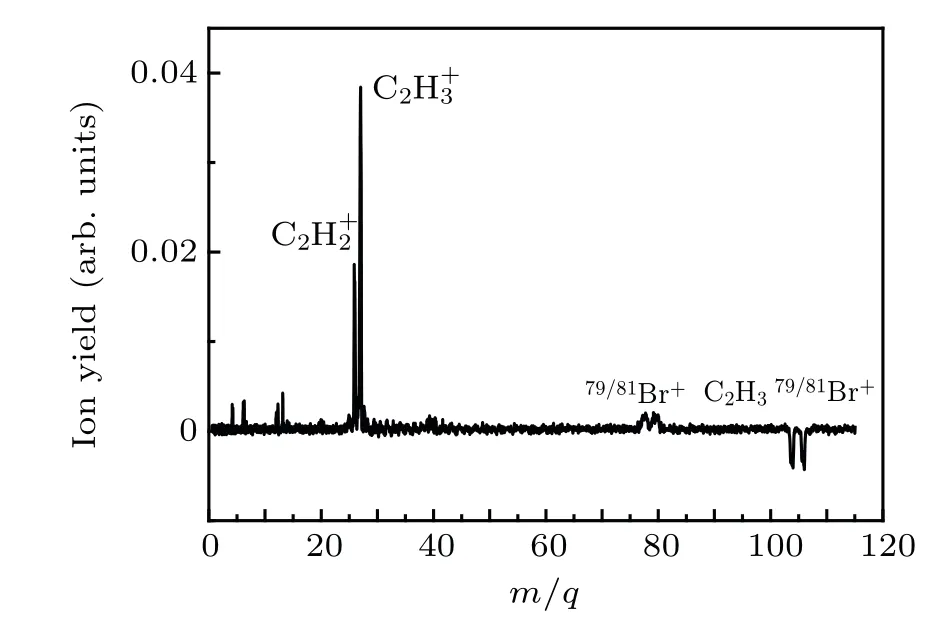
Fig.1. Subtracted background time-of-flight mass spectrum of C2H3Br molecules by SFI-PF at the delay time Δt=+4 ps.
In order to identify the dynamics of the cationic electronic state, we measure the time-resolved yields of C2H3Br+and different fragments (and Br+) in SFI-PF. We have observed quite different behaviors of the dynamics at a low pulse-energy(15μJ)and a high pulse-energy(≥200μJ)of the SFI-laser,as we will discuss in the following.
3.1. Time-resolved ion yields at low pulse-energy of the SFI laser
In Fig.2 we show the yields of C2H3Br+and the daughter ions(Br+,and)in the Δtrange of?2.5 ps to 10 ps.The SFI-laser pulse energy used to ionize the molecules is 15μJ.The experimental data of either C2H3Br+or the fragment ions can be well fitted to the combination of a Gaussian instrumental response function (full width at half maximum FWHM=140±20 fs) and a step function, as shown by the solid lines in the figures. Compared to the background signal at Δt
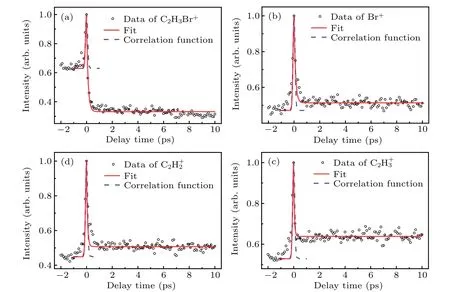
Fig.2. Dependence of the yields of C2H3Br+ (a)and different fragments(Br+,and ,(b)–(d))on the delay time between the SFI and PF lasers. All of the measured ion yields are individually normalized to the maximum. The solid red line is the fitting of the experimental data. The dash blue line is the correlation function.
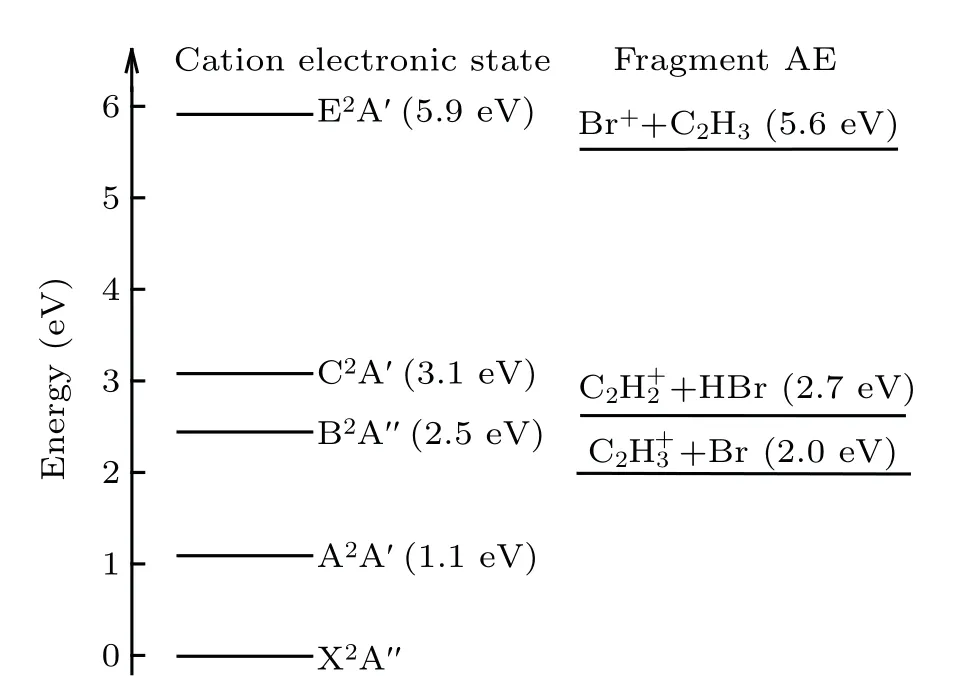
Fig.3. Vertical transition energy and appearance energies of dissociation channels above the ground state X2A′′ of C2H3Br cations. Energy data come from Ref.[27].
Figure 3 shows the vertical transition energies (VTE) of the electronic states of C2H3Br cation,along with the appearance energies (AE) of the dissociation channels, which were reported in previous PIMS and TPEPICO study using synchrotron radiation.[27]At low SFI-laser energy, the electron is more likely to be ionized from the molecular HOMO, and the parent ions are in the ground state X2A′′according to the Koopmans’ theorem. After the PF-laser is introduced, the cations are resonantly excited from X2A′′to the C2A′state,as it lies at a vertical transition energy that is equal to onephoton energy of the 400 nm laser (hν400nm=3.1 eV). The appearance energies of the fragments,and Br+are 2 eV, 2.7 eV and 5.6 eV, respectively above that of the cationic ground state X2A′′.[27]Thus,andfragments could be produced by one photon absorption of the 400 nm PF-laser. After excited to the C2A′state, the cations could decay via internal conversion to high vibrational states of the lower B2A′′or A2A′state, from which dissociation toormay occur, as also predicted in previousab initiocalculations.[24,27]The large AE for the Br+fragment indicates that one additional photon of the PF-laser should be absorbed from the C2A′state,most probably to the E2A′state of C2H3Br+,to form the Br+product channel.
3.2. Time-resolved ion yields at high pulse-energy of the SFI laser
We further investigate the dependence of the timeresolved ion yields on the pulse-energy of the SFI-laser. We find that the transients of the parent ions show similar constant depletion regardless of the SFI-laser pulse energy,while those of the daughter ions exhibit quite different behavior upon increasing the pulse energy. In Fig.4,we compare the transients recorded at the SFI-laser pulse energies of 15μJ and 400μJ,for the daughter ions Br+and. Unlike that at 15μJ SFI laser, which shows constant increment as we have described above,the transient recorded at 400μJ presents an additional component which exponentially decays at 0<Δt <1 ps. For the results of the other daughter ions,it is interesting to find that an exponential growth component is observed when the SFI-laser energy is higher than 200μJ,as shown in Fig.5.
The different behaviors in the time-resolved ion yields shown in Figs. 4 and 5 strongly imply that there is another channel for the evolution of the electronic states of C2H3Br+in SFI-PF with increasing the ionization laser intensity. Thepossibility of the evolution of a neutral excited state of C2H3Br can be excluded,owing to the fact that the additional process is absent in the results of C2H3Br+at any of the pulse energies of the SFI laser. The relaxation process is reasonably attributed to the dynamics of a cationic excited electronic state produced by strong field ionization of C2H3Br+. With varying Δtof SFI-PF,the evolution of the cationic excited state may lead to a decay in the yields of the fragments,however that of the parent ions would not change because they are indistinguishable in the measurements of TOF-MS.
When a polyatomic molecule interacts with a strong laser field,ionization could occur from multiple molecular orbitals,since the energy difference between MOs is small.As the laser intensity is increased, while ionization from HOMO could still be the dominant process,ionization from inner-shell MOs would play a more and more important role.[21,29]For C2H3Br,the energy difference between HOMO and HOMO-1 is only 1 eV (see Fig. 3, the VTE of A2A′lies at only 1 eV above that of the ground state X2A′′). It is expected that the multiorbital effect would result in population in both X2A′′and A2A′cationic states in strong field ionization from contributions of both HOMO and HOMO-1 of vinyl bromide.
Our results provide an experimental hint of the dynamics of the A2A′state of C2H3Br+. Owing to the fact that the A2A′state could be populated upon strong field ionization at high pulse energy, the observed exponential decay at 0<Δt <1 ps of the transient of Br+or(Fig.4)could be reasonably attributed to the internal conversion of A2A′–X2A′′of the cations. The fitting results showing as the solid line in Fig.4 give the internal conversion occured at a time ofτ1=220±60 fs.
However, at higher SFI laser pulse energy, the yields ofions show an additional exponential growth component,which is apparently different from Br+andfragment ions. This observation strongly indicates that there is another channel for producingions. Actually, previous studies using synchrotron radiation have indicated that the A2A′state of C2H3Br+can undergo dissociation to produce+Br.Thus,once populated in the A2A′state by strong field ionization, the C2H3Br+(A2A′) ions could dissociate and produceions. After introducing the PF laser, theyields from dissociation of the A2A′state will change until the dissociative process is completed. This leads to the different behavior in thetransient(Fig.5)compared to those of Br+andfragments shown in Fig.4. Fitting the data results in the dissociation time of about 300±230 fs,which is in good agreement with recent study using femtosecond EUV transient absorption spectroscopy of vinyl bromide.[21]

Fig. 5. Measured transients of fragment ions at 15 μJ (black circle) and 200 μJ (red circle). The solid red line is the fitting of the experimental data. The dash blue line is the correlation function.
4. Conclusion
For summary, the dynamics of electronic states of vinyl bromide cations is investigated by SFI-PF method. Different behaviors in the transients of parent and fragment ions by varying SFI-laser pulse energy are observed. For fragments Br+and,an additional component that exponentially decays with a timescale about 220±60 fs occurs as increasing the SFI-laser pulse energy,which is attributed to the internal conversion of A2A′–X2A′′of vinyl bromide cations.For fragment,the additional exponential growth component indicates the formation ofat the A2A′state of the cations. Our study provides new experimental evidence of the dynamics of electronic states of vinyl bromide cations,and would add our knowledge on the ultrafast evolution of polyatomic molecular cations.
Acknowledgements
Project supported by the National Key Research and Development Program of China(Grant No.2019YFA0307700),the National Natural Science Foundation of China (Grant Nos. 11874179, 11704149, and 12074144), the Natural Science Foundation of Jilin Province, China (Grant Nos. 20180101289JC and 20190103045JH), and the Science and Technology Project of the Jilin Provincial Education Department,China(Grant No.JJKH20190184KJ).

- Chinese Physics B的其它文章
- A broadband self-powered UV photodetector of a β-Ga2O3/γ-CuI p-n junction
- High-sensitive terahertz detection by parametric up-conversion using nanosecond pulsed laser
- High efficiency,small size,and large bandwidth vertical interlayer waveguide coupler
- High-fidelity resonant tunneling passage in three-waveguide system
- An analytical model for cross-Kerr nonlinearity in a four-level N-type atomic system with Doppler broadening
- Determine the physical mechanism and source region of beat wave modulation by changing the frequency of high-frequency waves