
Microwave preionization and electron cyclotron resonance plasma current startup in the EXL-50 spherical tokamak
2022-02-15 11:08:02BinCHEN陳彬YubaoZHU朱玉寶QingZHOU周慶JiangboDING丁江波XianmingSONG宋顯明ShaodongSONG宋紹棟YuanmingYANG楊圓明XinZHAO趙鑫EnwuYANG楊恩武MinshengLIU劉敏勝andtheEXL50Team玄龍50團隊
Plasma Science and Technology 2022年1期
Bin CHEN (陳彬), Yubao ZHU (朱玉寶), Qing ZHOU (周慶),Jiangbo DING (丁江波), Xianming SONG (宋顯明), Shaodong SONG(宋紹棟), Yuanming YANG (楊圓明), Xin ZHAO (趙鑫), Enwu YANG(楊恩武), Minsheng LIU (劉敏勝) and the EXL-50 Team (玄龍-50團隊)
1 Hebei Key Laboratory of Compact Fusion, Langfang 065001, People’s Republic of China
2 ENN Science and Technology Development Co., Ltd, Langfang 065001, People’s Republic of China
Abstract Preionization has been widely employed to create initial plasma and help the toroidal plasma current formation.This research focuses on implementing a simple, economical and practical electron cyclotron resonance (ECR) preionization technique on the newly constructed EXL-50 spherical tokamak, and evaluating the effectiveness on improving the plasma current startup.Two types ECR microwave preionization experiments for the plasma initialization without the central solenoid are reported: (1) 2.45 GHz microwave preionization and current startup with 2.45 GHz ECR source; (2) 2.45 GHz microwave preionization and current startup with 28 GHz ECR source.Application of the 2.45 GHz ECR microwave preionization to the experiments has contributed to(1)getting rid of the plasma breakdown delay;(2)the significant improvement of the discharge quality: the discharge is much longer and more stable while the driven plasma current is larger, compared to the discharge without preionization.
Keywords: preionization, microwave, ECR, spherical tokamak, plasma current startup
1.Introduction
The spherical tokamak(ST)is an attractive option for achieving controlled nuclear fusion with high beta [1–3].However, the ohmic current carrying capability of conventional ST is very limited due to the smaller central pole space.Electron cyclotron resonance(ECR)plasma current startup is important for compact fusion scenarios and future steady state ST reactor operation.
The EXL-50 is a middle size ST without central solenoid developed in the ENN Group, China [4, 5].One important motivation of the EXL-50 ST is to explore the practicability and validity of ECR plasma current startup.Beyond that,because of the compactness,flexibility and low operation cost,the EXL-50 may contribute to better understanding of phenomena in a wide field such as ST plasma confinement, equilibrium and stability,scenarios of plasma heating and current drive,and development of novel plasma diagnostics etc.
The initial stage of a ST discharge may be divided into three phases: breakdown, plasma formation and current ramp-up.As regard to the discharge initiation,preionization is considered to be a powerful technique.The conventional thermionic electron emission method of preionization with a tungsten filament depends on the ramp up time of the vertical magnetic field, and impurities from the filament cannot be avoided.This causes difficulties in reliable and reproducible experiment operation.In recent years,microwave applications on fusion plasma devices have become more favorable in the area of preionization and current startup, by producing a target plasma for subsequent plasma heating and current drive.

Figure 1.Schematic diagram of EXL-50 spherical tokamak.(a) Access ports, available diagnostics, ECRH system and microwave oven arrangement,(b)the poloidal geometry of magnetic field coils and MHD equilibrium magnetic flux surfaces.The last closed flux surface is shown in red, in subplot (b).
In addition,the microwave preionization can improve the quality of the plasma and discharge.Since 1980s,a number of microwave preionization experiments have been practically demonstrated on the SUNIST [6], TST-2 [7, 8], NSTX[9, 10], VEST [11, 12], QUEST [13], START [14] and MAST [14] STs and SINP [15], T-10 [16], Tore Supra [17],KSTAR [18, 19], Taban [20], HT-6B [21], DIII-D [22–24],GLAST [25], Aditya [26], KAIST [27] and JT-60 [28, 29]tokamaks.For inductive plasma current startup, the ECR preionization is known to be very effective for minimizing the loop voltage.The results from JT-60U [28], DIII-D [22–24],KSTAR [18], T-10 [16], HT-6B [21], and Tore Supra [17]experiments fully prove that ECR preionization plays an important role in reducing the ohmic flux consumption.
To pursue the ECR plasma experiments on the EXL-50,the lack of central solenoid makes the breakdown and current drive more challenging.According to the EXL-50 initial experimental results, the delayed breakdown happens frequently and startup failure is observed occasionally when operating without the preionization.In order to satisfy the requirements of discharge initiation and quality improvement, the behavior and characteristics of preionization for the EXL-50 need to be carefully studied.
The 2.45 GHz microwave based preionization startup experiments are presented in this article.The experimental setup is described in section 2.Result and discussion on preionization behaviors with different experimental conditions are described in section 3, which is followed by a conclusion and future plan section.
2.Experimental setup
2.1.The EXL-50 apparatus
The EXL-50 is based on a stainless steel 316 vacuum vessel(3.31 m diameter,2.81 m height)with major radius R ~ 0.58 m and minor radius a ~ 0.33 m.As shown in figure 1, a cylinder of 0.34 m diameter forms the central rod.The magnet system consists of 12 toroidal field (TF) coils and 3 pairs of poloidal field(PF1–PF6)coils.The designed maximum plasma current isIp~500 kA,Bt~0.46 T.The planed auxiliary heating system includes 2.4 MW/28 GHz ECR and 1.0 MW/2.45 GHz low hybrid wave, when toroidal field coils are operated at designed 100 kA current.
Figure 1 also shows the installed diagnostics on the EXL-50 at the time of this research.One high-speed video camera is used to monitor the visible image of the plasma.One Langmuir probe is installed to measure the edge plasma parameters.The line-integrated density is estimated by a single-channel microwave interferometer.The visible spectrometer is developed to measure the impurities of B,C,Fe, O etc.The intensities of two-channelαHspectral lines are monitored during the ionization process.
2.2.Microwave systems
Low power, 2.45 GHz ECR sources are employed for preionization in the EXL-50 1st-phase experiment at ~800 Gauss Bt.Similar 2.45 GHz microwave preionization sources have been frequently used for the ECR assisted plasma startup in several tokamaks,e.g.KAIST[27]and SUNIST[6].Based on the differences of the methods to generate the 2.45 GHz microwave for preionization, two experimental settings for different research purposes are designed.In the first experiment, a 0.75 kW/2.45 GHz household microwave oven is used as the preionization source while a 15 kW/2.45 GHz ECR magnetron drives the current.In the second experiment,a 15 kW/2.45 GHz ECR magnetron was used as the preionization source (maximum power of ~12 kW was injected into the vacuum vessel which was measured by the water load),while a 50 kW/28 GHz ECR gyrotron was employed to drive the toroidal current.
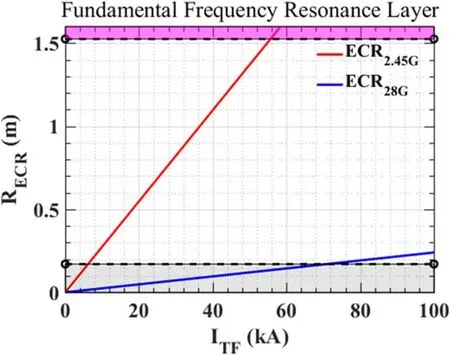
Figure 2.The radial position of the ECR fundamental frequency resonance layer RECR versus TF coil current IT F.The blue line is for 28 GHz microwave,the red line is for 2.45 GHz microwave,the grey shadow is the central rod (R = 0.17 m), the magenta shadow is the limiter (R = 1.53 m), the area in between is the vacuum vessel.
The present EXL-50 ECR systems include one 50 kW/28 GHz gyrotron and three 15 kW/2.45 GHz magnetrons.The ECR and microwave oven arrangement on EXL-50 is shown in figure 1.The modified 2.45 GHz/0.75 kW household microwave oven is installed at the 30° window.It is temporarily installed for prototype testing and replaced by ECRH 2# (# means number, see figure 1) after the microwave oven preionization experiment.The 2.45 GHz/15 kW/CW (continuous wave) ECR systems are installed at the windows:270°,30°,and 300°for the ECRH 1#,2#and 3#magnetrons, respectively.The gyrotron 28 GHz/50 kW/30 s ECRH is installed at the 0° window.The low field side ECR antennas arrangement allows extensive control of toroidal injection angles by adjustable mirrors.Twisted waveguide is used to control the polarization of the 2.45 GHz ECR wave which allows O-mode or X-mode power injection for all injection angles.
As the microwave source frequency is fixed,the position of the fundamental frequency resonance layer varies only depending on the TF coils currentITFwhich determines the toroidal magnetic field BT.For the maximum safe current in the TF coils (100 kA), the BTin the center of the vessel is about 0.4 T.However, theITFmay change for different physics experiment purposes.In the two 2.45 GHz ECR sources experiment, theITFis kept constant around 16 kA.While, in the 2.45 GHz microwave preionization and current startup with 28 GHz ECR source experiment, theITFis set to climb from 16 kA to 90 kA during the discharges, which gives different positions of the resonance layers.In figure 1 subplot (a), the fundamental frequency resonance layers,where the preionization is expected to be observed, are displayed.For 28 GHz ECR, the resonance layer is located at R = 0.24 m, as theITF=100 kA (magenta, dash line).For 2.45 GHz ECR, the resonance layers are located at R = 0.44 m, as theITF=16 kA (red, dash line), and at R = 1.53 m, as theITF=56 kA (blue, dash line), respectively.In figure 2,the radial position of the ECR fundamental frequency resonance layerRECRversus TF coil currentITFis shown.The blue line is for 28 GHz microwave,while the red line is for 2.45 GHz microwave.The 2.45 GHz fundamental frequency resonance layer moves out of the vacuum vessel as theITF>56 kA,while the 28 GHz moves into the vessel as theITF>74 kA.
3.Experiments and preliminary results
3.1.Microwave preionization and current startup with two 2.45 GHz ECR sources
In the microwave oven preionization experiment, the 2.45 GHz wave from a modified household microwave oven with power level of 0.75 kW is used as the preionization source, which is kept injected from the low field side midplane during the entire process of the experiment.While the 2.45 GHz magnetron with power up to 15 kW (continuous wave), which operates as the ECRH/CD system, is injected at 0 s.
Before the formal experiment, a test experiment is conducted with only the microwave oven source is turned on without the 15 kW ECRH/CD power injected.The test result of shot #1351 is shown in figure 3.The preionization is clearly captured by the high-speed camera (figure 3(e)).According to the theoretical calculation, for 2.45 GHz microwave,the preionization ought to be located at the major radius R = 0.44 m as theITF=16 kA.Figure 3(e)shows that a bright cylindrical tube with a certain broadening in width occurs and holds there around the ECRH fundamental frequency resonance layer.The preionization is typically timed to start at the initial stage for a discharge, when the EXL-50 plasma electron temperature and vacuum pressure are low at several eV and 10?4Palevel, respectively.Under such parameters, the ionization is always accompanied with obvious visible light emission, which could be observed by the visible camera.
Another evidence to prove the preionization’s success is the observed toroidal current (for convenience the toroidal current before the closed flux surface formation is named asIpas well) and chord integrated electron density signal in figures 3(a) and (b).Although, no closed flux surface is generated in shot #1351, the 750 W microwave still drives 450 A toroidal current.The measured electron density signal(~1 .2 × 1016m?2)implies that a sufficient number of neutral gas is ionized.The gas is injected before 0 s and at 7 s,respectively.The first increase of the density is accompanied with the current jump near 3 s when the breakdown triggered even though the produced plasma line-averaged density was low,at ~1 .2 × 1016m?2level.The gradual drop in density is due to the consumption of the injected gas and continuously pumping.When the gas is injected again at 7 s, the density increases again.According to the poloidal field coil current signal(figure 3(d),the currents in all of the PF coils are set to the same waveform for shot#1351),we can confirm that the toroidal current is driven purely by the preionization microwave,not the ohmic drive from PF.After 12 s the PF currents declining steadily,although the ohmic driven current changes sign, the toroidal current keeps stable and unchanged.
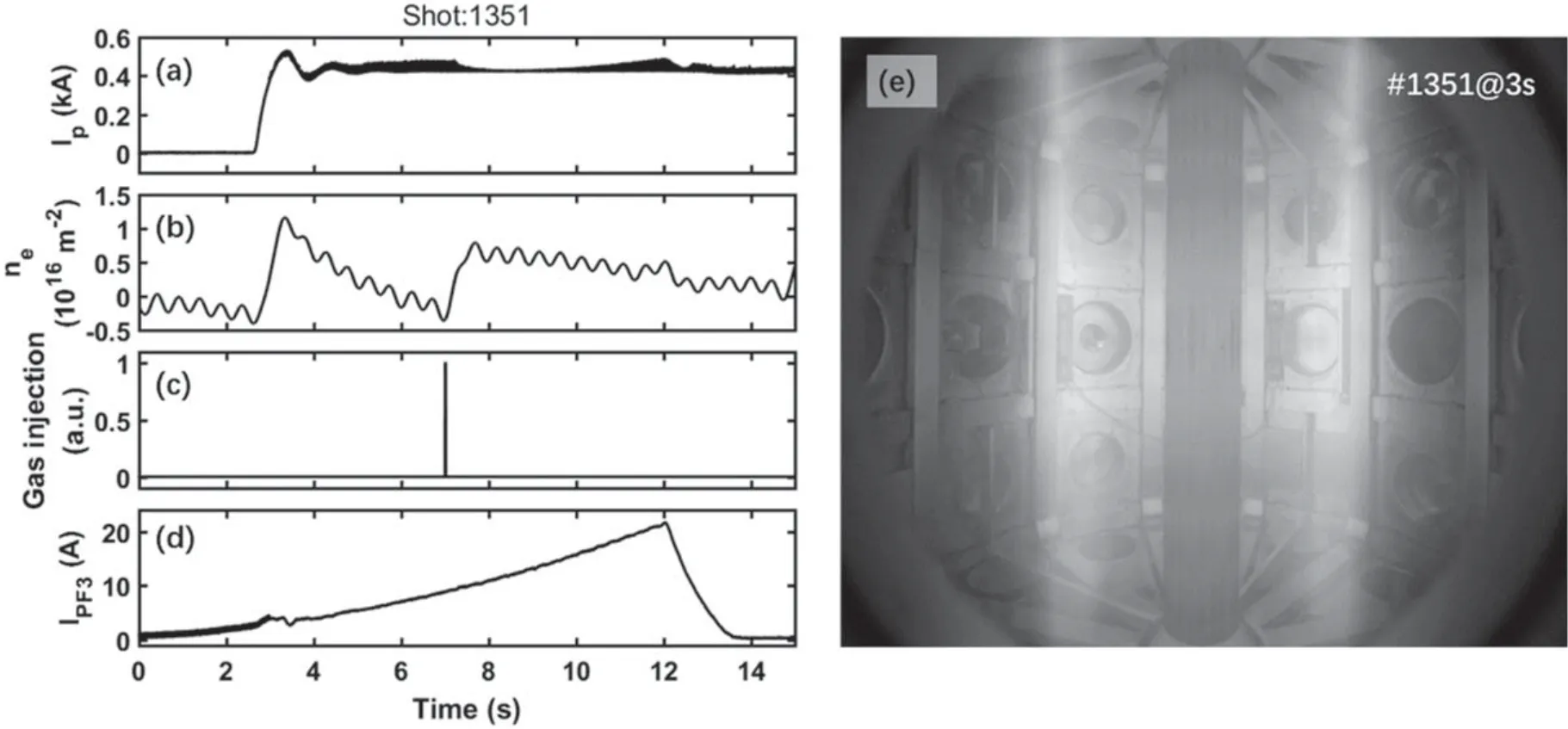
Figure 3.Experimental signals (a) toroidal current, (b) chord-integrated electron density, (c) gas injection at ?1.9 s (not shown) and 7 s,(d) PF3 coil current and (e) the high-speed Phantom camera image at 3 s for the shot 1351 of EXL-50.The microwave, from a modified household microwave oven with power level of 0.75 kW,was kept injected from the low field side midplane all the way until the end of this discharge.No other ECR power was injected for this shot.
The preliminary test results of shot #1351 have proved that the microwave oven preionization is effective.The following formal experiments are designed and conducted to investigate how the preionization impacts on the parameters and quality of the EXL-50 discharges.
In these experiments, discharges with and without microwave preionization are compared in table 1 and figure 4.For the comparability, the pre-set waveforms and settings of the controllable parameters are kept the same to guarantee the univariate experimental conditions.For the ECRH power scan experiments,the only difference in experimental settings is whether there is preionization (PMicrowave=0.75 kW) or not (PMicrowave=0 kW).Table 1 shows the statistic results.Note that for O-mode with 5 kW ECRH power,the discharge waveforms are almost the same.However,the shot duration is shorter for the case without preionization (4.8 s/4.9 s) than that with preionization(8.0 s/8.1 s).In general,the shots with preionization show a significantly longer plasma duration(>30%) with a higher plasma current (Ip, > 10%, for example, see 8 kW cases in figure 4) than the cases without preionization, which implies that the quality of the discharges is improved by the microwave preionization.Microwave preionization generally helps the discharges to be more stable and longer, and improving theIpas well.
3.2.2.45 GHz microwave preionization and current startup with 28 GHz ECR source
In the experiment, the 2.45 GHz magnetron ECR with power up to 15 kW is used as the preionization source, which is injected from the low field side midplane at ?2 s.Then the 28 GHz gyrotron ECRH/CD system with power up to 50 kW(pulse length of 30 s) is injected at 0 s.The 2.45 GHz preionization source is switched off after the injection of 28 GHz ECRH.

Figure 4.Comparison of waveforms for 8 kW ECRH discharges with and without preionization.(a) Plasma current Ip , (b) chordin tegrated electron density n e.For each kind of ECR mode injection experiments,cases with the 0.75 kW microwave preionization(dash curves) and without preionization (solid curves) are compared.

Figure 5.Experimental signals and the preionization image at ?0.500, ?0.455, ?0.419 and ?0.371 s for the shot #4984 of EXL-50.The waveforms on the right is the zoom-in of the left subplot between ?0.8 and ?0.2 s.(a) Plasma current, (b) electron density, (c) TF coils current,(d)PF1 coil current,(e)PF3 coil current and(f)PF5 coil current.The magnetron 2.45 GHz ECR system is used as the preionization source, which is injected from ?2 to 0 s.The 28 GHz ECRH system is injected at 0 s, and after the 2.45 GHz preionization source is switched off.
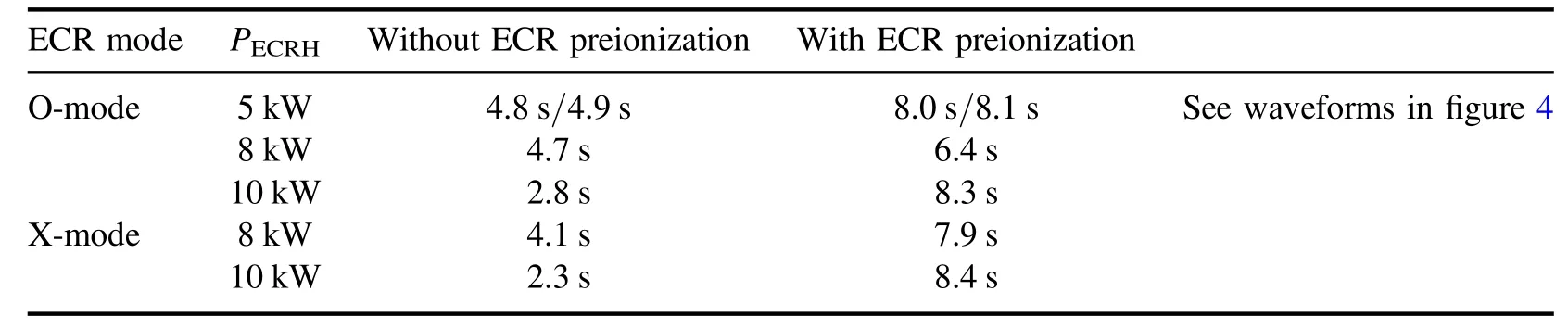
Table 1.ECRH power scan of shot duration with and without preionization by the injection of 0.75 kW microwave power.A magnetron of 2.45 GHz ECR with O-mode or X-mode was turned on at 0 s and turned off at 12 s for all the shots.The waveforms for 8 kW discharges with O-/X-mode are shown in figure 4 as an example.
In order to obtain high parameter plasmas, the capability of toroidal magnetic fieldBTis increased to 100 kA level,leading to the upgrade of the ECR system.As a result, the main ECR frequency has been changed from 2.45 to 28 GHz.For the 28 GHz discharges,the flat top ofITFhas to be larger than 71 kA to guarantee that the ECRH fundamental frequency resonance layer lies inside the vacuum vessel.However, for the 2.45 GHz preionization, the limitation forITFis in between 6.2 and 56 kA (figure 2).So, to include the 2.45 GHz preionization in a 28 GHz ECRH/CD discharge,the waveform ofITFshould climb from a lower value (e.g.15 kA in shot #4984) to around 90 kA, as shown in figure 5(magenta curve).In shot 4984, the 2.45 GHz ECR preionization power is injected from ?2 to 0 s.In this period,the preionization image evolving with the rising of theITFis observed.Before ?0.5 s when theITFis low (15 kA), a clear bright cylindrical tube is generated by the preionization process right at the ECR fundamental frequency resonance layer near the central rod.Then the preionization region moves outward with the rising of theITF,and moves out of the vacuum vessel after ?0.371 s.The key goal, no delayed breakdown,of this experiment is accomplished(that is to say,the plasma current and density quickly climb at 0 s),which is extremely important for the plasma control and experiment operation.
4.Conclusion and future plan
In summary, microwave preionization in the EXL-50 has been proven robust,the ordinary discharge waveforms can be obtained as long as the ECR fundamental frequency resonance layer is located inside the torus.It was observed that with the help of microwave preionization, the plasma current could be started up with no delayed breakdown, it can be sustained by the main ECR/CD after 0 s and the discharge quality is improved obviously: the discharge is much longer and more stable compared to the discharge without ECR preionization, and the driven plasma current is larger.
These initial results are promising for using ECR as preionization source as well as heating and current driving source in a future ST reactor.The 28 GHz preionization is preferable, when theITFis raised to 100 kA level.Further work is needed to demonstrate that the low microwave power,as a 28 GHz preionization source, can help improve the electron cyclotron plasma current startup without the central solenoid for a high power ECRH system and in a much higher parameter interval.
Acknowledgments
This work was funded by the compact fusion project in the ENN group.The authors would like to appreciate Dr Y-K M Peng and B S Yuan for supports on the EXL-50 physics and engineering,Dr H Y Guo for invaluable comments,S J Li for providing the density data, and Y Liu for help running the experiments.
ORCID iDs
 Plasma Science and Technology2022年1期
- Plasma Science and Technology的其它文章
- Design of improved compact decoupler based on adjustable capacitor for EASTICRF antenna
- W fuzz layers: very high resistance to sputtering under fusion-relevant He+irradiations
- Discharge and post-explosion behaviors of electrical explosion of conductors from a single wire to planar wire array
- Influence of anode temperature on ignition performance of the IRIT4-2D iodine-fueled radio frequency ion thruster
- Experimental study on plasma actuation characteristics of nanosecond pulsed dielectric barrier discharge
- A novel double dielectric barrier discharge reactor with high field emission and secondary electron emission for toluene abatement