
5-min mindfulness audio induction alleviates psychological distress and sleep disorders in patients with COVID-19
2022-01-24 09:24:40JingLiYunYunZhangXiaoYinCongShuRongRenXiaoMingTuJinFengWu
World Journal of Clinical Cases 2022年2期
INTRODUCTION
The global pandemic of coronavirus disease 2019 (COVID-19) has become the most severe public health threat in recent years[1,2].From December 2019 to November 22,2020,57.8 million people were infected,and 1.3 million died[3].Fever and respiratory symptoms of varying degrees are common manifestations of COVID-19[1,2].Severe cases develop pneumonia,severe acute respiratory syndrome,renal failure,or death[1,2].Owing to the strong infectivity and pathogenicity[4],the National Health Commission of the People’s Republic of China classified COVID-19 as a category B infectious disease that should be managed as a category A infectious disease[5].
She was rather alarmed, but the Prince reassured her, telling her it was the good Fairy to whom she owed so much, and who was now conducting her in safety to her mother
Besides the pulmonary complications and mortality,COVID-19 has a psychological impact on the populations around the world,manifesting as depression,anxiety,panic attacks,and sleep disorders[5-8].In Wuhan (China),the hardest-hit area of COVID-19 in China,the residents are prone to psychological problems[7,9].For patients with COVID-19,fear of the disease and negative emotions easily lead to a psychological crisis,and timely and effective psychological interventions are of great significance[10-12].
Mindfulness meditation has been increasingly applied in clinical practice as a psychological intervention[13-16].Relevant evidence has demonstrated that mindfulness meditation has pronounced effects on chronic diseases,sleep disorders,anxiety,and neurosis[14-19],especially for nurses who play critical roles in public health emergencies[20-22].Mindfulness meditation is beneficial to mitigate the negative effects of the COVID-19 pandemic in the general population[23-26],but no study examined such meditation in the COVID-19 patients themselves.
Therefore,this study aimed to explore the efficacy of mindfulness meditation in alleviating psychological distress and sleep disorders in patients with COVID-19 in Wuhan Fangcang Hospital.Mindfulness meditation might be beneficial to alleviate negative emotions and improve sleep quality in patients with COVID-19.
MATERIALS AND METHODS
Study design and subjects
Anxiety and depression lead to sleep disorders,which,in turn,aggravate the negative emotions[38].During the induction of the 5-min mindfulness meditation,the participants better controlled their emotions,cognitions,and behaviors.Davidson[39] reported that the left prefrontal cortex is significantly activated during meditation,and such activation is linked to the enhancement of positive emotions.Functional magnetic resonance imaging results suggested that mindfulness meditation can strengthen the insula's function,change the brain's circuit,and arouse more positive and optimistic feelings[13].On the one hand,mindfulness meditation can guide the patients to focus on and get used to the current situation;on the other hand,it achieves a state of being mentally clear and emotionally calm,which improves sleep quality[40].This study showed lower PSQI scores in the mindfulness group than in the conventional group after the intervention,indicating that an effective psychological intervention was as important as meditation in improving sleep quality.
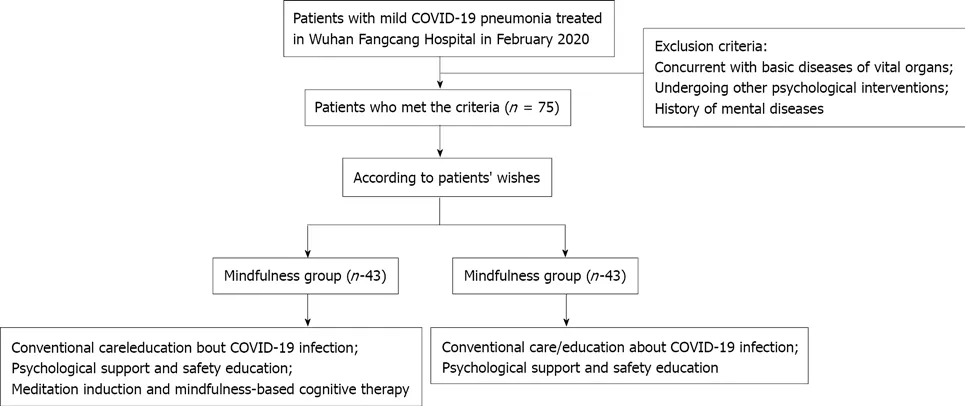
The inclusion criteria were:(1) Patients with COVID-19 treated at Wuhan Fangcang Hospital;(2) 18-60 years of age and normal hearing,reading,and language;and (3) No history of mental diseases,and clear verbal expression.All participants enrolled in this study were diagnosed according to World Health Organization interim guidance[27].The exclusion criteria were:(1) Concurrent with comorbidities of vital organs;(2) Receiving other psychological interventions;or (3) History of mental diseases (schizophrenia).
Groups
He appeared dazed but said nothing. Getting up, he walked closer to inspect them. Then he withdrew to eye them at a distance. I tried to control my stomach flip7 flops8. Finally, with a tear escaping down one cheek, he mumbled9, I don t believe it. The eyes are so real that they follow you everywhere-and look how beautiful your mother is. Will you let me have them framed?
Interventions
At present,coronavirus disease 2019 (COVID-19) is becoming a severe public health concern,especially in Wuhan (China),the most hit area of COVID-19 infection in China,which has set up and opened nine Fangcang Hospitals to treat patients with COVID-19.For patients with COVID-19,fear of the disease and negative emotions easily lead to a psychological crisis,and a timely and effective psychological intervention is of great significance.
In the conventional group,the participants received conventional care/education about admission,COVID-19,medication,physical examinations,psychological support,and safety education.
In conclusion,a 5-min mindfulness meditation audio induction can elevate the mindfulness levels,improve the sleep quality,and decrease the depression in hospitalized patients with COVID-19.Furthermore,it is an effective,economical,and convenient non-drug psychological intervention that can be universally applied.
Outcomes
The Short Inventory of Mindfulness Capability (SIM-C) was used to assess the mindfulness level of the participants[29] using 12 items in three categories (acting with awareness,describing,and non-judging of experience).The SIM-C scores were determined using a 5-point Likert scale,ranging from 1 (never true) to 5 (always true).A higher SIM-C score indicates a higher level of mindfulness.
The Princess stayed where she was, dreaming of her delightful Prince, and nothing could have been further from her thoughts than any trouble or misfortune, when suddenly, in a cloud of dust and shavings, by came the enchanter Grumedan, and unluckily he chanced to catch sight of Potentilla
The Hospital Anxiety and Depression Scale (HADS) was used to determine the levels of anxiety and depression in the participants[30] using seven items in two categories.Each item is weighed on a scale of 0-3.The total HADS score ranges from 0 to 21.A higher score indicates more severe anxiety or depression.HADS scores ranging from 9 to 21 indicate that a person is experiencing anxiety or depression.
The intervention was explained to each potential participant in detail.According to their wishes,the participants were divided into either a mindfulness or a conventional intervention group.There was no blinding.
The little tailor willingly consented to do this, and following his friend they went on till they reached a cave where several other giants were sitting round a fire, each holding a roast sheep in his hand, of which he was eating
The Pittsburgh Sleep Quality Index (PSQI) was used to assess sleep quality[31]using 18 items and seven components (subjective sleep quality,sleep latency,sleep duration,habitual sleep efficiency,sleep disturbances,use of sleeping medication,and daytime dysfunction).Each item is weighed on four-interval scales (0-3).The total PSQI score ranges from 0 to 21,where higher scores indicate worse sleep quality.Sleep disorders were determined with PSQI>7.The patients were evaluated using SIM-C,HADS,and PSQI before and after the intervention.
Data collection
Demographic characteristics (including age,sex,body weight,height,and educational background) and SIM-C,HADS,and PSQI scores were recorded.
When I had scratched what I thought was an itch, I was actually grinding the jellyfish, and all of its poisonous, stinging tentacles9, into the crack of my bottom.
Statistical analysis
SPSS 19.0 (IBM,Armonk,NY,United States) was used for statistical analyses.Continuous data are expressed as the mean ± SD.Differences between groups were analyzed using the independent-sampletest.Differences before and after the intervention were analyzed using the paired-sampletest.Categorical data are presented as(%) and were analyzed using the chi-square test.Two-sidedvalues<0.05 were considered statistically significant.
RESULTS
Characteristics of the participants
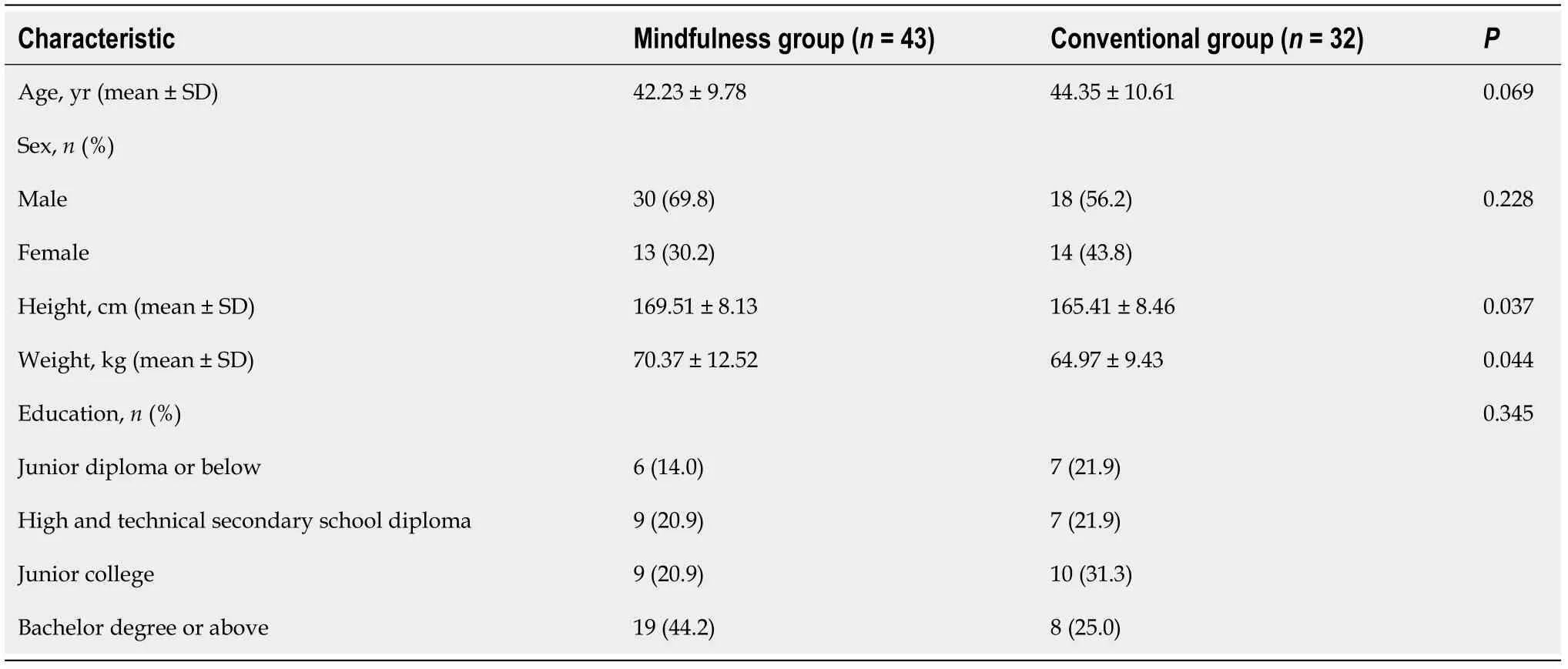
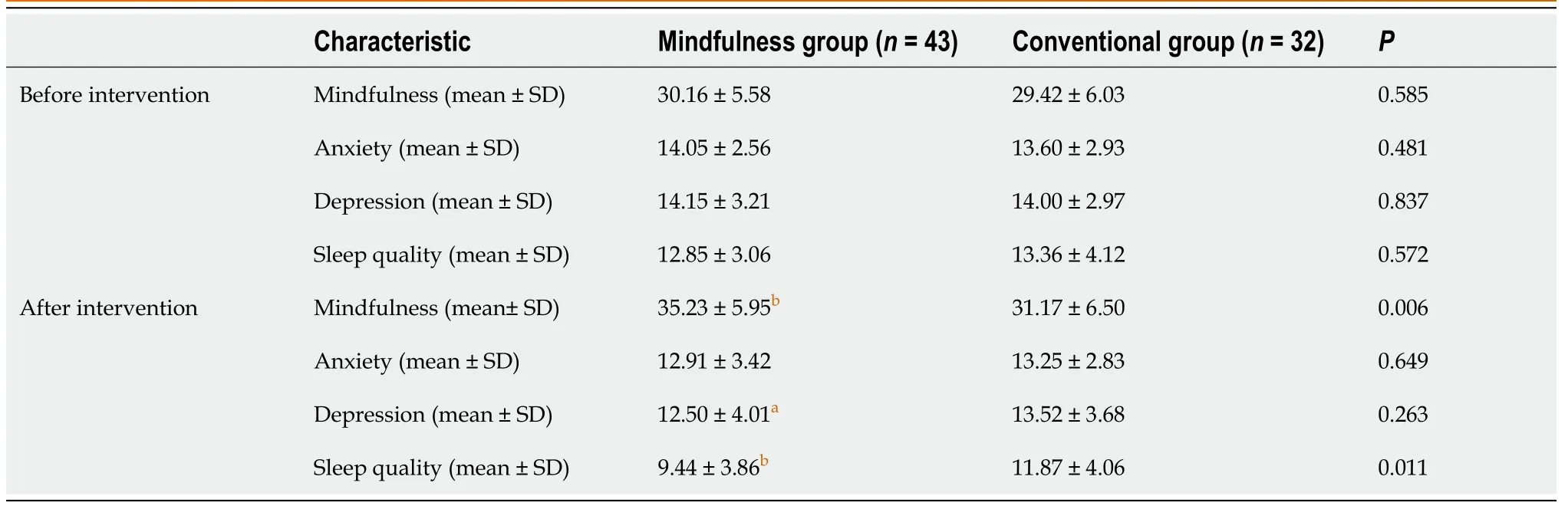
Figure 1 presents the flowchart of the participant enrollment process.In the mindfulness group,there were 30 males and 13 females;the participants were 42.23 ± 9.78(range:30-55) years of age.Eighteen males and fourteen females were enrolled in the conventional group;they were 44.35 ± 10.61 (range:27-56) years of age (Table 1).There were no significant differences in SIM-C,HADS,or PSQI scores between the two groups before the intervention (>0.05;Tables 2 and 3).
Mindfulness levels after intervention in patients with COVID-19
The Wuhan Fangcang Hospital is a temporary hospital constructed to treat COVID-19 and has relatively crude facilities.Wuhan Fangcang Hospital has 1000 beds to isolate patients with COVID-19.A narrow space,a brightly lit environment,and strict protective measures (masks and protective clothing) enhance negative emotions.This hospital serves public health purposes in terms of physical care and isolation on the patients,but the environment is not conducive to mitigating stress and anxiety.In this hospital and this study,a short-term mindfulness meditation audio file that only takes 15-20 min could significantly enhance the patients' mindfulness by eliminating distractions and focusing on the current awareness.
Sleep quality after the intervention
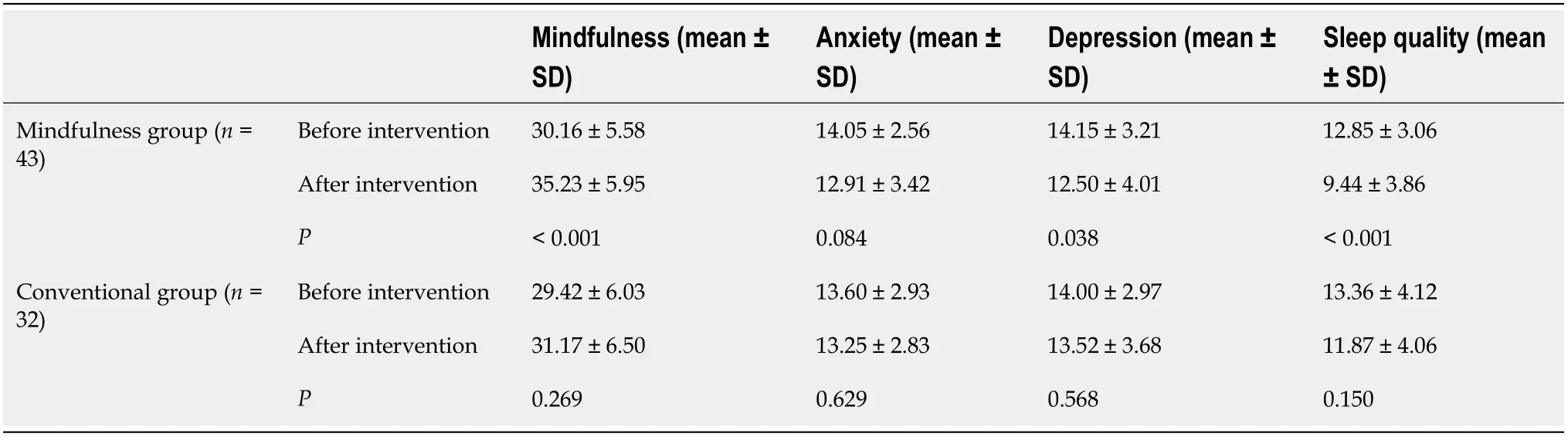
After the 2-wk intervention,sleep quality (from 12.85 ± 3.06 to 9.44 ± 3.86,<0.001) in the mindfulness group was significantly improved,but there was no change in the conventional group.The sleep quality (9.44 ± 3.8611.87 ± 4.06,=0.011) was significantly higher in the mindfulness group than in the conventional group,and the degree of sleep quality (=0.022) was significantly different between the two groups(Tables 2 and 3).
Anxiety and depression before and after the intervention
Before the intervention,the participants in both groups experienced anxiety and depression.After the 2-wk intervention,the depression level was decreased significantly in the mindfulness group (from 14.15 ± 3.21 to 12.50 ± 4.01,=0.038),but there was no change in the conventional group.There were no significant differences in anxiety (=0.649) or depression (=0.263) between the two groups after the intervention (Tables 2 and 3).
DISCUSSION
COVID-19 damages physical health and poses a huge impact on mental health because of the isolation,uncertainness about disease outcomes,and rumors,leading to anxiety,depression,and negative emotions during treatment[10-12].Therefore,timely and effective psychological counseling should be implemented in the comprehensive therapy of COVID-19[10-12,32].A strongly effective intervention is necessary to relieve the overwhelming negative emotions,thus decreasing ego depletion[33].Mindfulness meditation is a unique practice to enhance attention and awareness,focusing on one’s internal and external experiences in a moment of conscious and non-judgmental awareness[13-16,33].Mindfulness is conducive to the treatment of a variety of conditions[13-16].It also helps to regulate emotions and enhances well-being.Furthermore,mindfulness can reduce unconscious behaviors and overcome automaticity[13-16,34].Mindfulness meditation is beneficial to mitigate the negative effects of the COVID-19 pandemic in the general population[23-26],but no study examined such meditation in the COVID-19 patients themselves.Therefore,this study aimed to explore the efficacy of mindfulness meditation in alleviating psychological distress and sleep disorders in patients with COVID-19.The results suggested that a shortterm (2-wk) mindfulness induction can increase the mindfulness level,improve the sleep quality,and decrease the depression of patients with COVID-19.
After the 2-wk intervention,the mindfulness level (from 30.16 ± 5.58 to 35.23 ± 5.95,<0.001) was significantly increased in the mindfulness group and was significantly higher in the mindfulness group than in the conventional group (35.23 ± 5.9531.17 ±6.50,=0.006;Tables 2 and 3).
That s just where it is, sighed the Caliph, whose wings drooped94 in a dejected manner; how do you know she is young and lovely? I call it buying a pig in a poke26
Fear in response to life-threatening events is common in human beings[35,36].An effective psychological intervention can elevate mindfulness levels,thereby offering the patient a positive attitude towards diseases.Mindfulness meditation originates from the ancient orient[37] and is closely related to activating the prefrontal lobe and the cingulate gyrus[34].Mindfulness meditation brings a non-judgmental concentration on internal and external stimuli,and finally,a balanced mentality.Owing to the rapid spread of the epidemic,Wuhan was locked down on January 23,2020.In the current situation,most patients with COVID-19 have a good prognosis[1,2],but fear remains[5-8,10-12].In the present study,a 15-20 min mindfulness meditation was helpful for patients to foster positive emotions.This intervention can be performed together with the medical treatment of COVID-19.Mindfulness levels were significantly higher in the mindfulness intervention group than in the conventional group after the intervention,suggesting that the 15-20 min mindfulness meditation could effectively induce and enhance mindfulness in patients with COVID-19.
This prospective study enrolled patients with mild COVID-19 treated at Wuhan Fangcang Hospital in February 2020.This study was approved by the ethics review board of Jiangsu Province Hospital.Written informed consent was obtained from each participant.
At present,mindfulness-based stress reduction and MBCT can be combined with cognitive-behavioral therapy to provide a more definite psychological education about emotions,cognition,and functions[41].In this study,the participants in both groups had high HADS scores before the intervention,indicating that the diagnosis and isolation influenced the psychological state of patients with COVID-19.After the 2-wk intervention,no significant difference in the HADS score was observed.Isolation and the cold environment of the hospital might play a role in this result,but it will have to be confirmed in future studies.
This study has some limitations.First,the participants were not randomized,and the assessors were not blinded.Second,the sample size was small,limiting the generalizability of the results.Additional studies are needed to address these issues.
CONCLUSION
Mindfulness meditation induction and mindfulness-based cognitive therapy(MBCT) were applied in the mindfulness intervention group.A 5-min mindfulness audio file produced by Li[28] was played using a mobile phone through WeChat.The participants were guided into mindfulness meditation according to the instructions in the audio file.During mindfulness meditation,the participants were asked to keep an alert and relaxed posture,with the eyes gently closed.At least 1 h of collective Q&A was performed in the participants each day,and face-to-face psychological support was provided if necessary.The research group included one registered psychiatrist and three registered nurses with a bachelor’s degree or above and at least 3 years of working experience.The psychiatrist was responsible for selecting the 5-min mindfulness audio instructions and for training the nurses about mindfulness knowledge and nursing precautions before and after playing the mindfulness instructions.A WeChat group was generated for the participants during the study period.On the first day of participation,the mindfulness meditation audio and texts were pushedWeChat.The nurses guided the participants to meditate,and the induction lasted about 30 min.On the second day,after mastering the mindfulness meditation training methods,the participants were free to undergo a daily mindfulness meditation (5-20 min) before sleeping.The nurses directed and supervised the daily mindfulness meditation and recorded the sleep quality of the participants.
ARTICLE HIGHLIGHTS
Research background
The participants in both groups were treated with the same supportive therapy for COVID-19.
Research motivation
Mindfulness meditation is beneficial to mitigate the negative effects of the COVID-19 pandemic in the general population,but no study examined such meditation in the COVID-19 patients themselves.
Research objectives
The survey explored the efficacy of mindfulness meditation in alleviating psychological distress and sleep disorders in patients with COVID-19 in Wuhan Fangcang Hospital.
Research methods
This was a prospective study of patients with mild COVID-19 treated at Wuhan Fangcang Hospital in February 2020.The patients were voluntarily divided into either a mindfulness or a conventional group.The participants in both groups were treated with the same supportive therapy for COVID-19.Besides,the mindfulness group received mindfulness-based cognitive therapy,which contains a 5-min meditation.
Research results
After a 2-wk intervention,the mindfulness level (from 30.16 ± 5.58 to 35.23 ± 5.95,P<0.001) and sleep quality (from 12.85 ± 3.06 to 9.44 ± 3.86,P<0.001) significantly increased in the mindfulness group.However,there were no difference in the conventional group.After a 2-wk intervention,the mindfulness level (35.23 ± 5.95 vs 31.17 ±6.50,P=0.006) and sleep quality (9.44 ± 3.86 vs 11.87 ± 4.06,P=0.011) were significantly increased in the mindfulness group than in the conventional group.Depression decreased in the mindfulness group (from 14.15 ± 3.21 to 12.50 ± 4.01,P=0.038),but there was no difference between the two groups.
But the littlest knight wasn t afraid. With his kind heart all he could feel now was pity. He wanted to help the beast, to give it water to drink and cool its swollen eyes.
Oh, how long have I waited for thee! Never, never must you leave me any more! When the old king heard the news he welcomed him as a son, and made ready a feast, and all the court sat down
Research conclusions
The short-term mindfulness meditation can increase the mindfulness level,improve the sleep quality,and decrease the depression of patients with COVID-19.
6.Thursday evening: Fairy tales do not usually provide detailed44 settings of time, such as the day of the week and season, like the one provided in this tale.
Research perspectives
The short-term mindfulness meditation is very useful to patients with COVID-19,and long-term mindfulness meditation is worth further study as well.
 World Journal of Clinical Cases2022年2期
- World Journal of Clinical Cases的其它文章
- Successful management of delirium with dexmedetomidine in a patient with haloperidol-induced neuroleptic malignant syndrome:A case report
- Using a fretsaw in treating chronic penial incarceration:A case report
- Occupational fibrotic hypersensitivity pneumonia in a halogen dishes manufacturer:A case report
- Accelerated Infliximab Induction for Severe Lower Gastrointestinal Bleeding in a Young Patient with Crohn’s Disease:A Case Report
- Tension pneumocephalus following endoscopic resection of a mediastinal thoracic spinal tumor:A case report
- Primary adrenal diffuse large B-cell lymphoma with normal adrenal cortex function:A case report