
Exact solutions of non-Hermitian chains with asymmetric long-range hopping under specific boundary conditions
2022-01-23 06:35:26CuiXianGuo郭翠仙andShuChen陳澍
Chinese Physics B 2022年1期
Cui-Xian Guo(郭翠仙) and Shu Chen(陳澍)
1Beijing National Laboratory for Condensed Matter Physics,Institute of Physics,Chinese Academy of Sciences,Beijing 100190,China
2School of Physical Sciences,University of Chinese Academy of Sciences,Beijing 100049,China
3Yangtze River Delta Physics Research Center,Liyang 213300,China
Keywords: non-Hermitian physics,exact solution,topological physics,long-range hopping
1. Introduction
Recently, non-Hermitian systems have gained much attention, both theoretically and experimentally.[1,2]In contrast to the Hermitian systems, the non-Hermitian systems exhibit many novel properties, such as complex spectrum structures,rich topological classifications and non-Hermitian skin effect(NHSE).[3-21]NHSE is characterized by the emergence of a large number of bulk states accumulating on one of the open boundaries accompanying with remarkably different spectra from those under periodic boundary condition (PBC).[15-21]As this counterintuitive phenomenon has no Hermitian correspondence, the NHSE has attracted intensive studies in the past years.[22-33]
The NHSE is essentially a boundary-sensitivity phenomenon. The boundary effect for non-Hermitian systems has been studied in Refs. [18,24,34-42]. To understand why the change of boundary terms dramatically affects the properties of bulk states of non-Hermitian systems, with collaborators we presented exact solutions for the one-dimensional non-Hermitian models with generalized boundary conditions in a recent work,[38]in which the size-dependent boundary effect has been clarified from the perspective of exact solution. The analytical results uncovered the existence of size-dependent NHSE and gave quantitative description of the interplay effect of boundary hopping terms and lattice size. The sizedependent NHSE was firstly observed by Liet al. in coupled nonreciprocal chains,[43]and was generalized to open quantum systems.[44]It was also observed in non-reciprocal chains with impurity.[39]
In this paper,we generalize the exact solutions to the onedimensional non-Hermitian models with nonreciprocal(asymmetric) long-range hopping under specific boundary conditions. Although the introduction of long-distance hopping terms hinders the finding of analytical solutions for arbitrary boundary parameters, we identify the existence of exact solutions when the boundary parameters fulfill some constraint relations,which give the specific boundary conditions considered in the present work. Under the specific boundary conditions, we exactly solve the eigenvalue equations and give analytical results of eigenvalues and wavefunctions. Based on our analytical results, we demonstrate the existence of sizedependent NHSE and rich structures of the eigenvalue spectra.Some concrete examples are also discussed.
2. Models and solutions
We start with the general 1D non-Hermitian model with asymmetric long-distance hopping terms under generalized boundary conditions,described by the Hamiltonian

wherepis the farthest length of left hopping,qis the farthest length of right hopping, andNis the number of lattice sites.A model withp=2 andq=2 is schematically displayed in Fig.1. While the PBC corresponds toδjL=tjL(j=1,...,p)andδjR=tjR(j= 1,...,q), the open boundary condition(OBC)corresponds toδjL=δjR=0.

Fig. 1. Schematic diagram of general 1D non-Hermitian model with p=2 and q=2.
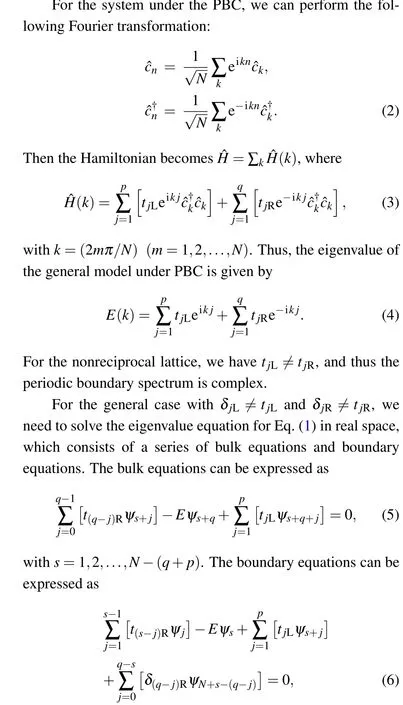


For a givenE, there areq+psolutionszi(z1,z2,...,zq+p).Then it follows that the superposition ofp+qlinearly independent solutions is also the solution of Eq.(5)corresponding to the same eigenvalue,i.e.,

withn=1,2,...,N.
To solve the eigenequationHΨ=EΨ,the general ansatz of wave function should also fulfill the boundary conditions.

which is usually too complicated to be precisely solved for the general case. For convenience, we shall divide the solutions into two cases: one is that the number ofci(/=0,i=1,...,q+p)is 1,and the other is that the number ofci(/=0)is greater than 1 and less than or equal toq+p. In general,the second case is hard to be analytically solved. An exception is the case ofp=q=1,which was exactly solved for arbitrary boundary parameters.[38]
The solutions ofzifor the first case (i.e., there is only one nonzerociand for convenience we denote it asc1)can be easily obtained by applying a simplified method,which is the situation studied in this paper. In this case, the eigenfunction is composed of only one solution, i.e.,|Ψ〉=c1|Ψ1〉, and the boundary equationHB(c1,...,0)T=0 requiresc1/=0,c2=0,...,andcq+p=0. Thus,Eq.(14)gives rise to


whereθ=(2mπ/N). Whenμ=1, Eq. (25) is identical to Eq.(4),and the eigenstates are all extended states,corresponding to PBC.The case ofμ=eiφwithφ ∈(0,2π)corresponds to a twist boundary condition by shifting the momentum by a twist angleφ/N.
3. Results and discussion

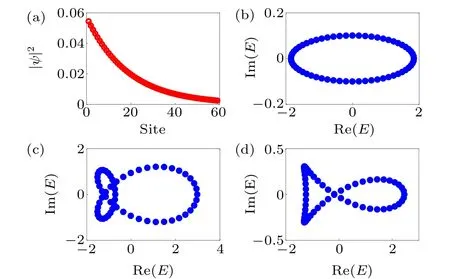
Fig.2. (a) The profile of all eigenstates for different models in (b)-(d). (b)Energy spectra for general model with p=1,q=1,t1L=1,and t1R=0.85.(c)Energy spectra for general model with p=2,q=1,t1L=1,t1R=0.85,and t2L=1.2.(d)Energy spectra for general model with p=2,q=2,t1L=1,t1R =0.85,t2L =0.2, and t2R =0.4. The boundary hopping parameters are determined by the specific boundary condition Eq. (24). Common parameters: N=60 andμ =0.2.
Next we shall discuss some special cases and display how the boundary parameterμaffects the spectra and wavefunctions.
3.1. Hatano–Nelson model under the specific boundary condition
Whenp=1 andq=1,the general model reduces to the Hatano-Nelson model[45,47]under the specific boundary conditiont1R/δ1R=δ1L/t1L=μ. The corresponding eigenvalues from Eq.(25)withp=1 andq=1 can be rewritten as
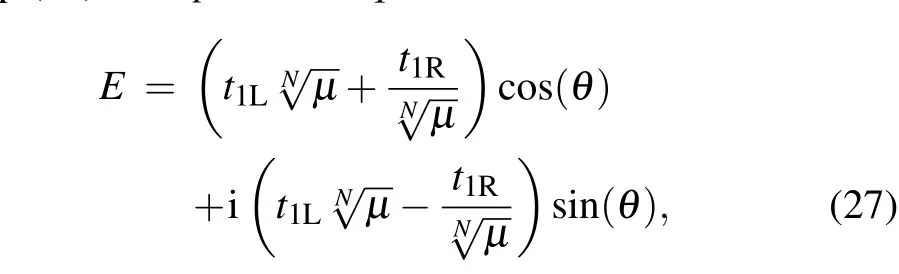
withθ=(2mπ/N),and the eigenstates are given by Eq.(26).
There are some special situations in the specific boundary conditions as follows:
Whenμ=1(PBC),the eigenvalues can be expressed as

Since the valuesθappear always in pairs of (θ,-θ) except the case ofθ=0 andπ(sin[0]=sin[π]=0),we find that the spectrum are the same as the spectrum under PBC,whereas the corresponding wave functions exhibit NHSE.This special case is the so called pseudo-PBC studied in Ref.[38]. This result is a little counterintuitive since we can get a Bloch-like spectrum even the translation invariance is broken by the boundary term.A straightforward interpretation is that the Hamiltonian under the pseudo-PBC ?HpPBCcan be transformed to a Hamiltonian ??Hby carrying out a similar transformation,i.e.,S?HpPBCS-1= ??H,where ??His identical to the original Hatano-Nelson model under PBC witht1Landt1Rexchanged each other.
In Fig. 3, we plot the energy spectra and the profile of eigenfunction with differentμfor a fixedN. As shown in Fig.3(a),the energy spectra under pPBC(μ=rN)are the same as those under PBC (μ=1), and both are located at energy spectra under PBC in the thermodynamic limit. In addition,the energy spectra under mPBC are located at spectra under OBC in the thermodynamic limit,which is consistent with our prediction. Forμ>1,the wavefunctions are localized on the left boundary,and the NHSE becomes more obvious asμincrease as displayed in Fig.3(b).

Fig. 3. Hatano-Nelson model under specific boundary conditions. (a) Energy spectra with μ =1, 0.6, rN and r2N described by the red circles, blue circles, magenta circles and cyan circles, respectively. The green and black line represents energy spectrum corresponding to OBC and PBC case in the thermodynamic limit, respectively. (b) The profile of all eigenstates withμ =1, 0.6, rN and r2N. Common parameters: t1L =1, t1R =0.85, N =20 and r=
3.2. Model with next-nearest-neighbor hopping

which are the same as those under PBC, while the corresponding wave functions exhibit NHSE. Therefore, this special boundary condition is also named as the pseudo-PBC.
In Fig. 4, we plot the energy spectra and the profile of eigenfunction with differentμfor a fixedN. We can see that the energy spectra under pPBC are the same as those under PBC,while the wavefunctions exhibit NHSE obviously,which is consistent with our prediction.

Fig.4. General model with p=2 and q=2 under specific boundary conditions. (a)Energy spectra withμ=1,0.2,0.002 and r2N described by the red circles,blue circles,magenta circles and cyan circles,respectively.The black line represents energy spectrum corresponding to PBC case in the thermodynamic limit. (b)The profile of all eigenstates withμ=1,0.2,0.002 and r2N.Common parameters: t1L =1, t1R =0.2, t2L =2.5, t2R =0.1, N =20 and
3.3. General model with p=q

are fulfilled. Whenμ=r2N,the eigenvalues can be expressed as

Table 1. Energy spectra and eigenfunctions for non-Hermitian chains with asymmetric long-range hopping under different boundary conditions.

which are the same as those under PBC,while the corresponding wave functions exhibit NHSE. We also call this special case as the pseudo-PBC.
In Table 1, we display the energy spectra and eigenfunctions for the non-Hermitian chains with asymmetric longrange hopping under different boundary conditions. It is noticed that pseudo-PBC exists only for the case ofp=q, and we haveθ=(2mπ/N)(m=1,...,N)in the table.
4. Conclusion
In summary, we present exact solutions for general nonreciprocal chains with long-distance hopping under specific boundary conditions. Our analytical results indicate the existence of size-dependent NHSE.While the NHSE is distinct for small size system,it becomes less discernable in the large size limit. The wave functions are independent of hopping range,whereas the eigenvalue spectra are model dependent and display rich structures. We also find the existence of a special point called pseudo-PBC, for which the spectra are identical to periodic spectra when the hopping parameters meet certain conditions, while eigenstates display NHSE. Our exact solutions provide examples that the boundary terms can dramatically change the bulk properties of non-Hermitian systems.While both asymmetric and long-range hopping are hard to be realized in conventional quantum systems,electric circuits provide a platform to simulate non-reciprocal non-Hermitian systems,[48,49]which may be used to verify generalized bulkboundary correspondence and non-Hermitian skin effect. We expect that more interesting solutions can be found and be simulated in electric circuits in future works.
Acknowledgments
Project supported by the National Key Research and Development Program of China(Grant No.2016YFA0300600),the National Natural Science Foundation of China (Grant No. 11974413), and the Strategic Priority Research Program of Chinese Academy of Sciences(Grant No.XDB33000000).

- Chinese Physics B的其它文章
- Role of compositional changes on thermal,magnetic,and mechanical properties of Fe–P–C-based amorphous alloys
- Substrate tuned reconstructed polymerization of naphthalocyanine on Ag(110)
- Anti-PT-symmetric Kerr gyroscope
- Information flow between stock markets:A Koopman decomposition approach
- Cascading failures of overload behaviors using a new coupled network model between edges
- High efficiency ETM-free perovskite cell composed of CuSCN and increasing gradient CH3NH3PbI3