
Tri-hexagonal charge order in kagome metal CsV3Sb5 revealed by 121Sb nuclear quadrupole resonance
2022-01-23 06:34:32ChaoMu牟超QiangweiYin殷薔薇ZhijunTu涂志俊ChunshengGong龔春生PingZheng鄭萍HechangLei雷和暢ZhengLi李政andJianlinLuo雒建林
Chinese Physics B 2022年1期
Chao Mu(牟超) Qiangwei Yin(殷薔薇) Zhijun Tu(涂志俊) Chunsheng Gong(龔春生) Ping Zheng(鄭萍)Hechang Lei(雷和暢) Zheng Li(李政) and Jianlin Luo(雒建林)
1Beijing National Laboratory for Condensed Matter Physics and Institute of Physics,Chinese Academy of Sciences,Beijing 100190,China
2School of Physical Sciences,University of Chinese Academy of Sciences,Beijing 100190,China
3Department of Physics and Beijing Key Laboratory of Opto-electronic Functional Materials&Micro-nano Devices,Renmin University of China,Beijing 100872,China
4Songshan Lake Materials Laboratory,Dongguan 523808,China
Keywords: charge-density-wave systems,nuclear magnetic resonance
The newly discovered superconductorAV3Sb5(A=K,Rb,Cs)possesses a quasi-two-dimensional kagome structure,which provides a platform to investigate the interplay of topology, electron correlation effects and superconductivity.[1-5]They undergo a charge density wave (CDW) transition atTCDW=78 K, 103 K, 94 K and a superconducting transition atTc=0.93 K,0.92 K,2.5 K forA=K,Rb,Cs,respectively.The superconducting state is found to be spin singlet with swave pairing symmetry in the bulk state.[6-8]STM studies observed possible Majorana modes[9]and pair density wave[10]in the surface state. A residual density of states was experimentally observed in the superconducting state,[11]which may be due to the competition between the superconductivity and the CDW.[11-16]
The CDW order breaks time-reversal symmetry[17-19]and leads to the anomalous Hall effect in the absence of magnetic local moments.[20-23]Inelastic x-ray scattering and Raman scattering exclude strong electron-phonon coupling driven CDW,[24]while optical spectroscopy supports that the CDW is driven by nesting of Fermi surfaces.[25]STM experiment find the CDW peak intensities at 3Qwhich breaks the six-fold rotational symmetry.[26]An additional unidirectional 1×4 superlattice is observed on the surface,[10,27-29]but is absent in the bulk state.[30]The “star of David” (SoD) and “trihexagonal” (TrH) structure configurations were proposed to be the likely candidates for the CDW structures,[31,32]as illustrated in Figs. 2(b) and 2(c). SoD or TrH with a lateral shift between the adjacent Kagome layer results in a 2×2×2 structure modulation.[33]Density functional theory calculations showed that the TrH deformation is preferred.[31,32,34]However, there is still lack experimental evidence whether SoD or TrH deformation is the ground state configuration in the CDW state.
In this work, we report nuclear quadrupole resonance(NQR) investigations on CsV3Sb5. The splitting of121Sb spectra demonstrates that a commensurate CDW order forms at 94 K with a first-order transition. Our results indicate that the charge order has a tri-hexagonal deformation which is 2×2 period modulation. The shift between the adjacent kagome layers induces a modulation in thec-direction and the CDW is a three-dimensional modulation with 2×2×2 period. Spinlattice relaxation rate measured at the peak of the CDW state shows a coherence peak just belowTc, indicating that the superconducting state coexists with the CDW order and shows a conventional s-wave behavior.
Single crystals of CsV3Sb5were synthesized using the self-flux method.[6]Superconductivity withTc=2.5 K was confirmed by dc magnetization measured using a superconducting quantum interference device (SQUID). The NQR measurements were performed using a phase coherent spectrometer. The spectra were obtained by frequency step and sum method which sums the Fourier transformed spectra at a series of frequencies.[35]The spin-lattice relaxation timeT1was measured using a single saturation pulse. Crystal structures were visualized in VESTA.[36]

Fig. 1. The 121Sb-NQR spectra around TCDW. The peaks in the low frequency range are from ±1/2 ?±3/2 transition and the peaks in the high frequency range are from ±3/2 ?±5/2 transition. There are 2 sites of Sb marked by Sb1 and Sb2 above TCDW. Both peaks of Sb2 split due to non-equivalent sites emerging below TCDW. The notations of Sb1, Sb2′H, Sb2′′H and Sb2T are consistent with those in Fig. 2(c). The spectra of all temperatures are presented in the supplemental material.
Figure 1 shows the NQR spectra of121Sb in zero field.There are two different crystallographic sites of Sb in CsV3Sb5with the atomic ratio of Sb1: Sb2=1:4. Sb1 is located in the V-kagome plane, and Sb2 forms a graphite-like network between V-kagome layers,as shown in the inset of Fig.1 and Fig.2(a).It is easy to distinguish Sb2 peaks from Sb1 peaks by the spectral intensity. The nuclear spin Hamiltonian of the interaction between quadrupole momentQand the electric field gradient(EFG)is described as

Four NQR transition peaks can be clearly identified above 95 K.BelowTCDW=94 K,the intensity of the original peaks decreases gradually and four sets of new peaks emerge, indicating that the CDW transition is commensurate and four unequal sites of Sb atoms appear in the CDW state. The coexistence of two phases between 91 K and 94 K demonstrates that the CDW transition is of first-order due to a simultaneous superlattice transition.[2]It is consistent with NMR studies on51V which also show coexistent behavior.[6,37,38]The peaks belowTCDWare complex and cannot be distinguished by the intensity alone.

Fig.2. Perspective view of crystal structures of CsV3Sb5 in(a)the pristine phase, (b) the star of David phase and (c) the tri-hexagonal phase. There is a shift between adjacent layers in the star of David configuration and the tri-hexagonal configuration.
Two structure configurations named as “star of David”and “tri-hexagonal” have been proposed in the CDW state.[31,32,34]We can assign the Sb2Hand Sb2Tsites by their symmetry. In SoD configuration,as shown in Fig.2(b),Sb2His inside the star and Sb2Tis outside the star. In TrH configuration, as shown in Fig. 2(c), Sb2Tis located at the center of the trigonal V-network and Sb2His outside. A lateral shift between the adjacent kagome layers forms modulation on thec-axis,[33,34]which results in a nematic state with onlyC2rotation symmetry and makes Sb2′Hsite different from Sb2′′Hsite.[39]The subscript “H” denotes the sites around the hexagon and the subscript“T”denotes the sites at the triangle center. The four new peaks in Fig.1 correspond to these four sites, Sb1, Sb2′H, Sb2′′Hand Sb2T. The spin-lattice relaxation timeT1is employed to track the evolution of the peaks. 1/T1Tof the peak around 77 MHz evolutes from Sb1, as shown in Fig. 3. 1/T1Tof the peaks around 74 MHz marked by Sb2′Hand Sb2′′Hare the same and evolute from Sb2, see Fig. 2 in Ref. [6]. The peak around 72 MHz has a weak intensity andT1measurement has large uncertainty just belowTCDW. Fortunately,there is only Sb2Tsite left,so the peak around 72 MHz is attributed to it. In addition,the asymmetry parameterηcan also be used to distinguish them.


Fig.4. Temperature dependence of(a),(d)peak positions,(b),(e)νQ and(f),(g)η of Sb1 site and Sb2 site,respectively. The vertical dashed lines indicate the transition temperature of CDW.

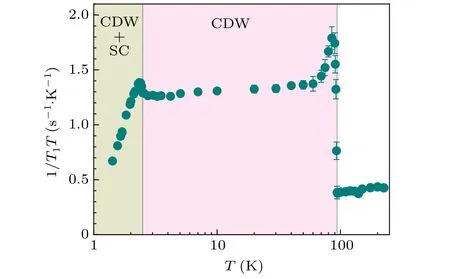
Fig.3. Temperature dependence of 121(1/T1T)of Sb1 site. 1/T1T jumps at TCDW. A Hebel-Slichter coherence peak appears just below Tc.
Next,we will distinguish between the two configurations of TrH and SoD.The CDW has a three-dimensional modulation and the modulation inc-axis will make Sb2 plane have different pattern from the kagome plane. Therefore, the different between TrH and SoD in the kagome plane should be detected by Sb1 rather than Sb2. In TrH deformation,V atoms are closer to Sb1 site, soνQof Sb1 moves a lot toward high frequency,as shown in Fig.4(b). In SoD deformation,on the other hand,V atoms move away from Sb1 site,soνQof Sb1 should not increase,which is inconsistent with the NQR spectra. The Sb2Hpeaks split to Sb2′Hand Sb2′′Hpeaks due to a lateral shift between adjacent layers in the tri-hexagonal configuration. The intensity ratio of the two peaks is 1:2,which is consistent with the atoms ratio. NQR frequency is determined by EFG, so the NQR spectra indicates that the electronic modulation pattern is formed simultaneously with the structural distortion. Our results favor TrH deformation over SoD deformation and are consistent with 2a×2a×2cpattern.If 4apattern exists,it should only exist on the surface.[30,32]
TheνQandηjump atTCDWand then change gradually in the CDW state. They remain constant when entering the superconducting state, indicating the coexistence of superconductivity and the CDW order.121(1/T1T) measured at the peak in the CDW order state shows superconducting transition, as shown in Fig. 3, confirming the coexistence.121(1/T1T)shows a clear Hebel-Slichter coherence peak just belowTcand then rapidly decreases at low temperatures, as shown in Fig.3, indicating that CsV3Sb5is a conventional swave superconductor. It is consistent with our previous result measured at Sb2 site.[6]
In conclusion,we have performed121Sb NQR studies on CsV3Sb5. The variation of the NQR spectra indicates a firstorder commensurate CDW transition at 94 K. We identified four Sb sites in the CDW state which give restriction on the CDW order. The charge order can be understood in terms of tri-hexagonal deformation with lateral shift between the adjacent kagome layers, which has a 2×2×2 period. In the superconducitng state,121(1/T1T)of Sb1 site in kagome planes shows conventional s-wave behavior, just as121(1/T1T) of Sb2 site between kagome planes. The superconducting phase coexists with CDW order in the bulk state.
Acknowledgments
Project supported by the National Key Research and Development Program of China(Grant Nos.2017YFA0302901,2018YFA0305702,2018YFE0202600,and 2016YFA0300504),the National Natural Science Foundation of China (Grant Nos. 12134018, 11921004, 11822412, and 11774423),the Beijing Natural Science Foundation, China (Grant No. Z200005), and the Strategic Priority Research Program and Key Research Program of Frontier Sciences of the Chinese Academy of Sciences(Grant No.XDB33010100).

- Chinese Physics B的其它文章
- Role of compositional changes on thermal,magnetic,and mechanical properties of Fe–P–C-based amorphous alloys
- Substrate tuned reconstructed polymerization of naphthalocyanine on Ag(110)
- Anti-PT-symmetric Kerr gyroscope
- Information flow between stock markets:A Koopman decomposition approach
- Cascading failures of overload behaviors using a new coupled network model between edges
- High efficiency ETM-free perovskite cell composed of CuSCN and increasing gradient CH3NH3PbI3