
Lattice plasmon mode excitation via near-field coupling
2022-01-23 06:34:48YunLin林蘊ShuoShen申爍XiangGao高祥andLianchengWang汪煉成
Chinese Physics B 2022年1期
Yun Lin(林蘊) Shuo Shen(申爍) Xiang Gao(高祥) and Liancheng Wang(汪煉成)
1State Key Laboratory of High Performance Complex Manufacturing,College of Mechanical and Electrical Engineering,Central South University,Changsha 410083,China
2Xiangya School of Stomatology,Xiangya Stomatological Hospital,Central South University,Changsha 410000,China
Keywords: optical response of metal nanoparticles,lattice plasmon modes,finite-difference time-domain
1. Introduction
Metal plasmonic materials have attracted intensive interest due to their wide potential applications including surfaceenhanced Raman spectroscopy(SERS),[1]nanolithography,[2]biosensors,[3]thin film solar cells,[4]beam manipulations,nanolasers,[5]and color filters.[6,7]The optical response of a single metal particle is determined by its size, shape,composition, and local environment,[8]whereas this can be modified through near-field interaction by positioning metal nanoantennas in close proximity[9]or through far-field interaction by positioning the same particle in a regular array,i.e., diffraction effect.[10]Peter Nordlander has introduced a hybridization model for the plasmon response of complex nanostructures.[11]Since then, various nanocavity configurations have been proposed,such as ring/disk,dolmen,oligomer clusters, heptamer clusters and ring/rod nanostructures. Recently, structured lattices have been used to demonstrate superlattice resonances,[12,13]opening an extra route to manipulate optical properties. Nikitin[14-16]has theoretically and experimentally studied lattice plasmon modes (LPMs) originating from diffraction in periodic arrays of metal nanoparticles.Humphrey[17]has studied the lattice resonances in plasmonic arrays of asymmetric disc dimers. The Odom group has observed the lasing action of LPMs from the two-dimensional array of plasmonic Au or Ag surrounded by gain material.[18-21]The influence of size,shape,disorder,symmetry breaking and dielectric environment on the properties of LPMs has also been investigated.[22-26]
The above-mentioned LPMs are all excited through the diffraction effect. In order to activate the LPMs, the size of metal structure has to be small enough to make the energy of localized plasmon resonance(LPR)higher than that of the diffraction modes,which puts some limits on the structure design and nanofabrication. Here we present an approach to excite the LPMs via near-field coupling. We designed a coupled nanometal structure array and studied its optical responses in detail here. Our results could explain the abnormally increased transmission observed in Refs.[27-29],from Stephen Y. Chou’s group. Various devices, such as sensors, color filters, emitters, and solid-state lighting, can be envisioned by using the proposed LPMs.[30-33]
2. Result and discussion
Electromagnetic properties of the designed nanometal structures were investigated by the method of threedimensional(3D)finite-difference time-domain(FDTD)using the Lumerical software package. The structure(Al DK-HLs)consists of a glass substrate, an upper Al disk array (AlDKs)and a lower Al holes array (AlHLs), with a dielectric HSQ array (hydrogen silsesquioxane,n=1.47) sandwiched in between.A plane wave with wavelength spanning from 300 nm-800 nm is incident from above and two-dimensional monitors are placed under and above the Al DK-HLs to record the electric field distributions of transmission (T) and reflection (R),respectively. The background refractive index is set to be 1 except where specially mentioned. The simulation area is discretized using a 3D grid mesh,with a step size of 6 nm in all thex-,y-,andz-directions. The material constants used for the structures in the simulation are silica(Palik),HSQ(n=1.41),and Al (CRC Handbook of Chemistry and Physics). A periodic boundary condition is employed, with a rectangular unit cell consisting of one whole and four quarter spheres. The heights of AlDKs and AlHLs are both 30 nm.
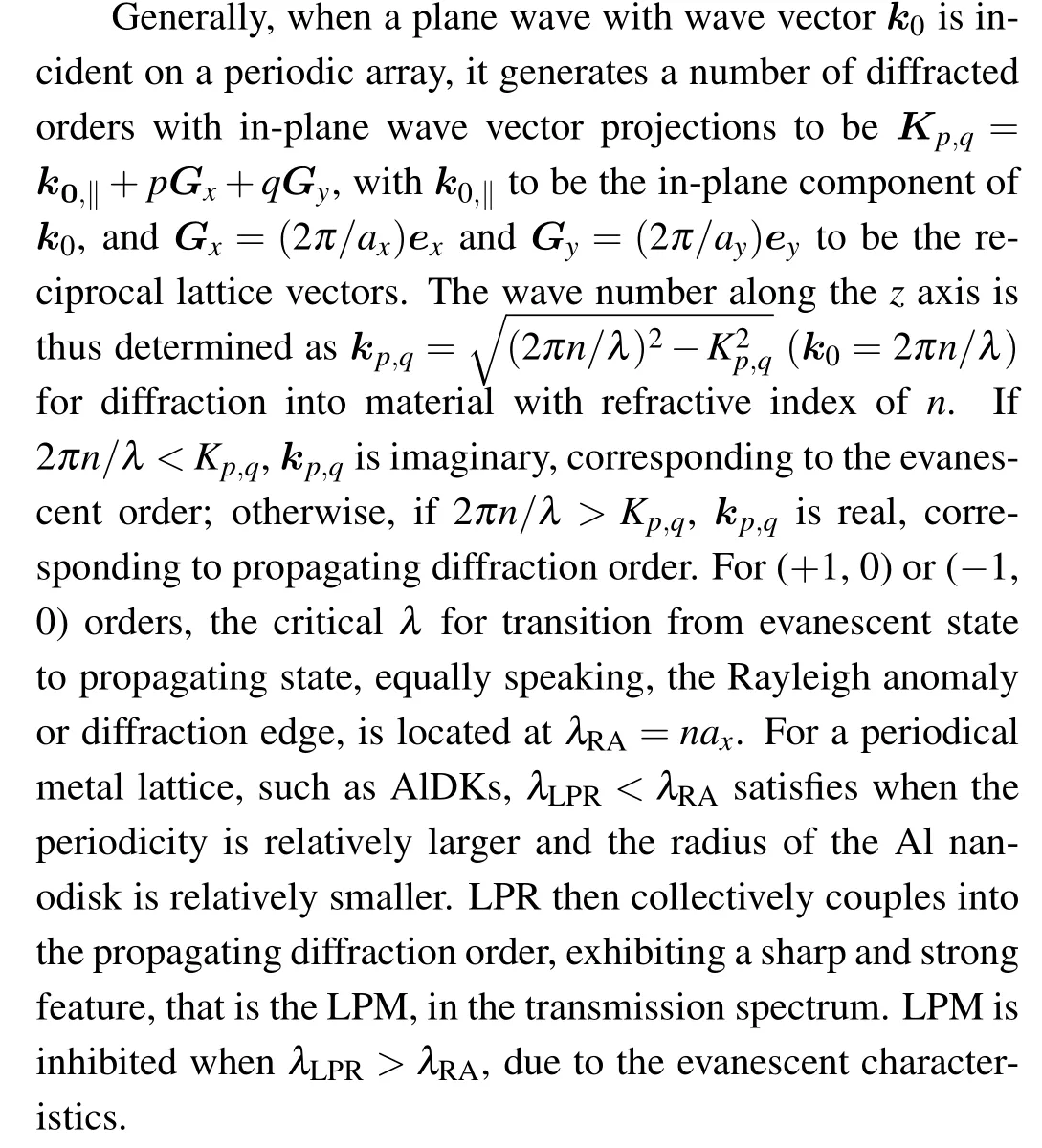
Figure 1(a)sketches the structure(Al DK-HLs)under investigation.AlDKs,HSQ and AlHLs have the same radius(R)and periodicity(P),and the height of HSQ isH. The inset of Fig.1(a)sketches the cross section of the unit Al DK-HLs.We purposely decomposed the Al DK-HLs and investigated the optical properties of each component,i.e.,AlDKs,AlHLs,and their combinations. The periodicity and radius are purposely chosen with(b)P=520 nm,R=60 nm and(c)P=420 nm,R=100 nm,respectively,to locateλRAat the short and long wavelength side ofλLPR,corresponding to the diffraction and near filed region, respectively. The diffraction edge (denoted as blue dashed line) and LPR (denoted as black dashed line)are located at (b)λRA= 639 nm,λLPR= 500 nm and (c)λRA=516 nm,λLPR=650 nm, respectively. At diffraction region(Fig.1(b)),the transmission lineshape of AlDKs+HSQ(red line)exhibits a sharp and narrow LPM dip atλ=680 nm,with the transmission modulation depth to be 0.38,along with a broad and relatively weak LPR dip centered atλ~500 nm.LPM exhibits as a peak atλ=674 nm in the transmission spectrum (blue line) of AlHLs, exhibiting much lower intensity compared with surface plasmon polaritons (SPP) mode,which is located at~500 nm. Note that transmission through Al DK-HLs(H=100 nm)is significantly enhanced to be 0.38 at the LPM position (with transmission is 0.06 for AlHLs),even though all holes of AlHLs are blocked by the metal disks with zero projected open area in AlDKs. The transmission peak intensity decreases when the height of the dielectric HSQ is decreased to 40 nm(green line,Fig.1(b)).
Nikitinet al.[14-16]have investigated the spectral characteristics of AlDKs at the diffraction region; we concentrate more on the near-field coupling region here. At the near-field region (Fig. 1(c)), the transmission lineshape for AlDKs+HSQ, red line, (AlHLs, blue line) consists of a faint peak (dip) and a dominantly much broader dip (peak), corresponding to the Rayleigh anomaly and LPR (SPP), respectively. Note that AlHLs could also support LPR resonances. The faint dip (peak) located within the Rayleigh anomaly region is considered to be LPM,which is quite weak due to its evanescent characteristics. Compared with sole AlDKs (AlHLs), an addition of dielectric HSQ, i.e., AlDKs+ HSQ (AlHLs + HSQ) red shifts the spectrum and simultaneously intensifies (weakens) the LPMs. The Al DK-HLs(H=100 nm)exhibits an obvious LPM peak besides the dominant peak(antibonding symmetrical mode(SM))in the visible wavelength region. The SM mode will be discussed later.WhenHis decreased to 40 nm,the intensity of SM decreases and converges with LPM.The LPM lineshape exhibits a typical asymmetrical Fano feature whenH= 100 and 40 nm.Compared with the AlDKs+AlHLs structure(i.e.,Al DK-HLs without HSQ),LPM is much stronger in the Al DK-HLs(not shown),suggesting that the HSQ intensifies the process of energy channelling to LPMs, even though it red shifts the SM and makes LPM and SM more separated.

Fig.1. Panel(a)sketches the structure(Al DK-HLs)under investigation,with periodicity P,radius R and height H. The inset of(a)sketches the cross section of the structure unit. Optical properties of AlDK-HLs and its component at(b)diffraction region with P=520 nm,R=60 nm and(c)near-field interaction region with P=420 nm,R=100 nm.

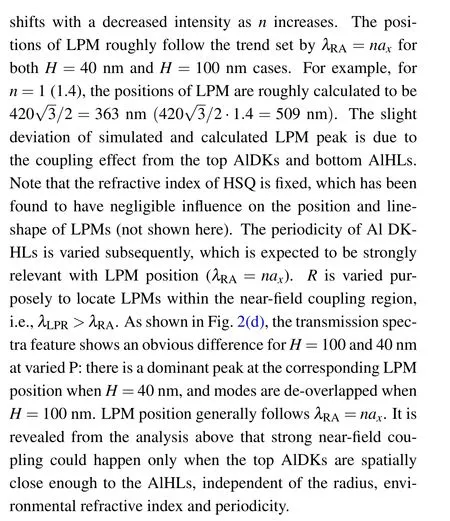
We further analyzed the field distribution for LPM, SM and ASM (anti-symmetric mode). Figures 3(a) and 3(b) plot the transmission and reflection spectra for AlDK-HLs withP=420 nm,R=100 nm and variedH. Figure 3(e)summarizes the energy positions of LPM,ASM and SM as a function ofH. It is clearly observed that, whenHdecreases, SM and ASM mode blue and red shifts,respectively,whereas LPM remains almost unvaried. Figures 3(c)and 3(d)plot the electric field distribution of SM and ASM along theXZcross section.
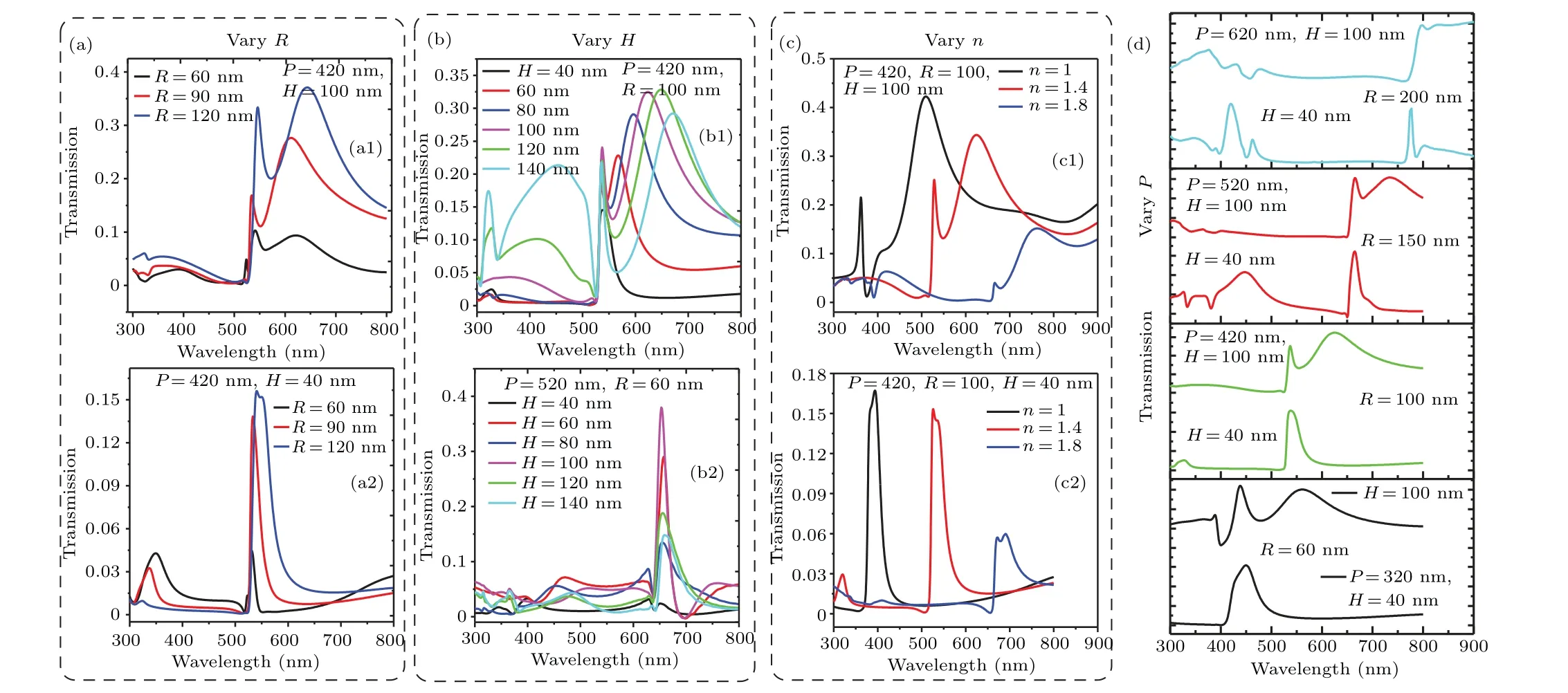
Fig. 2. Optical transmission properties of the Al DK-HLs with systematically varied structural parameters: (a) varied radius R, (a1) P=420 nm,H =100 nm,(a2)P=420 nm,H =40 nm;(b)varied height of HSQ(H)for(b1)near-field coupling region with P=420 nm,R=100 nm,and(b2)diffractive coupling region with P=520 nm,R=60 nm;(c)varied environment refractive index n;(d)varied lattice periodicity P.

Fig. 3. (a) Transmission and (b) reflection spectra in the full wavelength region for Al DK-HLs with P=420 nm, R=100 nm and varied H; the electric field distribution of(c)SM and(d)ASM modes in the XZ cross section; (e)the energy position of LPM,ASM and SM as a function of H;(g)and(h)the transmission spectral of Al DK-HLs(P=420 nm,R=100 nm)with H=100 nm and 40 nm;(f)summarizes the q value for the three sections in(g)and(h).
It is observed that the electric field is concentrated between the top metal disk and bottom metal hole for ASM,
whereas it is pushed outward for the SM mode, indicating the asymmetric bonding and symmetric antibonding features for the ASM and SM modes, respectively. The energy of the SM mode and incident light are channeled into LPM.Equally speaking, the broad SM mode and incident light couple with the relatively narrower LPM, resulting in a typical asymmetrical Fano lineshape. Figures 3(g)and 3(h)plot the transmission spectra of Al DK-HLs(P=420 nm,R=100 nm)whenH=100 nm and 40 nm. The spectra with a Fano-like asymmetric line shape could be expressed as[34,35]

whereωais the central position of resonance,Wais an approximation of its spectrum width in frequency units,qis the asymmetry parameter,andbis the modulation damping parameter originating from intrinsic losses.The resonance strength of the broad mode follows a symmetric pseudo-Lorentzian line shape as a function of the frequencyω,whereais the maximum amplitude of the resonance,ωsis the resonance frequency,andWsis an approximation of its spectrum width in frequency units forωs. The resonance strength of the entire system is given by the product of the symmetric resonance(SR)σswith the asymmetric resonance(AR)σa,as shown in the following equation:

We used the above equation to fit the lineshape separated into three sections I, II and III, corresponding to red, green and blue lines in Figs.3(g)and 3(h),respectively. The asymmetry parameter q characterizes the energy transfer direction: in the limit ofq →∞, the transition to the continuum is weak, and the lineshape is entirely determined by the transition to the discrete state; whenq →0, the transition to the discrete state is weak; whenq →1, the transitions to the discrete and continuum states are almost equal. A largerqindicates that more energy is channeled into the discrete LPM state. Figure 3(f)summarizes theqvalue for the three sections as a function ofH.qincreases whenHis decreased, indicating that the probability of transition to the discrete LPM state increases.The interaction between the LPM,ASM and SM modes can be simply and qualitatively summarized as the following Hamiltonian matrix:

The near-field coupling strength is determined by the energy separation,which is further dependent on dielectric heightH.
Based on the above analysis, the process for the optical transmission in the near-field region for AlDK-HLs is summarized as illustrated in Fig. 4: LPR and SPP in AlDKs and AlHLs and weak LPMs in the relatively wider RA regions are excited by the incident light. LPR and SPP couple with each other, resulting in the formation of a low-energy ASM and a high-energy SM. ASM extends to the infrared region and SM further couples with LPMs via near-field interaction.When the separation between the AlDKs and AlHLs becomes smaller,coupling is intensified,resulting in a dominant quasisingle LPM peak in the visible region. Chou[20]reported an extraordinary light transmission through Al DK-HLs, which is considered to be located at the diffraction region; instead,LPMs in this scenario are excited via evanescent mode nearfield coupling.

Fig.4. Mechanism of LPM excitation:LPR and SPP in AlDKs and AlHLs are excited by the incident light,couple with each other,resulting in a low-energy ASM and a high-energy SM.SM further couples with LPMs via near field interaction,resulting in a dominant quasi-single peak transmission LPM peak in the visible region.
3. Conclusion
To conclude, we have analyzed LPM excitation at the near-field region in an arrayed structure composed of paired upper AlDKs and lower AlHLs.The excitation process,mechanism and the influence of the structure parameters,including the radius,post height,environmental refractive index and periodicity,have been investigated in detail through FDTD simulation. The LPM originates from the near-field coupling between LPR from the upper AlDKs and SPP from the lower AlHLs,which depends on the gap distance and is independent of the radius, environmental refractive index and periodicity of the structure. This renders the LPM excited at the nearfield region advantages of increased tolerance on nanofabrication process. The study presented here renders a deeper understanding on near-field interaction between plasmon modes,and LPMs may find potential applications in various areas,including near-field optical microscopes, chemical sensing,novel optical filters,and plasmonic lasers.
Acknowledgements
Project supported by Key Laboratory of Energy Conversion and Storage Technologies (Southern University of Science and Technology), Ministry of Education, Shenzhen,China,the National Key Research and Development Program of China(Grant No.2018YFB0406702), Professorship Startup Funding(Grant No.217056),Innovation-Driven Project of Central South University(Grant No.2018CX001), Project of State Key Laboratory of High Performance Complex Manufacturing,Central South University(Grant No.ZZYJKT2018-01).

- Chinese Physics B的其它文章
- Role of compositional changes on thermal,magnetic,and mechanical properties of Fe–P–C-based amorphous alloys
- Substrate tuned reconstructed polymerization of naphthalocyanine on Ag(110)
- Anti-PT-symmetric Kerr gyroscope
- Information flow between stock markets:A Koopman decomposition approach
- Cascading failures of overload behaviors using a new coupled network model between edges
- High efficiency ETM-free perovskite cell composed of CuSCN and increasing gradient CH3NH3PbI3