
Bandwidth-tunable silicon nitride microring resonators
2022-01-23 06:34:40JiachengLiu劉嘉成ChaoWu吳超GongyuXia夏功榆QilinZheng鄭騎林ZhihongZhu朱志宏andPingXu徐平
Chinese Physics B 2022年1期
Jiacheng Liu(劉嘉成), Chao Wu(吳超), Gongyu Xia(夏功榆), Qilin Zheng(鄭騎林),Zhihong Zhu(朱志宏), and Ping Xu(徐平)
Hunan Provincial Key Laboratory of Novel Nano-Optoelectronic Information Materials and Device,Institute for Quantum Information and State Key Laboratory of High Performance Computing,College of Advanced Interdisciplinary Studies&College of Computer,National University of Defense Technology,Changsha 410073,China
Keywords: silicon nitride,microring resonators,Mach-Zehnder interferometer,ring filter,nonlinear optics
1. Introduction
The silicon nitride (Si3N4) photonic platform which has a wide bandgap enabling operation across wavelengths from the near-ultraviolet to the mid-infrared, has a variety of applications such as low-threshold frequency combs,[1-3]highprecision sensing,[4,5]and frequency conversion.[6]Microring resonators are the typical device in the silicon nitride photonics platform owing to their large field enhancement. The quality factors or the coupling conditions of the reported silicon nitride microrings are mostly fixed. However,different applications have different requirements for the working state of the microring resonator. For quantum photonic applications,microrings have been used to achieve quantum dot filtering[7]to overcome the broadening and indistinguishability of quantum emitters,[8,9]therefore the microring’s bandwidth needs to be adjustable and work at “critical coupling” to guarantee high extinction ratio. For some nonlinear process,like pulsed pumped four wave mixing,[10]micoring resonator needs to work in“overcoupling”to optimize the conversion efficiency.Hence a reconfigurable microring resonator with tunable coupling conditions are highly desired. Tunable rings have been reported on the platform of the silicon-on-insulator, such as the strategy by adopting MEMs actuators[11]or thermallycontrolled transverse temperature gradient coupler[12,13]for rings. However, the MEMS-actuated ring occupies a large footprint and is sensitive to environmental factors. For the temperature gradient coupler, a large resonance shift always accompanies with the quality-factor tuning.
In 1995,Barbarossaet al.first proposed to adopt an asymmetric Mach-Zehnder interferometer (AMZI) as the coupler for the ring resonator.[14]The interferometer coupler can modulate the extrinsic quality factor, then the total quality factor will be regulated. Different coupling conditions being overcoupling, critical coupling or under-coupling will be meet for different applications, such as ingenious optical sensor and tunable bandwidth filter.[15-18]Recent studies[19-23]have shown this design can improve the spectral purity and photon pair brightness as well as the efficiency of four-wave-mixing.But all these studies are performed on the silicon-on-insulator platform.
Herein, we demonstrate a dual-interferometer coupled ring based on the silicon nitride microring resonator. Silicon nitride has a more widely transmission window and the waveguide has much lower transmission loss,hence the applications of a tunable ring resonator differs from the silicon ring resonator. Here in this work, the dual-interferometers coupled ring is demonstrated to realize a variety of working conditions spanning from the “undercoupling” to “over-coupling” when the heater on one of the interferometers is applied with different voltages. When two interferometers are coordinated, a continuously tunable critical-coupling with bandwidth varying from 0.008 nm to 0.21 nm was achieved while the extinction ratio was kept higher than 25 dB. These results indicate that this design will have wide applications in optical filtering,nonlinear optics and quantum optics.
2. Theory
The dual-interferometer coupled resonators is shown in Fig. 1(a). Phase tuning of the interferometer is accomplished by the integrated heaters. We can use the transfer matrix method to deal with the dual-interferometer coupled resonators,and the transmissions in the through and drop side are as follows:
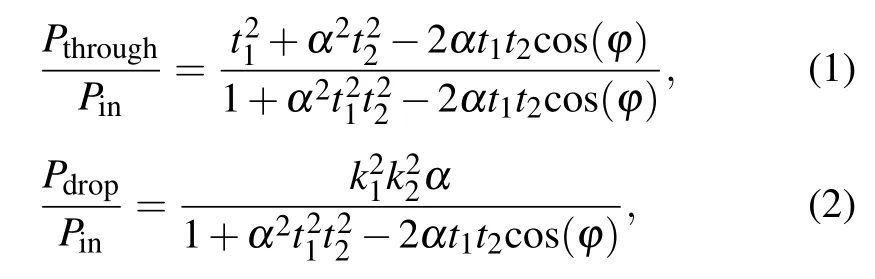
whereφ=neff(2π/λ)Lrepresents the phase change propagating round trip in the microring resonator,αis the round-trip loss coefficient,Lis the total length of the microring resonator andneffis the effective refractive index.k1,2andt1,2denote the waveguide effective amplitude cross-coupling and transmission coefficients. Assuming that the four amplitude transmission coefficients and coupling coefficients between waveguides are same and are denoted byt0k0, we can write the effective amplitude transmission coefficient from the waveguide to the ring as
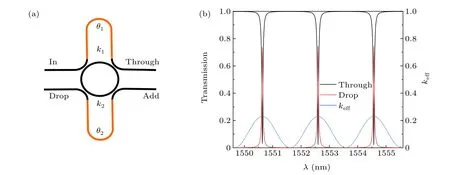
Fig.1. (a)Schematic diagram of the dual-interferometer coupled microring. (b)The transmission spectra of the dual-interferometer coupled microring for the through side and drop side. The effective coupling coefficient is shown by the blue curve.

where ΔLrepresents the length difference between the two arms of the interferometer, and we set the length difference equal to the roundtrip length of ring,i.e.,θ1,2denotes the phase tuning by integrated heater. ΔL=Lensures the transmission of resonant modes kept to be modulated by the interferometer coupler synchronously. Figure 1(b) shows transmission spectra of the dual-interferometer coupled microring for the through side and drop side and the effective coupling coefficient.
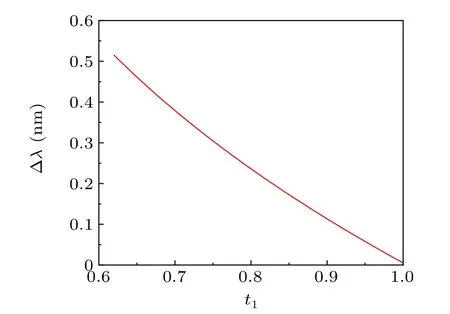
Fig.2. The“critical coupling”bandwidths.
The full width at half-maximum bandwidth Δλcan be written as

whereλrandngare the resonant wavelength and group index.“critical coupling” condition of the dual-interferometer coupled resonator ist1(θ1)=at2(θ2), andt1andt2are tunable which means that we can achieve“critical coupling”of different bandwidths.Here we setα=0.995 andt0=0.9.After satisfyingt1(θ1)=at2(θ2), we calculate the “critical coupling”bandwidths in Fig.2.
3. Experiment
The dual-interferometer coupled resonators are fabricated on the Si3N4chip.The total length of resonator is 700μm with the cross-section width and height at 800 nm and 1000 nm.The coupling distance between waveguides is 300 nm and the coupling length is 2 μm. The length difference between the two arms of the interferometer is 700 μm to ensure the same modulation to the resonant mode, and phase modulation is changed by the integrated heater above the waveguide.The fiber array is coupled to the side of the chip, with a total coupling loss of 8 dB.We measure the transmission spectrum by the transmitted power at different wavelengths. The linear propagation is measured to be 0.17 dB/cm.
Figure 3(a) shows the through port power transmission with both heaters off,and free spectral range is 1.68 nm. Figure 3(b)shows the quality factor with the voltage tuning of two heaters.The quality factor changes from 6.0×10³to 2.3×10⁵which indicates that the structure has a large tuning range.The yellow line connects the points of“critical coupling”,and this means that adjusting the two integrated heaters can find differentt1,2to meet thet1(θ1)=at2(θ2) conditions to achieve critical coupling.
In Fig. 4(a),t1is fixed and we tune the heater to changet2.Under the tuning of the voltage,the microring resonator can achieve“over-coupling”,“under-coupling”,and“critical coupling” which confirms the capability of the device for tuning microring coupling states. In Fig. 4(b), we tunet1andt2respectively to achieve critical coupling of different bandwidths.The bandwidth changes from 0.21 nm to 0.008 nm, and the correspondingQvalue changes from 7.9×10⁴to 1.9×10⁵.At the same time,in the“critical coupling”state,the resonant mode can maintain extinction ratio of more than 25 dB.

Fig.3. (a)Measured through port power transmission with both heaters off. (b)The quality factor with the voltage tuning of two heaters. Yellow line connects the points of“critical coupling”.
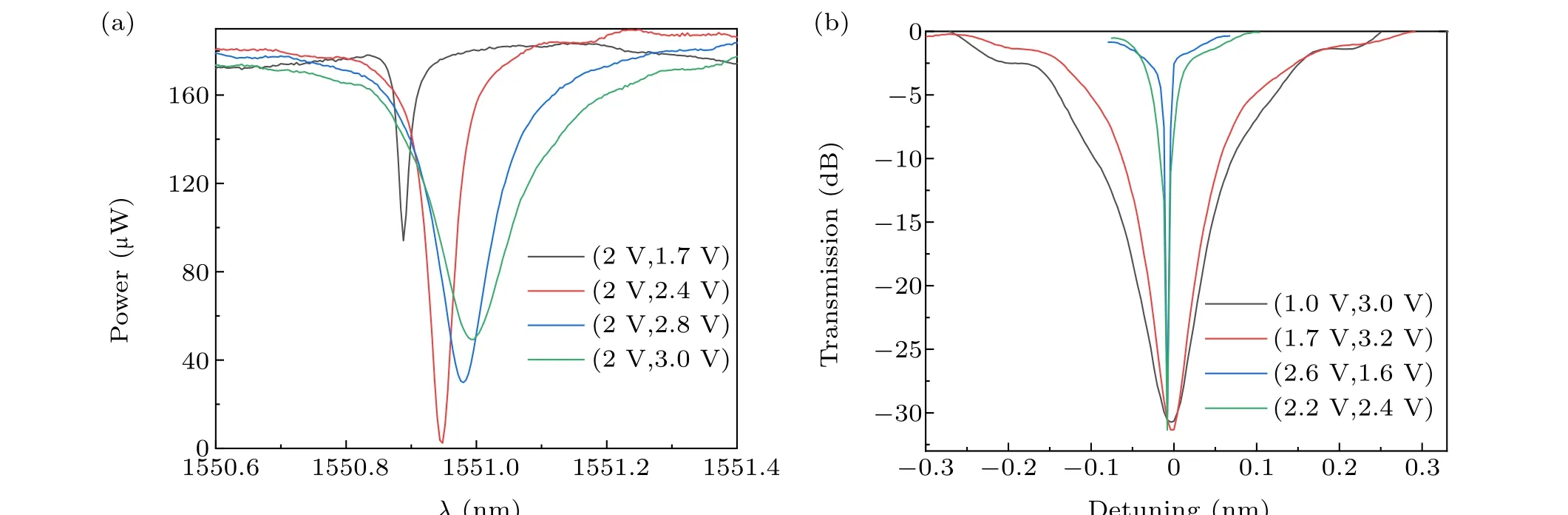
Fig.4. (a)Transmission of“over-coupling”,“under-coupling”,and“critical coupling”with tuning of t2 by heater voltage. (b)Transmission of different bandwidth“critical coupling”with tuning of t1,t2 by heater voltage.
4. Discussion and conclusion
We designed and fabricated reconfigurable dualinterferometer-coupled silicon nitride microring resonator.The continuous tunable, “overcoupling”, “critical coupling”,and “undercoupling” are realized and the bandwidth at critical coupling is also continuously adjustable. The reconfigurable dual-interferometer-coupled silicon nitride microring resonator will enable practical use in the research field of quantum photonic and all-optical signal processing.
Acknowledgments
Project supported by the National Key Research and Development Program of China (Grant Nos. 2019YFA0308700 and 2017YFA0303700), the National Natural Science Foundation of China (Grant Nos. 11627810 and 11690031), and the Open Funds from the State Key Laboratory of High Performance Computing of China(HPCL,National University of Defense Technology).

- Chinese Physics B的其它文章
- Role of compositional changes on thermal,magnetic,and mechanical properties of Fe–P–C-based amorphous alloys
- Substrate tuned reconstructed polymerization of naphthalocyanine on Ag(110)
- Anti-PT-symmetric Kerr gyroscope
- Information flow between stock markets:A Koopman decomposition approach
- Cascading failures of overload behaviors using a new coupled network model between edges
- High efficiency ETM-free perovskite cell composed of CuSCN and increasing gradient CH3NH3PbI3