
Giant Turbines Poised to Claim Offshore Wind
2021-12-25 10:02:50SeanNeill
Engineering 2021年7期
Sean O’Neill
Senior Technology Writer
A wave of giant turbines appears set to define the offshore wind energy industry for the next decade. The first of its kind, the Haliade-X turbine—designed and built by GE Renewable Energy,headquartered in Paris,France—stands 260 m tall,with a rotor 220 m in diameter, its 107 m blades sweeping an area of 38 000 m2(Fig. 1).The prototype, built on the harbourside in Rotterdam, the Netherlands (Fig. 2), was initially a 12 MW machine, since optimised to 13 MW.Industry certified in November 2020,the turbine produced its first milliwatt hour of electricity in November 2019.The company claims the Haliade-X can produce 45% more energy than any other offshore wind turbine currently in production,generating up to 67 GW?h annually, enough to power 16 000 homes [1].
The first Haliade-X turbine installed offshore will be a 13 MW version at Dogger Bank Wind Farm, situated in the North Sea,about 130 km off the North East coast of England. The project has ordered 190 of the turbines for its first two phases, with the first turbines installed in 2022.The third and final phase will install a 14 MW version [2]. As currently planned, the wind farm will be the largest in the world,producing 18 TW?h annually and powering six million UK homes.

Fig. 1. The Haliade-X is currently the largest offshore wind turbine in the world, with one turbine able to power about 16 000 European households. Credit: GE Renewable Energy, with permission.

Fig.2. The prototype of the Haliade-X stands on the harbourside in Rotterdam,the Netherlands. Credit: GE Renewable Energy, with permission.
‘‘Larger,higher capacity turbines reduce the number of turbines required, and provide greater efficiency from installation through to operation and maintenance,” said Simon Bailey, commercial director of the Dogger Bank Wind Farm. ‘‘We have also had to supersize a lot of our other components,including our installation vessel, and they do not come bigger than the Voltaire jack-up vessel.” Made by Belgian civil engineering company Jan De Nul,the Voltaire when fully extended rises to 325 m from the bottom of its legs, on the seabed, to the top of its crane—a fraction taller than the Eiffel Tower—and can lift 3000 tonnes (Fig. 3) [3].

Fig. 3. An artist’s illustration of the Voltaire jack-up vessel that is being manufactured by Belgium’s Jan de Nul Group. In 2022, the vessel will be used to install the first commercial Haliade-X turbines, at Dogger Bank Wind Farm in the North Sea.Credit: Jan de Nul Group, with permission.
The increasingly attractive proposition larger turbines offer to investors and power companies is a result of their levelized cost of energy (LCOE)—the average revenue per unit of electricity generated required to recover the building and operating costs over a turbine’s approximately 25 year lifetime. Essentially, these turbines are ‘‘economies of scale” writ large.
In 2020,GE Renewable Energy took the global top spot in commissioned wind turbine capacity(combined onshore and offshore),formerly held by Danish energy company firm Vestas, based in Aarhus, Denmark [4]. However, Siemens Gamesa, headquartered in Zamudio, Spain, leads the market in offshore with about twothirds of installed offshore capacity. In May 2020, the company announced its answer to the Haliade-X, introducing a new direct drive turbine, the 14 MW SG14-222 DD. Its rotor measures 222 m in diameter—just 2 m wider than the Haliade-X. A prototype is scheduled for completion in late 2021 in ?sterild, northern Denmark, with production anticipated in 2024 [5].
Meanwhile, the Mingyang Smart Energy Group Co., Ltd., based in Zhongshan City, Guangdong Province, China, has a comparably large turbine nearing readiness, the MySE11-203. The company plans to complete a prototype of this 11 MW turbine, with its 203 m rotor diameter and carbon-glass hybrid blades, this year(2021), and has promised commercial availability in 2022 [6].Rounding out this increasingly crowded field, Vestas announced plans for its giant turbine in February 2021.Its V236-15.0 MW turbine will have a rotor 236 m in diameter, making it the biggest in the world when its prototype is built in 2022, with commercial production starting in 2024 [7].
To see how far offshore power has come, consider the capacity of each of the 11 turbines in the world’s first offshore windfarm,Vindeby, off the coast of Denmark in 1991: 450 kW [8]. By 2019,average offshore turbine capacity had increased to 7.2 MW. By 2025, the average will be 10–12 MW, thanks in large part to the Haliade-X and its incoming peers, according to the Global Wind Energy Council, the international trade association for the wind power industry, based in Brussels, Belgium.
As offshore has scaled up,so too has its share of the wind energy market. In 2009, offshore claimed just 1% of the world’s newly installed wind capacity. For 2019, new offshore installations claimed 10%. In terms of total installations in operation, offshore capacity currently generates 35 GW, about 5% of total wind capacity [8] roughly equivalent to avoiding 6.25 × 10⁷t of CO2emissions, or taking more than 20 million cars off the road [9].Furthermore,2020 was a record year for new financing of offshore wind capacity, with more than 15 GW financed. That is over 50%more than the previous record, set in 2019, and 15 times the amount financed in 2012 [4].
This growth largely reflects the steady increase in European installations. For the last three years, however, China has led the world in new annual offshore wind installations. In 2020, it installed about 3 GW of new offshore wind capacity—half of the global increase of just over 6 GW [9]. The United States has been slow to embrace offshore wind, but in March 2021 the Biden administration announced plans to ‘‘jumpstart” its adoption, setting a national target to build 30 GW of offshore wind capacity by 2030 [10].
The stage seems set for the next decade. Beyond that, how big might offshore turbines go?Tony Quinn,Test and Validation Director for the UK’s Offshore Renewable Energy Catapult—a technology innovation and research center dedicated to offshore renewable energy—was responsible for the testing of a Haliade-X blade and nacelle at the Catapult’s facility in Blyth (Fig. 4). Quinn said that when considering future generations of turbines, bigger is not necessarily better.‘‘The optimum size,as opposed to the maximum size, is a function of the benefits to the LCOE. If nothing changes in the design of the blade, then the energy captured goes up with the square of the blade length,but the weight of the blade goes up with the cube of its length. This means that the cost of the blades increases faster than the power output. However, for many other aspects of turbine componentry, the normal rules on economies of scale apply, so we should take a view of the whole system.”
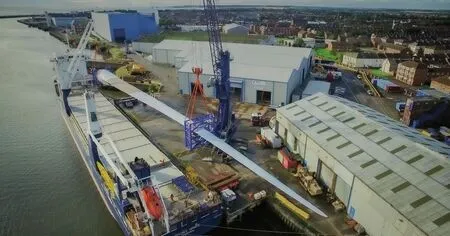
Fig.4. A 107 m long Haliade-X blade arrives at the UK’s Offshore Renewable Energy Catapult facility in Blyth to begin independent testing. Credit: Offshore Renewable Energy Catapult, with permission.
Peter Esmann, a senior product manager at Siemens Gamesa based in Middle Jutland, Denmark, raised a different concern:‘‘From the business-case perspective, there is no reason not to go bigger. The number one potential bottleneck would be the size of the installation vessels. What we are concerned with is the lifting of the turbine tower. This new generation of turbines requires a vessel with a crane that can lift that tower to a hub height—where the generator sits—of about 140 m above sea level, in one go.” In other words, if turbines got much bigger, there would be no practical way to install them.
But wind energy is not only about going bigger—a wide range of new wind-exploiting technologies are in development that aim to fill smaller niches[11,12].These include the use of tethered kites to produce energy from high-altitude winds, turbines wrapped around roadside lampposts—powered by the air displaced by passing cars—and even bladeless wind towers, dubbed ‘‘skybrators,”that generate power through being wobbled back and forth by a wind phenomenon called vortex shedding[13,14].There is a great deal of engineering innovation ahead at these smaller scales.
At the large scale, despite this incoming wave of giant offshore turbines,Quinn said we should not expect further leaps in turbine size any time soon.‘‘The rapid growth in turbine size is pushing the boundaries of materials science and manufacturability,” he said.‘‘Step changes in size bring about not only technological challenges but also supply chain capability and capacity challenges too.”

- Engineering的其它文章
- Visible Light-Induced 3D Bioprinting Technologies and Corresponding Bioink Materials for Tissue Engineering: A Review
- Temporal Profiles of Antibody Responses, Cytokines, and Survival of COVID-19 Patients: A Retrospective Cohort
- The East–West Divide in Response to COVID-19
- COVID-19 Vaccine Allocation: Modeling Health Outcomes and Equity Implications of Alternative Strategies
- Facilities for Centralized Isolation and Quarantine for the Observation and Treatment of Patients with COVID-19
- Next Steps for Efficacy Evaluation in Clinical Trials of COVID-19 Vaccines