
Colorectal cancer in Arab world:A systematic review
2021-11-20 06:33:36NahedMakhloufMuhammadAbdelGawadAyaMahrosSamehLashenMariamZaghloulAhmedEliwaEmanElshemyZainabAliEldinDoaaAbdeltawabFathiyaElRaeyDaliaOmranMarwaKhalafNancyFanousAhmedShawkatAbdelmohsenAhmedAbuElfatthMohamedAbdelghaniMahm
Nahed A Makhlouf,Muhammad Abdel-Gawad,Aya M Mahros,Sameh A Lashen,Mariam Zaghloul,Ahmed Eliwa,Eman E Elshemy,Zainab Ali-Eldin,Doaa Abdeltawab,Fathiya El-Raey,Dalia Omran,Marwa Khalaf,Nancy Fanous,Ahmed Shawkat Abdelmohsen,Ahmed Abu-Elfatth,Mohamed Abdelghani,Mahmoud Farouk,Mohamed Abdelaziz,Mohamed Alboraie
Nahed A Makhlouf,Doaa Abdeltawab,Ahmed Shawkat Abdelmohsen,Ahmed Abu-Elfatth,Mohamed Abdelghani,Mahmoud Farouk,Department of Tropical Medicine and Gastroenterology,Faculty of Medicine,Assiut University,Assiut 71515,Egypt
Muhammad Abdel-Gawad,Department of Hepatology,Gastroenterology,and Infectious Diseases,Al-Azhar University,Assiut 71631,Egypt
Aya M Mahros,Mariam Zaghloul,Department of Hepatology,Gastroenterology and Infectious Diseases,Kafrelsheikh University,Kafrelsheikh 33656,Egypt
Sameh A Lashen,Department of Internal Medicine,Alexandria University,Alexandria 21521,Egypt
Ahmed Eliwa,Mohamed Alboraie,Department of Internal Medicine,Al-Azhar University,Cairo 11884,Egypt
Eman E Elshemy,Department of Hepatogastroenterology and Infectious Diseases,Al-Azhar University,Cairo 11651,Egypt
Zainab Ali-Eldin,Department of Internal Medicine,Ain Shams University,Cairo 11646,Egypt Fathiya El-Raey,Department of Hepatogastroenterology and Infectious diseases,Faculty of Medicine,Al-Azhar University,Damietta 34511,Cairo,Egypt
Dalia Omran,Department of Endemic Medicine,Cairo University,Cairo 12613,Egypt
Marwa Khalaf,Department of Tropical Medicine and Gastroenterology,Assiut Liver Center,Assiut 71511,Egypt
Nancy Fanous,Department of Gastroenterology,Hepatology and Endoscopy,Police Authority Hospital,Cairo 12654,Egypt
Mohamed Abdelaziz,Department of Clinical Oncology and Nuclear Medicine,Al-Azhar University,Cairo 11824,Egypt
Abstract BACKGROUNDThe incidence of colorectal cancer(CRC)is increasing among young individuals in the Arab world as well as in other regions of the world.AIMTo explore the incidence and prevalence of CRC in the Arab world.METHODSThe PubMed,Scopus,Web of Science,EBSCO and Wiley databases were searched to retrieve relevant articles irrespective of the language or the publication year.The search terms were “("colon OR rectum OR sigmoid OR rectal OR colonic OR colorectal")AND("cancer OR malignancy OR malignant OR neoplasm")AND("Jordan" OR "United Arab Emirates" OR "Bahrain" OR "Tunisia" OR "Algeria" OR "Djibouti" OR "Saudi Arabia" OR "Sudan" OR "Syria" OR "Somalia" OR "Iraq" OR "Oman" OR "Palestine" OR "Qatar" OR "Comoros" OR "Kuwait" OR "Lebanon" OR "Libya" OR "Egypt" OR "Morocco" OR "Mauritania" OR "Yemen").Reviews,metaanalyses,and articles containing nonoriginal data were excluded.Retrieved articles were screened,and relevant data were extracted.Descriptive statistics were used for data analysis.RESULTSNine studies were included.Five of the studies provided information regarding the prevalence of CRC.The prevalence of CRC was 0.72% in Saudi Arabia and 0.78% in the United Arab Emirate,while in Egypt,it ranged from 0.4% to 14%.Four studies showed information regarding the incidence.The annual incidence rate of CRC in Qatar was 7.5/100000/year.In Egypt,the crude incidence rate(CIR)in males was 3.1 for colon cancer and 1 for rectal cancer,while in females,it was 2.3 for colon cancer and 0.8 for rectal cancer.The age-standardized rate for CRC incidence in 2003 was 36.90 for males,26.50 for females,and 30.49 for both sexes in Saudi Arabia.In 2016,the CIRs in Saudi Arabia were 3.6 and 2.1 in females for colon cancer and rectal cancer,respectively,while in males,it was 3.3 and 2.8 for colon cancer and rectal cancer,respectively.One study in Egypt revealed that 25% of CRC cases occurred among individuals younger than 40 years old.CONCLUSIONThere is a considerable prevalence of CRC in some Arab countries.More studies are needed to explore the incidence and prevalence of CRC in the rest of the Arab world..
Key Words:Colorectal cancer;Incidence;Prevalence;Arab world
INTRODUCTION
Colorectal cancer(CRC)is the third most common cancer(10.0%),and it is the second leading cause of cancer deaths worldwide(9.4%)[1].
In the past decade,an increase in the incidence of CRC has been observed worldwide.Additionally,there is increase in the prevalence of CRC in the younger population,and new cases are expected to increase among the younger population aged 20–49 years by 2030[2,3].
In particular,the prevalence of CRC is increasing among young individuals in the Middle East and other regions in the world[4,5].These changes in the incidence and epidemiology of the disease presentation have also been observed in the Arab world[2].The influence of Western lifestyles on the Arab population has led to an increase in the prevalence of CRC and affected younger populations[2].
To our knowledge,there has been no systematic review on CRC prevalence and/or incidence in the Arab World.
The primary aim of this review was to explore the prevalence and/or incidence of CRC in the Arab world by reviewing the available literature studies from Arab countries.
MATERIALS AND METHODS
Literature search
The PubMed,Scopus,Web of Science,EBSCO and Wiley databases were searched using the following search terms:“("colon OR rectum OR sigmoid OR rectal OR colonic OR colorectal")AND("cancer OR malignancy OR malignant OR neoplasm")AND("Jordan" OR "United Arab Emirates" OR "Bahrain" OR "Tunisia" OR "Algeria" OR "Djibouti" OR "Saudi Arabia" OR "Sudan" OR "Syria" OR "Somalia" OR "Iraq" OR "Oman" OR "Palestine" OR "Qatar" OR "Comoros" OR "Kuwait" OR "Lebanon" OR "Libya" OR "Egypt" OR "Morocco" OR "Mauritania" OR "Yemen"),to retrieve relevant articles irrespective of the language or the publication year of the articles.For non-English articles,all relevant data were taken from the English abstract,and two reviewers translated the full text to English to retrieve all other data of interest.Reviews,meta-analyses,and all other articles containing nonoriginal data were excluded from our review.All retrieved articles were screened and selected by three independent authors.Relevant data were extracted into a standardized data collection sheet by four independent authors.The Preferred Reporting Items for Systematic Reviews and Meta-Analyses(PRISMA)flow chart is shown in Figure 1.This systematic review was registered in the PROSPERO registry(CRD42021226703).
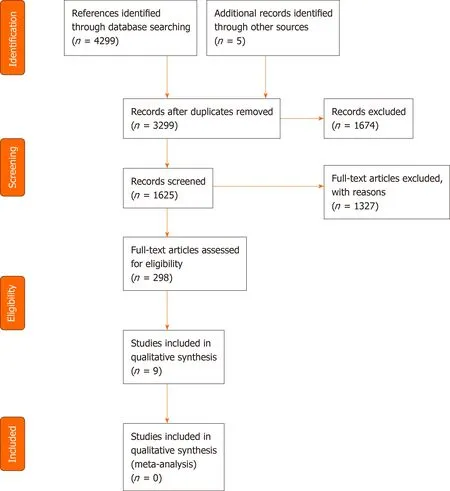
Figure 1 PRISMA 2009 flow diagram.
Statistical analysis
Descriptive statistics were used for data analysis.
RESULTS
At the time of this review,a total of nine studies containing information about the prevalence and/or incidence of CRC in the Arab world were included[6-14](Table 1).Five studies provided information regarding the prevalence of CRC in Arab Worlds[one from Saudi Arabia[6],3 from Egypt[9,11,12],and one from the United Arab Emirate(UAE)]13.
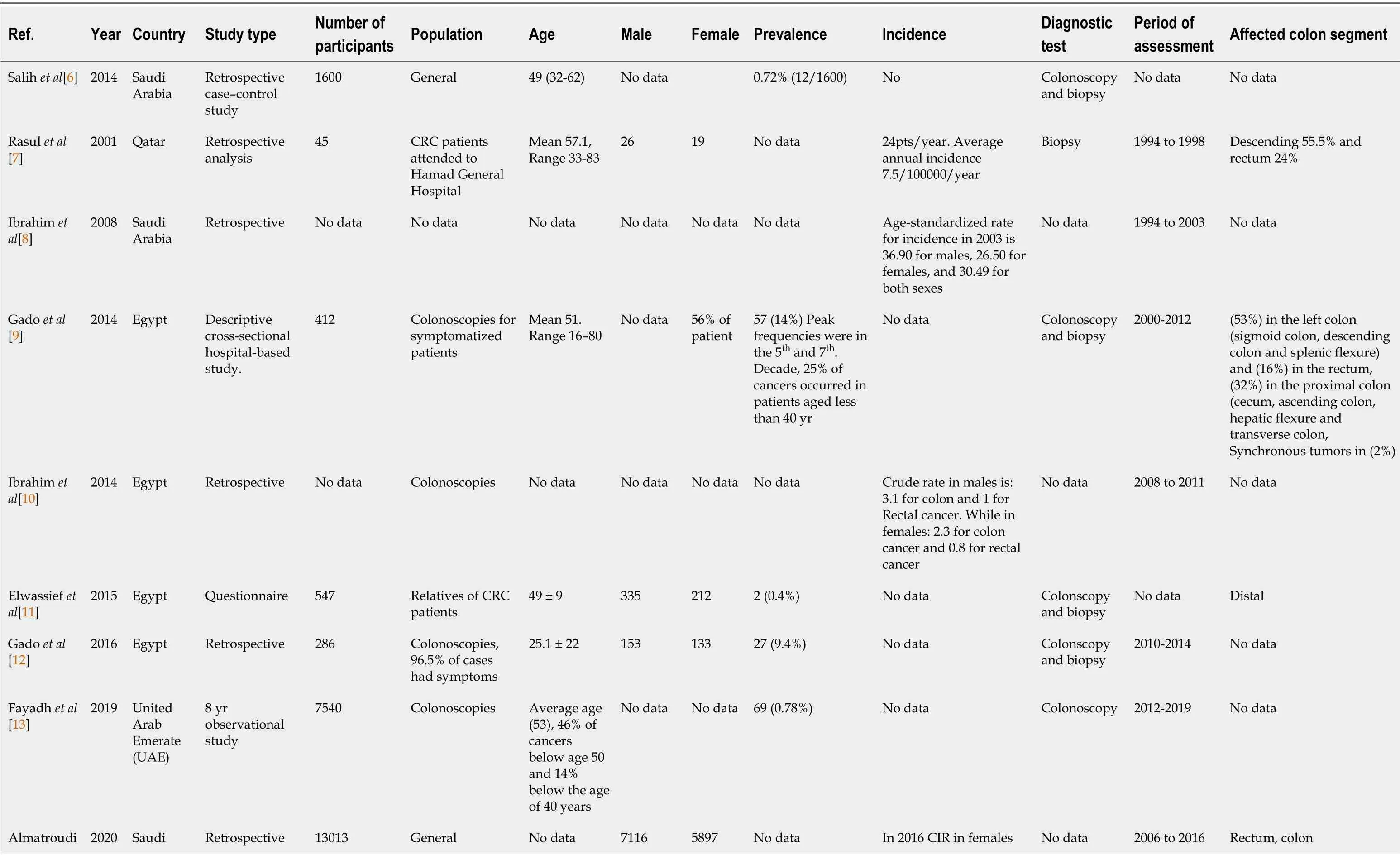
Table 1 Summary of included studies

MOH:Ministry of health;CIR:Crude incidence rate.
The prevalence of CRC was 0.72% in Saudi Arabia[6]and 0.78% in the UAE[13,while Egypt reported different prevalence rates of 0.4%[11],9.4%[12]and 14%[9].
Among these studies,four showed information regarding the incidence of CRC in the Arab world[7,8,10,14].In their retrospective analysis of Qatar's area,Rasulet al[7]reported an average annual incidence rate of 7.5/100000/year.A retrospective study in Egypt(from 2008 to 2011)revealed that the crude rate in males was 3.1 for colon cancer and 1 for rectal cancer,while in females,it was 2.3 for colon cancer and 0.8 for rectal cancer[10].
The age-standardized rate for CRC incidence in 2003 was 36.90 for males,26.50 for females,and 30.49 for both sexes in Saudi Arabia,as reported by Ibrahimet al[8].However,another retrospective analysis of Saudi Arabia Ministry of Health Registry data including 13013 participants from general population was conducted in 2016;the crude incidence rates(CIRs)for colon and rectal cancer among females were 3.6 and2.1,respectively,and the CIRs for colon and rectal cancer among males were 3.3 and 2.8,respectively[14].
Regarding the age of CRC patients,there was predominance in the fourth or fifth decade of life[6,7,11,13].However,Gadoet al[9]in Egypt reported two peak frequencies in the fifth and seventh decades;25% of CRC occurred in patients aged less than 40 years.
DISCUSSION
The updated CRC burden according to the latest GLOBOCAN 2020 estimates demonstrated that CRC ranks third among frequently newly diagnosed cancers,with almost 1.9 million new cases(10.0%),and second leading cause of death worldwide,with approximately 935000 deaths in 2020(9.4%)[1].The incidence rates are 4-fold higher in countries with developed economies,mainly in European regions,Australia/New Zealand,and Northern America.Furthermore,the overall CRC trends are increasing for incidence and decreasing for mortality almost all over European countries,with some national and regional variability attributed to differing levels of healthcare expenditure and the resulting quality of screening,diagnosis,and treatment[15,16].Despite the rising trends of CRC,there is a paucity of data reporting the incidence and/or prevalence of CRC in Arabian countries.The retrieved 9 studies were mostly retrospective data analyses,with only four studies providing information regarding the incidence of CRC in the Arab world[7,8,10,14].
CRC incidence has always been known as an indicator of higher levels of socioeconomic development and is dominant in countries undergoing major economic transition.This is well demonstrated in higher incidence in Europe,Australia and Northern America[17-19].Additionally,Almatroudi[14],in his large epidemiological study of CRC in Saudi Arabia,showed that there was a markedly increasing incidence of CRC from 2006 to 2016.He attributed that increase to the large-scale screening program that increased the case detection rate and the change toward more unhealthy lifestyles with higher incidence in large cities,such as the regions of Riyadh,Makkah,and Eastern Province,where westernized lifestyles and flourishing industries are more evident.A hospital-based case-control study in Kuwait concluded that CRC risk is strongly attributed to higher body mass index,excessive red and processed meat consumption and decreased fruit/vegetable consumption[20].
The rising trend of CRC despite the screening programs adopted in many countries was disappointing.This was partly justified by the favorable outcomes of screening,and a decline in incidence within older age groups was not able to overcome the rising incidence of CRC in a younger population[21-23].This was in accordance with Fayadhet al[13]in their single center experience of CRC screening in UAE from 2012 to 2019,which demonstrated increasing trends in CRC with an average age of 53 years.Of note,46% of CRC cases were below the age of 50.Furthermore,another single center experience from Egypt reported that approximately 25% of CRC cases occurred in individuals younger than 40 years of age[9].
Limitations of our study
Our study has some limitations.There were few studies that met our inclusion criteria,and many Arab countries were not represented due to the lack of suitable studies for our review.There were not enough data to examine some questions of interest,such as regional differences in the prevalence,epidemiology and risk factors for CRC in Arab countries and the lack of programmed screening and/or surveillance strategies for CRC in most Arab countries.
CONCLUSION
In conclusion,there is a considerable prevalence of CRC in some Arab countries.More studies are needed to explore the incidence and prevalence of CRC in the rest of the Arab world.
Recommendations:Based on the available literature,it is recommended that multicenter prospective studies be conducted to assess the actual prevalence and incidence of CRC in different Arab countries and in different age groups.Proper utilization of retrospective data emerging from currently running CRC screening programs in some countries and establishment of new screening programs in other countries will guide decisions in management and prevention strategies to contain the rising incidence of CRC in the Arab world.Proper awareness about CRC and early screening among the population represents the initial step to prevent morbidity and mortality resulting from CRC.
ARTICLE HIGHLIGHTS
Research background
Morbidity and mortality of colorectal cancer(CRC)is increasing globally.There is a particular concern about the rising incidence of CRC in young people in different parts of the world.
Research motivation
It is crucial for each country/region to know the actual prevalence,incidence,and predisposing factors for CRC to help in adequate planning for screening programs,preventive measures,and proper allocation of health care resources.
Research objectives
The main objective of this study was to explore and summarize the available evidence about prevalence and/or incidence of CRC in the Arab world.
Research methods
A systematic review of available literature was done to retrieve articles containing original data about CRC in the Arab world.Available data were extracted and summarized.
Research results
Nine studies including data about CRC in 5 Arab countries were found.Reported prevalence of CRC in Saudi Arabia was 0.72%,in United Arab Emirates was 0.78% and in Egypt ranged from 0.4%-14%.Qatar reported an average annual incidence rate of 7.5/100000/year.Egypt reported a crude rate of 3.1 in males and 2.3 in females.In Saudi Arabia,the crude incidence rate for CRC was 3.6 and 3.3 among females and males respectively.CRC tends to occur in the fourth or fifth decade of life,however,25% of CRC patients were less than 40 years.
Research conclusions
Some Arab countries have a considerable prevalence of CRC.More data are expected to arise from the currently running CRC screening programs.
Research perspectives
Multicenter prospective trials and proper utilization of retrospective data are needed to assess the actual prevalence and incidence of CRC in different Arab countries.
 World Journal of Gastrointestinal Oncology2021年11期
- World Journal of Gastrointestinal Oncology的其它文章
- Hepatocellular carcinoma biomarkers,an imminent need
- Anatomical vs nonanatomical liver resection for solitary hepatocellular carcinoma:A systematic review and meta-analysis
- Atezolizumab plus bevacizumab versus sorafenib or atezolizumab alone for unresectable hepatocellular carcinoma:A systematic review
- Cell-free DNA liquid biopsy for early detection of gastrointestinal cancers:A systematic review
- Induction chemotherapy with albumin-bound paclitaxel plus lobaplatin followed by concurrent radiochemotherapy for locally advanced esophageal cancer
- Genetic variation of TGF-ΒR2 as a protective genotype for the development of colorectal cancer in men