On the concept and connotation of science popularization ethics
2021-11-16 01:37:38XuanLiuFujunRenandHaitaoGe
科學文化(英文) 2021年2期
Xuan Liu,Fujun Ren and Haitao Ge
National Academy of Innovation Strategy,China
Abstract Some ethical norms should be followed in science popularization.Such norms are related to,but also different from,the ethics of science and technology,communication and education.This paper explores the definition of science popularization ethics in Chinese and foreign literature and reflects on the concept and connotation of the ethical norms that should be followed in science popularization in China.It suggests that the ethical norms that people should follow in science popularization should be defined as ‘science popularization ethics’in China.
Keywords Science communication,science popularization,science popularization ethics
Science popularization is an important part of socialist material and spiritual civilization.The development of science popularization is a long-term task in China and has a long-term impact on improving the scientific literacy of the population,promoting the development of science and technology and constructing a cultural ecosystem.Inappropriate science popularization will hinder the dissemination of the scientific spirit in society and weaken scientific culture.Therefore,clear ethical boundaries must be established to set the norms for the content,form and goals of science popularization.
Given the distinctive features of science popularization,there are certain connections and crossovers between science popularization ethics and ethical norms in other similar fields,so it is necessary to identify and distinguish science popularization ethics from those alternatives.In addition,as there are several ways to understand this topic in China and abroad -such as science popularization,science communication and public understanding of science -it is important to define and choose a concept that is suitable for the Chinese context and appropriate for describing the ethical norms of science popularization in China.
1.Science popularization ethics compared with the ethics of science and technology,communication and education
There are connections and also differences between science popularization ethics and the ethical norms in other fields,such as science and technology ethics,communication ethics and education ethics.
1.1.Science and technology ethics and science popularization ethics:Value orientations
Science and technology ethics is an ethical system that addresses science and technology’s relationship with people and nature.It concerns the responsible and positive development of science and technology.Advances in science and technology affect all aspects of human life.Due to significant emerging issues,the tension between science and technology development and ethics is increasingly evident.In this context,science and technology ethics has placed more emphasis on basic principles,such as human well-being,respect for people,justice and responsibility (Lei,2020).
Science and technology are the content of science popularization,which makes it different from other communication processes.The value orientation of science and technology ethics determines the value orientation of science popularization content.As important themes of science and technology ethics,the principles of ‘being responsible’ and ‘working towards positive results’ are also the spiritual core of science popularization ethics.For example,respect for human life and dignity,respect for academic freedom and independence,avoidance of prejudice and discrimination,protection of the right to information and openness and transparency are important components of science and technology ethics,and they are also the values advocated by science popularization ethics.
1.2.Communication ethics and science popularization ethics:Code of communication
Communication ethics consists of a set of norms that should be followed by all communication media and communication actors,including norms regarding the values,content and activities of communication(Zhou,2018).In the new-media environment,it has gained great relevance.Communication ethics includes the norms of behaviour for players in both professional media and non-traditional media,and even involves expectations for the quality of the audience.Communication ethics is reflected in the code of media ethics,the code of journalism,the code of self-media communication and other specific acts of communication,such as the regulations on the ‘5Ws’ (who,says what,in which channel,to whom and with what effect),and the bottom-line thinking that draws the boundaries of what should be advocated,permitted or prohibited.
Science popularization is a process that communicates scientific and technological knowledge and information,and thus it must also observe the common code of conduct of communication ethics and follow the basic principles of communication ethics,such as the requirements of laws and regulations,of moral ethics and of information authenticity.It is also important to uphold the basic duties of communication ethics in science popularization,such as shouldering the responsibilities of confirming or disproving information and educating the public about communication ethics.Communication ethics is reflected in the code of conduct of science popularization through providing guidance for communication behaviour.
1.3.Education ethics and science popularization ethics:Realization of the goal
As a communication process,science popularization undertakes the social function of education and cultural inheritance,so the ethical norms of science popularization should be consistent with the ethical norms of education in terms of goal orientation.The goal of science popularization is to improve the scientific and cultural quality of citizens and promote economic development and social progress.In short,the ethics of science popularization is guided by education ethics in terms of its ultimate purpose and desired influence.Education ethics is reflected in the goal orientation of science popularization ethics through its influence on those who are educated.
2.Defining science popularization ethics:‘Science popularization ethics’ or ‘science communication ethics’?
Due to the different contexts in China and abroad,Western scholars normally use the concept ‘science communication’,while Chinese scholars tend to use the term ‘science popularization’.Yet,in essence,these two concepts are the same.In academic discussions,the terms ‘science popularization’ and ‘science communication’ are used and interpreted differently from different perspectives.Whether the ethical norms observed in the popularization and dissemination of science and technology should be defined as ‘science popularization ethics’ or ‘science communication ethics’ needs to be clarified.In addition,the connotation of science popularization ethics in the context of modern-day China should also be clearly defined.
2.1.Discerning the Chinese and foreign concepts of science popularization ethics
To have a clearer understanding of the scope of ethics discussed in the popularization and dissemination of science and technology,we summarized typical definitions of science popularization ethics in Chinese and foreign literature.Table 1 lists selected definitions in foreign studies.
Researchers focus on different points when they discuss the concept of science popularization ethics.Medvecky and Leach (2017,2019),for example,focus on the place and boundaries of ethics in science communication and the four elements of science communication ethics,while Priest et al.(2017) study the activities of multiple groups and the importance of ensuring morality and improving the effectiveness of science popularization.As for other authors,some have explored the ethics of communication,believing that all stakeholders should shoulder their respective responsibilities in the dissemination of information to ensure the truthfulness and appropriateness of science popularization in a vast ocean of complicated information (Nerlich et al.,2009).Some believe that the authenticity and effectiveness of science communication should be maintained on issues vital to the development of human society (Clarke,2009;Suhr,2009),and that scientists should undertake social responsibilities in the communication and education of science issues (Reydon et al.,2012).Some authors,on the other hand,have taken a different approach and reflected on the traditional concept of science communication ethics,arguing that it is not equivalent to sincerity,openness and honesty and that overemphasis on these principles may cause certain social risks(John,2017).
As part of our comparative studies,we also selected a few Chinese research papers on the concept of science popularization ethics (see Chen,2016;Luo and Yang,2018;Wang et al.,2007)(Table 2).
A comparison of Tables 1 and 2 shows that the focus of science popularization ethics varies at home and abroad,and different scholars have taken different approaches to discussing this concept.However,there are also commonalities in the definitions of science popularization ethics given by Chinese and foreign scholars.Their definitions of science popularization ethics involve different groups of people,such as science communicators,scientific researchers and the general public.The moral features of science popularization ethics differ from those of scientific research activities,and the ethical features of communication ethics are also part of it;its purpose is to coordinate the relationship between science and society and promote the sound development of science and science communication.
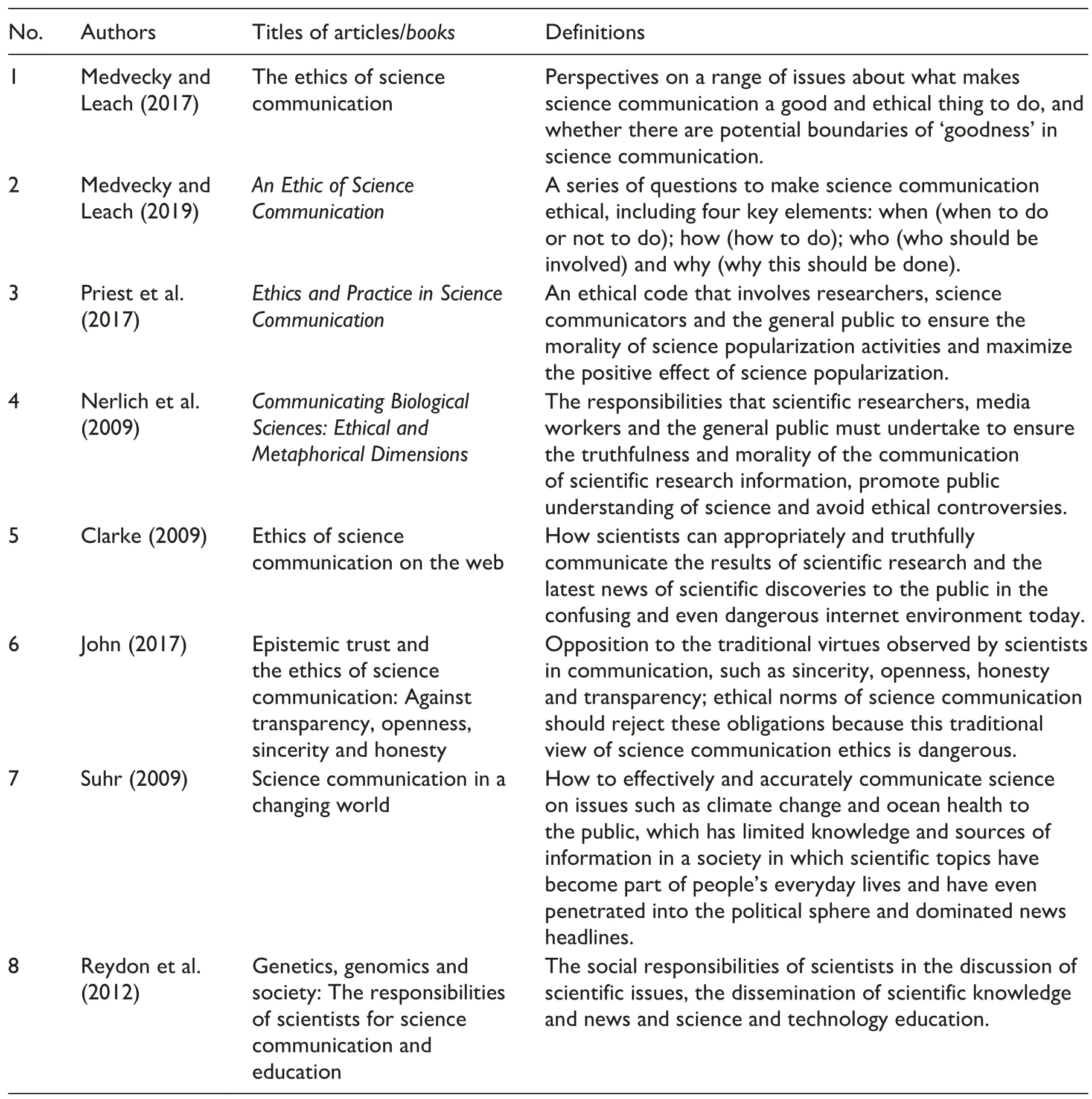
Table 1.Definitions of science popularization ethics in English-language literature.
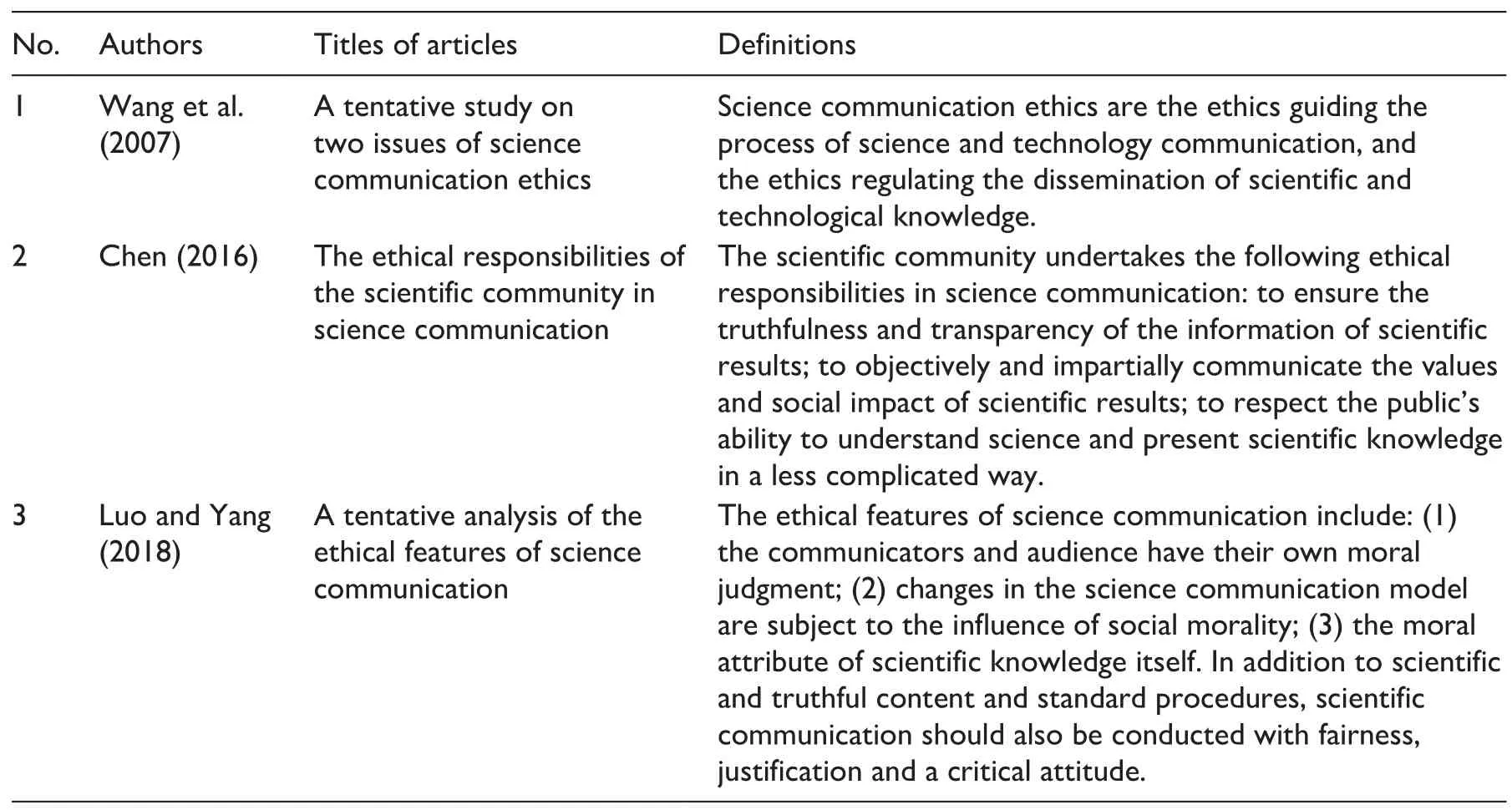
Table 2.Definitions of science popularization ethics in Chinese-language literature.
In the Chinese context,it is more appropriate to use the term ‘science popularization ethics’ rather than ‘science communication ethics’ when describing the ethical norms that should be observed in the dissemination of scientific and technological knowledge to the public.The reasons are as follows.
A neighbour passing by called out to him- - Hi! I say! why are you beating the pedlar s donkey like that? The pedlar should keep him from eating my cabbages, said Nur Mahomed; if he comes this evening here again I ll cut off his tail for him! Whereupon he went off indoors, whistling cheerfully
First,considering the practical need to promote the research and practice of science and technology communication and popularization,‘sciencepopularization’ is a more appropriate expression.Therefore,‘science popularization ethics’ is the correct term to use in describing the ethical norms under this concept.
Second,from the perspective of the history of science popularization in China,‘science popularization’ can be seen as the sum of all related activities,including the dissemination and popularization of science and technology,public understanding of science and the promotion of public engagement in science.Using the term ‘science popularization ethics’to refer to the ethical norms of the whole undertaking can better cover all related fields.
Third,the term ‘science popularization ethics’can be more accurately understood.If the term ‘science communication ethics’ is used,it is easy tomistake it as a branch of communication ethics,which does not properly reflect the uniqueness of this ethical field.
2.2.The connotation of science popularization ethics in the modern-day context
Based on the above analysis,this paper proposes that science popularization ethics should be the ethical norms to be observed by science and technology journalists,editors of science and technology journals,workers in science popularization venues,science popularization creators,scientists,science popularization enterprises and other people who are committed to science popularization.Those norms will define the ethical boundaries of the value orientation of science popularization content,the code of conduct of science popularization activities and the purpose and impact of science popularization.Science popularization is a broad concept.Considering its different aspects,it encompasses the ethical norms of science and technology museums,of science popularization creation and of science and technology reporting,among others.‘Science popularization ethics’ is a general term for all the ethical norms to be followed in various types of science popularization activities.
Science popularization is part and parcel of modern science.Contemporary science popularization normally includes three aspects:first,cultivating the ability to understand science and culture;second,cultivating the ability to understand the scientific knowledge system;and third,understanding the application of scientific and technological knowledge (Li,2004).Therefore,the actors of science popularization ethics include not only science popularization workers but also scientific researchers,social media,science and technology managers and decision-makers and members of the public (Xue and Guo,2015).The scope of science popularization ethics should include the content,form,purpose and other elements of science popularization and cover the whole process.The purpose of science popularization ethics is to improve the scientific literacy of the population and promote economic development and social progress.
As an important component of science popularization,science popularization ethics has played a key role in shaping values,regulating behaviours and setting goals.With the advance of science and technology,new methods of information dissemination and new forms of social organization keep emerging;this also poses new challenges for effective communication and popularization of science and technology and for innovation in the model of science and technology communication and popularization.
3.Conclusion
General Secretary Xi Jinping has pointed out that science and technology innovation and science popularization are the two wings of innovative development.Science popularization should be given the same importance as science and technology innovation.Due to the rapid progress of science and technology and its growing importance to China’s national development,science and technology ethics has attracted greater attention.During the ninth meeting of the Central Committee for Deepening Overall Reform on 24 July 2019,the Proposal for the Establishment of the National Committee of Science and Technology Ethics was adopted,paving the way for the development of a comprehensive and systematic governance system of science and technology ethics in China.As the other half of the two wings,science popularization also needs the constraint and guidance of ethics.It needs to be further studied from a theoretical point of view to deepen understanding and explore a governance system of science popularization ethics that is suitable to China’s conditions.
The concept of science popularization ethics is both related to and different from the concepts of the ethics of science and technology,communication and education.The content and value orientation of science popularization must follow the value orientation of science and technology ethics,and the communication behaviours in science popularization should follow the norms of communication ethics.In addition,the ultimate purpose and desired impact of science popularization should follow the goals of education ethics.
The concepts related to science popularization ethics have been widely discussed both in China and abroad.In the Chinese context,it is more appropriate to use the term ‘science popularization ethics’ to define the ethical norms related to science popularization.Given the changing domestic and international situations,rapid advances in science and technology and the rise of new forms of social organization and innovation,science popularization ethics has a big role to play in raising the scientific literacy of the population,promoting the public understanding of science and cultivating scientific and innovation culture.
Acknowledgements
We would like to thank Dr.Cheng Donghong,Professor Liu Bing,Professor Jin Jianbin,Research Fellow Li Zhenzhen,Professor Tang Shukun,Professor Zhao Yandong,Research Fellow Zhao Yang and Dr.Li Xiang for their contributions to this paper.
Declaration of conflicting interests
The authors declared no potential conflicts of interest with respect to the research,authorship,and/or publication of this article.
Funding
The authors received no financial support for the research,authorship,and/or publication of this article.