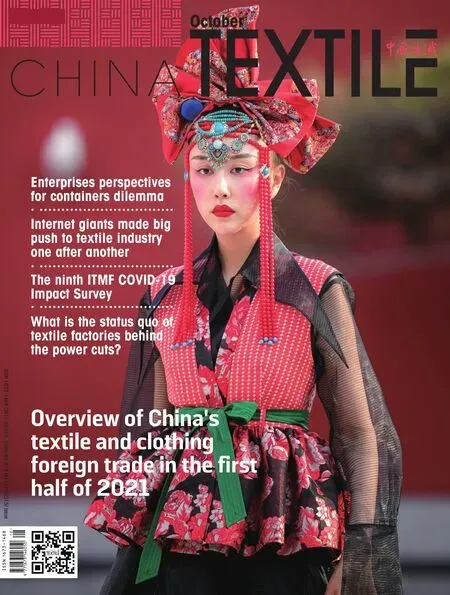
How is China’s textile and apparel foreign trade in Aug?
2021-11-09 01:05:04ByZhaoXinhua
China Textile 2021年5期
By Zhao Xinhua

China’s textile and apparel exports decelerated in August, but remained within expectations. In August, the recurrence of the pandemic and rare large-scale rainstorms and floods in China had a negative impact on domestic consumption and the service sector, and economic indicators showed a slowdown. Despite the lack of significant improvement in overseas pandemic prevention and control, combined with the effect of a high base, the growth rate of China’s trade exports in goods slowed down in the month, while imports fell from the previous month. Thee export of textile and apparel showed negative year-on-year growth for three consecutive months, but the deceleration rate was not more than expected. Thee export of traditional categories of commodities still maintained growth yearon-year and compared with the same period in 2019.
Textiles drove monthly exports down
From January to August, China’s textile and apparel trade reached USD 188.4 billion, up 9.7 percent year-onyear and 13.5 percent compared with the same period in 2019. Exports totaled USD 172.31 billion, up 8.5 percent year-on-year and 13.7 percent over the same period in 2019. Imports reached USD 16.09 billion, up 24.4 percent year-on-year and 11.6 percent over the same period in 2019. Thee cumulative trade surplus reached USD 156.22 billion, up 7 percent yearon-year and 13.9 percent over the same period in 2019. In August, China’s textile and apparel trade was USD 31.31 billion, down 7.3 percent yearon-year, up 5.1 percent from the same period in 2019, and up 2.5 percent from the previous month. Exports reached USD 28.91 billion, down 8.9 percent year-on-year, up 5.2 percent from the same period in 2019 and up 2.2 percent from the previous month. Imports were USD 2.39 billion, up 18 percent year-on-year, up 2.6 percent from the same period in 2019 and up 4.8 percent from the previous month. The trade surplus for the month was USD 26.52 billion, down 10.7 percent year-on-year, up 5.5 percent from the same period in 2019 and up 2 percent from the previous month. Thee third quarter is the traditional peak season for textile and apparel export. In the first month of the third quarter, the export continued to rise compared with the previous period. In that month, the export reached USD 28.91 billion, up 2.2 percent from the previous month, but decreased for three consecutive months year-on-year, mainly caused by the reduction of textile export, textile exports fell by 26.2 percent year-on-year and 6.6 percent month-on-month respectively, while apparel exports still maintained growth of 8.8 percent year-on-year and 9.3 percent month-onmonth.

Exports to key markets fluctuated downward
According to the statistics of the General Administration of Customs, China’s exports to the four key markets of the United States, the European Union, Japan and ASEAN all experienced a slowdown or a wider decline in August, but the fluctuation was not more than expected. Among them, the cumulative exports to the United States and ASEAN still maintain growth, exports to the European Union and the Japanese market perform slightly less.
Exports to the U.S. fell 17.5 percent in August, the decline widened by just 2 percentage points from June, cumulative exports to the U.S. have maintained growth. From January to August, exports to the U.S. reached USD 30.78 billion, up 5.9 percent year-on-year and 16.5 percent higher than the same period in 2019. Among them, knitted and woven garments grew 43.4 percent, down 3.7 percent from the same period in 2019.
ASEAN remains the fastest growing market. Exports to ASEAN grew at a slower pace in August than in the previous month, up just 2.7 percent. From January to August, China’s textile and apparel export to ASEAN increased by 30 percent year-on-year, the fastest growth among the four markets, an increase of 22.7 percent over the same period in 2019. Among them, yarn and fabric increased by 34.4 percent year-on-year and 6.6 percent compared with 2019. In terms of import data from the three key markets, cumulative imports from China all showed negative growth, mainly due to the decline of pandemic prevention materials. Recently, ASEAN countries such as Vietnam, Cambodia and Myanmar have not started work due to the aggravating impact of the new wave of pandemic, and a large number of orders have returned to China. It is expected that the import data of key markets will reverse in August, and China’s share will recover slightly.
Exports of key goods to the EU showed negative growth in one month. China’s exports of knitted and woven garments to the European Union fell 1.8 percent in August, the first decline since February. From January to August, China’s textile and apparel exports to the EU reached USD 26.16 billion, down 20.4 percent year-on-year and up 11.4 percent compared with the same period in 2019. Among them, the export of knitted and woven garments increased 17.4 percent, up 0.7 percent from 2019. The Japanese market lacks growth momentum and the downward trend of exports to Japan continues. From January to August, China’s textile and apparel exports to Japan dropped by 8.9 percent year-on-year and grew by 3.4 percent compared with the same period in 2019. Among them, knitted and woven garments saw a year-on-year growth of 7.5 percent, down 7.3 percent from the same period in 2019.

European Union, U.S., and Japan’s imports from China dropped
According to Eurostat, from January to May, the 27 EU countries imported USD 52.93 billion of textiles and apparel from the world, down 1 percent year-on-year. Among them, imports from China fell 27.6 percent, and China accounted for 32.2 percent, lower than the same period in 2020, but still higher than the same period in 2019. Among them, textiles accounted for 42.3 percent and apparel for 27.9 percent, both lower than the same period in 2020 but higher than the same period in 2019. ASEAN’s market position was further enhanced. EU’s textile and apparel imports from ASEAN increased by 37.8 percent, accounting for 13.3 percent, both higher than the previous two years.
According to the statistics of the U.S. Department of Commerce, from January to June, the U.S. imported USD 65.11 billion from the world, up 21.8 percent, while imports from China dropped 1.2 percent. China accounted for 30.3 percent, higher than the same period in 2020 and lower than the same period in 2019. Among them, textiles accounted for 36.6 percent, lower than the same period in 2019 and 2020, while apparel accounted for 27.9 percent, higher than the same period in 2020 and lower than the same period in 2019. Textile and apparel imports from ASEAN increased by 36.7 percent, accounting for 25.7 percent, both higher than the previous two years.
According to the statistics of Japan’s Ministry of Finance, from January to June, Japan’s imports from the world decreased by 5.9 percent, while its imports from China decreased by 13.3 percent. China accounted for 54.9 percent, lower than the same period in 2020, but higher than the same period in 2019. Among them, textiles accounted for 57.5 percent, lower than the same period in 2020 and higher than the same period in 2019. Apparel accounted for 53.9 percent, both lower than the same period in 2020 and 2019. Textile and apparel imports from ASEAN increased by 4.1 percent, accounting for 29.6 percent, both higher than the previous two years.
Growth in exports of major commodities slowed down
In August, export growth slowed from the previous month due to a larger year-on-year base, with monthly apparel export growth falling below 10 percent (8.8 percent) for the first time since February, while the decline in textiles widened again to 26 percent. Thee recurrence of the pandemic temporarily halted the month-on-month decline in the export of pandemic prevention materials. Thee total export of masks and protective clothing rose by 3.8 percent month-on-month. From January to August, the cumulative export of textiles was USD 81.12 billion, down 10.4 percent year-onyear and up 17 percent compared with the same period in 2019. Thee export of apparel was USD 91.19 billion, up 33.5 percent year-on-year and up 10.9 percent compared with the same period in 2019. Thee total exports of masks and protective clothing were USD 10.21 billion, down 78.5 percent year-on-year. Textiles excluding masks rose 43.2 percent year-on-year and 10.4 percent from the same period in 2019; apparel without protective clothing rose 47.4 percent year-on-year and 9.5 percent from 2019. Masks and protective clothing accounted for 5.9 percent of total exports. Thee cumulative growth of yarn, fabric and knitted and woven garments was 48.8 percent, 43.2 percent and 30.1 percent respectively.
Export growth slowed in key provinces and cities
In August, the export of Zhejiang, which ranked the first place, showed negative growth for the first time since January. Thee export growth of Shandong and Fujian narrowed to 0.3 percent and 11.8 percent respectively, and the export decline of Guangdong expanded to 33.6 percent. Only the export of Jiangsu improved compared with the previous period, but still did not stop falling. From January to August, the top five export provinces and cities except Guangdong all saw growth, with Zhejiang, Jiangsu, Shandong and Fujian up 14.7 percent, 9.5 percent, 22.7 percent and 31.1 percent, respectively. Hebei and Xinjiang saw the fastest growth, up 62.1 percent and 80.3 percent respectively.
Apparel import growth slowed
Imports continued to grow in August, but at a slightly slower pace than in the previous month, up 18 percent year-on-year and 4.8 percent month-on-month, respectively. Among them, textile imports were USD 1.42 billion, up 23.5 percent year-on-year, apparel imports were USD 970 million, up 10.8 percent year-on-year, apparel decline is more obvious, the main product knitted and woven garments imports increased 12.5 percent, the growth rate of 26.4 percentage points lower than last month. From January to August, the import of yarn, fabric and knitted and woven garments, which are key imported goods, increased by 43.1 percent, 15.8 percent and 41.8 percent respectively, still in the high-speed growth range.
Negative growth in monthly cotton imports
From January to August, the cumulative import of cotton grew rapidly, with the total import of 1.691 million tons from the world, up 61.5 percent year-on-year. 90 percent of cotton imports now come from the United States, Brazil and India, where imports are growing fast. Australia’s share has fallen rapidly from 30 percent in 2018 to 1 percent and continues to shrink. Thee average cumulative import price from the world was USD 1,840/ton, up 7 percent. Cotton imports continued to fall in August, with 144,000 tons of imports, down 3 percent, the first negative growth since August last year. Imported cotton prices continued to rise, rising 36.2 percent to USD 2,070/ton in the month.
Information released by the China Cotton Association, in August, because of China’s powerful pandemic prevention and control measures, the production and business operation further recovered, textile production and sales further restored, corporate orders were sufficient, operating rates remained at a high level, and finished product sales were smooth, yarn profit was relatively high, which was rare in the past 10 years. Cotton demand continues to be strong and there is no sign of slowing down. Cotton prices at home and abroad have risen sharply, domestic cotton futures and spot prices have reached the highest point since 2015, and international cotton prices have hit a new high since 2013. The average price in August was 16,945 yuan/ton, up 960 yuan/ton month-on-month and 4,987 yuan/ton year-on-year. International cotton prices rose less than domestic, and the price gap between domestic and foreign cotton has widened compared with the previous month. China’s imported cotton price FC Index M was 99.71 cents/pound, up 3.37 cents month-on-month and 30.08 cents year-on-year. On August 30, the price was 101.92 cents/pound, up 3.55 cents from the previous month, with 1 percent tariff discount of 16,051 yuan/ton, lower than the domestic spot price of 1,680 yuan in the same period, and the price gap between domestic and foreign cotton expanded by 1,124 yuan compared with the end of last month