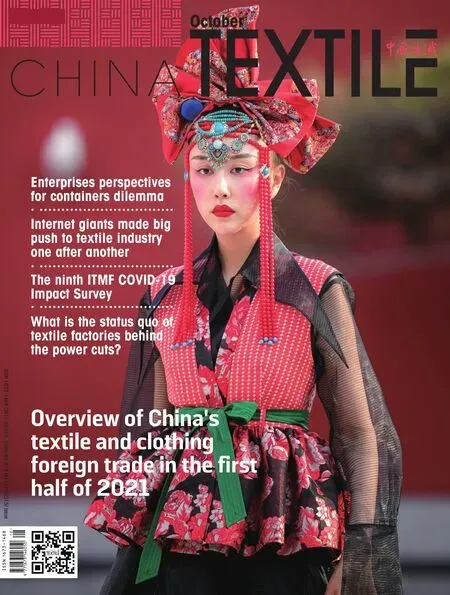
Overview of China's textile and clothing foreign trade in the first half of 2021
2021-11-09 01:05:00
China Textile 2021年5期
In the first half of the year, China's exports of goods showed good growth, but corporate profits have little room. In terms of data, textile and clothing export showed a good and healthy growth trend, still increasing by 12.8% in a high base, while traditional commodity exports achieved double growth (compared with the same period in 2020 and 2019). In the field survey, enterprises also generally expressed that there are sufficient orders in hand right now.
In the second half of the year, although the global pandemic has not reached an inflection point, it is expected to be further alleviated as vaccination coverage continues to expand, and demand in key markets picks up and global trade grows. In addition, there are still opportunities under the pandemic. It is reported that the pandemic situation in Vietnam is serious again recently, and the government has taken quarantine measures, which leads to the reduction of local production capacity. Some orders are returned to China and accepted by Chinese enterprises, which is good for our exports. The textile and clothing export in the second half of the year will maintain a steady and good development trend, and the probability of exceeding expectations.
According to the IMF's latest forecast for global economic growth, the global economy will grow by 6% this year, the highest rate in nearly 40 years. Next year, the figure is expected to reach 4.4 percent, significantly higher than the average growth rate of the world economy since 1990. Among them, China is the engine driving global economic growth. Due to China's remarkable response to the pandemic and rapid recovery of economic activities, IMF forecasts that China's economic growth rate will reach 8.4% this year, higher than the target of over 6% set by the Chinese government.
Excluding the impact of contingencies, exports are expected to achieve minor increase. However, due to some negative matters, such as large fluctuations in exchange rates, floods in Henan province, and repeated outbreaks in Europe and the United States, it is more likely to be slightly lower than last year.
Trade increased by 13.8% year-on-year
In the first half of 2021, China's textile and clothing trade reached USD 157.09 billion, up 13.8 percent yearon-year, accounting for 5.6 percent of the country's total trade. Exports reached USD 143.39 billion, up 12.8% and 15.6% over the same period in 2019, accounting for 9.44% of China's total exports. Imports reached USD 3.7 billion, up 25.6% and 13.3% over the same period in 2019, accounting for 1.1% of China's total imports. The cumulative trade surplus was USD 129.69 billion, up 11.6% and 15.8% over the same period in 2019, accounting for 51.6% of China's total trade surplus in goods.
However, from the second quarter, exports of textile and clothing was gradually fell back. Exports fell 16.8 percent in May and continued to fall in June, but the decline slowed significantly from May to 3.7 percent. Compared with the same period in 2019, the growth rate remains fast. The cumulative export of textiles decreased by 27.9% year-on-year and increased by 17.2% compared with the same period in 2019. Apparel maintained a good growth trend, with the cumulative export increasing by 35.7% year-on-year and increased by 10% compared with the same period in 2019.

4 major markets perfomance differently
Thee United States, EU, Japan and ASEAN account for China’s export 55 percent. In the first two quarters, China’s export to the United States and ASEAN maintained a relatively stable growth, while the growth to the EU and Japan slowed down or declined.
With the gradual recovery of demand, the US market has stabilized and its exports to the US have achieved rapid growth. From January to June, China's export to the US reached 25.31 billion USD, up 12.8% year on year and 19.4% compared with the same period in 2019. Among them, needle-woven clothing, increased by 49.4 percent, down 3.2 percent from 2019, basically returning to the pre-pandemic level.
China's exports to the EU have plummeted due to a sharp reduction in the export of pandemic prevention materials. From January to June, China's textile and garment export to the EU reached USD 21.22 billion, down 19.1% year on year, with an average drop of 43.2% in the second quarter, mainly driven by the rapid reduction of pandemic prevention materials. In the second quarter, China's export of medical masks and protective clothing to the EU decreased by 94%. Thee export of needlewoven clothing, rose 24.5 percent, up 3.7 percent from 2019.
Due to the slow economic recovery, the demand in Japan has not increased significantly. In addition, since the second half of last year, Japan took the lead in resuming import transfer from countries other than China, which lead to low trade level of China. From January to June, China's textile and garment exports to Japan were USD 9.65 billion, down 8.2% year-on-year and up 6.6% compared with the same period in 2019. Among them, the needle woven clothing saw a year-on-year growth of 9.6%, down 4.5% from 2019.
We maintained steady growth in exports to ASEAN, and ASEAN's share in China's exports continued to increase. From January to June, China's textile and garment exports to ASEAN reached 22.73 billion USD, up 36% year-on-year and 23.5% compared with the same period in 2019. Among them, yarn and fabric saw a year-onyear growth of 40.8% and a year-on-year growth of 6.9% compared with 2019. ASEAN's share in China's textile and garment export market has further increased to 15.8%, up 2.4 percentage points from 2020, surpassing the EU for the first time.
The overall share of Chinese products in three key markets declined from the high level last year. Thee proportion of key products in the European and American markets was still higher than the level of the same period in 2020 and 2019, while Japanese market fell back.
In the first four months, 27 countries of EU export 43.55 billion dolloars from the world, with the increase of 7 percent, while imports from China accounted for 14.37 billion dollors, down 3.9 percent. China accounted for 33 percent, down from the same period in 2020 and still higher than the same period in 2019. Among them, textiles accounted for 43.7%, lower than 2020 and higher than the same period in 2019, while apparel accounted for 28.4%, both higher than the same period in 2019 and 2020. The import of textiles and apparel from ASEAN reached USD 5.75 billion, up 35% and accounting for 13.2%, both higher than the previous two years. ASEAN has overtaken Bangladesh and Turkey, the EU's traditional sources of imports.
In the first half of 2021, the US imported 54.06 billion US dollars from the world, up 24.9 percent, and 16.29 billion US dollars from China, up 10.9 percent. China accounted for 30.2 percent, lower than 34.06 percent in 2020 and 30.85 percent in the same period in 2019. Among them, textiles accounted for 36.3 percent, lower than the same period in 2019 and 2020, while apparel accounted for 27.9 percent, both higher than the same period in 2019 and 2020. Textile and apparel imports from ASEAN reached 14.07 billion US dollars, up 37% and accounting for 26.06%, both higher than the previous two years.
Thee share of Chinese products in the U.S. market has fallen back, but the outlook still optismtic. According to the 2021 Fashion Industry Benchmark Report released by the Fashion Industry Association of America in July, although American buyers continue to reduce their purchases from China, they still regard China as the most competitive and balanced sourcing source, and few countries can compete the flexibility and sensitivity of China's industrial chain.
Sixty-three percent of US companies surveyed plan to further reduce purchases from China over the next two years, down slightly from 83 percent in 2019 and 70 percent in 2020. Meanwhile, 30 percent of respondents want to keep the current amount of purchases from China, up from 13 percent in 2019 and 25 percent in 2020.
In the first five months, Japan's imports from China dropped 14.4 percent to 8.21 billion dollars, with China accounting for 55.1 percent, lower than the same period in 2020 but higher than the same period in 2019. Among them, textiles accounted for 57.6%, lower than the same period in 2020 and higher than the same period in 2019. Clothing accounted for 54.2%, both lower than the same period in 2020 and 2019. Textile and apparel imports from ASEAN reached 4.42 billion US dollars, up by 2.9%, accounting for 29.7%, both higher than the previous two years.