
Late Jurassic adakitic ore-bearing granodiorite porphyry intrusions in the Xiaokele porphyry Cu(-Mo)deposit,Northeast China:implications for petrogenesis and tectonic setting
2021-11-03 04:41:44YonggangSunBileLiZhonghaiZhaoQingfengDingFanboMengXushengChenYeQianYujinLi
Acta Geochimica 2021年5期
Yonggang Sun·Bile Li·Zhonghai Zhao·Qingfeng Ding·Fanbo Meng·Xusheng Chen·Ye Qian,4·Yujin Li,4
Abstract The Xiaokele Cu(-Mo)deposit is a recently discovered porphyry deposit in the northern Great Xing’an Range(GXR)of northeast China.The ore bodies in this deposit are mainly hosted within granodiorite porphyry intrusions.Potassic,phyllic,and propylitic alteration zones develop from center to edge.In this paper,we present zircon LA-ICP-MS U-Pb ages,zircon Hf isotopic compositions,and whole-rock geochemistry of the ore-bearing granodiorite porphyries from the Xiaokele Cu(-Mo)deposit.Zircon U-Pb dating suggests that the Xiaokele granodiorite porphyries were emplaced at 148.8±1.1 Ma(weighted-mean age;n=14).The Xiaokele granodiorite porphyries display high SiO2,Al2O3,Sr,and Sr/Y,low K2O/Na2O,MgO,Yb,and Y,belonging to high-SiO2 adakites produced by partial melting of the subducted oceanic slab.Marine sediments were involved in the magma source of the Xiaokele granodiorite porphyries,as indicated by enriched Sr-Nd isotopic compositions(εNd(-t)= -1.17--0.27),low positive zirconεHf(t)values(0.4-2.2),and high Th contents(4.06-5.20).The adakitic magma subsequently interacted with the mantle peridotites during ascent through the mantle wedge.The Xiaokele granodiorite porphyries were derived from slab melting during the southward subduction of the Mongol-Okhotsk Ocean.
Keywords Xiaokele porphyry Cu(-Mo)deposit·Adakite·Slab melting·Mongol-Okhotsk Ocean·Northern Great Xing’an Range
1 Introduction
Porphyry deposits are the main source of Cu,accounting for about 80%of the world’s Cu reserves(Sillitoe 2010;Sun et al.2015).Generally,most porphyry deposits occur in island arc and continental margin arc settings(Sillitoe 2010;Richards 2011a).Recently,discoveries of some world-class porphyry Cu(Mo-Au)deposits in some continental collision orogens(e.g.,Qinling-Dabie Orogen)indicate they may also form in post-subduction collisional settings(Chen and Santosh 2014;Richards 2015;Chen et al.2017a).Porphyry Cu deposits are generally closely correlated with intermediate-felsic porphyritic intrusions with high oxygen fugacity(Mungall 2002;Shen et al.2015;Zhang et al.2017)and high water contents(≥4 wt.%;Richards 2011b).Interestingly,most of these porphyries display the geochemical characteristics of adakites(e.g.,SiO2≥56 wt.%;Al2O3≥15 wt.%;Y≤18 ppm;Yb≤1.9 ppm;and Sr≥400 ppm;Defant and Drummond 1990;Sajona and Maury 1998;Oyarzu′n et al.2001;Mungall 2002;Reich et al.2003;Hollings et al.2011;Sun et al.2015).
Northeast(NE)Chinaislocated in theeastern part of the Central Asian Orogenic Belt(CAOB),adjacent to the Siberia Craton in the north and the Tarim-North China Craton in thesouth(Fig.1A;S?engo¨r et al.1993;Jahn et al.2004).The Great Xing’an Range(GXR)liesin the western part of NE China(Fig.1B),is a vitally important polymetallic metallogenic belt in China(Song et al.2015;Chen et al.2017b).During previous decades,several epithermal and orogenic Au deposits,porphyry deposits,hydrothermal-vein Ag-Pb-Zn deposits,and skarn Pb-Zn deposits have already been discovered in the northern GXR(Fig.1C).The Xiaokele porphyry Cu(-Mo)deposit,located in the northern GXR,was discovered by the Qiqihaer Institute of Geological Exploration in 2013.This deposit contains estimated reserves of>500,000 tons Cu with grades of 0.2%-4.41%,>100,000 tons Mo with grades of 0.03%-0.70%,and>53 tons Ag,with ongoing exploration(Sun et al.2020a).The discovery of this deposit is an important breakthrough for porphyry Cu prospecting in the northern GXR.The published wholerock geochemical data for Late Jurassic ore-bearing granodiorite porphyries in the Xiaokele deposit exhibit adakitic aff inity(Deng et al.2019a;Feng et al.2020a).However,two quite different genetic models for the adakitic orebearing granodiorite porphyries lead to diff iculties in understanding their petrogenesis and Late Mesozoic tectonic evolution.Deng et al.(2019a)suggested that the Xiaokele granodiorite porphyries were formed by the partial melting of an altered oceanic slab associated with the southward subduction of the Mongol-Okhotsk oceanic slab,whereas Feng et al.(2020a)considered the Xiaokele granodiorite porphyries were derived from partial melting of an enriched mantle metasomatized by subduction-related melts in a post-collision setting.
To solve the above problem,in this study,we present zircon LA-ICP-MS U-Pb ages,zircon Hf isotopic compositions,and whole-rock geochemistry of theadakitic orebearing granodiorite porphyries from the Xiaokele Cu(-Mo)deposit.We discuss their petrogenesis and implications for tectonic settings.
2 Geological background
From east to west,NE China is divided into the Jiamusi-Khanka,Songnen,Xing’an,and Erguna blocks(Fig.1B;Wu et al.2011).During the Paleozoic,these blocks collided and amalgamated,triggered by the subduction and closure of the Paleo-Asian Ocean(S?engo¨r et al.1993;Wu et al.2011;Zhou et al.2018).During the Mesozoic,NE China wasnot only inf luenced by the Paleo-Pacif ic tectonic regime but also superimposed and modified by the Mongol-Okhotsk tectonic regime(Wu et al.2011;Xu et al.2013;Liu et al.2017).
The Xiaokele Cu(-Mo)deposit issituated in theeastern part of the Erguna Block(Fig.1C).The Erguna Block lies between the Mongol-Okhotsk,and Tayuan-Xiguitu sutures(Fig.1C).Studies on early Paleozoic blueschist facies metamorphic rocks and post-orogenic granites suggest that Xing’an and Erguna blocks collided along the Tayuan-Xiguitu suture at ca.500 Ma(Fig.1C;Ge et al.2005;Zhou et al.2015).The basement of the Erguna Block is mainly composed of Precambrian metamorphic supracrustal rocks and sporadic Paleoproterozoic and Neoproterozoic granitoids(Inner Mongolian Bureau of Geology and Mineral Resources(IMBGMR)1991;Miao et al.2004;Zhou et al.2011).Outcropping strata are mainly Paleozoic shallow marine sediments(IMBGMR 1996),widespread Mesozoic volcanic rocks,and minor Cenozoic terrigenous clastic rocks(Zhang et al.2008).Late Mesozoic NEtrending Derbugan and Erguna River faults develop in the Erguna Block(Fig.1C;IMBGMR 1991).Intrusive rocks(granitic rocks are predominant)in the Erguna Block were mainly emplaced during Paleozoic and Mesozoic(Fig.1C;Wu et al.2011;Gou et al.2017).
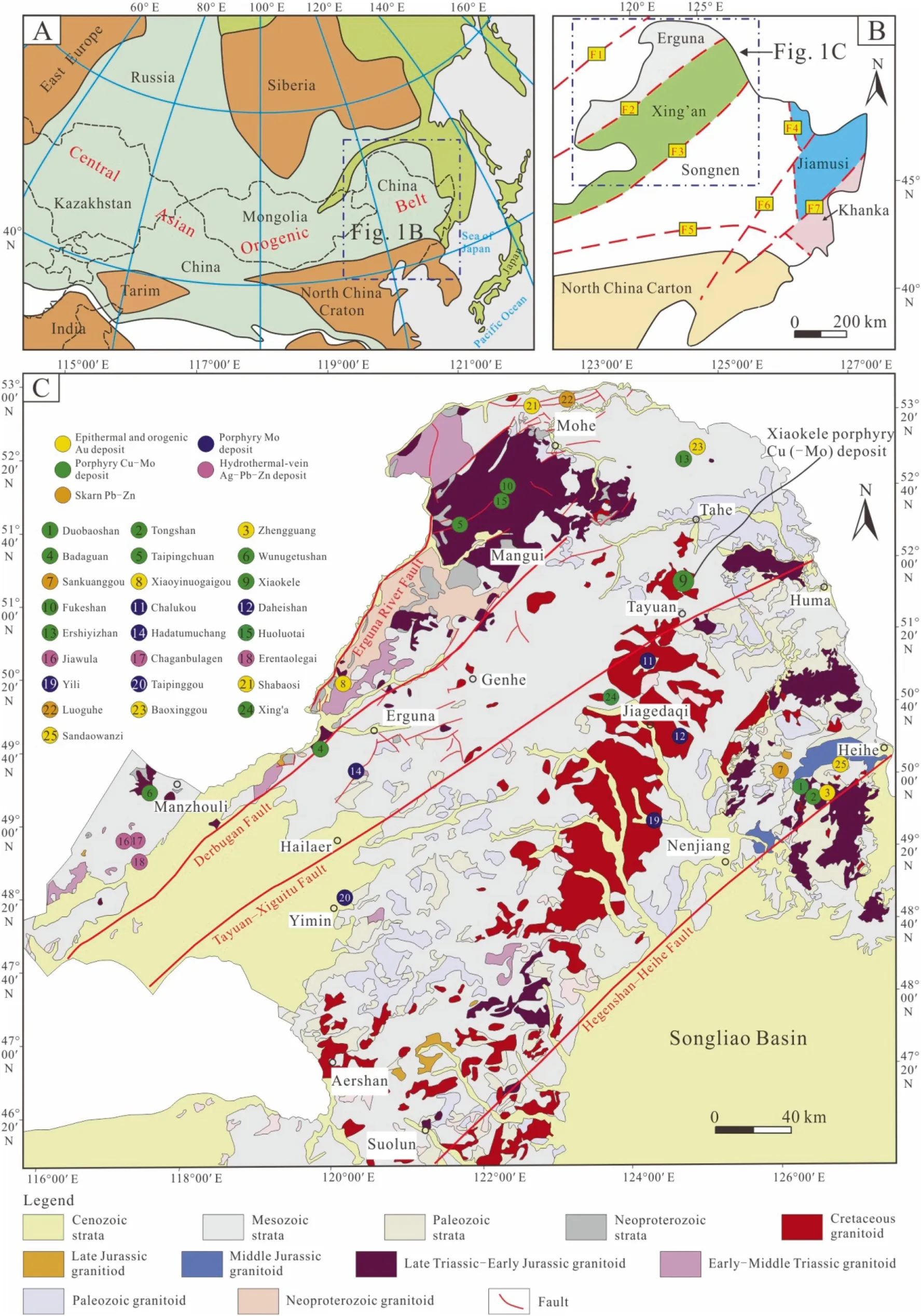
Fig.1 A Location of the Central Asian Orogenic Belt(Jahn et al.2000).B Geological map of NE China(Chen et al.2012).Fault abbreviations:F1,Mongol-Okhotsk;F2,Tayuan-Xiguitu;F3,Hegenshan-Heihe; F4, Mudanjiang-Yilan; F5, Solonker-Xar Moron-Changchun-Yanji;F6,Jiamusi-Yilan;F7,Dunhua-Mishan.C Geological map of the northern Great Xing’an Range(modified from Deng et al.2019b),showing the distribution of major deposits
3 Deposit geology
3.1 Ore district geology
The Xiaokele porphyry Cu(-Mo)deposit is located~20 km north of Tayuan Town in Heilongjiang Province(Fig.1C).From old to young,the outcropping strata in this area are mainly the Neoproterozoic-Lower Cambrian Jixianggou and Dawangzi Formations,Upper Jurassic Baiyingaolao Formation, and Quaternary sediments(Fig.2A).The Jixianggou Formation is mainly composed of phyllite,schist,marble,slate,feldspar-bearing quartz siltstone,and metamorphic sandstone.The Dawangzi Formation is mainly composed of metamorphosed intermediate-basic lava interbedded with metamorphosed acidic lava and slate.The main rocks in the Baiyingaolao Formation are rhyolitic tuff and rhyolite,which rests unconformably on the Dawangzi and Jixianggou Formations.The Xiaokele Cu(-Mo)deposit is located near the junction of the NNW-trending Dawusu River and NEEtrending Xiaokele River faults(Fig.2A).Multiphase intrusive rocks are developed in the Xiaokele mining area,including the early Permian syengranite(292.5±0.9 Ma,Sun et al.2020b),Late Jurassic granodiorite porphyry(150.0±1.6 Ma), and diorite porphyrite(147.9±1.3 Ma),and Early Cretaceous granite porphyry(123.2±1.7 Ma)(Deng et al.2019a).The granodiorite porphyry,whose outcrop area is~1.6 km2(Fig.2A),is considered astheore-bearing rocksand isclosely related to the associated hydrothermal alteration of this deposit.The granodiorite porphyry is gray-white and exhibits porphyritic texture,it consists of 65%-70%phenocrysts and 30%-35% f ine-grained groundmass (Fig.3A, B).Phenocrysts are dominantly composed of quartz(25%-30%),plagioclase(25%-30%),alkali-feldspar(5%-10%;including perthite and orthoclase),biotite(~5%),and hornblende(<5%),with minor accessory sphene(1%-2%)(Fig.3C),the groundmass has the same composition as the phenocrysts.
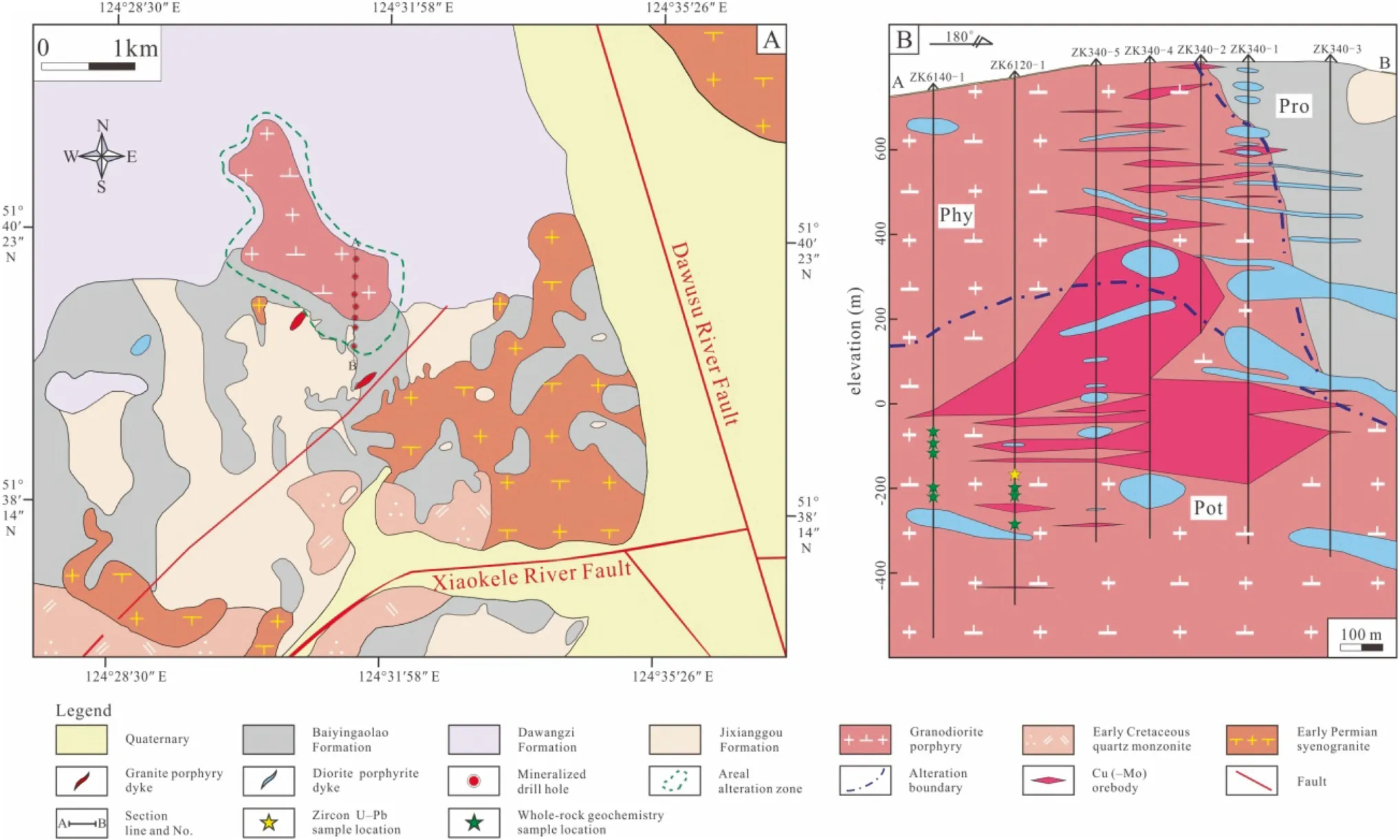
Fig.2 A Geological map of the Xiaokele Cu(-Mo)deposit(modified from Qiqihaer Institute of Geological Exploration(QIGE 2018).B Geological sections along the A-B exploration lines of the Xiaokele Cu(-Mo)deposit with sample locations as indicated(modified from QIGE,2018).Abbreviations:Pot=potassic alteration zone;Phy=phyllic alteration zone;Pro=propylitic alteration zone.
3.2 Alteration and mineralization
Based on drilling,mineralization is mainly located at the top and center part of the granodiorite porphyry in the Xiaokele porphyry Cu(-Mo)deposit(Fig.2B).The orebodies are generally 100-1050 m long and 4-112 m thick(Fig.2B).Three alteration zones can be divided,from center to edge,into potassic,phyllic,and propylitic alteration zones(Fig.2B).The potassic alteration zone is mainly distributed in the center of the granodiorite porphyry(Fig.2B),and potassic alteration is characterized by secondary biotite and K-feldspar(Fig.3D).The potassic alteration zone mainly contains magnetite,hematite,chalcopyrite,and molybdenite(Fig.3D-F).Phyllic alteration is characterized by secondary quartz and sericite(Fig.3G,H).Phyllic alteration overprinted the preexisting potassic alteration.Pyrite,chalcopyrite,and molybdenite are developed in the phyllic alteration zone(Fig.3G,H).The propylitic alteration zone forms at the periphery of the deposit.It is characterized by chlorite,epidote,and calcite,with minor disseminated pyrite(Fig.3I).Most Cu-Mo mineralization occurs in the middle-upper part of the potassic alteration zone and the lower part of the phyllic alteration zone(Fig.2B).
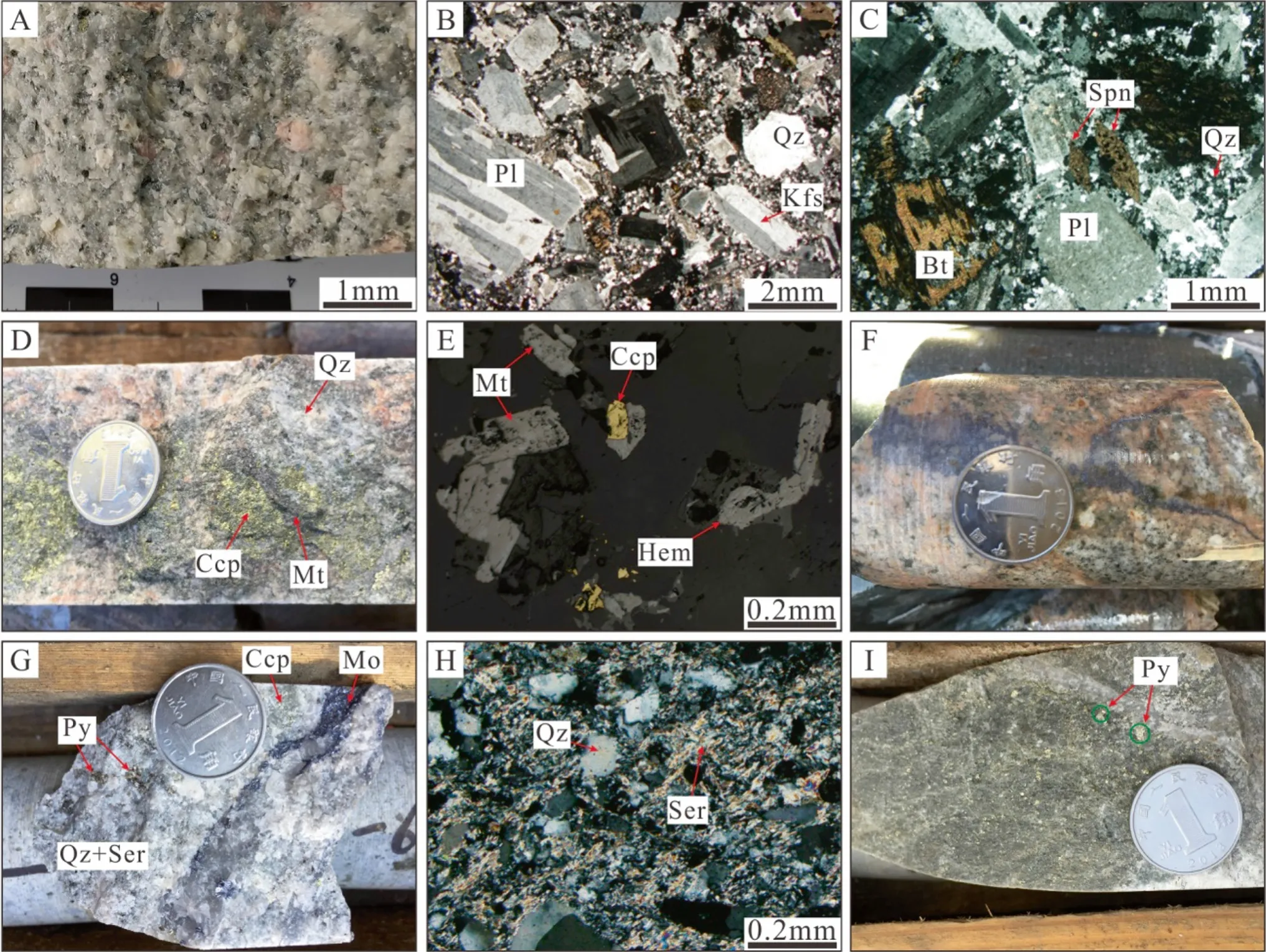
Fig.3 Photographs and photomicrographs of granodiorite porphyry and representative hydrothermal alteration features in the Xiaokele Cu(-Mo)deposit.A Hand specimen of granodiorite porphyry.B-C)Photomicrographs of granodiorite porphyry.D Quartz+magnetite+chalcopyrite assemblage in potassic-altered granodiorite porphyry.E Magnetite,hematite,and minor chalcopyrite in the potassic-altered wall rock.F Quartz+molybdenite vein with K-feldspar alteration halos.G Disseminated molybdenite,chalcopyrite,and pyrite associated with intensive phyllic alteration.H Phyllic alteration,with the alteration assemblage of quartz and sericite.I Propylitic alteration with minor disseminated pyrite in granodiorite porphyry.Abbreviations:Qz=quartz;Kfs=K-feldspar;Bt=biotite;Pl=plagioclase;Spn=sphene;Ep=epidote;Ser=sericite;Hem=hematite;Mt=magnetite;Py=pyrite;Ccp=chalcopyrite;Mo=molybdenite
4 Analytical methods
4.1 Zircon U-Pb dating
Zircon crystals were separated from the granodiorite porphyry samples using standard heavy liquid and magnetic techniques,and then the zircon crystals were handpicked under a binocular microscope at the Shangyi Geologic Service,Langfang,China.All zircon crystals were examined by Cathode Luminescence(CL)imaging to reveal their internal structures.Laser ablation inductively coupled mass spectrometry(LA-ICP-MS)zircon U-Pb dating and trace element analyses were undertaken at Yanduzhongshi Geological Analysis Laboratories,Beijing.The laser ablation system is New Wave UP213 and ICP-MS is Aurora M90.Analyses were carried out with a beam diameter of 30μm,ablation rate of 10 Hz,and energy density of 2.5 J/cm2.Detailed experimental testing procedures were described by Yuan et al.(2004).Helium was used as the carrier gas,and argon was used as compensation gas.Zircon 91,500 was used as the external standard for U-Pb dating.Trace element compositions of zircon crystals were quantified using SRM610 as an external standard,and Si was used as an internal standard(Liu et al.2010a).Correction of common Pb was evaluated using the method described by Andersen(2002).The ICP-MS DATECAL program was used to calculate isotopic data and elemental contents(Liu et al.2008).Isoplot/Ex_ver3 was used to perform age calculations and generate Concordia diagrams(Ludwig 2003).The uncertainties for individual analyses are quoted at the 1σconf idence level.Zircon U-Pb dating and zircon trace element composition data are presented in Table S1 and Table S2,respectively.
4.2 Whole-rock major and trace element analyses
Eight granodiorite porphyry samples were sampled distal to the location of mineralization and alteration.The freshest parts of the samples without alteration were selected for whole-rock geochemistry analysisbeforebeing crushed to 200 mesh.All whole-rock geochemistry analyses were conducted at the Key Laboratory of Mineral Resources Evaluation in Northeast Asia,Ministry of Land and Resources,Jilin University,Changchun,China.Major element compositions were determined by X-ray f luorescence(XRF)spectroscopy and fused glass disks.Trace element compositions were determined by an Agilent 7500a ICP-MSafter the samplepowderswere dissolved in HF in Tef lon bombs.The analytical precision was better than 5%for major elements,and was better than 10%for trace elements,as estimated by using the international standards BHVO-2 and BCR-2,and national standards GBW07103 and GBW07104.The analytical results of major and trace elements are listed in Table S3.
4.3 Zircon Hf isotopic analyses
Zircon Lu-Hf isotope analysis was carried out in-situ by using an NWR193 laser-ablation microprobe(Elemental Scientif ic Lasers LLC),attached to a Neptune multicollector ICP-MS at Yanduzhongshi Geological Analysis Laboratories,Beijing,China.The ablation spots for the Hf isotope analyses were located over the positions on the zircon crystalspreviously analyzed for zircon U-Pb dating.We adopted a beam diameter of 40μm,ablation time of 31 s,ablation rateof 8 Hz,and energy density of 16 J/cm2.Detailed instrumental conditions,analytical procedures,and data acquisition techniques were comprehensively described by Wu et al.(2006).Zircon 91,500 and Plesovice were used as the reference standards during our routine analyses.Hf isotopic composition data are listed in Table S4.
5 Analytical results
5.1 Zircon U-Pb ages and geochemistry
Zircons from the granodiorite porphyry samples are generally columnar(Fig.4A).All analyzed zircons were euhedral to subhedral.Their oscillatory growth zoning,the Th/U ratios(0.80-1.30),and pronounced positive Ce anomalies(Fig.4B)indicate a magmatic origin(Hoskin 2005).Fourteen zircons yielded206Pb/238U ages of 152-145 Ma and a weighted-mean age of 148.8±1.1 Ma(MSWD=1.12;n=14)(Fig.4C,D).These results indicate that the granodiorite porphyry formed during Late Jurassic.
5.2 Whole-rock major and trace element compositions
The eight analyzed granodiorite porphyry samples display relatively high SiO2(63.01-65.70 wt.%), Al2O3(15.83-16.43 wt.%),K2O(2.79-3.32 wt.%),and Na2O(4.90-5.54 wt.%),and low TiO2(0.54-0.73 wt.%),and MgO(1.18-1.36 wt.%).The granodiorite porphyry samples belong to the high-K calc-alkaline series(Fig.5A).A/CNK ratios of 0.82-0.94 display metaluminous characteristics(Fig.5B),with geochemical compositions similar to the published Late Jurassic-Early Cretaceous subducting oceanic crust-derived adakitic rocks in the northern GXR(Fig.5;Deng et al.2019a,b;Xu et al.2020).
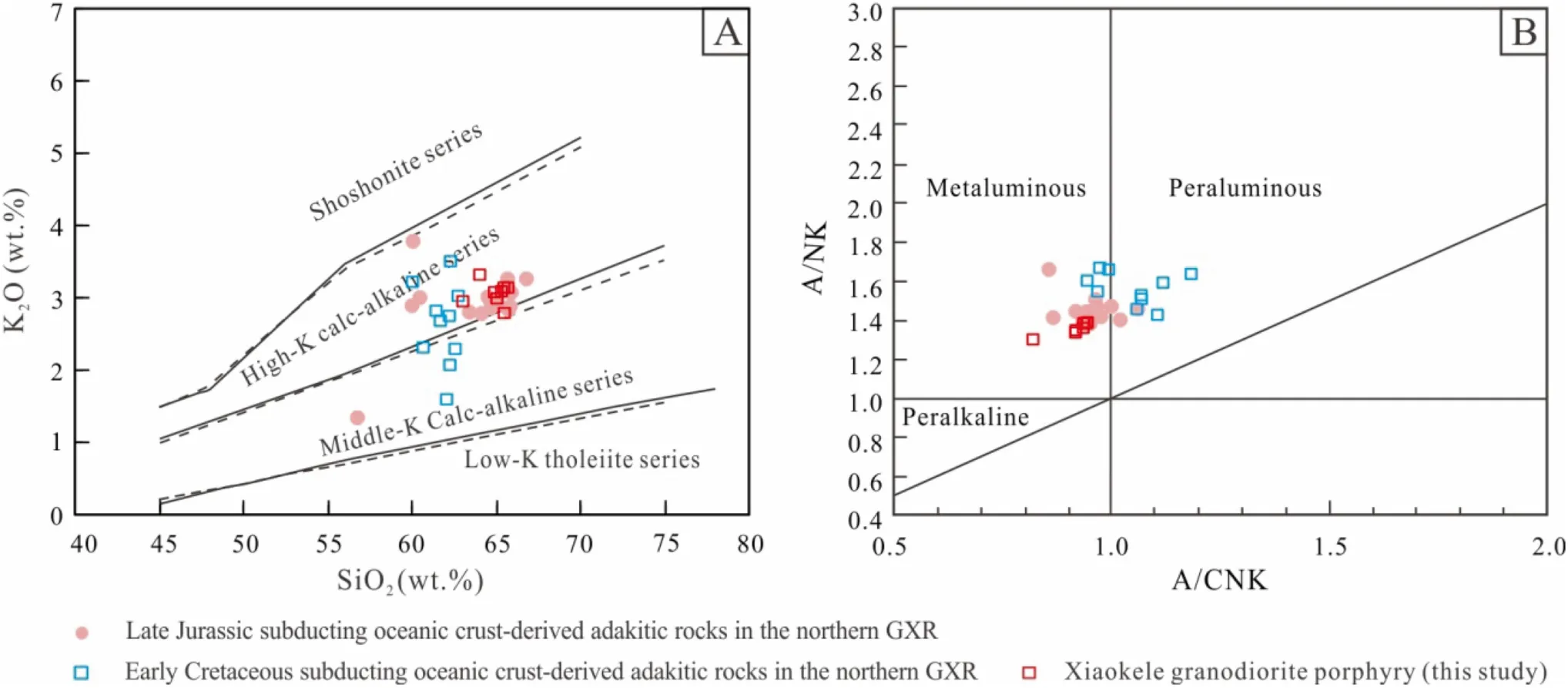
Fig.5 A SiO2 vs.K2O plot and B A/CNK vs.A/NK plot for the granodiorite porphyry from the Xiaokele deposit.Data for the Late Jurassic subducting oceanic crust-derived adakitic rocks in the northern GXRare from Deng et al.(2019a)and Deng et al.(2019b),whereas data for the Early Cretaceous subducting oceanic crust-derived adakitic rocks in the northern GXR are from Xu et al.(2020)
The chondrite-normalized REE patterns of all the granodiorite porphyry samples are slightly enriched in light rare-earth elements(LREEs)with respect to heavy rareearth elements(HREEs)and show weak negative Eu anomalies(Eu/Eu*=0.80-0.91)(Fig.6A).In theprimitive mantle-normalized spider diagram(Fig.6B),the granodiorite porphyry samples are depleted in Nb,Ta,and Ti and enriched in Rb,Ba,and K.These geochemical compositions are also in accordance with the published Late Jurassic-Early Cretaceoussubducting oceanic crust-derived adakitic rocks in the northern GXR(Fig.6;Deng et al.2019a,b;Xu et al.2020).
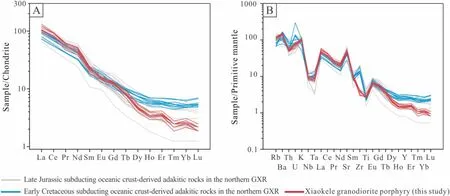
Fig.6 A Chondrite-normalized REE patterns and B primitive mantle-normalized spider diagrams for the granodiorite porphyry from the Xiaokeledeposit.Thechondritevaluesarefrom Boynton(1984),theprimitivemantlevaluesarefrom Sun and McDonough(1989).Datafor the Late Jurassic-Early Cretaceous subducting oceanic crust-derived adakitic rocks in the northern GXRare from the same data sources as in Fig.5
5.3 Zircon Hf isotopic compositions
Fourteen magmatic zircons from the granodiorite porphyry samples were analyzed for Lu-Hf isotopes,yielding initial176Hf/177Hf ratios of 0.282692-0.282744 and positive εHf(t)values of 0.4-2.2(Fig.7),with corresponding TDM1and TDM2ages of 786-708 Ma and 1045-942 Ma,respectively(Table S4).TheεHf(t)values plot in the f ield between the depleted mantle line and the chondrite evolution line (Fig.7),similar to εHf(t)values of the Phanerozoic magmatic rocks in the east CAOB(Fig.7A;Yang et al.2006).
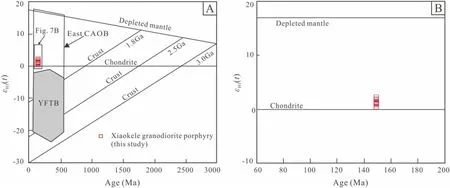
Fig.7 A Plotsof zircon U-Pb ages vs.εHf(t)values for thegranodiorite porphyry from the Xiaokele deposit.YFTB=Yanshan Fold-and-Thrust Belt(Yang et al.2006).B Close-up view of the distribution of samples in Fig.7A
6 Discussion
6.1 Age of magmatism and mineralization
Deng et al.(2019a)showed that the zircon U-Pb ages of rhyolite,granodiorite porphyry,diorite porphyrite,and granite porphyry associated with the Xiaokele Cu(-Mo)deposit are 152.5±1.7,150.0±1.6,147.9±1.3,and 123.2±1.7 Ma,respectively.This evidence indicates that the granodiorite porphyry was emplaced after the rhyolite but before the granite porphyry and diorite porphyrite.Observations of the intrusive relationships between magmatic rocks also support this conclusion.The granodiorite porphyry intruded into the Baiyingaolao Formation rhyolite/rhyolitic tuff and was subsequently intruded by the granite porphyry and diorite porphyrite dykes(Fig.2A,B).
In thisstudy,the Xiaokelegranodioriteporphyry yielded a weighted-mean age of 148.8±1.1 Ma(Fig.4D),which coincides well with molybdenite Re-Os isochron age(148.5±1.5 Ma;Feng et al.2020a,b).In addition,Cu(-Mo)mineralization is mainly hosted within granodiorite porphyry(Fig.2B).Based on the evidence,we conclude that the Late Jurassic granodiorite porphyry most likely caused porphyry Cu(-Mo)mineralization in the Xiaokele Cu(-Mo)deposit.
6.2 Petrogenesis of the Xiaokele ore-bearing granodiorite porphyry
The Xiaokele granodiorite porphyries have high SiO2(63.01-65.70 wt.%, >56.0 wt.%), Al2O3(15.83-16.43 wt.%,>15.0 wt.%),Sr(918-1196 ppm,>400 ppm), Sr/Y ratios (141-160), and low Y(5.76-7.76 ppm,<18 ppm)and Yb(0.45-0.64 ppm,<1.9 ppm),as well as weakly negative Eu anomalies(Eu/Eu*=0.80-0.91),showing a geochemical aff inity to adakites(Defant and Drummond 1990;Kay and Kay 1993;Kay et al.1993).All the Xiaokele granodiorite porphyry samples plot in the typical adakitic rocks f ield in the YbNversus(La/Yb)Nand Y versus Sr/Y geochemical classif ication diagrams(Fig.8A,B).Adakitic magmas can be produced by partial melting of subducted oceanic slabs(Defant and Drummond 1990;Martin et al.2005),assimilation-fractional crystallization (AFC) processes of basaltic magmas(Castillo et al.1999;Macpherson et al.2006),mixing between crustal and mantle magma(Guo et al.2007;Richards and Kerrich 2007;Streck et al.2007),partial melting thickened maf ic lower continental crust(LCC)(Atherton and Petford 1993;Condie 2005;Deng et al.2018),partial melting of subducted continental crust(Wang et al.2008,2010),or partial melting of the delaminated LCC(Kay and Kay 1993;Xu et al.2002;Hou et al.2007;Kadioglu and Dilek 2010).
The negligible Eu anomalies indicate little or no plagioclase fractionation(Macpherson et al.2006).The highpressure fractional crystallization(HPFC)of a garnetbearing assemblage from parental basaltic melts will commonly exhibit a positive relationship of SiO2with either Dy/Yb or Sr/Y ratios(Macpherson et al.2006),but the adakitic rocks show no such correlations(Fig.8C,D).Hornblende fractionation would result in high Sr/Y ratios,but there are no correlations between SiO2and Sr/Y(Fig.8D).We propose that partial melting played a dominant role in magma formation based on a similar compositional trend to the partial melting process(Fig.8E,F).In addition,there is no large volume of coeval maf ic rocks in the Xiaokele area,excluding the possibility for the generation of adakitic magma through AFC processes(Deng et al.2019a;Feng et al.2020a).Mixing between crustal and mantle magma would result in magmatic rocks with a wide range of geochemical characteristics,but the granodiorite porphyries have relatively homogenous wholerock geochemical and zircon Hf isotopic compositions.Moreover,maf ic microgranular enclaves(MMEs)are absent in the granodiorite porphyries,further indicating that they were not derived from mixed magma.

Fig.8 A YbN vs.(La/Yb)N(after Martin 1986),B Y vs.Sr/Y(after Defant and Drummond 1990),C SiO2 vs.Dy/Yb,D SiO2 vs.Sr/Y,E La vs.La/Sm,and F La versus La/Yb diagrams for the granodiorite porphyry from the Xiaokele deposit.Data for the Late Jurassic-Early Cretaceous subducting oceanic crust-derived adakitic rocks in the northern GXR are from the same data sources as in Fig.5
Partial melting of delaminated maf ic LCC would produce adakiteswith high MgO,Cr,and Nicontents and Mg#values as a result of reaction with surrounding mantle peridotites(Xu et al.2002;Huang et al.2008).However,thisis inconsistent with the low Cr(13.87-43.73 ppm)and Ni(9.02-16.10 ppm)contents of the Xiaokele granodiorite porphyries.In addition,the delamination of LCCisusually conf ined to the regions which are undergoing crustal extension(Wang et al.2007).Delamination of LCC is unlikely to occur because of simultaneous thrust-nappe structure in the Mohe Basin(Chang et al.2007)and strong deformation of Late Mesozoic igneous rocks in the Erguna Block(Tang et al.2015).All theevidencesuggeststhat the GXR was controlled by a compressive regime during the Late Jurassic-early Early Cretaceous.Accordingly,it seems unlikely that the Xiaokele granodiorite porphyries were derived from the partial melting of the delaminated LCC.
The Xiaokele granodiorite porphyry samples are sodic with Na2O=4.90-5.54 wt.%and K2O=2.79-3.32 wt.%.Their K2O/Na2O ratios vary from 0.53 to 0.65(average=0.60).In the Al2O3vs.K2O/Na2Odiagram,they plot in the area of oceanic slab-derived adakites for their low K2O/Na2Oratiosand high Al2O3contents(Fig.9A),which aredifferent from typical lower-crust-derived adakiteswith high K2O/Na2O ratios(Xiao and Clemens 2007).The Xiaokele granodiorite porphyry samples display low(La/Yb)N(average=43.2)but high variable Sr/Y(141-160;average=152),which are also comparable to adakites related to slab melting in subduction zones(Fig.9B).In addition,adakites derived from subduction zones can be classified into two signif icantly different groups based on SiO2contents(Martin et al.2005).The high-SiO2(HSA;SiO2>60%, MgO=0.5-4 wt.%) adakites formed through subducted basaltic slab-melts that reacted with peridotites during ascent through the mantle wedge.The low-SiO2(LSA;SiO2<60%,MgO=4-9 wt.%)adakites formed through melts of peridotitic mantle wedge that was modified by reaction with felsic slab-melts(Martin et al.2005).In the discrimination diagrams for HSA and LSA(Fig.9C-F),the Xiaokele granodiorite porphyry samples are mainly distributed in the HSA f ield,indicating an interaction between slab-derived melts and mantle peridotites.Regionally,the Late Jurassic-Early Cretaceous adakitic rocks in the northern GXR(Fig.8A,B)show geochemical characteristics similar to the Xiaokele granodiorite porphyry(Figs.5,6),they were suggested to be produced by partial melting of an oceanic slab(Fig.9;Deng et al.2019a,b;Xu et al.2020).

Fig.9 A Al2O3 vs.K 2O/Na2O,B(La/Yb)N vs.Sr/Y,C SiO2 vs.MgO,D TiO2 vs.Cr/Ni,E(CaO+Na2O)vs.Sr,and F Y vs.Sr/Y diagrams for the granodiorite porphyry from the Xiaokele deposit.Figure 9C,F is after Martin et al.(2005).The f ield of adakites derived from the thickened lower continental crust(LCC)in the Dabie orogeny is from Wang et al.(2007),He et al.(2010),and Liu et al.(2010b);the f ield of adakites derived from oceanic slab melting is from Kamei et al.(2009).Data for the Late Jurassic-Early Cretaceous subducting oceanic crust-derived adakitic rocks in the northern GXR are from the same data sources as in Fig.5.Abbreviations:HSA=high-SiO2 adakitic rocks;LSA=low-SiO2 adakitic rocks
However,the lower zirconεHf(t)values of the Xiaokele granodiorite porphyries relative to the depleted mantle(Fig.7)suggest that ancient crustal materials were involved in the genesis of the Xiaokele granodiorite porphyries besides the subducted MORB.These crustal materials may be continental crust materials added through crustal contamination or magma mixing,or the subducted marine sediments added in the source during slab melting(Deng et al.2019c;Qi et al.2020).The model of magma mixing is not favored as mentioned above.No xenocrystic zircons were found in the Xiaokele granodiorite porphyry samples,suggesting that negligible crustal contamination occurred during magma ascent.Thus the ancient crustal materials added in the source of the Xiaokele granodiorite porphyriesare most likely the subducted marine sediments.The marine sediments generally display high Sr and Nd contents,and highly enriched radiogenic isotopic compositions,thus the Sr-Nd isotopic compositions of adakites derived from oceanic crust can be enriched through the addition of a small number of marine sediments in the source(Elliott et al.1997;Wang et al.2013).The Xiaokele granodiorite porphyries have slightly enriched Sr-Nd isotopic compositions[(87Sr/86Sr)i=0.7055-0.7057,εNd(-t)=-1.17--0.27](Deng et al.2019a),suggesting the involvement of marine sediments in the source.Sr-Nd isotopic data of the Xiaokele granodiorite porphyries and Jurassic granitoidsin the GXRappear thetrend towardsthe EMII end member,and similar to the typical trend of marine sediments(Hofmann 2003),also ref lecting the signif icant role of marine sediments in their source(Fig.10).Moreover,marine sediments generally display high Th contents(Hawkesworth et al.1997),thus Th contents could be increased by the involvement of marine sediments in the magma source(Woodhead et al.2001).In the Ba/La versus Th/Yb diagram(Fig.11),the Xiaokele granodiorite porphyries display trends characteristic of sediments or sediment melts,further indicating the involvement of marine sediments.
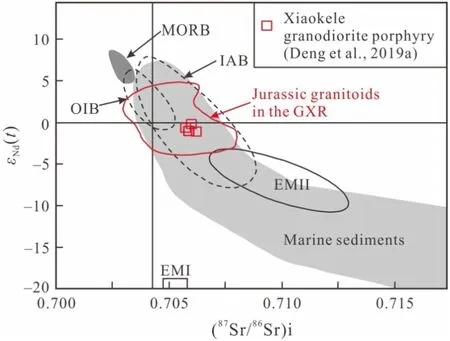
Fig.10 Sr-Nd isotopic compositions of the granodiorite porphyry from the Xiaokele deposit.Sr-Nd isotopic data source:the f ields for MORB,OIB,and IAB are from Vervoort et al.(1999);the f ield for marine sediments is from Hofmann(2003);EMI and EMII represent two types of mantle end-members(Hou et al.2011);the Xiaokele granodiorite porphyries are from Deng et al.(2019a);the Jurassic granitoids in the Great Xing’an Range is from Wu et al.(2002),Chen et al.(2011),Hu et al.(2016),and Deng et al.(2019b).Abbreviations:MORB=mid-ocean ridge basalt;OIB=ocean island basalt;IAB=island arc basalt
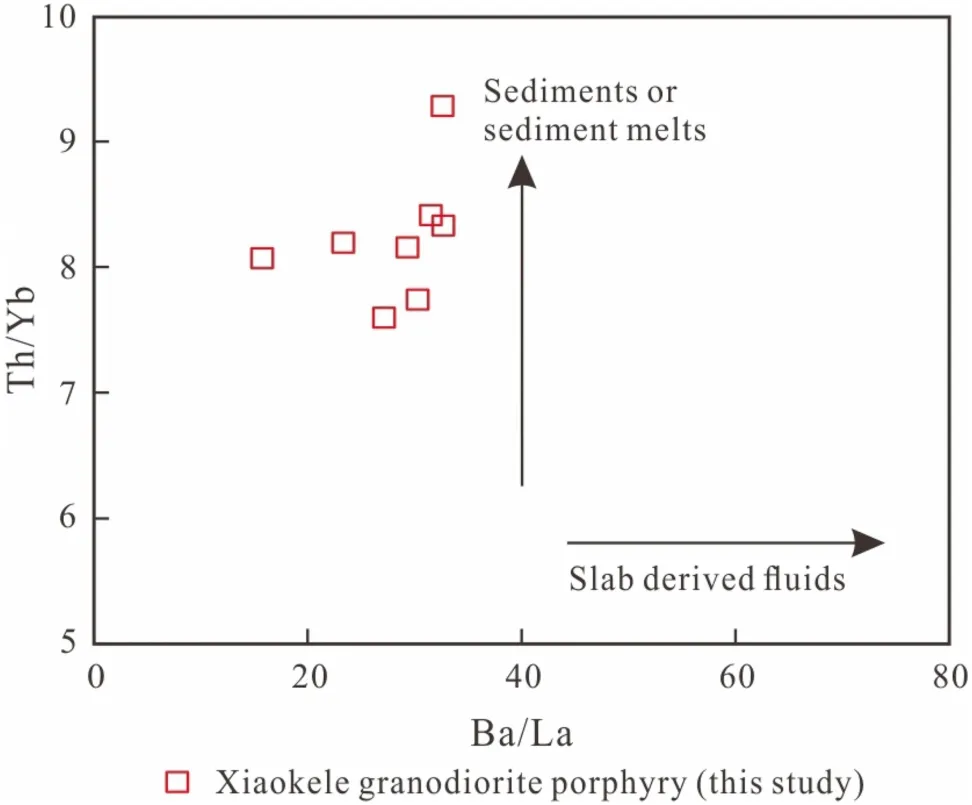
Fig.11 Ba/La versus Th/Yb diagram(after Woodhead et al.2001)for the granodiorite porphyry from the Xiaokele deposit to distinguish the contribution of subducted sediments in the source
Therefore,based on the above discussion,we suggest that the Xiaokele granodiorite porphyries were produced by partial melting of a subducted oceanic slab,with the involvement of marine sediments in the source,followed by interaction with the mantle peridotites during ascent through the mantle wedge.
6.3 Implications for regional tectonic setting
The generation of Late Mesozoic magmatism in the GXR has been debated to be related to the Paleo-Pacif ic(Zhang et al.2010;Hu et al.2014;Liu et al.2014;Shu et al.2016)or the Mongol-Okhotsk tectonic regime(Ying et al.2010;Xu et al.2013;Tang et al.2016;Chen et al.2017b;Deng et al.2019b).However,the Late Jurassic-early Early Cretaceous(150-130 Ma)porphyry Cu-Mo depositsin NE China are spatially conf ined to the western part of the Songliao Basin,and concentrated in the GXR and western part of North China Craton,but not distributed in the eastern part(Chen et al.2017b;Zhang and Li 2017).This scenario suggests a genetic relation to the evolution of the Mongol-Okhotsk Ocean rather than the Paleo-Pacif ic Ocean(Chen et al.2017b).However,the subduction history of the Mongol-Okhotsk Ocean has not been well constrained,some researchers propose that the Erguna Block was in a post-orogenic extensional setting related to the closure of the Mongol-Okhotsk Ocean during Late Jurassic-Early Cretaceous(Mao et al.2013;Li et al.2014;Han et al.2020),while other researchers conclude that the southwards subduction of the Mongol-Okhotsk Ocean continues to occur during Late Jurassic-Early Cretaceous(Zhang 2014;Deng et al.2019a,2019b;Zhang et al.2019).This is because the f inal closing time of the Mongol-Okhotsk Ocean is still controversial,the Mongol-Okhotsk Ocean might havef inally closed during the Middle Jurassic(Sun et al.2013;Li et al.2018)or the Late Jurassic-Early Cretaceous(Zonenshain and Kuzmin 1997;Metelkin et al.2010;Pei et al.2011;Yang et al.2015).
Extensive paleomagnetic studies have shown that the Mongol-Okhotsk Ocean was still thousands of kilometers wide in the Late Jurassic and f inally closed in the Early Cretaceous(Cogne′et al.2005;Peiet al.2011).Zhang et al.(2019)proposed that the middle sector of the Mongol-Okhotsk Ocean did not close until 110 Ma based on a compilation of updated paleomagnetic data in support of the latest Early Cretaceous f inal ocean closure.Therefore,these multiple lines of evidence strongly suggest that the Mongol-Okhotsk oceanic slab may have maintained southward subduction in the Late Jurassic.This conclusion can also be supported by studies of petrogeochemistry on Late Jurassic porphyry deposits in the northern GXR.The published whole rocks geochemical data for Late Jurassic quartz diorite porphyries associated with Cu(Mo)mineralization in the Fukeshan deposit indicate that they possibly derived from the melting of an oceanic slab,forming in the subduction tectonic setting related to Mongol-Okhotsk oceanic slab tectonic activities(Deng et al.2019b).Moreover,in this study,Late Jurassic adakitic ore-bearing granodioriteporphyriesin the Xiaokeleporphyry Cu(-Mo)deposit belong to adakitic rocks,also derived from the partial melting of subducted oceanic crust,such that the Xiaokele deposit is most likely the product of southward subduction of the Mongol-Okhotsk Ocean.Therefore,Late Jurassic porphyry deposits are extremely likely to be related to intermediate-felsic porphyritic intrusions with subduction-related geochemical features and are interpreted to be the product of the southward subduction of the Mongol-Okhotsk oceanic plate(Zhang and Li 2017;Deng et al.2019a;Guo et al.2020).
7 Conclusions
(1) LA-ICP-MS zircon U-Pb dating shows that the Xiaokele granodiorite porphyries were emplaced at 148.8±1.1 Ma.
(2) The Xiaokele ore-bearing granodiorite porphyries are adakites produced by partial melting of the subducted oceanic slab,with involvement of marine sediments in the magma source,followed by interaction with the mantle peridotites during ascent through the mantle wedge.
(3) The Xiaokele granodiorite porphyries were the product of the southward subduction of the Mongol-Okhotsk Ocean.
SupplementaryInformationThe online version contains supplementary material available at https://doi.org/10.1007/s11631-021-00485-z.
AcknowledgementsWe would liketo thank the staff membersof the Qiqihaer Institute of Geological Exploration,Heilongjiang,China for sample collection.This research was funded by the National Natural Science Foundation of China(No.41272093),National Key R&D Program of China(No.2017YFC0601304),Natural Science Foundation of Jilin Province(No.20180101089JC),Key Projects of Science and Technology Development Plan of Jilin Province(No.20100445),Self-determined Foundation of Key Laboratory of Mineral Resources Evaluation in Northeast Asia,Ministry of Natural Resources(No.DBY-ZZ-19-04),and Heilongjiang Research Project of Land and Resources(No.201605 and 201704).
Declarations
Conf lict of interestWe declare no conf licts of interest in this study.
- Acta Geochimica的其它文章
- Correction to:Variations of methane stable isotopic values from an Alpine peatland on the eastern Qinghai-Tibetan Plateau
- Bicarbonate use and carbon dioxide concentrating mechanisms in photosynthetic organisms
- The possible source of uranium mineralization in felsic volcanic rocks,Eastern Desert,Egypt of the Arabian-Nubian Shield:Constraints from whole-rock geochemistry and spectrometric prospection
- Dissolved organic carbon concentration and its seasonal variation in the Huguangyan Maar Lake of Southern China
- Geochemistry and provenance of the lower-middle pliocene cheleken formation,Iran
- Geochemistry,geochronology,and zircon Hf isotopic compositions of felsite porphyry in Xiangshan uranium oref ield and its geological implication